THE SHORT ANSWER
Budget $1,082 to $1,442 for a Silverado 1500, per RepairPal: parts run $783 to $1,004 and labor $299 to $439. RepairPal's 2020 through 2023 rows are higher, at $1,375 to $1,793. NHTSA lists no recall for the pump, so the owner normally pays. Confirm the pump is the real leak first, since GM documents several look-alikes that cost more or less.
- RepairPal range
- $1,082–$1,442
- RepairPal 2020–2023 rows
- $1,375–$1,793
- Pump recalls, 2008–2024
- None found at NHTSA
- Electric pump
- 2.7L turbo four only
Three published figures to hold against your quote
None of these numbers comes from a shop that will work on your truck, so use them as a yardstick, not as a bid.
| Publisher | Figure | What it covers |
|---|---|---|
| RepairPal, Silverado 1500 | $1,082–$1,442 | The whole job: parts $783–$1,004, labor $299–$439 |
| RepairPal, 2020–2023 rows | $1,375–$1,793 | The same job on the newest trucks |
| Kelley Blue Book, 2019 Double Cab | No truck-specific price | Only a generic Chevrolet range of $375–$787 |
RepairPal notes that taxes, fees and local price differences are not in its range, and its page was last updated on September 3, 2026. Parts outweigh labor in its split, so a quote that leans on labor deserves a question. The Kelley Blue Book range is generic, not a Silverado figure.
Belt-driven or electric: the engine settles the repair
On the 5.3L and 6.2L V8s, GM's dealer notes have a technician remove the serpentine belt and listen again before condemning the pump. That treats the pump as a belt-driven part. The 2019 arrival of a 2.7L turbo four changed that.
| Engine | What GM's documents show | What to ask the shop |
|---|---|---|
| 5.3L and 6.2L V8 | Belt removed to test a noise near the pump | Was the belt pulled and the noise retested? |
| 2.7L turbo four | Electric pump run by the engine computer, still spinning after shutdown | How was an electrical fault ruled out? |
| 4.3L V6, 3.0L diesel, hybrids | No statement on pump drive found | What labor time does the quote assume? |
A vehicle record's factory specifications name the engine the truck left the plant with, which catches a quote written for the wrong pump before any parts are ordered.
Coolant problems GM blames on parts other than the pump
GM wrote four dealer documents, all posted by NHTSA, in which the pump is not the culprit. Each one changes the size of the bill.
- Bulletin PIP5330D, 2014–2019 trucks with the 4.3L V6, 5.3L V8 or 6.2L V8: pressure test for a leak at the outer head bolts and replace the cylinder head if one shows. Bulletin 22-NA-047 carries the pattern to 2019–2021 trucks and names porosity in the head as a possible cause.
- Bulletin PI1513G, 2014–2016 trucks: a thermostat that opens and closes too often can wear out the radiator tubes, which then crack where they join the headers. The fix is a new radiator and thermostat housing, which GM books at 1.4 hours on the 5.3L and 6.2L and 5.2 hours on the V6 truck.
- Bulletin PIP5108A, 2011–2013 V8 trucks: for a whine between 1,500 and 1,800 rpm, pull the belt, swap the thermostat, and leave the pump for last.
- Bulletin 22-NA-216, 2014–2023 trucks: after earlier head work, a gasket fitted backward chokes coolant flow, and on the newest engine generation the scrape can pass for a worn pump bearing.
A cylinder head is a far larger job than a pump. If a seller says the pump was replaced and the truck still loses coolant, ask which of these four was ruled out.
No pump recall, so the owner normally pays
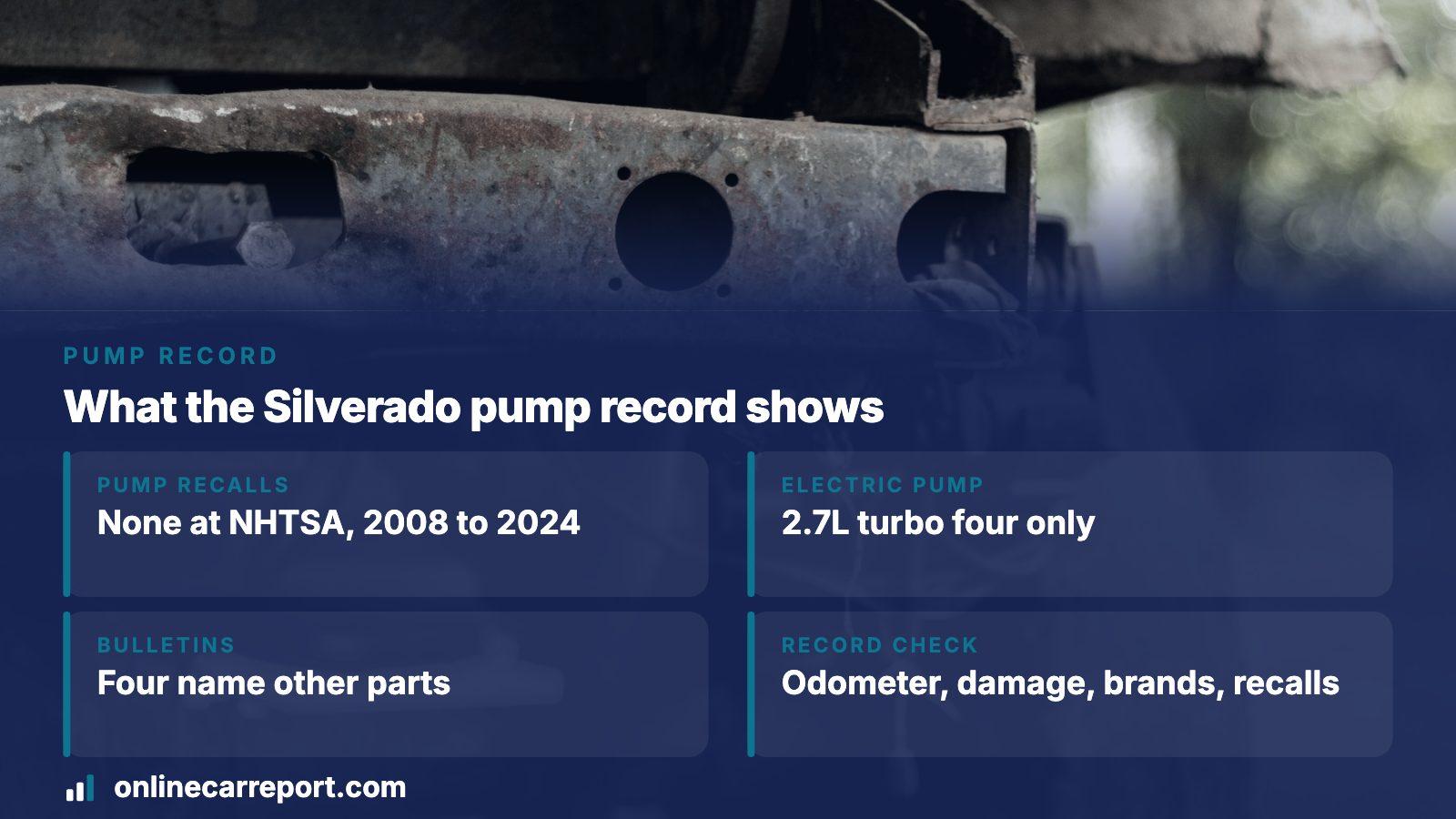
NHTSA's recall database, searched model year by model year from 2008 through 2024 under the two names GM uses for the truck, turns up no recall that mentions the pump, the radiator, the thermostat or the coolant. Two engine campaigns sit close by: 14V-007, a 2014 recall of 4.3L and 5.3L trucks whose overheated exhaust parts could melt nearby plastic, and 25V-274, covering 2021–2024 trucks with the 6.2L, where connecting rod or crankshaft parts may be defective.
From an NHTSA owner complaint
A 2021 Silverado owner told NHTSA the pump gave out at 31,000 miles. The owner saw "no warning lamps" first, only a grinding noise, and the dealer confirmed the pump and asked for more than $1,400. The owner felt warranty should have covered the job.
That quote sits just above the low end of RepairPal's 2020–2023 rows. Whether coverage applied was a question for the dealer and the truck's paperwork, and a history report does not settle it. GM prints a notice on its bulletins not to assume one fits a given truck, so a bulletin number is a question to ask, not a diagnosis.
What a failed pump does to a used Silverado's price
A used truck is priced from comparable trucks of the same year, engine and mileage, then adjusted for what its record shows. A pump that was diagnosed, quoted and fixed costs the seller about the invoice. One that is only suspected costs more, because buyers add a cushion for the unknown.
From an NHTSA owner complaint
An owner of a 2018 Silverado 1500 reported overheating while driving at 55 to 60 mph. An independent shop traced it to a failed pump that also damaged the drive belt, but fitted the wrong pump and the failure returned. The dealer then found the pump on national backorder, so the truck sat for about three months at roughly 119,000 miles, and GM declined to repurchase it.
Parts supply can cost as much as the part. A truck parked for months is hard to sell, and a seller who cannot produce the finished repair order leaves a buyer guessing. Ask for the invoice that names the part, the date and the mileage.
What the vehicle record adds to a pump question
A pump invoice shows what was replaced. The VIN record shows what else happened to the truck, and that is where value usually moves.
- Odometer readings: does the mileage on the invoice fit the readings logged before and after it?
- Accident and damage records: a front-end hit can crack a radiator or hose, so coolant loss after a collision says little about the pump.
- Auction and salvage photos: pictures of the grille and engine bay can show damage a seller never mentions.
- Title brands: a flood or salvage brand usually outweighs any cooling repair.
- Open recalls: on a 2021–2024 truck with the 6.2L, an unrepaired 25V-274 matters more than the pump.
- Market value: the number the repair bill gets subtracted from.
OnlineCarReport turns a VIN into a record of this kind, with a market value beside it. A preview comes first at no charge; the complete report is a single payment, and the pricing page shows how the packs work.
Checklist before you pay the shop or the seller
- Read the engine from the factory specifications, not the badge: 2.7L turbo, 4.3L, 5.3L, 6.2L or 3.0L diesel.
- Ask to see the wet spot, with a photo and a pressure test result, before accepting the word pump.
- On a 2014–2019 truck losing coolant, ask whether the outer head bolt area was checked.
- On a 2014–2016 truck leaking at the front, ask whether the radiator headers were inspected.
- Set the labor line against RepairPal's $299–$439 and ask about anything far above it.
- For a used truck with a pump invoice, match its date and mileage to the odometer readings, then run the VIN before agreeing on a price.
Where this information comes from
- NHTSA: recalls by vehicle and VIN — The lookup behind the finding that no Silverado pump campaign exists, and the place to check 14V-007 and 25V-274 by VIN.
- NHTSA copy: GM bulletin PIP5330D — Coolant loss at the outer head bolts on 2014–2019 trucks.
- NHTSA copy: GM bulletin PI1513G — Radiator cracks tied to the thermostat, with GM's labor times.
- GM TechLink: New Turbocharged 2.7L 4-Cylinder Engine Powers Full-Size Trucks — GM's technician publication describing the electric water pump on the 2.7L.
- RepairPal: Chevrolet Silverado 1500 water pump replacement cost — The national range and the parts and labor split.
- NHTSA owner complaint 11765602 — owner experience, paraphrased
- NHTSA owner complaint 11618394 — owner experience, paraphrased
Sources and photos: Facts checked against the sources above in November 2026. Photos by Victor Hughes, Carrie Allen www.carrieallen.com and Zoshua Colah on Unsplash; diagrams by OnlineCarReport.
Keep reading
- Ford F-150 water pump replacement cost and what it does to valueHow the rival pickup's pump estimate and its effect on value compare.
- Ram 1500 water pump replacement cost and what it does to resale valueAnother full-size truck's pump bill, plus the cheaper parts that get blamed on the pump.
- Chevy Silverado transmission replacement cost and what it does to valueThe same truck's other large drivetrain repair.
- VIN truck value: what the VIN prices and what a truck's history takes offHow a VIN gives a truck a starting value before any repair is subtracted.
Frequently asked questions
What should a Silverado water pump replacement cost?
RepairPal's published range for the Silverado 1500 is $1,082 to $1,442. Parts run $783 to $1,004 of that and labor $299 to $439, and the 2020 through 2023 rows climb to $1,375 to $1,793. Local prices, taxes and fees sit outside the range, and coolant or a belt may be added, so ask for every item on its own line.
Is the Silverado water pump driven by a belt?
On the V8s, GM's bulletins have technicians pull the serpentine belt to test a noise at the pump. The 2.7L turbo four differs: GM's technician magazine says an electric pump moves its coolant under engine-computer control. For the V6, diesel and hybrid trucks no GM statement turned up, so ask what labor time the quote is built on.
Has the Silverado water pump ever been recalled?
Not in NHTSA's database, which was searched for 2008 through 2024 under GM's two model names. Two engine recalls exist: 14V-007 for 2014 trucks carrying the 4.3L or 5.3L, and 25V-274 for 2021–2024 trucks with the 6.2L. Neither concerns the pump, so a pump failure is the owner's bill unless some other coverage applies.
Does a new water pump lower a used Silverado's value?
A documented repair costs a seller little when the invoice names the part, the date and the mileage, and the odometer record agrees. An untraced coolant leak costs more, because buyers subtract the likely bill and add a margin. Overheating history, front-end damage and title brands weigh on the price more than a pump alone.
What else leaks coolant like a bad Silverado water pump?
GM points to possible porosity in the cylinder head on 2014–2021 trucks, radiator tube cracks tied to the thermostat on 2014–2016 trucks, and a head gasket installed backward after earlier head work. A pressure test and a photo of the wet spot show which part is leaking before anyone orders a pump.
Now check the car itself
The guide explains what to look for. The report shows what this VIN has on record.