THE SHORT ANSWER
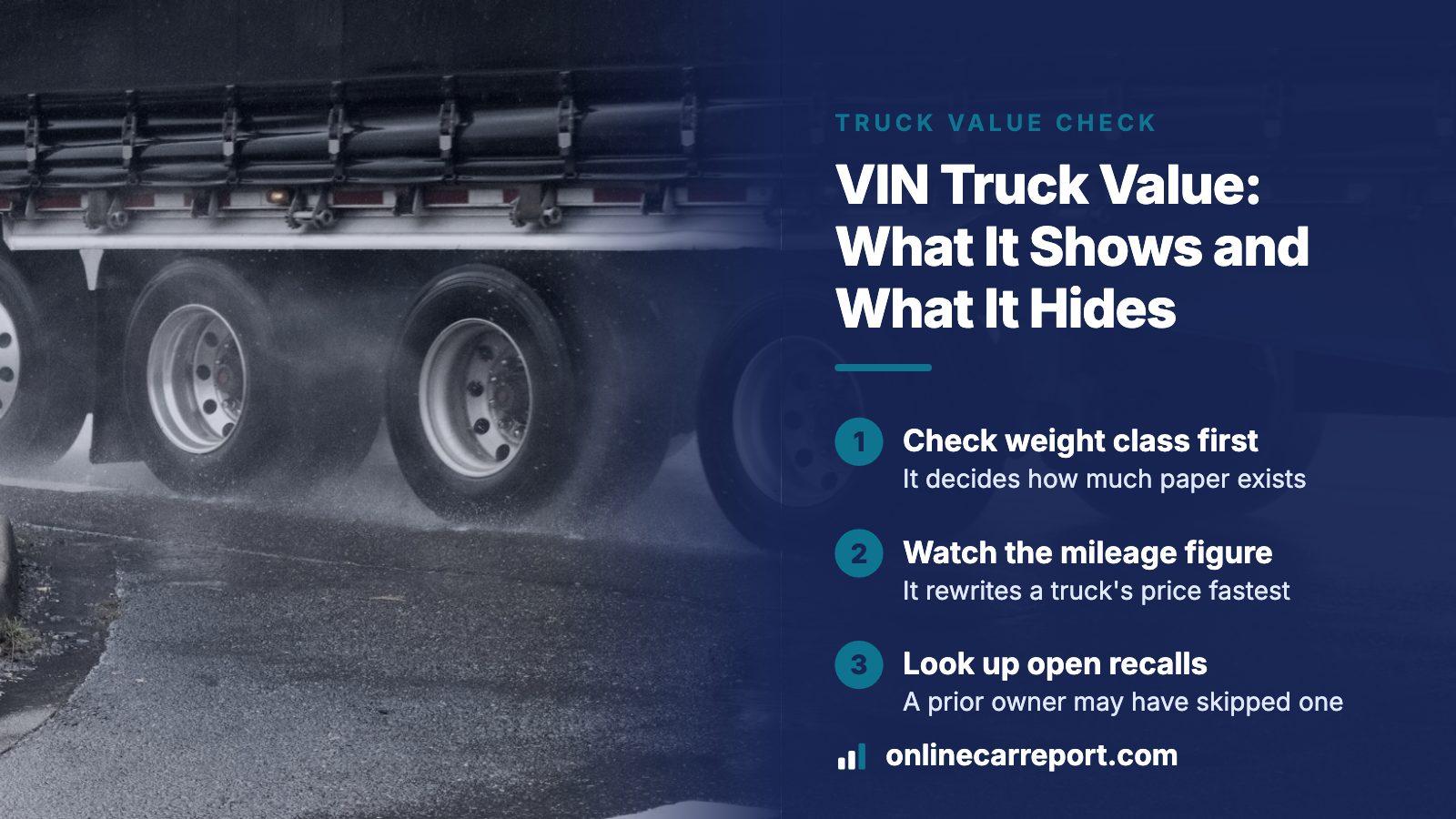
Run the VIN to learn exactly which truck it is, then price that configuration from comparable listings. The VIN holds no value, true mileage or condition. Adjust for the record next: mileage that disagrees between sources, a branded title, damage or auction photos, an open recall, and fleet or commercial use each justify paying less. Heavier trucks leave a thinner paper trail, so lean harder on an inspection.
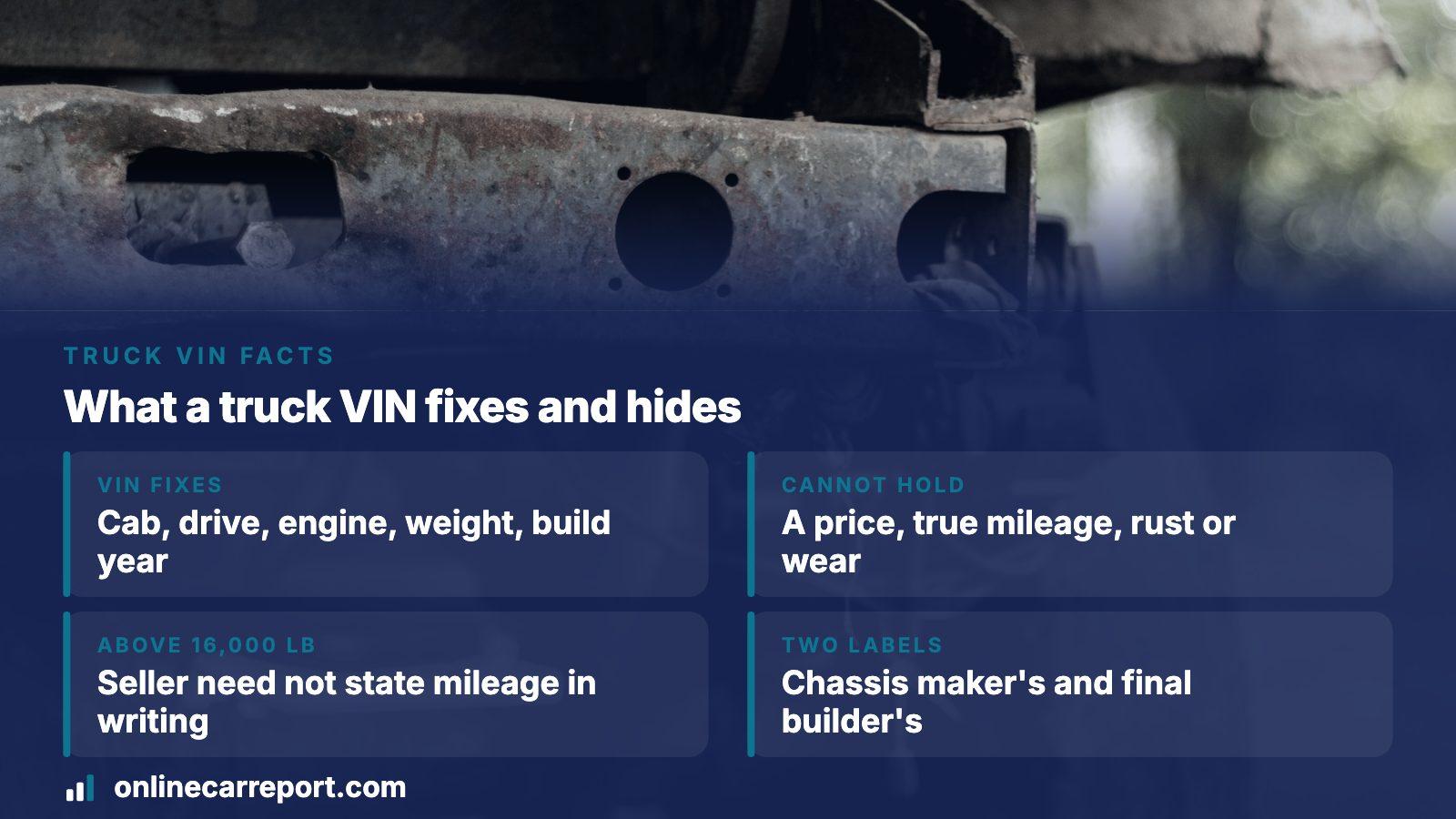
- What the VIN fixes
- Cab, drive, engine, weight class, build year
- What it cannot hold
- A price, true mileage, rust or wear
- Rated above 16,000 lb
- Seller need not state mileage in writing
- Preview
- Free; the full report is one payment
What a truck's VIN fixes before any price appears
A maker has to be able to say what truck it built, so the cab, chassis, engine, brakes and weight rating are all encoded somewhere in characters four to eight. NHTSA holds the key, which is how its public decoder turns them into plain words.
Two partial Ford pickup VINs show why that matters. One decoded as a crew-cab F-150 with four-wheel drive and six cylinders, rated 7,001 to 8,000 pounds. The other was an F-250 Super Duty with eight cylinders, rated 9,001 to 10,000 pounds. Both are pickups, and they price as different trucks.
| Filed by the maker | Why it matters to the price |
|---|---|
| Cab type and series | Narrows the comparable listings to your cab and trim line |
| Drive and engine | Two-wheel and four-wheel drive, gas and diesel, form separate price groups |
| Weight rating | Separates light pickups from heavy-duty and chassis trucks |
| Model-year character | Lets you test the seller's year against the plate |
Weight class decides how much paper trail exists
Federal weight classes run in letters up to 10,000 pounds, then in numbers from 3 to 8, and Class 5 starts at 16,001. That line carries a consequence for paperwork: a seller whose truck carries a rating over 16,000 pounds need not write the mileage down.
Heavier trucks also tend to arrive unfinished. A partial Ford F-550 VIN decoded as an incomplete chassis cab with an eight-cylinder diesel in Class 5, and the result listed no dump body, box or flatbed. A later builder added that equipment, so much of the price sits outside the decode. Title-record coverage thins too, since federal reporting is required only for common automobiles.
- Ask to see both labels, the chassis maker's and the final builder's, because each carries a build date.
- Ask for engine and drivetrain service records, since the title may show no mileage.
How each record entry moves a truck's price
A comparable listing assumes an ordinary past. The record shows whether this truck had one, and each kind of entry pushes the number its own way.
| On the record | What it does to your offer |
|---|---|
| Mileage that differs between sources | Reprice from the higher credible reading and ask what paperwork backs each one |
| Salvage, rebuilt or flood brand | Price it as a damaged truck; the brand travels with it |
| Damage or auction photos | Aim your inspection at the cab, bed and frame, where paint can hide a repair |
| Open recall | A repair someone has to book; settle who before you settle the price |
| Fleet, rental or commercial use | Allow for wear that the mileage understates |
| Lien, impound or theft entry | Keep your money back until a payoff letter, a release or a written explanation is in hand |
No single line decides it. Add the entries up against what similar trucks are asking.
Mileage: the figure that rewrites a truck's price fastest
Each sale of a covered vehicle puts a signed mileage statement on the title: the seller attests that the figure is real, that it overflowed the dial, or that it should not be trusted. Even so, a signature is only a claim, and the readings stored in a history record are how you test it.
From an NHTSA owner complaint
A 2018 F-150 owner who bought privately saw roughly 93,000 miles on the dash. At trade-in time the dealer pointed to a history report that put the mileage above 190,000, and the owner filed the case under odometer fraud.
The lesson is timing. Found before payment, a gap like that reprices the truck or ends the deal; found afterward, it is the owner's loss. Where a truck is exempt from the written statement, stored readings and service records are the only evidence available.
Open recalls: a repair the last owner left on the truck
NHTSA's recall lookup accepts a VIN and shows whether the maker has issued a recall that nobody has completed on this truck. Booking that repair falls to the buyer, and whether a seller marks the price down for it is a separate question.
From an NHTSA owner complaint
The owner of a 2011 Silverado 1500 blamed a long-open air bag recall for a weak trade-in offer, nearly $5,000 lower by the owner's count. The owner's explanation was that a dealer cannot resell a traded truck with an active recall and sends it to auction. Meanwhile the truck sat parked, out of fear of the air bag.
Treat that as one owner's report of dealer behavior, not a rule. The solid part is that the recall was visible to anyone who typed in the VIN, so look before agreeing on a price.
What a clean record still leaves out
The federal title-record system warns that an empty-looking report proves little. Not every state or business reports yet, so a search can return nothing while a problem exists, and salvage brands follow each state's own damage threshold.
From an NHTSA owner complaint
Another 2011 Silverado 1500 owner described a very clean body riding on a frame that had rusted through. By that owner's figures the truck dropped from $12,000 to nothing, and the owner wants the maker to buy such trucks back.
Rust lives in the steel, not in a database. Make the inspection its own step: lift the truck, study the frame rails, bed mounts and hitch, and ask the shop for written findings with the VIN on the page, so a repair estimate can back your offer.
Running a truck's VIN, in order
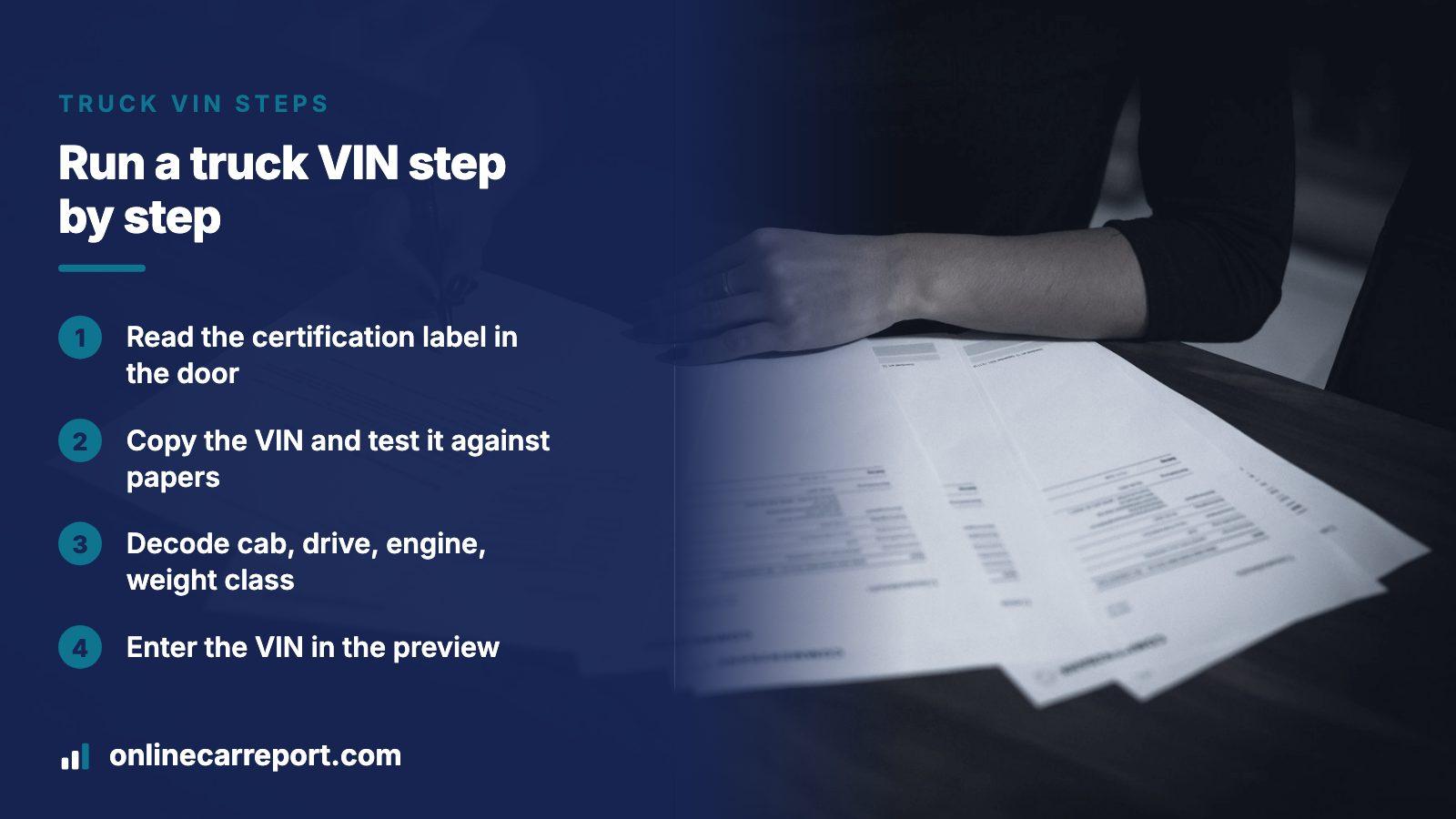
- Read the certification label in the driver's side door opening: it sits on the hinge pillar, latch post or the door edge facing it. Photograph it, since it also gives the build month and year and the weight and axle ratings.
- Copy the VIN from the label and test it against the paperwork and the advert. A single wrong character decodes as the wrong truck, and any difference goes to the seller as a question.
- Decode it and line up cab, drive, engine and weight class with the listing. On a chassis cab or a dump, box or flatbed truck, read the builder's label too.
- Enter the VIN in the preview. It is free, and it shows what kinds of records exist for the truck.
- If entries turn up and the truck is still a contender, pay for the report and test the seller's story against its mileage readings, brands, auction photos and recalls.
- Price from comparable trucks of the same configuration, subtract for the record, inspect, and collect any lien release before paying.
Cost, and what to do with the market figure
Looking costs nothing, because the preview is free. Reading every entry takes one payment, and nothing renews afterward. A single report covers one truck, and multi-report packs exist for buyers weighing several. Rates are on the pricing page.
The report sets a market value beside the history. Use it as one reference and test it against listings that match the cab, drive, engine and weight class you decoded, since a figure for the wrong configuration misleads. Subtract for the record, inspect the metal, and keep every lien and title document in hand until money moves.
Where this information comes from
- eCFR 49 CFR 565.15: VIN content requirements — What a truck's VIN must describe, the weight-class table and the character rules.
- eCFR 49 CFR 580.17: Odometer disclosure exemptions — The 16,000 pound line and the age cutoffs for written mileage statements.
- NMVTIS: Information for consumers — What a federal title-record report holds, who reports to it and where it can miss.
- NHTSA vPIC VIN decoder — The public decoder, fed by maker filings, used here on partial pickup and chassis VINs.
- NHTSA owner complaint 11758222 — owner experience, paraphrased
- NHTSA owner complaint 11180623 — owner experience, paraphrased
- NHTSA owner complaint 11551881 — owner experience, paraphrased
Sources and photos: Facts checked against the sources above in November 2026. Photos by fr0ggy5, Dimitri Karastelev and Zoshua Colah on Unsplash; diagrams by OnlineCarReport.
Keep reading
- Car value by VIN: what the number tells you and how history moves itThe baseline guide to how recorded history moves a vehicle's value, for cars and crossovers.
- Car trade-in value by VIN number: what a dealer sees and what history changesHow a dealer reads the same record when you bring a truck in to trade.
- Trailer value by VIN: what the number prices and what history takes offIf a trailer rides behind the truck, its VIN and its record work differently.
- Sample reportA finished report on screen, so you know what the entries look like before you pay.
Frequently asked questions
Can I get a truck's value from the VIN alone?
Not a dependable figure. The VIN identifies the configuration and opens the record, while price comes from comparable trucks, mileage and condition. Treat any single number, the report's market value included, as a starting point to test against live listings of the same cab, drive and engine.
Does the VIN show whether a truck was used for work?
No. The 17 characters describe how the truck was built, not how it was used. Fleet, rental or commercial use appears as an entry in a history report. Where it does, spend extra time on the bed, hitch, frame and drivetrain, since heavy use wears a truck beyond what mileage shows.
Why might a heavy truck's title show no mileage?
Federal rules excuse written mileage statements on vehicles rated above 16,000 pounds. Age exempts others: model year 2010 or earlier after 10 years, 2011 or later after 20. Ask for service records and read the stored readings in the history.
Does a salvage brand on a truck ever disappear?
Not from the national record: a brand, once a state applies it, remains there. States still differ on damage thresholds and some lack a flood designation, so a truck that looks clean on one state's paperwork can carry a brand elsewhere.
Is the decoder the same as a history report?
No. NHTSA's decoder gives the build as the maker filed it: cab, drive, engine, weight class, plant. A history report adds what happened afterward, such as brands, damage, auctions, recalls and odometer readings. Decode to know the truck, then read the record to know its past.
Now check the car itself
The guide explains what to look for. The report shows what this VIN has on record.