
THE SHORT ANSWER
No installed price for an Accord alternator could be confirmed. The part alone lists at $742.81 for the 1.5-liter turbo, with labor, tax and any core charge extra. On 2013–2016 Accords the charging light is often the battery sensor, which Honda replaces at no charge under recall 17V-418. Check the VIN for open recalls first, then price the car on its whole record, since title, damage and odometer entries outweigh one repair.
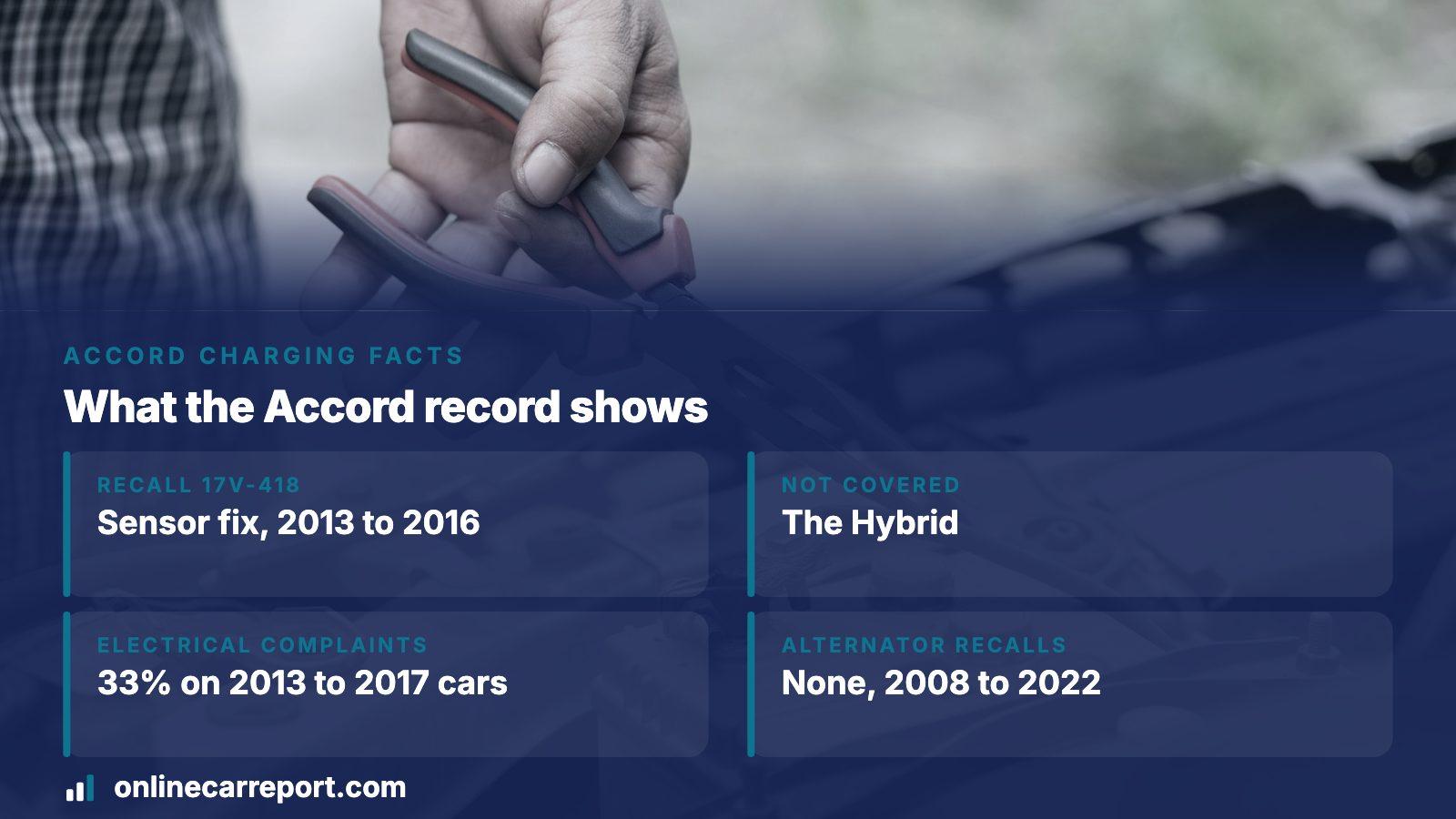
- Part price, 1.5L turbo
- $742.81 list, part 31100-5PA-A01
- No-charge sensor fix
- Recall 17V-418, 2013–2016, not the Hybrid
- Electrical share of complaints
- 33% on 2013–2017 cars
- Recalls naming the alternator
- None, 2008–2022
The one Accord alternator price that holds up
No installed price for an Accord alternator could be confirmed: the sources that answer requests directly give none, and the ranges on estimate sites disagree. A Honda parts seller's October 26, 2026 listing puts the 1.5-liter turbo unit for 2018–2022 cars, part 31100-5PA-A01, at an MSRP of $742.81.
| Engine and years | What is known | What is missing |
|---|---|---|
| 1.5L turbo, 2018–2022 | $742.81 MSRP, part only | Seller's sale price, core charge |
| Turbo 2.0L, same years | Another unit, with conflicting listings | Any price worth printing |
| 2.4L and V6, 2008–2017 | Fit depends on the VIN | A single list price |
Tax, any core charge and labor are extra, and Honda's labor times for these engines were not obtained. Ask whether the quote covers a new Honda part, a Honda rebuilt one or an aftermarket one, and have labor listed on its own line.
How an alternator quote changes what an Accord is worth
Used-car value starts from the factory build and the local market, then subtracts work the next owner must pay for. A diagnosed alternator subtracts about the quote. An undiagnosed charging complaint subtracts more, because the buyer prices the doubt along with the part. A title brand, damage entries, odometer readings and auction history usually move an Accord's price further than one repair.
| The seller says | What it can mean | What to look up |
|---|---|---|
| The alternator was just replaced | Fixed, or the true cause never found | Invoice with part, date and mileage |
| It needs an alternator | Battery sensor, cables or the alternator | Stored codes and a written charging test |
| Charging light on, 2013–2016 | Possibly a recall repair at no charge | Recall status for the VIN |
2013–2016: the charging light Honda repairs at no charge
On the ninth-generation Accord, a battery sensor on the negative post reports battery condition to the engine computer. Honda's March 2016 Service Bulletin 16-026 blamed an internal sensor failure for a charging indicator that came on with code P154A, a 0.4-hour job with no alternator involved. Recall 17V-418 followed in June 2017 for 2013–2016 Accords except the Hybrid, since water carrying road salt could damage the sensor's circuit board and cause a fire.
Per the owner letter, the indicator may light when the sensor reports a problem before any short develops. The dealer swap costs nothing and takes about 30 minutes, Honda says.
Check the VIN before approving an alternator
If 17V-418 is open on a non-Hybrid 2013–2016 car, the first fix costs nothing and leaves the alternator alone. If it is closed, ask whether code P154A is stored, since Honda's recall procedure still swaps the sensor then.
A salvage brand, a late recall and a self-paid alternator
Title history and recall status meet in ways a repair quote never shows, as one owner's federal complaint illustrates.
From an NHTSA owner complaint
A 2015 Accord owner wrote in July 2025 that the alternator failed and was replaced at their own cost before they learned of Honda's battery sensor recall. The recall repair came later, after dealer pushback over the car's salvage title, and it cleared the dashboard alerts. Honda declined to cover the earlier damage from the sensor. The owner had "replaced the alternator out of pocket."
The takeaway: learn the title brand and recall status before paying for charging work. Both shape the repair bill and the resale price, and a salvage brand lowers market value on its own.
Which Accord years lean electrical, and what that fails to prove
NHTSA has no alternator category, so the closest group is the electrical system, which also covers the 12-volt battery, wiring, lights and modules. Among 9,607 federal complaints on 2008–2022 Accords, electrical faults are 33% of those filed on 2013–2017 cars, and the largest category in 2014 through 2017 and again in 2022.
| Model years | Electrical share | Position |
|---|---|---|
| 2013–2017 combined | 33% | Largest in 2014 to 2017 |
| 2015 alone | 39% | Largest |
| 2019–2021 | 17% | Third at best |
| 2022 | 34% | Largest |
A high share means owners wrote about electrical faults above all else, not that alternators failed. These are unverified owner submissions, useful for spotting clusters, not causes. Years where electrical falls outside the top five categories are uncounted, not zero.
2008–2012 V6 cars: look up before replacing the alternator
Honda's bulletin 20-023, dated March 5, 2020, covers automatic V6 Accords built 2008 to 2012 whose oil control valve at the front of the engine, the spool valve, can leak. The fix is part 15810-R70-A04 at 0.8 hours, and only normal warranty applies. The bulletin never mentions the alternator. Owners of the older cars supply that link in their complaints, describing oil from the engine, or on some cars power steering fluid, getting onto it.
Buyers should look for wetness around the front valve, since a new unit fitted under a continuing leak repeats the failure later. V6 Accords from 2013 to 2017 are not on the bulletin.
The Accord Hybrid and the newest cars
The two-motor Hybrid recharges its 12-volt battery by a different route than the gasoline cars. Recall 20V-798, filed December 17, 2020, covers 10,385 Hybrids of the 2020 model year, where the DC-DC converter can shut down in cold weather after an overvoltage and leave the battery uncharged. Honda says driving on after the indicator lights can limit or remove drive power.
No battery sensor recall turned up for gasoline cars of 2018 through 2022, and NHTSA's data names the alternator on no model year from 2008 to 2022. A failed alternator on those cars is an ordinary repair bill.
A short list to run before anyone orders the part
- Look up open recalls on the VIN: 17V-418 for 2013–2016 cars, 20V-798 for 2020 Hybrids.
- Ask for the battery test result, the charging voltage and stored codes such as P154A or B1192, a lost link between gauge module and battery sensor.
- On a 2008–2012 V6, check for oil near the front valve above the alternator.
- Get the part number in writing, with its source (new Honda, Honda rebuilt or aftermarket) and the core charge.
- File the invoice with part, date and odometer reading for the next buyer.

Where the VIN record fits into the decision
A VIN history cannot say whether an alternator was ever replaced, since shop invoices are not in it. It does give the context that sets how much a charging fault matters: damage and accident entries, the title brand, odometer readings, auction history and open recalls, beside the car's market value.
From an NHTSA owner complaint
Another 2015 Accord owner wrote in August 2025 that Honda logged the battery sensor recall as done in 2017, yet the trouble has persisted from 2021 onward and several alternators and batteries have been bought since. Per the owner, the dealer said only that the work was complete and it "can't see back that far." The owner asked NHTSA to examine whether the repair was done correctly.
A closed recall is Honda's entry, not proof the symptom is gone, so ask for the work order. OnlineCarReport pairs a VIN's history with its market value and starts with a free preview; a full report is one purchase, not a subscription, and the pricing page lists the packs.
Where this information comes from
- NHTSA: recalls by vehicle and VIN — The lookup used to confirm that no Accord campaign from 2008 to 2022 names the alternator.
- Honda owner letter, recall 17V-418 (NHTSA copy) — Says the charging indicator may light when the battery sensor has a problem, with a sensor replacement at no charge.
- Honda Service Bulletin 16-026 (NHTSA copy) — The charging indicator with code P154A on 2013–2015 Accords, traced to the battery sensor.
- Honda Service Bulletin 20-023 (NHTSA copy) — The front valve leak on the 2008–2012 V6 automatic, with part and labor time.
- Honda defect report, recall 20V-798 (NHTSA copy) — The 2020 Hybrid converter that can stop the 12-volt battery recharging.
- NHTSA owner complaint 11671363 — owner experience, paraphrased
- NHTSA owner complaint 11682346 — owner experience, paraphrased
Sources and photos: Facts checked against the sources above in November 2026. Photos by Sander Jeurissen, Scott Graham and Towfiqu barbhuiya on Unsplash; diagrams by OnlineCarReport.
Keep reading
- Car value by VIN: what the number tells you and how history moves itHow a VIN gives an Accord its starting value before any repair bill is subtracted.
- Honda Accord starter replacement cost, and how it fits the car's valueThe other part owners blame when an Accord will not start.
- Honda Accord Hybrid battery replacement cost and what it does to valueThe Hybrid's high-voltage pack, priced apart from its 12-volt charging system.
- Honda Odyssey alternator replacement cost and what the leak does to resale valueWhere the same kind of valve leak wrecks alternators on Honda's minivan.
Frequently asked questions
How much does a Honda Accord alternator replacement cost?
No installed price could be confirmed. The part alone lists at $742.81 MSRP for the 2018–2022 1.5-liter turbo, part 31100-5PA-A01, on a parts seller's page dated October 26, 2026. Labor, tax and a core charge are extra, and a 2013–2016 car should be checked for recall 17V-418 before anything is paid.
Why does my Accord say check charging system?
Frequently the battery sensor rather than the alternator. Bulletin 16-026 blames the warning on 2013–2015 cars on an internal sensor fault, and the 17V-418 owner letter says the light may appear when that sensor has a problem. Test the sensor, battery and cables first.
Is there a recall on the Accord alternator?
Not on the alternator itself; NHTSA's recall data for 2008–2022 Accords has no such campaign. The nearest are 17V-418, a no-charge battery sensor replacement on 2013–2016 cars, and 20V-798 on the 2020 Hybrid.
Will a new alternator raise my Accord's resale value?
It mostly removes a deduction rather than adding value, because buyers expect charging to work. Price follows the wider record: title brand, damage, odometer readings and open recalls. Get any open recall repaired, since dealers do that at no charge, and keep the invoice.
Does the Accord Hybrid have an alternator?
Honda's 20V-798 filing describes a DC-DC converter recharging the 2020 Hybrid's 12-volt battery, and its motor/generator starts the engine. A charging warning there can come from the 12-volt battery, the converter or the hybrid system itself. Find out which part the shop plans to fit before approving any quote.
Now check the car itself
The guide explains what to look for. The report shows what this VIN has on record.