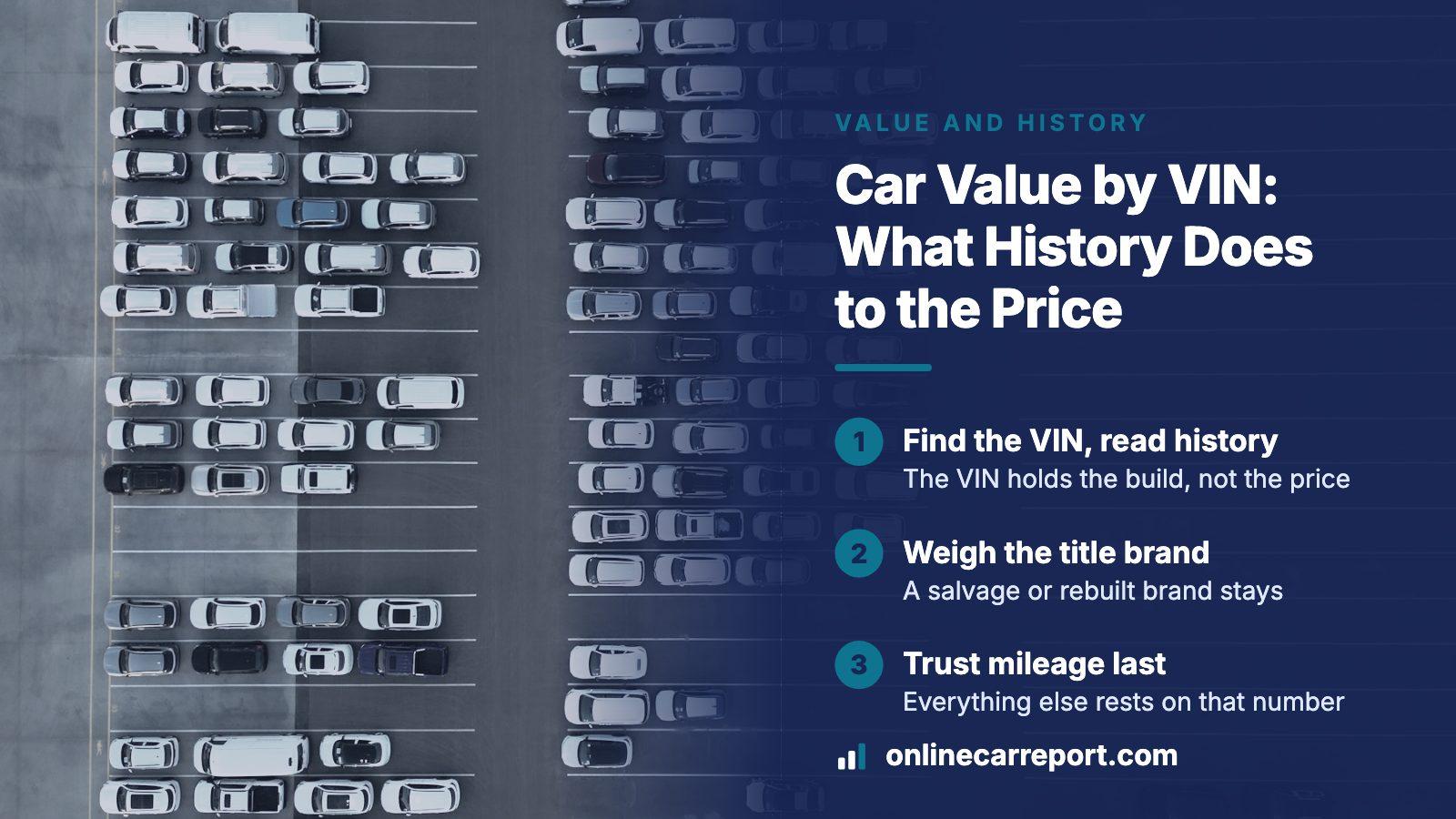
THE SHORT ANSWER
A VIN cannot tell you a car's price. It fixes the year, make, model, engine and plant, while mileage, condition and location, which set the price, are not in it. To value a car by VIN, decode the build, confirm the mileage against recorded readings, grade the condition honestly, then adjust for title brands, accidents and auction records. Compare two valuation books and treat the gap as your range.
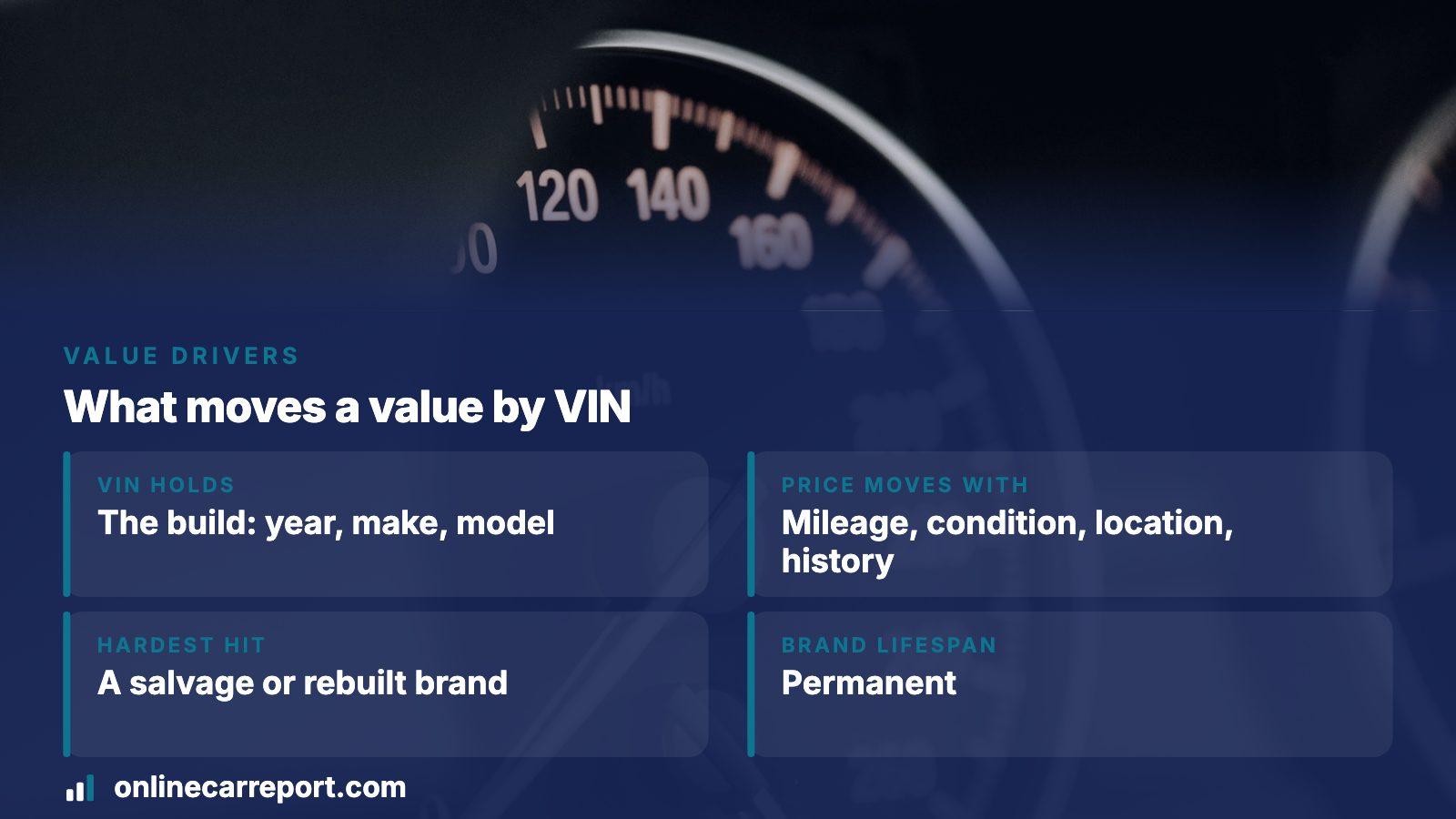
- What a VIN holds
- The build only: year, make, model, engine, plant
- What moves the price
- Mileage, condition, location and recorded history
- Hardest hit
- A salvage or rebuilt brand, which is permanent
- Preview
- Free; the full report is one payment
What a VIN can and cannot price
A VIN works like a birth certificate for the car. Its seventeen characters record the maker, model line, body style, engine family, model year and assembly plant, then stop. Every owner, mile and repair after that day sits outside the number, and those are what a buyer pays for.
NHTSA's public decoder, vPIC, shows how little the string carries. It fills more than 60 fields for a typical VIN and has a base price field too, yet in a test run on a recent Chevrolet that field came back blank. Even a filled one would show only the new-car sticker price, which says little about a used market.
The inputs behind any value by VIN
Think of a valuation as the VIN plus four things it cannot supply. The table shows where each comes from and what it does to the price.
| Input | Where it comes from | What it does to the price |
|---|---|---|
| Build | The VIN itself | Fixes the year, trim, engine and body, so you price the right car |
| Mileage | The odometer, checked against recorded readings | The biggest swing on an ordinary used car |
| Condition | A person looking at the car | Mechanical and cosmetic grades both count |
| History | Title, damage, insurance and auction records | Can cut a price sharply, or confirm that a clean car is clean |
| Location and season | The local market | Four-wheel drive and convertibles do not price the same everywhere |
Title brands: the adjustment that never expires
A title brand does the most damage to a price of anything in a car's history. Salvage and rebuilt brands never wear off, cross state borders with the car and take a large, lasting bite from its resale value. Lenders and insurers can also decline a branded car, so the pool of buyers shrinks along with the price.
That is why a valuation typed in without the brand overstates the car. A seller who quotes a clean-title book figure for a branded vehicle is asking you to pay for a history it does not have.
Accidents and auction photos: the damage the books never see
Valuation books price a typical example of the model, so they cannot know about a crumpled quarter panel or a waterline behind the carpet. Reported damage without a brand sits in a gray area: it can lower the price, but how far depends on severity and repair quality. Unreported damage surfaces only when an inspector or the next buyer finds it.
Salvage and auction history is where the evidence becomes visible. When a car has gone through such a sale, the report lists it with photos, so you can set the seller's story against how the car looked when it sold. A mechanic's inspection still beats any record.
Mileage: the number everything else rests on
Mileage carries so much weight because it is precise and other parties record it, at title transfers and in states that inspect. That precision is also why odometer fraud pays. A rolled-back reading lifts the value directly and leaves untouched everything a casual buyer looks at, which is why federal odometer rules exist.
Treat any mileage you cannot corroborate as a claim, not an input. Lay the recorded readings side by side: they should climb steadily. A drop, or a long flat stretch and then a jump, deserves questions before any price talk.
Running the check: find the VIN, then read the history
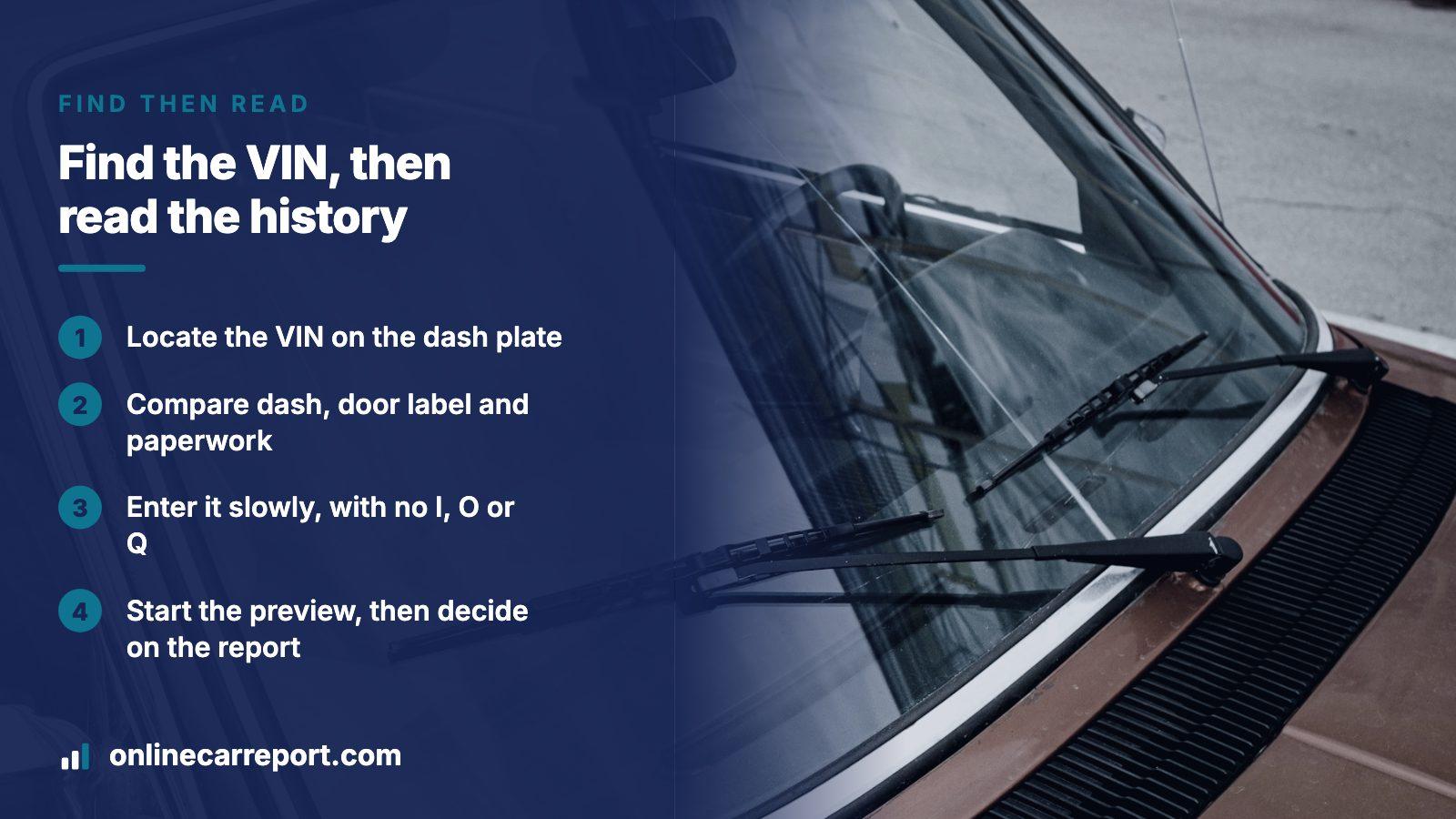
- Two spots on the car carry it: the plate on top of the dash, which you can read from outside the glass, and the label on the driver's door pillar. Title, registration and insurance paperwork list it as well.
- Compare the dash, the door label and the paperwork. All three should show the same 17 characters; if they differ, walk away.
- Enter the VIN slowly. A VIN has no I, O or Q, so any of those in your entry is a typing slip.
- Start the free preview at OnlineCarReport. Nothing is charged at that stage.
- Then choose whether the full report is worth buying. It is a single payment, not a subscription.
Red flags that should move your offer
No record arrives with a dollar figure attached. Treat each flag below as a question for the seller and as grounds to bid lower, or to leave.
- A title brand, or any record of a salvage sale
- Auction photos showing damage the listing never mentions
- Odometer readings that fall, repeat oddly or jump
- An open lien or an impound record, either of which can complicate the sale
- A theft record, even a recovered one
- A use type, such as rental or fleet, that the ad leaves out
- An open recall the owner has not had repaired
None of these proves a bad car. After a clean inspection a flag can be priced in; after a failed one, leave.
Trade-in, private party and retail: three numbers for one car
One vehicle has several defensible values on the same day. Trade-in is the dealer's offer against a purchase, shaded for reconditioning and risk. Private party is what another individual pays you directly, higher because you shoulder the hassle and exposure. Retail is the dealer's asking price after preparing the car.
A buyer quoting trade-in and a seller quoting retail can both read honestly from the same book while describing different deals. Settle which deal you are in before arguing over a figure.
Which valuation book to open
Every book serves a distinct buyer, so they disagree by design. Two readings beat one.
- J.D. Power, once called NADA: the figures lenders and dealers lean on
- Kelley Blue Book: the name most consumers recognize
- Edmunds: appraisals written for the retail shopper
- Auction data: what trade buyers really paid
Where a future value is put in writing
A lease is the one deal where a business states in advance what a specific car will be worth. Regulation M, 12 CFR 1013.4, separates the residual value set at the start from the realized value at the end, and lets a lessee obtain an independent appraisal that is final and binding, at the lessee's expense. It covers consumer leases only, not a car you buy outright.
What the report costs and what to do next
OnlineCarReport charges nothing for the preview. The full report is one payment: buy a single report, or take 3, 5 or 10 together, and no subscription follows. Current prices sit on the pricing page. The report places a market value beside the history: brands on the title, damage and accident records, odometer readings, salvage and auction sales shown with photos, liens, impounds, theft, insurance, open recalls and use type.
Then work in order. Price the clean version of the car from two books, subtract for what the history shows, set your offer, and book an independent inspection before any money moves.
Where this information comes from
- NHTSA: vPIC VIN decoder — The federal decoder behind the point that a VIN resolves to build details, with a price field that stays blank in practice.
- NHTSA: Odometer fraud — Background on why mileage readings get tampered with and why a stated reading deserves a second source.
- eCFR: 12 CFR 1013.4, Regulation M disclosures — The lease disclosure rule that covers residual versus realized value and the binding independent appraisal.
Sources and photos: Facts checked against the sources above in November 2026. Photos by Iain, Max Tokarev and CHUTTERSNAP on Unsplash; diagrams by OnlineCarReport.
Keep reading
- Kelley Blue Book value by VIN: how the history changes the numberHow the consumer book prices a car and where it parts ways with the lender's book.
- NADA value by VIN: the lender's book and what history does to itThe dealer and lender reference, read against the same VIN.
- Diminished value calculatorWhat a past accident does to a car's worth, even after a good repair.
- Sample reportSee how the title, damage and odometer records are laid out before you buy.
Frequently asked questions
Does the VIN by itself reveal a car's value?
Not on its own. The VIN describes the factory build and says nothing about mileage, condition or the market around the car. That is why a valuation form asks you for those details first. The VIN picks the right trim and engine; your inputs and the car's history do the pricing.
Why do two sites give different values for the same VIN?
Each one models a different transaction and draws on different sales data. A lender's book tracks what dealers pay and finance, a consumer book leans toward retail asking prices, and an auction figure reflects wholesale buyers. None is wrong. Match your own situation, whether buying, selling or trading in, to the deal each figure describes.
How much does an accident lower a car's value?
No fixed percentage applies, and any site quoting one is guessing. The drop depends on severity, repair quality and whether the title was branded afterward. A brand is the heaviest penalty because it is permanent. For unbranded damage, auction photos and an inspection tell you more than a formula.
What if the mileage on a listing looks too low?
Check it against readings recorded at earlier title transfers and inspections, which a history report lists. A figure that contradicts the record is a claim, not a fact, and it can wreck the price. A mechanic can also judge seat and pedal wear against the mileage shown.
Is a free online valuation enough before I buy?
A free valuation from a major book gives a fair first range. It assumes an ordinary history, though, and cannot see a brand, a damage record or a rolled-back odometer. The paid report fills that gap, and the preview before it costs nothing. Treat the report's market value as one reference and open a second book.
Now check the car itself
The guide explains what to look for. The report shows what this VIN has on record.