THE SHORT ANSWER
Published estimates for a Forester head gasket job run from about $2,000 to $4,000, with RepairPal's general range at $2,572 to $3,386. The risk belongs mostly to the EJ25 engine used through the 2010 model year. Foresters from 2011 on have a different engine, and the problem Subaru documented for them was oil consumption. Confirm the engine before you accept a quote or set a price.
- General estimate
- $2,572 to $3,386 (RepairPal)
- Forester page estimate
- $2,000 to $4,000 (RepairPal)
- Engine with the reputation
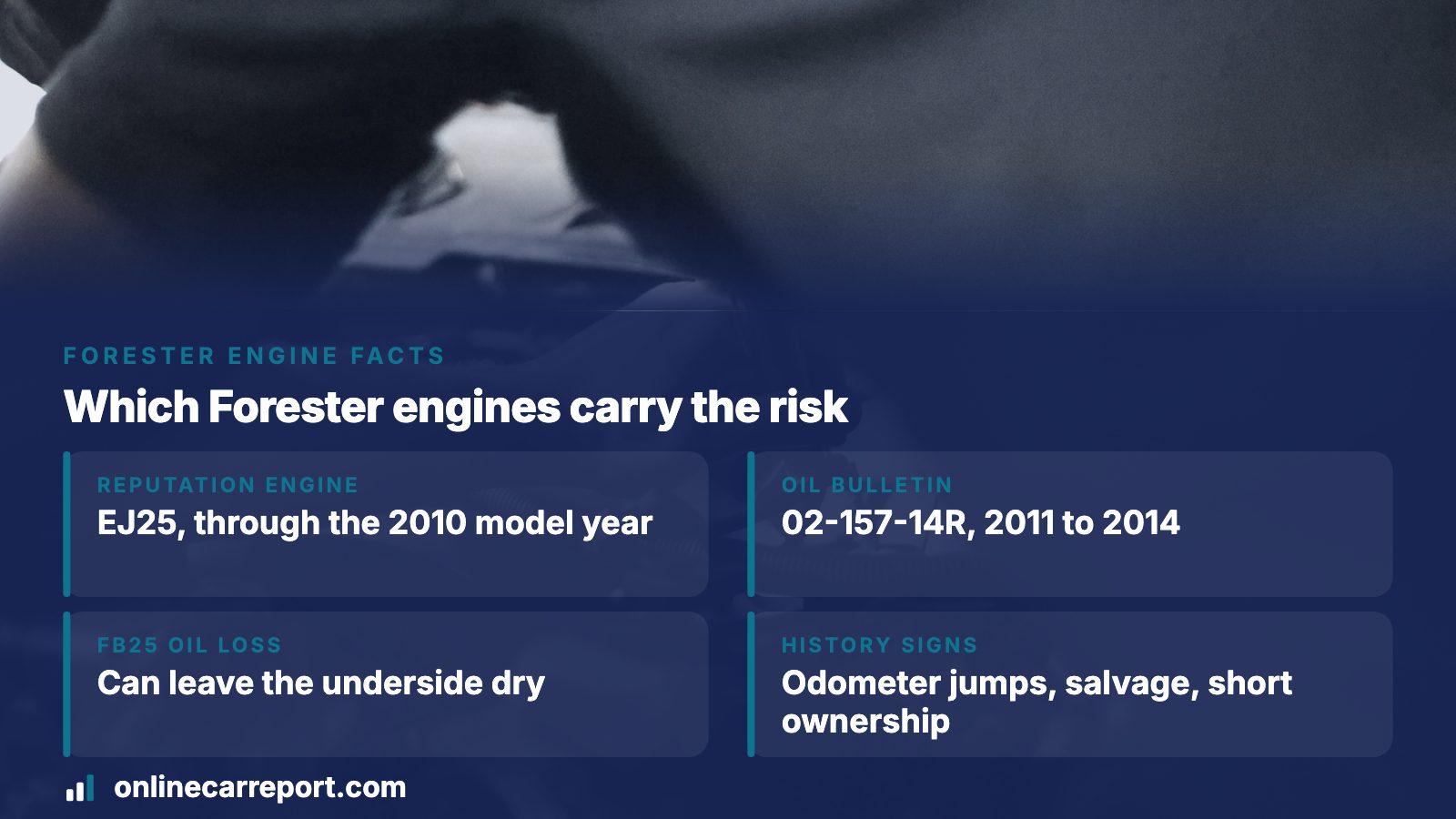
- EJ25, through the 2010 model year
- Oil bulletin
- 02-157-14R, 2011 to 2014 Foresters
What the published estimates say
RepairPal's general estimator puts $1,669 to $2,449 against labor and $903 to $937 against parts, before any tax, fees or local rate differences. A separate Forester page about gaskets seeping oil averages wider, at $2,000 to $4,000. These are RepairPal's figures. OnlineCarReport sells vehicle history reports, not repairs, so treat them as a ruler for judging a quote, not as a price.
Forum threads and social posts quote bills of their own, some far higher. They could not be verified on the source pages, so none appear here.
Why the labor line is so large
Every Forester engine is a flat, boxer-style four. The cylinder heads hang out to the left and right of the block, low and close to the frame, so a technician cannot simply unbolt them from above. Shops often lift the whole engine out to do the work properly, and that is where the hours go.
Subaru's own labor clock for a nearby job shows the scale. Take Subaru's bulletin on 2011 to 2014 oil consumption: its short block swap is timed at 11.5 to 12.0 hours of labor, with the engine and both heads coming out. Skip the new block and the gasket repair still requires most of that disassembly.
| Quote line | What to ask |
|---|---|
| Engine out or in the car | Which one is priced, since the hours differ sharply |
| Head surface check | Whether the heads are tested for flatness and machined if needed |
| Timing belt and water pump | Whether they are bundled on an older car, because the belt comes off anyway |
| Coolant and oil | Whether the fluids are in the total or added later |
Which Forester engines carry the risk
The non-turbo Forester used the 2.5-liter EJ25 through the 2010 model year. Its camshafts run off a belt. This is the engine that earned Subaru its head gasket reputation, typically a slow oil or coolant weep along the outside of the gasket once the miles pile up.
For 2011 Subaru switched the non-turbo car to the FB25, which uses timing chains. The turbocharged XT kept an EJ-family engine right up to the 2014 redesign. That means a 2011 to 2013 XT belongs with the older story. Because year and engine do not line up neatly, take the engine from the VIN instead of the seller's description.
Why the engine matters to price
A 2009 car with no gasket paperwork and a 2012 car with the same gap are different risks. Buyers who know the difference negotiate differently, and sellers who can document the work hold more of their asking price.
2011 to 2015: the documented problem was oil
Subaru's Service Bulletin 02-157-14R covers 2011 to 2014 Foresters with the 2.5-liter FB engine, plus 2015 cars with a manual gearbox. Its subject is oil consumption, and the remedy is a new short block once a test proves the engine uses over one-third quart across 1,200 miles.
The confusion comes from the parts list. A short block job removes both heads, so new head gaskets appear on the invoice even when the fault was piston rings. A related class action settled in 2016 and lengthened powertrain coverage for oil use, to eight years or a 100,000-mile limit. Subaru's notice limited it by VIN, below *529004 for automatics and below *543650 for manuals, and claims were due by October 1, 2016. Subaru denied any defect. Every eligible car has now passed eight years on the road.
What owners filed with NHTSA
NHTSA publishes owner complaints in the owners' own words. Two from EJ25-era cars show how the repair tends to arrive, and neither is a measured failure rate.
From an NHTSA owner complaint
An owner of a 2010 Forester wrote that the head gaskets needed replacing at 90,000 miles, a repair of about $2,600, even though every oil change and maintenance visit had been done. The owner asked how long the gaskets should last under normal use.
From an NHTSA owner complaint
An owner of a 2009 Forester described the check engine light coming on at 70 mph on an interstate, followed by a total loss of power. After a 3-hour wait for a tow, the dealer diagnosed a blown head gasket, with no warning beforehand.
The takeaway for a buyer is that a clean-looking older Forester can still be one failure away from a four-figure bill, so the price should reflect whether the work has been done.
How the repair changes what the car is worth
Appraisers and private buyers price a used Forester from its build, mileage, condition and recorded history. A dated invoice for gaskets, belt and water pump tells the next buyer the biggest known risk on an EJ25 car is already paid for. A blank file leads them to price the job in and subtract it.
The same logic cuts the other way for a car with an open leak. An unrepaired seep is a bargaining point for the buyer, and a seller who has quotes in hand can show the deduction is fair instead of arguing about it. Keep the invoice, the shop's description of what it found, and a photo of the odometer on the repair date.
What a VIN report can and cannot tell you
A history report will not tell you whether a Forester's gaskets were replaced. Shop work is not part of it. What it can show are the facts that change how much a repair history is worth: odometer readings over time, title brands, accident and damage records, auction and salvage entries with photos, ownership changes and open recalls.
- An odometer reading that jumps or falls between records makes any service paperwork less believable.
- A salvage or auction entry means the car's value was already cut for a reason other than the engine.
- A short ownership chain after a repair can hint that the problem came back.
The preview costs nothing to run. Going on to the full report means a single payment and no recurring plan, with the options laid out on the pricing page. Do it ahead of any haggling, so the engine is not the only item you have priced.
Before you authorize the repair or sign the sale
- Decode the VIN to learn whether the car has the older EJ25 or the newer FB25.
- Have the shop say what it actually found: oil or coolant on the outside, or a failure inside the engine, and the test behind that call.
- If an FB25 car loses oil but looks dry underneath, ask whether anyone ran a consumption test.
- If the car is an EJ25, check that the belt, idlers and water pump are or are not in the total.
- Get the quote itemized before agreeing to anything.
No recall campaign names a Forester head gasket. Three touch the engine in other ways: 08V460000 for a turbo oil supply pipe on certain 2009 cars, 16V162000 for a cracking turbo intake duct on certain 2015 and 2016 XT models, and 19V856000 for a PCV valve on certain 2019 cars. None of them pays for gaskets.

Where this information comes from
- Subaru Service Bulletin 02-157-14R (NHTSA copy) — oil consumption remedy, labor hours and the extended coverage terms
- Subaru retailer notice, February 2016 (NHTSA copy) — the VIN cutoffs by transmission type
- NHTSA: recalls by VIN — the official lookup for open campaigns
- RepairPal: head gasket replacement estimate — general range and its labor and parts split
- RepairPal: Forester head gasket leaking oil — the Forester-specific average
- NHTSA owner complaint 11429899 — owner experience, paraphrased
- NHTSA owner complaint 11404303 — owner experience, paraphrased
Sources and photos: Facts checked against the sources above in November 2026. Photos by Victor Hughes, Owen Michael Grech and Mustafa Sheikhmouss on Unsplash; diagrams by OnlineCarReport.
Keep reading
- Subaru Forester transmission fluid change: what it costs and what it does to resale valueThe other big drivetrain bill on the same car.
- Subaru Outback head gasket replacement cost, and what it does to the car's valueThe same gasket question on the Forester's bigger sibling.
- Car value by VIN: what the number tells you and how history moves itHow mileage, condition and recorded history set a car's price.
- PricingHow the one-time report options work before you buy.
Frequently asked questions
How much does a Subaru Forester head gasket replacement cost?
Expect somewhere between $2,000 and $4,000 on RepairPal's Forester page, while its general estimator reads $2,572 to $3,386 ($1,669 to $2,449 labor, $903 to $937 parts). Local rates and taxes come on top. Older cars often add a belt and water pump.
Which Forester years have head gasket problems?
The reputation attaches to the EJ25 engine, used in the non-turbo Forester through 2010. From 2011 the FB25 took over, and the problem Subaru documented for 2011 to 2014 was oil consumption. A turbo XT from 2011 to 2013 still has an EJ-family engine, so decode the VIN rather than guess.
Does a head gasket repair lower a Forester's resale value?
An unrepaired leak lowers what a buyer will pay, because they subtract the quote. A documented repair usually helps, since it removes the known risk on an older engine. Keep the invoice and the shop's findings. A history report will not show the repair itself, but it can back up the mileage story.
Is the Subaru oil consumption coverage still active?
Almost certainly not. Coverage lasted eight years or to 100,000 miles, counted from the original warranty start, on 2011 to 2014 FB25 cars and some 2015 manuals. Every eligible car is now older than that. Claim forms for cash back closed on October 1, 2016. Ask a dealer about a specific VIN.
Can I drive a Forester with a blown head gasket?
It depends on the failure. A slow external seep can sometimes be watched if you check fluids often and the engine never overheats. Coolant disappearing with nothing dripping, white exhaust, milky oil or overheating suggests the failure is internal, and more driving can warp the heads. Get a shop to test it first.
Now check the car itself
The guide explains what to look for. The report shows what this VIN has on record.