THE SHORT ANSWER
Enter a VIN on Kelley Blue Book and it settles the year, trim and engine, then needs your mileage, condition grade and ZIP code before it shows a number. The VIN carries no history, so the figure knows nothing about a salvage brand, a repaired crash or an auction sale. KBB itself calls a salvage or rebuilt title a permanent hit to value. Pull the history for that VIN, then adjust the book figure.
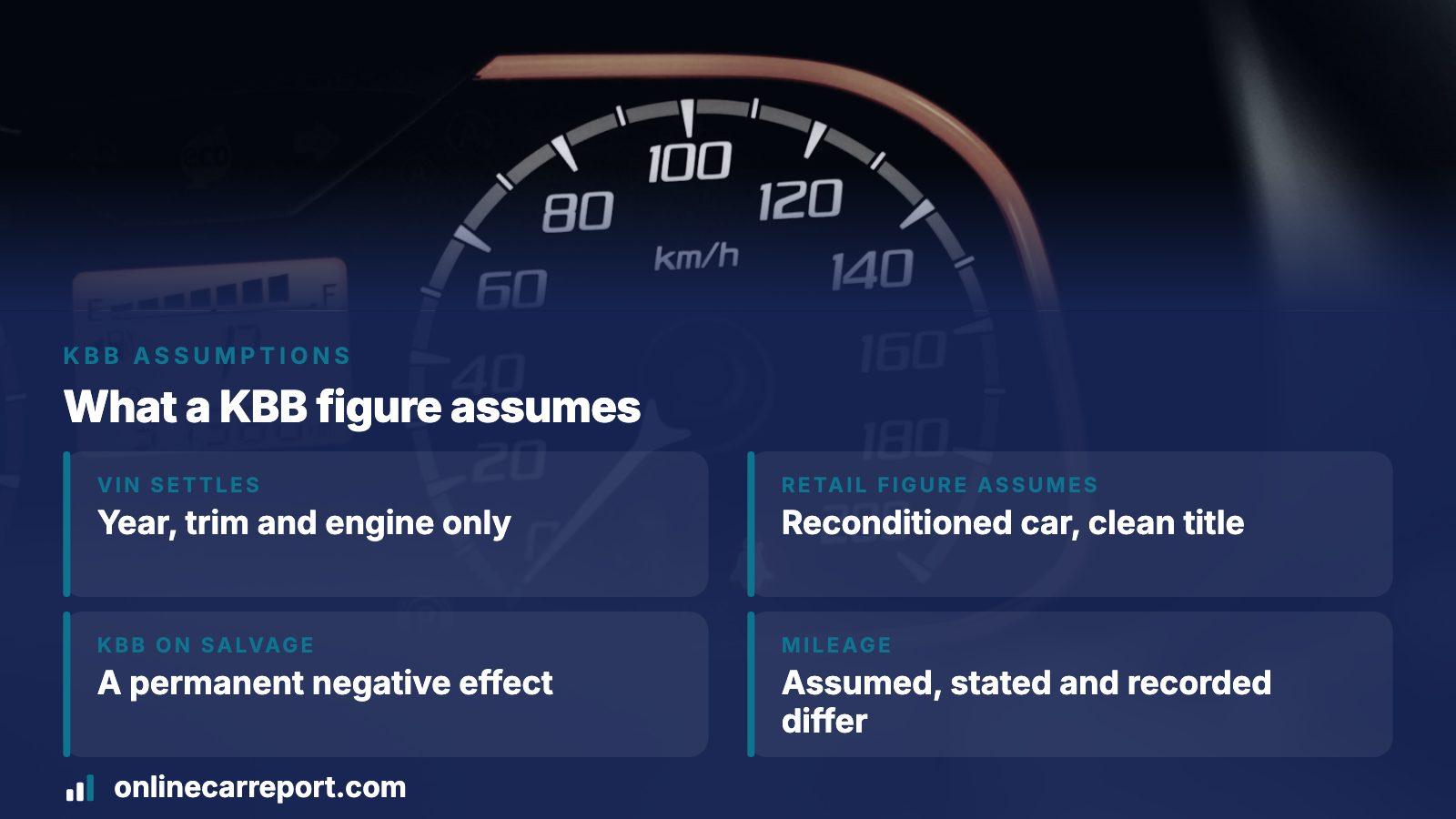
- What the VIN settles
- Year, trim and engine; not mileage, condition or history
- Retail figure assumes
- A fully reconditioned car with a clean title history
- KBB on salvage titles
- A permanent negative effect on value
- Preview
- Free; the full report is one payment
What the VIN does inside a Kelley Blue Book form
Paste a VIN into the form and it first returns a description of the car: year, make and model, the body style, the engine, and the trim level where the factory encoded one. That is the one part of the valuation the VIN can settle, and it matters, because two trims of a model line are priced differently and owners recalling their car by memory often name the wrong one.
The rest comes from you. The form asks for mileage, a condition grade and a ZIP code, all of which sit outside the seventeen characters. KBB says its figures draw on actual sales and auction prices, adjusted for season and local conditions, and refresh at least weekly. A figure built that way describes a typical car in your market. It has not seen yours.
The clean-car assumptions behind each figure
KBB publishes a definition for each kind of value it offers dealers and lenders. Side by side, each one quietly assumes a car in a particular state.
| Figure | What it takes for granted |
|---|---|
| Trade-in | A condition grade you judged accurately, with the dealer paying for inspection and reconditioning |
| Private party | Sold as is, with only any remaining factory coverage, priced on the mileage you state |
| Typical listing price | A fully reconditioned car with a clean title history |
| Lending value | Good or better condition, reconditioned and ready for retail |
| Auction value | A car not yet reconditioned, whose condition the seller disclosed properly |
In the definitions I read, only the listing price states a clean title history outright, and none mentions a reported accident. A seller who quotes the retail figure for a branded car is quoting a different car.
Title brands: the history KBB itself calls permanent
KBB's values FAQ says a salvage, reconstructed or clouded title has a permanent negative effect on value. It cites an industry rule of thumb of 20% to 40% off the Blue Book figure and adds that such a car should be appraised case by case. That is a wide band, and the book cannot place a given car inside it. Damage severity and repair quality do that, and both show up in records and photos rather than in a VIN decode.
From an NHTSA owner complaint
An owner in Massachusetts told NHTSA in 2017 that their 2008 Buick LaCrosse carried a reconstructed title from an earlier accident, repaired and inspected before the owner bought it 5 years earlier. When the owner booked a recall repair for the headlight relay, the dealer declined, the owner says, over the "branded title". The owner added that the relay had already failed twice after replacement with ordinary parts.
The lesson is that a brand is more than a price line. In this one case it changed what a dealer was willing to do with the car years after the repair. Read the title record before you read any book figure.
Accidents and auction photos: what a clean-title grade skips
A car can be hit, repaired and retitled without a brand. The retail definition is then technically met and the book figure goes through untouched. What is left to read is the accident and damage record, plus any auction or salvage sale that came with photographs.
- Accident and damage entries tell you which corner of the car to hand the inspector first.
- Auction photos show the car as it looked on sale day, which you can hold against the listing's description today.
- An insurance record shows that a claim was paid, a useful cross-check on any damage entry.
KBB's auction value assumes the seller disclosed the condition properly. Photos let you test that assumption instead of trusting it, and any gap between the photos and the seller's story justifies a lower offer.
Mileage: assumed, stated and recorded
The private party range runs on the mileage you state, so a wrong figure goes straight into the result with no warning. Even formal programs lean on assumptions. Ford's 2011 refund offer for 1999 to 2003 Windstar minivans with unrepairable subframes started from model year and trim, then used KBB's private party, excellent condition value at an assumed 12,000 miles per year, and set the offer at about 150% of it.
That notice is posted by NHTSA, and it shows what a book number really is: an assumed car with assumed miles. Recorded readings are the check on the stated one. NHTSA's odometer fraud page explains why readings get altered, and a rolled-back figure inflates every valuation built on it. A reading that falls between two records, or stalls and then jumps, needs an explanation first.
Turning a book figure into an offer, record by record
| What the history shows | What to do with the book figure |
|---|---|
| Clean title, mileage climbing steadily | Use the book figure as your range and let the inspection settle the rest |
| Accident entry, no brand | Ask for the repair paperwork, inspect that area, and aim for the low end of the range |
| Salvage or rebuilt brand | Set the retail figure aside; KBB says to appraise such a car individually |
| Auction photos showing damage the ad never mentions | Price in the repair, or ask the seller to explain the gap |
| Odometer reading that drops or jumps | Re-enter the mileage you can corroborate, and leave if none holds up |
| Open lien or impound record | Hold payment until the seller proves in writing that it is cleared |
No row carries a fixed dollar discount, and none should. The book gives the clean-car anchor, the records decide the discount, and the inspector tests both.
Running the check on the VIN you are pricing
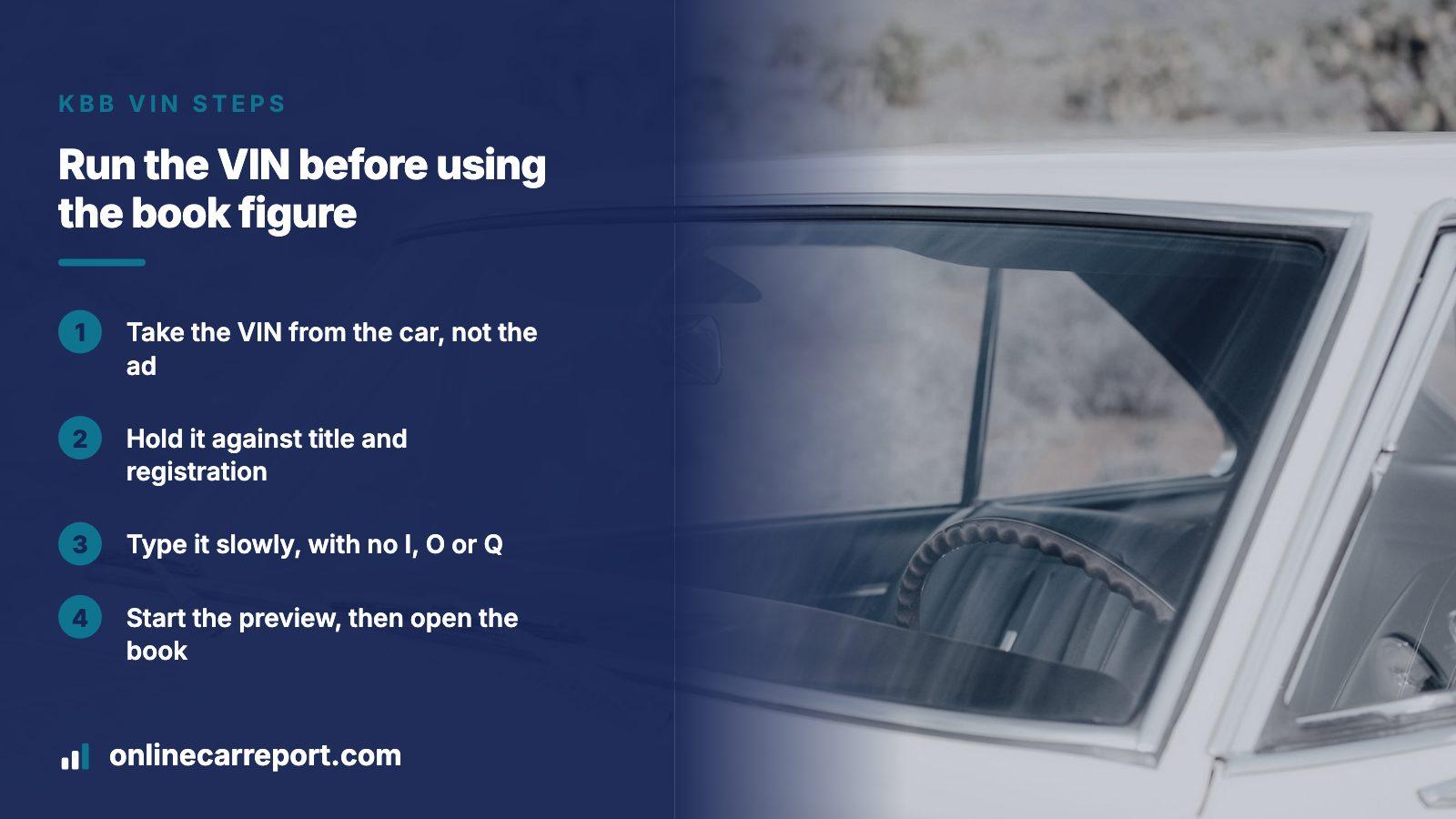
- Take the VIN from the car itself, not the ad: the stamped plate low on the driver's side of the dash, visible from outside, and the door-jamb label on the same side.
- Hold both against the title and registration. Every copy should match character for character.
- Type it slowly. A VIN never includes the letters I, O or Q, so if your entry shows one, you mistyped.
- Compare the build with NHTSA's public decoder, vPIC, so the trim you price is the trim the factory built.
- Start the preview at OnlineCarReport. Nothing is charged at that stage.
- Then open the book for the clean-car range, using mileage you have checked against the records.
What the preview and the report cost
OnlineCarReport shows a preview for any VIN at no charge. Payment happens once. A single report suits one car, and multi-report packs (three, five or ten) suit a shortlist. Nothing bills you again, and today's amounts are on the pricing page. The report sets a market value next to the records that move it: brand status on the title, crash and damage entries, odometer history, and salvage or auction sales that came with photos.
Then work in order. Take the book range for the right trim and miles, subtract for what the records show, book an independent inspection, and only then settle on a figure.
Where this information comes from
- Kelley Blue Book: values FAQ — KBB's own statement on salvage titles, the rule-of-thumb deduction, trade-in versus private party and the mileage input.
- Kelley Blue Book: definitions of its values — What the listing, trade-in, lending and auction figures each assume about condition and title history.
- NHTSA owner complaint 10953866 — owner experience, paraphrased
- NHTSA: Ford Safety Recall 11S16 refund notice — A manufacturer's buyback priced from a KBB figure at an assumed mileage.
- NHTSA: vPIC VIN decoder — The federal decoder for checking the factory build before any valuation.
- NHTSA: Odometer fraud — Why a stated mileage deserves a second source.
Sources and photos: Facts checked against the sources above in November 2026. Photos by Sasun Bughdaryan, Wesley Tingey and muhammad dennisa on Unsplash; diagrams by OnlineCarReport.
Keep reading
- Car value by VIN: what the number tells you and how history moves itThe general case: what a VIN can and cannot price, for any make.
- NADA value by VIN: the lender's book and what history does to itThe lender's book, read against the same VIN.
- Diminished value calculatorWhat a past accident does to a car's worth after a good repair.
- Sample reportSee how the title, damage and odometer records are laid out before you buy.
Frequently asked questions
Does a VIN alone give me a Kelley Blue Book price?
Not a finished one. The VIN identifies the year, trim and engine, then the form wants mileage, a condition grade and a ZIP code. Those are not encoded in the VIN and usually move the result more than the trim does. Enter them from facts you have checked, not from memory.
Does Kelley Blue Book know if a car has a salvage title?
A VIN carries no title status, so the lookup cannot see it. KBB's own FAQ says a salvage, reconstructed or clouded title permanently lowers value and advises appraising such a car individually. Look at the title record first and the book figure second.
Why does a dealer's offer come in below the KBB figure?
Trade-in values assume the dealer pays to inspect and recondition the car, which is why KBB lists them below private party. A brand or damage entry gives the dealer another reason to bid low, so the gap can widen once the history is read.
Is the KBB value the same for a car with an accident on record?
KBB says its values rest on age, mileage, equipment and condition, and the form asks for a condition grade, not an accident record. A repaired, unbranded car can match the book figure on paper and still sell for less once a buyer sees the entry.
How long does a Kelley Blue Book figure stay accurate?
KBB says its values refresh at least weekly, so a figure is a snapshot, not a fixed price. Re-run it when you are ready to make an offer, with the same mileage and condition grade as before.
Now check the car itself
The guide explains what to look for. The report shows what this VIN has on record.