THE SHORT ANSWER
No, a VIN alone does not produce a NADA value. It fixes the year, trim and engine, and the figure comes from J.D. Power, which bought the NADA guide, after you enter mileage and a condition grade. Lenders lend against that book, and it was never told about your car's past. Pull the title, damage and auction records for the VIN and adjust the number before you pay or sign a loan.
- Who publishes it now
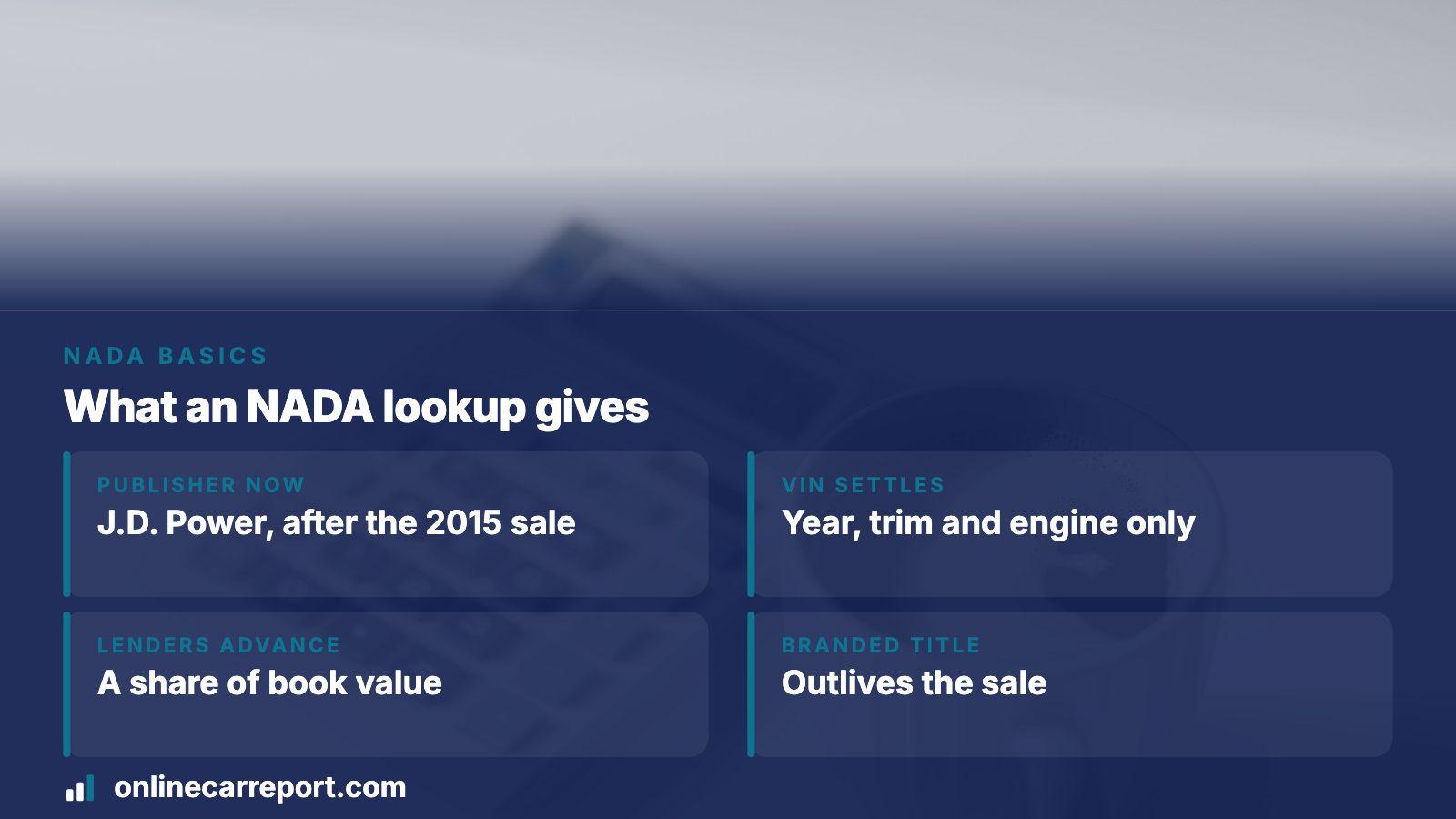
- J.D. Power, after the 2015 sale of NADA's guide
- What the VIN settles
- Year, trim and engine; not mileage or condition
- Lenders advance
- A share of the book value, not of your agreed price
- Preview
- Free; the full report is one payment
What a NADA lookup by VIN actually gives you
The name is older than its owner. The National Automobile Dealers Association began publishing a used car guide in 1933, then passed it to J.D. Power, with the sale announced in 2015. The figures now appear as J.D. Power Values, yet most people still type NADA, and that habit is what brought you to this page.
Enter a VIN and its seventeen characters settle the build: model year, body, engine and trim. After that the book asks for things the VIN has never carried. Mileage is not encoded in it, and neither is condition, so both answers come from you. Read the result as a figure for a typical car with your car's build, not as a measurement of your car.
Four figures for one car, and which deal each describes
A single book publishes several values for one vehicle. The costly mistake is quoting a figure that belongs to a different kind of deal.
| Figure | The deal it describes | Who usually quotes it |
|---|---|---|
| Trade-in | You sign the car over to a dealer as part of buying another | Dealers, at the desk |
| Private party | Two individuals agree a price between themselves | Sellers and buyers dealing directly |
| Retail | A dealer has prepared the car and stands behind it | Price tags on a lot |
| Loan value | A lender decides how much to advance against the car | Lenders, when sizing a loan |
When a dealer's offer feels like a lowball, check which row they are reading from. A private sale priced off the retail row asks the buyer to pay for preparation nobody did.
The lender's number can sit below your agreed price
J.D. Power says professionals use its valuations: dealers, lenders, insurers and government agencies, with loan origination among the named uses. That is why the figure matters to a buyer who is financing. A lender advances a share of the book value, not a share of the price on the contract.
When the seller's price is above the book, the difference comes out of your pocket at signing. A buyer who learns this after shaking hands has already spent most of the bargaining position. Ask the lender which figure it uses before you agree anything.
Why the gap still hurts after a crash
A total-loss payout is sized to what the car was worth when it was lost. If your loan balance is higher, the remainder is still owed. Borrowing above book value on a car that keeps losing value makes that shortfall likelier.
The records the book never saw
A guide value is built from other people's transactions, so it prices a typical example of your car's build. The FTC says reports of this kind turn up crashes and water damage but usually miss mechanical trouble, which splits the work sensibly: records cover the past, and a mechanic covers the present.
| Record tied to the VIN | What it does to a book figure |
|---|---|
| Salvage or rebuilt brand | Turns the published number into a ceiling to discount from, not a price |
| Accident or damage entry | Tells the inspector where to look first and justifies asking for repair paperwork |
| Auction sale with photos | Shows the car as it looked on sale day, to hold against today's description |
| Odometer readings | A reading that drops or stalls undermines the mileage you typed into the form |
| Open lien | A lender holds a claim that survives your purchase, so payment waits for proof of release |
Where a book value decides whether a title is branded
In some states that same figure does legal work. A salvage brand generally comes from comparing the repair bill with a share of the vehicle's value, so the law has to say where the value comes from. North Carolina's disclosure form calls a vehicle salvage when repairs would pass 75 percent of its fair retail value, and it says to read that value from the NADA Pricing Guidebook or another publication the Commissioner has approved.
New Jersey chose differently. Its salvage regulation sets fair market value at the average across the manuals that the Commissioner of Banking and Insurance has authorized, so no single publisher governs. For a car eight or fewer model years old, a repair estimate that equals or exceeds that value makes the car economically impractical to repair. On a car near that line, the valuation can matter more than the settlement check, because it decides the title.
How a brand follows a car after the repair is done
From an NHTSA owner complaint
A 2013 Kia Optima owner told NHTSA that an insurer declared the car a total loss following an October 2024 hit-and-run. The owner held on to the vehicle and had it titled as rebuilt. After the engine failed at about 136,000 miles in 2025, the owner says, the dealer confirmed the failure but would not repair the car because of its branded title. Kia's customer care then phoned to say the manufacturer had turned down the repair request.
That is one owner's account, not a rule. It shows a brand can follow a car into the service bay years after the body work, so the title record belongs ahead of the book figure in your checking order.
Running the check before you quote a figure
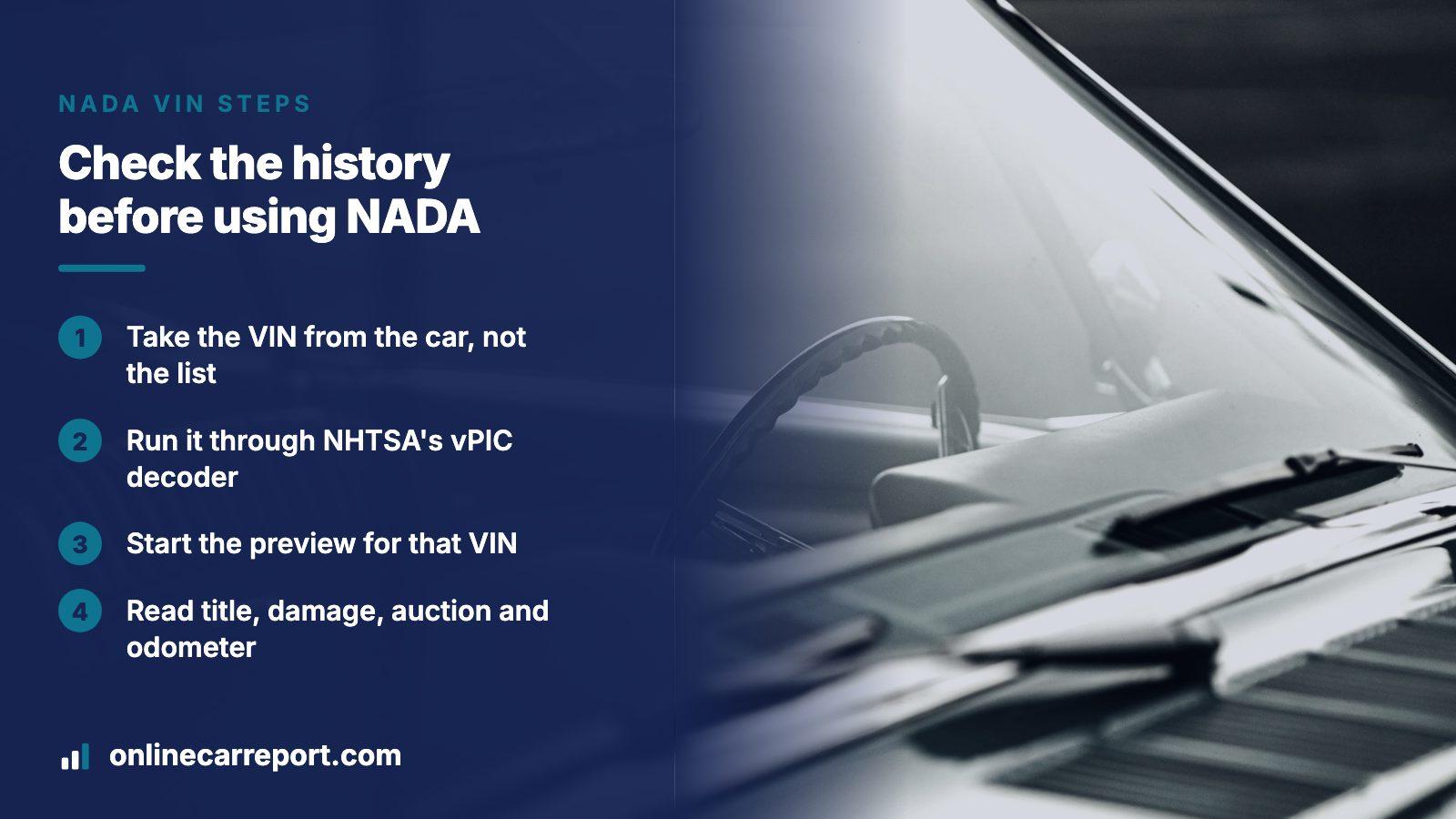
- Take the VIN from the car in front of you, not from the listing:the stamped plate in the windshield corner on the driver's side, or the sticker on the door edge. Compare it with the title paperwork.
- Run it through NHTSA's public decoder, vPIC, so the trim you price matches what the factory built.
- Start the OnlineCarReport preview for that VIN. No payment is taken at that stage.
- Read the title, damage, auction and odometer entries before any price, and note whatever the seller left out.
- Take mileage you can support from the odometer readings, plus an honest condition grade, to the J.D. Power book, in the column that matches your deal.
- Subtract for what the records showed, and hold the final number until an independent mechanic has looked at the car.
The price of the preview and the report
OnlineCarReport lets you preview a VIN at no charge. If you go on, you can buy a single report, or three, five or ten at once, each paid once, with no subscription and nothing that renews. Prices are on the pricing page. The report sets a market value beside the title, accident, odometer and auction records that move it, which is the pairing a book cannot give you by itself.
If the records come back clean, the book figure for your deal's column is a fair anchor for the conversation. If they do not, you now have specific entries to point at when you ask for a lower price, for repair paperwork, or for a different car.
Where this information comes from
- North Carolina DMV: damage disclosure statement MVR-181 — The salvage definition tied to fair retail market value, with the NADA Pricing Guidebook named as a source of values.
- New Jersey MVC: salvage certificate of title regulations — How fair market value is set by an average of approved manuals and when a car counts as economically impractical to repair.
- FTC: buying a used car from a dealer — What a history report can and cannot show, and why an independent inspection still matters.
- NHTSA: vPIC VIN decoder — The federal decoder for confirming the factory build before any valuation.
- NHTSA owner complaint 11710781 — owner experience, paraphrased
Sources and photos: Facts checked against the sources above in November 2026. Photos by Richard R, Dylan Michaud and Ben Wicks on Unsplash; diagrams by OnlineCarReport.
Keep reading
- Car value by VIN: what the number tells you and how history moves itThe general case: what a VIN can and cannot price on any make.
- Kelley Blue Book value by VIN: how the history changes the numberThe consumer book read against the same VIN and the same history.
- Diminished value calculatorWhat a past accident does to a car's worth, even after a good repair.
- Sample reportSee how the title, damage and odometer records are laid out before you buy.
Frequently asked questions
Is NADA the same thing as J.D. Power Values?
In practice, yes. The dealers' association transferred the guide to J.D. Power, so the product now carries that company's name. Old habits and old paperwork keep the NADA label alive, and North Carolina's disclosure form still names the NADA Pricing Guidebook, so the name can outlast its owner.
Does a VIN alone give me a NADA value?
Not a finished one. The VIN fixes the year, trim and engine, which matters because two cars with the same badge can sit far apart on drivetrain. The value also needs mileage and a condition grade, and neither is encoded in a VIN. Supply both from records and a close look.
Why does my lender's figure differ from the dealer's price?
Lenders work from a book built for lending, and they advance a share of that figure rather than of the sale price. If the seller asks for more, you cover the gap in cash or negotiate it down. Ask which figure the lender uses before you sign, not after.
Does a NADA value account for a salvage or rebuilt title?
Do not assume so. A VIN carries no title status, and a book only knows what you enter. A branded car is normally priced as a discount from the clean figure, with damage severity and repair quality deciding the size. Check the title record first, then decide whether the published number applies.
What figure do I use if I sell to a private buyer?
Use the private party row. A trade-in value describes what a dealer pays toward another purchase, and a retail value describes a dealer's asking price after preparing the car. Neither fits two individuals dealing directly. Clean records are worth showing the buyer, since they back up your asking price.
Now check the car itself
The guide explains what to look for. The report shows what this VIN has on record.