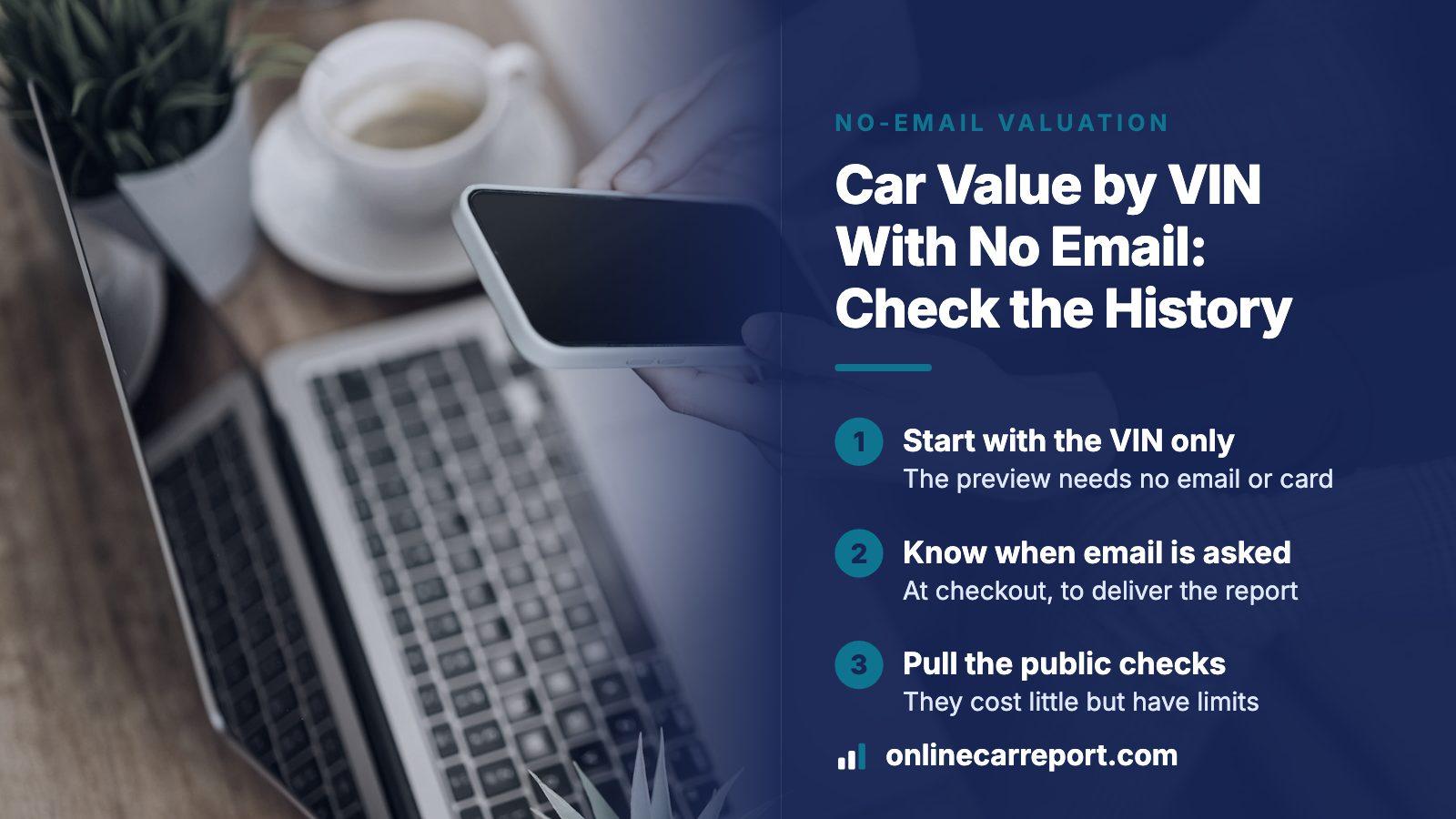
THE SHORT ANSWER
Yes, to a point. The free preview at OnlineCarReport needs only the VIN: no email, no card. The VIN names the build but carries no price, so a real value also depends on mileage, condition, location and what the title, accident and auction records show. The full report is a one-off payment, and your email is requested at checkout so the report and receipt can reach you.
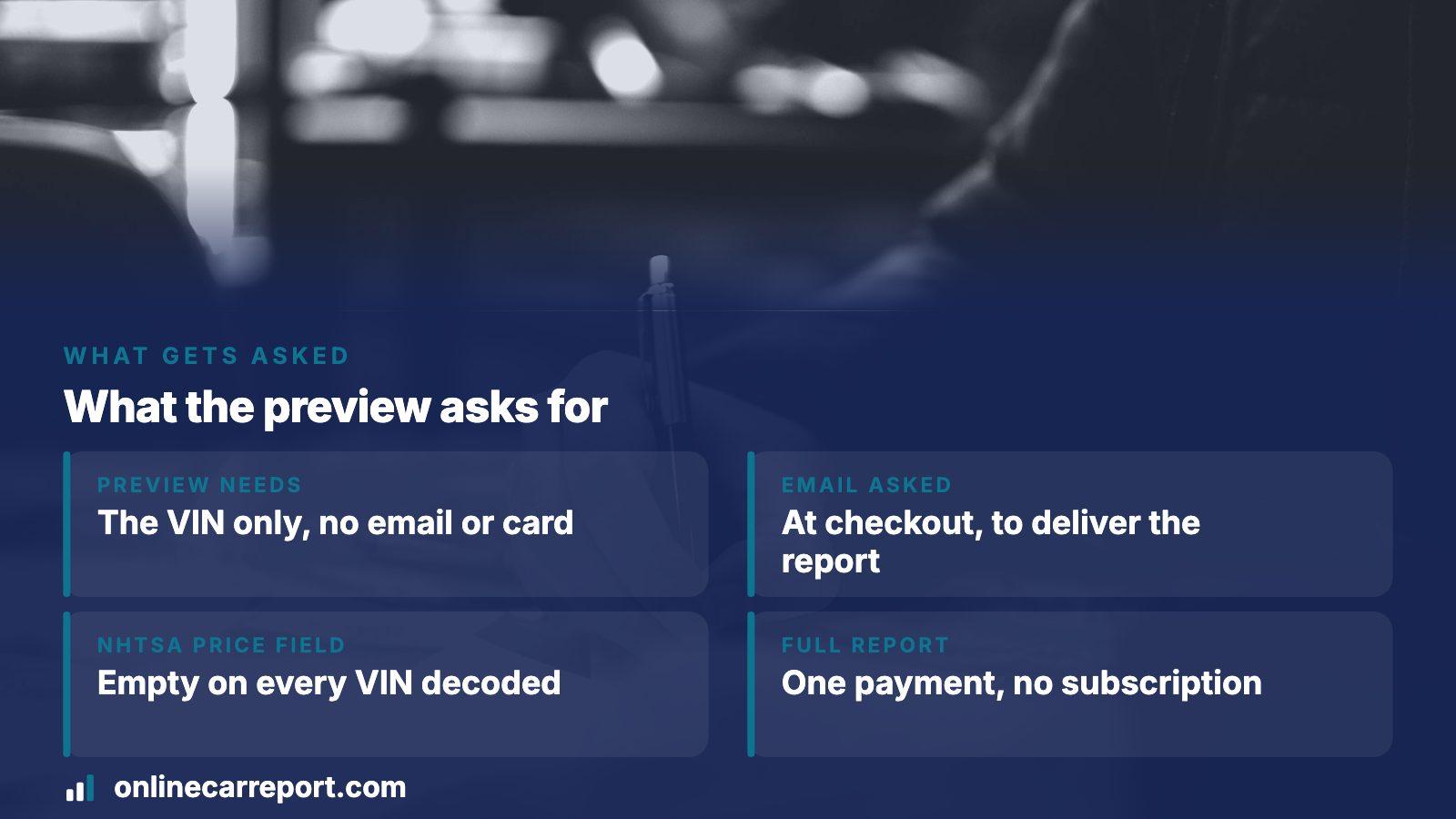
- Preview needs
- The VIN only: no email, no card
- Email is asked
- At checkout, to deliver the full report
- NHTSA price field
- Empty on every VIN decoded in testing
- Full report
- One payment, no subscription
What the preview asks for, and when an email comes in
Type a VIN into OnlineCarReport and the preview opens on the vehicle: year, make, model and trim, photos when any are on file, the number of open recalls, and counts of title and auction records. It asks for nothing more: no card, no email.
An address is requested at exactly one point, checkout for the full report. It delivers the report, carries the receipt and sends a link for reopening the report later. The privacy page states that the site neither sells nor rents addresses and sends no marketing mail.
| Step | What you give | What comes back |
|---|---|---|
| NHTSA decoder | The VIN | Factory build facts, nothing priced |
| Free preview | The VIN | Build, photos if on file, recall count, title and auction record counts |
| Full report | The VIN, an email, one payment | The full history records and a market value |
Why the VIN alone cannot hand you a price
NHTSA's public decoder, vPIC, shows what a VIN actually holds. A test run on a clean 2003 Honda Accord VIN returned 45 filled fields out of 154: maker, model line, body style, plant city, engine size. The base price field came back empty, and it was empty on a Ford F-150 and a Tesla Model S too.
Typos surface too. When the ninth character fails its arithmetic check, the decoder raises an error and the data may describe a different car, so retype any VIN that yields a surprising trim.
The price therefore rests on four things a VIN cannot supply: miles, condition, location and recorded history. Kelley Blue Book says it refreshes values weekly across more than 100 regions, and it answers with a trade-in range and a private party value. One car, two defensible numbers.
When your email address is the price of the number
Some valuation pages offer to email you a copy of the result. Kelley Blue Book's does, within 24 hours. That is a convenience on a page run by a name you know, unlike a site that holds the figure back until you surrender contact details.
The FTC has described the ugly end of this. Its alert on history-report scams covers fake sites that gather personal information along with a card payment of roughly $20, and it says the aim may be reselling the data through lead generators. The sites in that scheme redirected to .vin addresses.
- See whether a number or any record appears before you register.
- Find the operator: a company name, a postal address, a contact page.
- Search that name beside words like complaint, review and scam, as the FTC advises.
- If an address is unavoidable, give one you can abandon.
History is what the valuation books leave out
A valuation book prices a typical example of the model. It cannot know whether this particular car was declared a total loss, sold through a salvage auction or labeled by a state. Those events sit in title and insurer records, and a careful buyer weighs them heavily.
| Record | What it says | What it does to your offer |
|---|---|---|
| Title brand | A state labeled the car junk, salvage, flood or similar | Drop the clean-title figure; the label shows up in the national record |
| Total loss or salvage sale | Declared a total loss or recorded as salvage | Expect serious past damage, then price it or walk |
| Auction photos | How the car looked when it sold | Hold them against the listing; hidden damage gives you room to bargain |
| Odometer readings | Miles on record over time | A reading that falls undermines the stated mileage |
| Accident record | A reported collision | Ask for repair paperwork, then get a mechanic's opinion |
No official page cited here gives a percentage cut for any of these, so treat anyone's flat figure as a guess.
The public checks that cost little or nothing, and their edges
- NICB VINCheck is free and reports flood damage, theft with no recovery and salvage declarations. Flood damage lands in that database only if an insurer was covering the car when the water hit, so an uninsured one can come back clean.
- NHTSA's recall search by VIN is free. It is aimed at open recalls, not history or price.
- NMVTIS reports cover title state, odometer reading, total loss and salvage, plus any brand history. Private providers' repair, recall and maintenance data stay outside it, and the NMVTIS buying tips put provider reports at up to $4 each.
None of the three puts a dollar figure on the car. That comes from a valuation book, or from a full report that sets a market value beside the records explaining it.
Running it: from the car to the preview
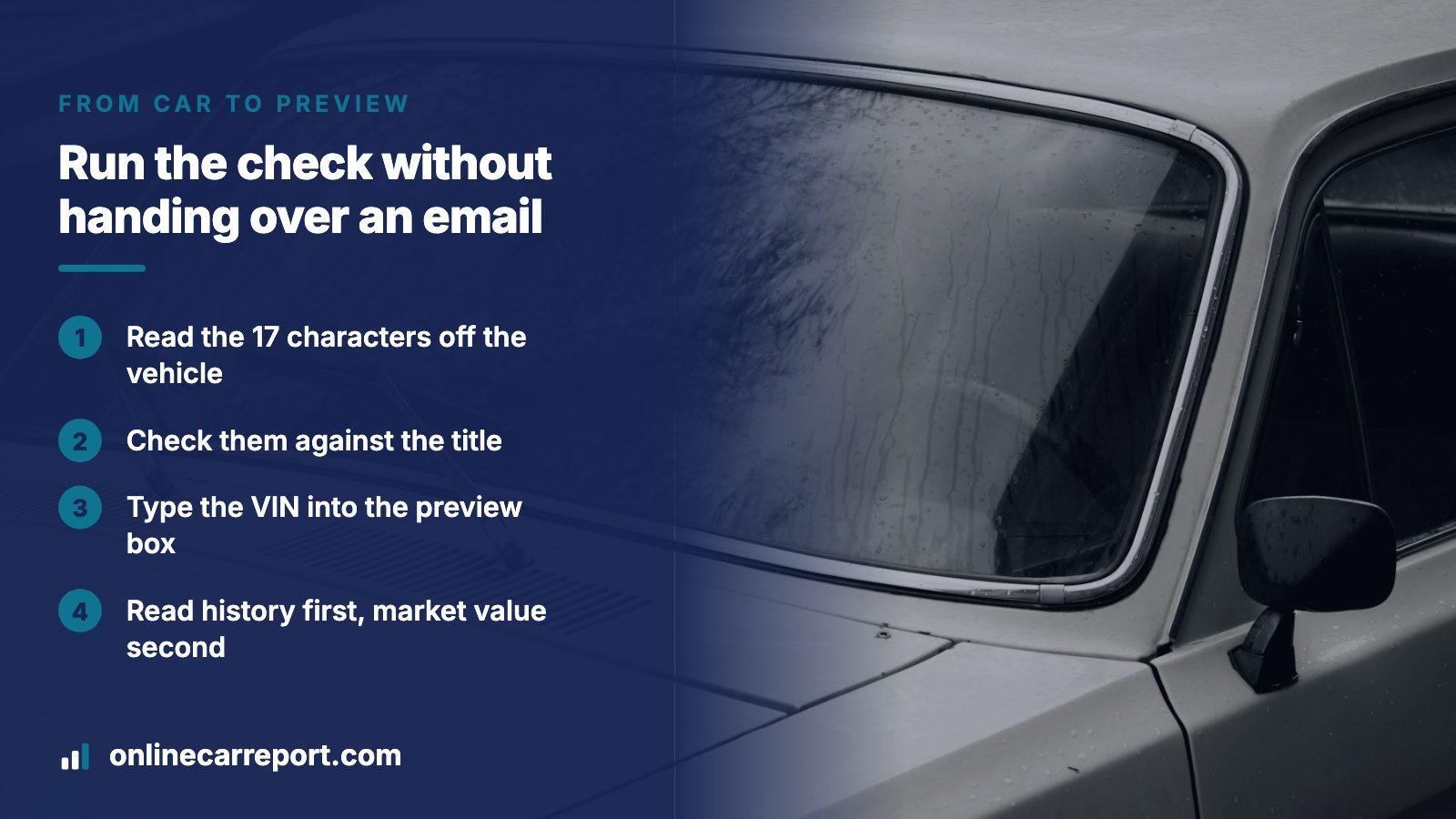
- Take the 17 characters from the vehicle itself, either the dashboard plate closest to the driver that can be read from outside the glass, or the sticker in the driver's door opening.
- Check them against the title or registration; if the two disagree, sort that out before any talk of price.
- Type the VIN into the preview box. The letters I, O and Q never occur in a VIN, so one in your entry is a slip.
- Read the preview against the listing: trim, photos, open recalls, and whether any title or auction records exist.
- If those counts are not zero, or the price is large enough to matter, buy the full report. Checkout is where the email goes.
- Read the history first and the market value second, then take both to a mechanic.
Reading the report: what should lower your offer
Treat the clean-title number from a valuation book as a ceiling, not an opening bid. Each flag below is a reason to offer less, and some are reasons to leave.
- A brand of any kind in the title history
- A salvage or total loss entry, especially with auction photos showing the damage
- Odometer readings that fall, stall, then jump
- A rental or fleet use type the ad never mentioned
- An open lien or an impound record
- A theft record, even one marked recovered
- An open recall the owner has not had fixed
Where the record ends and the mechanic begins
The FTC is clear that no history report replaces an independent inspection, since reports tend to show accidents and flood damage but not mechanical faults. Ask the mechanic for a written report with the VIN and a repair estimate. The FTC notes those estimates can be used to negotiate the price.
Cost, then the order of work
Nothing is charged for the preview. The full report is a single transaction that can be bought alone or as part of a 3, 5 or 10 multi-pack for car-value comparisons; no subscription follows and nothing renews. Today's amounts are listed on the pricing page, so none appear here.
Then work in order. Preview every car on your shortlist, buy the report on the one you would really bid on, price the clean version from two valuation sources, subtract for what the record shows and book the inspection before any deposit changes hands.
Where this information comes from
- NHTSA: vPIC VIN decoder — The public decoder behind the test decodes, where the base price field stayed empty.
- NMVTIS: Understanding an NMVTIS vehicle history report — Lists the title, brand, odometer, total loss and salvage indicators and what the federal report leaves out.
- NMVTIS: Used car buying tips — Source for the provider fee ceiling and the advice to inspect before buying.
- FTC: Steering clear of vehicle history report scams — The scheme that collects personal details and card payments through fake report sites.
- FTC: How to steer clear of a flood-damaged car — Explains what the free NICB check covers and the insured-only limit on flood reports.
- FTC: Buying a used car from a dealer — Backs the point that a history report does not replace an inspection and that repair estimates support a lower price.
- Kelley Blue Book: What is my car worth — The valuation page that offers an emailed copy, updates weekly and splits trade-in from private party.
Sources and photos: Facts checked against the sources above in November 2026. Photos by Jakub Żerdzicki, Tigran Shishmanyan and Owen Michael Grech on Unsplash; diagrams by OnlineCarReport.
Keep reading
- Car value by VIN: what the number tells you and how history moves itThe full explanation of what a VIN prices and what moves the number after that.
- Kelley Blue Book value by VIN: how the history changes the numberHow the consumer valuation book treats a VIN and where it needs history added.
- Diminished value calculatorWhat a past accident does to a car's worth even after a good repair.
- Sample reportSee how the title, damage and odometer records are laid out before you buy.
Frequently asked questions
Can I get a car value by VIN without giving an email?
You can start without one. The preview takes only the VIN, and NHTSA's decoder and recall search cost nothing either. An email enters at checkout for the full report, because the link and receipt are sent there. Read any other site's terms before typing an address.
Why does a value tool ask for mileage when it already has the VIN?
The VIN records how the car left the factory and stops there. NHTSA's decoder returned an empty base price field even for a clean VIN. Mileage, condition and location are inputs you supply, while recorded history is the piece the full report brings.
Does a free NICB check always show a flood car?
No. The check can flag a flood only if the car was under an insurance policy when it happened, a limit the FTC points out. A car with no coverage can return clean, so add a title history, a sniff for mold and a mechanic's inspection.
A buyer wants me to get a history report from one named website. Should I?
Be careful. The FTC describes scams where a fake buyer sends sellers to a named site that charges about $20 and takes personal details, then disappears. Ask why that site, look up who runs it, and choose a provider yourself, such as one on the NMVTIS approved list.
Do I need a subscription to check more than one car?
No. Every full report unlocks a single VIN for a one-time fee, and multi-packs of 3, 5 or 10 cover several cars without renewing. The preview is free for any VIN, so you can screen a whole shortlist before buying anything. Amounts are on the pricing page.
Now check the car itself
The guide explains what to look for. The report shows what this VIN has on record.