THE SHORT ANSWER
Yes, but only as a range. Year, make, model, trim, mileage and condition are enough to price a typical car of that description, and a partial VIN can sharpen the trim. What no lookup can see without the full 17 characters is this car's own record: title brands, damage and auction sales, odometer readings. Those change the price most, so get the VIN from the car or the seller's paperwork before you commit.
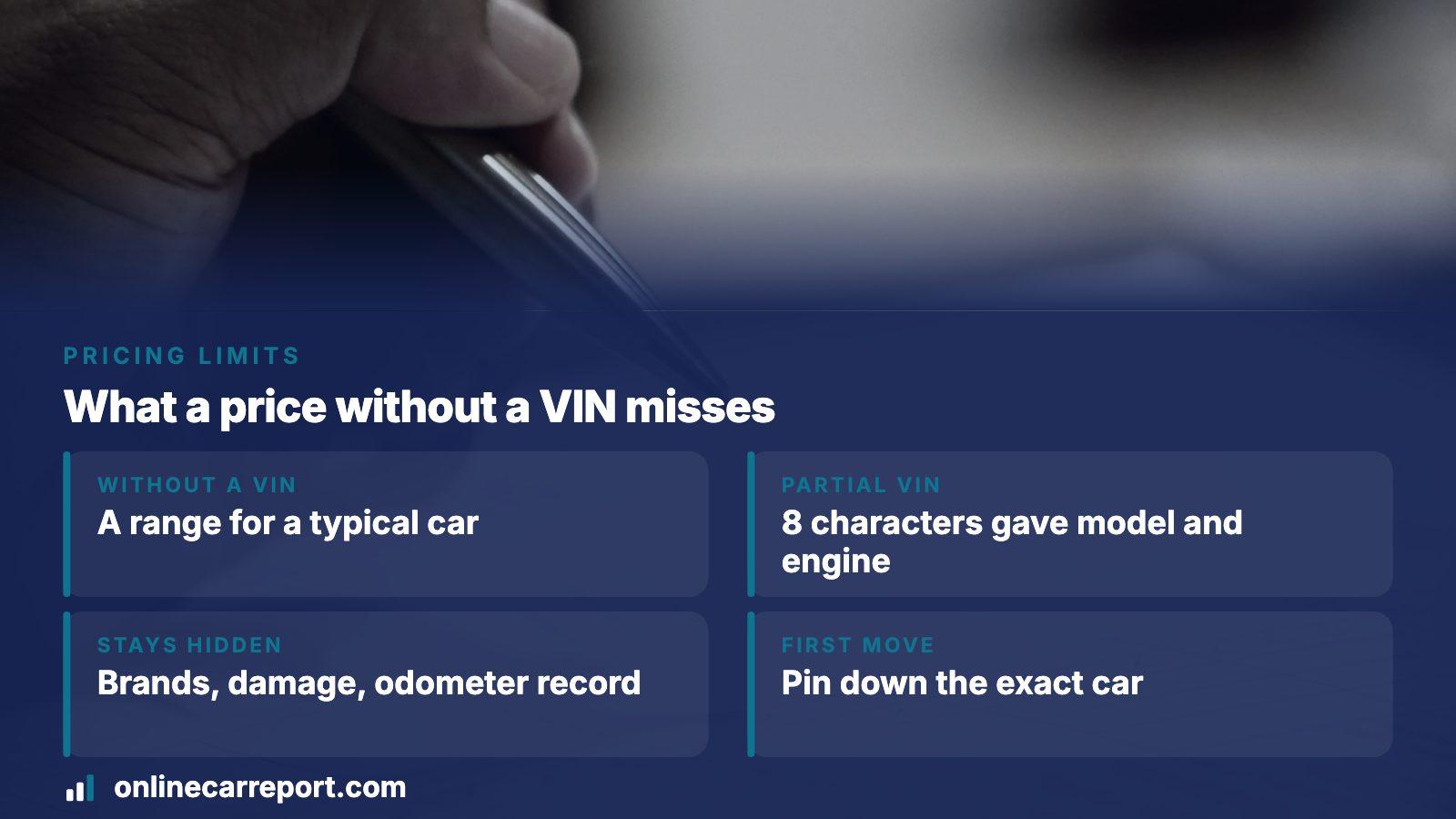
- Without a VIN
- A range for a typical car, not this one
- Partial VIN
- In a test, 8 characters gave model, trim and engine
- What stays hidden
- Brands, damage and the odometer record
- Preview
- Free; the full report is one payment
What a value without the VIN actually prices
Without a VIN, a valuation tool is pricing a description rather than a car. You supply a year, make, model, trim, mileage and a condition grade, and it returns what cars matching that description have tended to sell for. That works well for building a shortlist or judging whether an asking price sits in the right neighborhood.
It stops being enough once money is about to move. The description assumes an ordinary past: no brand on the title, no total loss, nothing odd about the odometer. Two cars with the same description can carry very different records, and the number you were quoted fits only the one with the clean story.
Pin down the exact car before you price it
A model name is looser than it sounds. Step through the Find a Car menus at fueleconomy.gov for a 2012 Honda Civic and the options step returns three separate listings, not one.
| Listing under that 2012 Civic | Engine |
|---|---|
| Automatic, 5-speed | 4 cylinders, 1.8 L |
| Manual, 5-speed | 4 cylinders, 1.8 L |
| Manual, 6-speed | 4 cylinders, 2.4 L |
A pricing book treats those as different cars, and the badge on the trunk may not reveal which one you are viewing. Before filling in any valuation form, jot down the engine size, transmission, drive layout and trim name from the listing, then ask the seller to confirm each.
A partial VIN still decodes a lot
Maybe the ad blurs the last digits, or the seller texted only a fragment. NHTSA's public decoder accepts any VIN shorter than 17 characters, lets a star stand in for each missing one, and does not need the ninth character. A test run on a BMW X3 shows how much a fragment buys.
| Characters entered | What the decoder returned |
|---|---|
| First 3 | The maker, BMW, and little else: about 10 of its 154 output fields held anything |
| First 8 | X3 xDrive35i, 3.0 L, six cylinders, all-wheel drive; about 29 fields filled |
| 11, with a star for the gap | The same car plus the plant country, Germany; about 31 fields, still marked incomplete |
That settles the build, which is all a valuation form needs. It does not reach the records. A history is looked up on the whole VIN, so a fragment tells you what the car is and nothing about what has happened to it.
Getting the full VIN out of a seller or a car
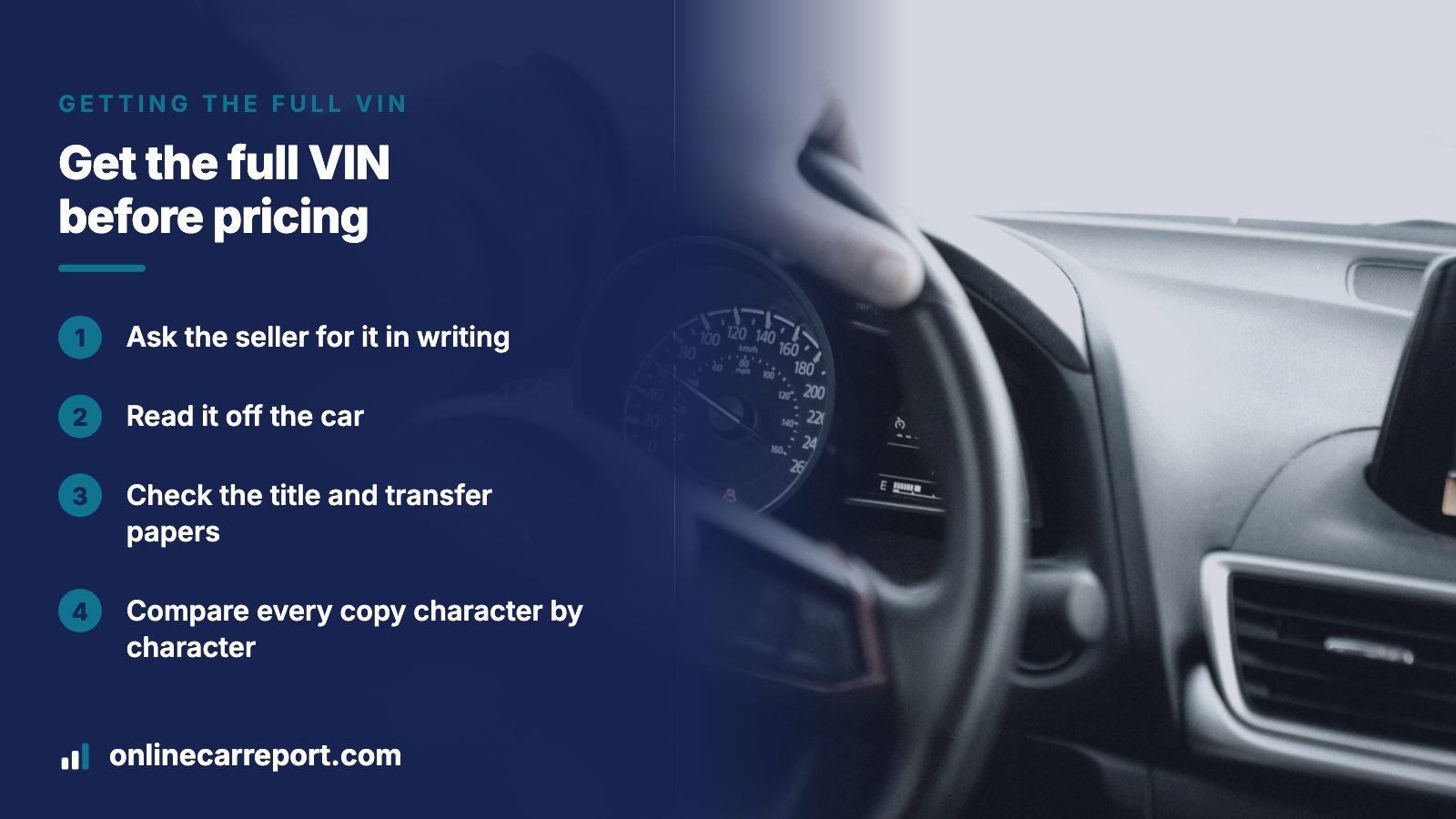
- Ask for it in writing before you drive anywhere. On most sales the seller signs a mileage statement that names the vehicle by its VIN, so handing it over a day early costs nothing.
- Read it off the car. On cars and light trucks, federal rules want it visible from outside, through the windshield glass at the driver's side, so no door needs opening.
- Check the title and transfer paperwork, where the signed mileage statement lists make, model, year, body type and VIN together.
- At a dealer, find the Buyers Guide, which shows the VIN on its front, and expect any inspection report to repeat it.
- Compare every copy character by character. A genuine VIN has 17 of them and contains no I, O or Q anywhere, so one of those in your notes is a transcription slip, and two copies that disagree are a reason to stop.
What history changes that a price book cannot see
NMVTIS, the federal title database, boils a car's past down to five items: where it is titled now and since when, any brands, an odometer figure, whether it was ever written off as a total loss, and whether it ever went through a salvage sale. Each bears on what the car is worth.
| Record | What it does to the price |
|---|---|
| Brand such as junk, salvage or flood | States attach these labels, and the federal system keeps the history of brands from any state, which helps buyers catch a damaged car sold without disclosure |
| Total loss or salvage entry | Generally points to severe damage, so a clean-car figure no longer applies |
| Odometer reading | A tampered figure can leave you paying above fair market value or driving something unsafe |
| Flood or theft flag | NICB's VIN check, as the FTC describes it, reports flood damage and cars stolen and never recovered |
| Open recall | NHTSA's recall listing, searched by VIN, shows repairs not yet done |
A clean result is useful too. With none of those flags, the book range stands and your offer can rest on the car's condition.
Running the check once you have the VIN
Enter the 17 characters slowly, then start the preview at OnlineCarReport. The preview is free; buying the full report is a separate step. The report sets a market value beside the records that shift it: any title brand, damage claims, mileage readings over time, and salvage or auction sales with their photos.
Read the odometer entries as a column, oldest to newest. They should climb. A reading that drops, repeats or leaps needs an explanation before you talk price.
What no history can tell you
A history shows what was recorded, not how the car runs today. The FTC's advice is that a report can reveal accidents and flooding but seldom covers mechanical faults, and it cannot stand in for an independent inspection. Hire a mechanic of your own choosing and get any repair estimate on paper.
Red flags that should lower the offer
None of these proves a car is bad. Each is a reason to ask, or to bid lower.
- A seller who shares the year and mileage but stalls on the VIN
- Paperwork whose VIN does not match the one on the car
- A brand, total loss or salvage entry that the ad never mentioned
- Odometer readings that fall, repeat or jump
- An open recall the owner has not had repaired
A car with one flag can still be fair at the right price after a clean inspection. A brand paired with an evasive seller is a different decision.
What the report costs and how to sequence your steps
Starting the preview costs you nothing. Buying is a single transaction, either for one report or for a larger set of three, five or ten when several cars are on your list. There is no recurring plan, and current amounts are shown on the pricing page.
- Price the description from two valuation books and treat the gap between them as your range.
- Collect the full VIN and use it to confirm the trim.
- Start with the preview, then pay for the full report on cars still in the running after your shortlist cut.
- Adjust the range for every brand, damage entry and odometer oddity.
- Pay for an independent inspection and take the written repair estimate off your offer.
Where this information comes from
- NHTSA: vPIC API, decoding partial VINs — Documents decoding with fewer than 17 characters and a star for gaps; the BMW X3 test run came from this decoder.
- fueleconomy.gov: Find a Car web services — Describes the year, make, model and options menus behind the three-listing Civic example.
- eCFR: 49 CFR Part 565, VIN requirements — Sets the 17-character format, the missing I, O and Q, and where the VIN must be readable inside the car.
- eCFR: 49 CFR 580.5, odometer disclosure — Shows that the signed mileage statement at a transfer identifies the vehicle by VIN.
- NMVTIS: Understanding a vehicle history report — Lists the five indicators and explains brands, total loss, salvage and what a clean report means.
- FTC: Used cars — Federal advice on history reports, NICB and recall lookups by VIN, and why a report is not an inspection.
- FTC: Buying a used car from a dealer — Backs the points on the Buyers Guide, independent inspections and using a written repair estimate in price talks.
Sources and photos: Facts checked against the sources above in November 2026. Photos by Jake Kling, Miles Loewen and Masjid MABA on Unsplash; diagrams by OnlineCarReport.
Keep reading
- Car value by VIN: what the number tells you and how history moves itHow a full VIN, mileage, condition and history combine into a price.
- Kelley Blue Book value by VIN: how the history changes the numberOne of the two valuation books to open for your range.
- Diminished value calculatorWhat a past accident does to worth, even after a good repair.
- Sample reportSee how title, damage and odometer records are laid out before you buy.
Frequently asked questions
Can I get an accurate car value without the VIN?
You can get a fair range, not an exact figure. Year, make, model, trim, mileage and condition describe a typical car. Without the VIN you cannot check this car's brands, damage or odometer record, and those are what push a real price above or below the range. Treat the range as a ceiling for a clean car.
What if I only have part of the VIN?
Decode it for the build. NHTSA's decoder takes anything under 17 characters, with a star for each gap, and in a test the first 8 characters returned the model, trim, engine and drive. Records are another matter: a history lookup needs the whole VIN, so ask the seller for the missing characters or read them off the car.
Should I keep shopping if a seller will not give me the VIN?
Pause, at least. On most sales the seller signs a mileage statement that lists the VIN, so there is nothing to protect by holding it back until the visit. Ask for it in writing, then check it against the one on the car. If the answer is still no, other cars share the same description.
Does a value based on year, make and model include accidents?
No. It describes an average example, which assumes no brand and no major damage on record. A total loss entry or salvage sale shows up only when the VIN is checked, so a quick lookup will overstate a car that has one.
Is a VIN report worth buying if I only want a ballpark?
Probably not. For a ballpark, two valuation books and the exact trim are enough. The report earns its cost when you are close to paying. The preview comes first with no charge, and the full report is a single purchase without a subscription. If it shows a brand you did not know about, you learn that before paying the seller.
Now check the car itself
The guide explains what to look for. The report shows what this VIN has on record.