THE SHORT ANSWER
No, a VIN alone gives no dollar figure for a classic or antique. It identifies the car, and NHTSA's decoder begins at model year 1981. The price comes from a collector guide such as Hagerty's, which needs your judgment of condition and originality. If the VIN is usable, the title, damage, odometer and auction records show whether the guide figure holds.
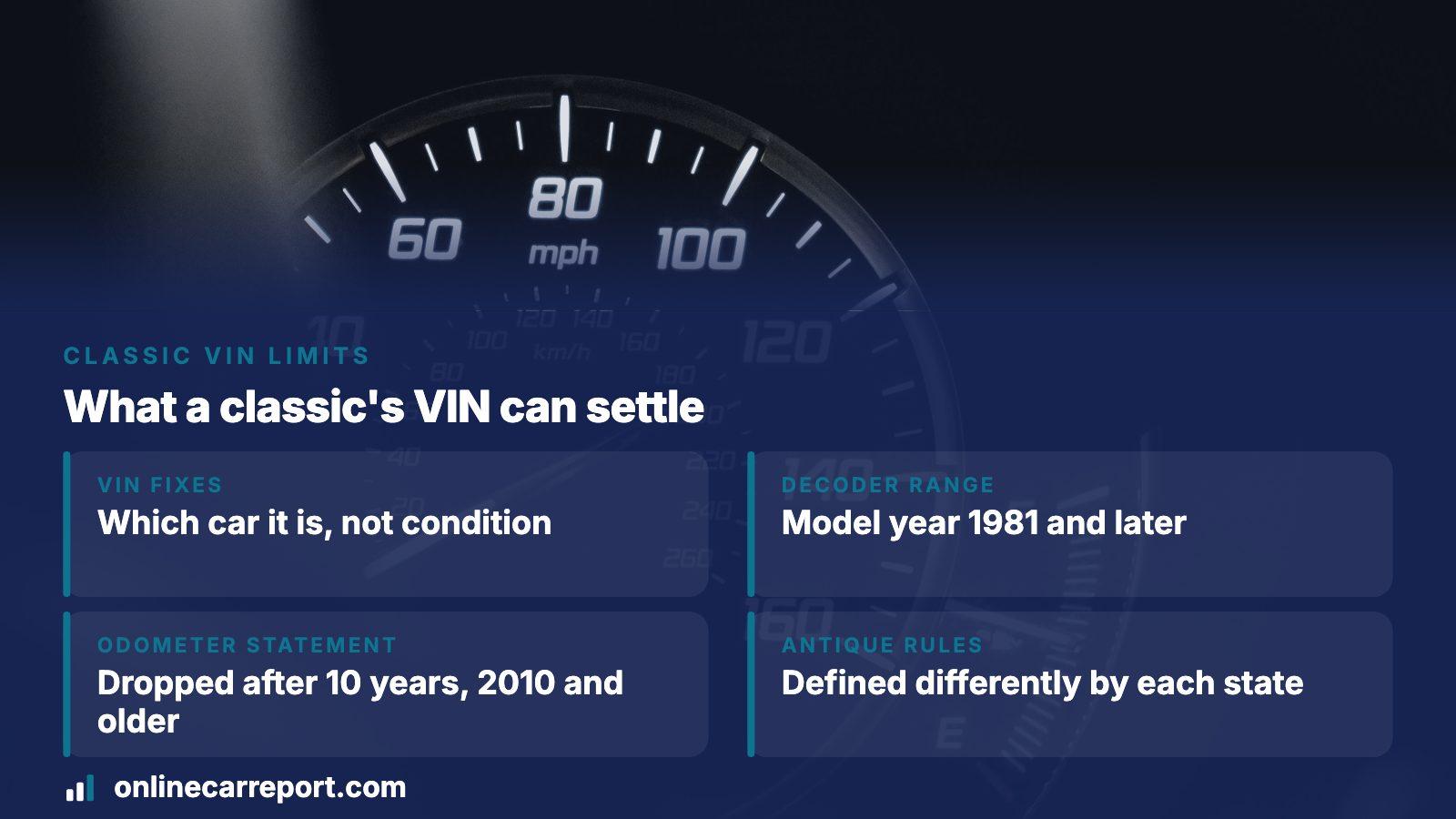
- What the VIN fixes
- Which car it is; not condition, originality or mileage
- Decoder range
- NHTSA's decoder covers model year 1981 and later
- Odometer statement
- Dropped after 10 years for model year 2010 and older
- Preview
- Free; the full report is one payment
What a VIN settles on an old car, and what it never will
Treat the VIN as a name tag. It says which car you have: maker, body, engine, year built. It is silent on whether the paint is original, whether the engine was swapped decades ago, or what a collector would pay this month. A price guide and a long look at the car answer those.
Age adds a snag. NHTSA scopes its public decoder to model year 1981 and newer. In a test, an invented eleven-character number in the old style drew an incomplete-VIN flag, yet the tool still returned a trailer builder and a model year unrelated to any classic. Check every decoded result against the car and its paperwork.
Where your car falls against the 1981 line
| The car | What the number looks like | What a lookup can do |
|---|---|---|
| Built before model year 1981 | An older stamping, not the modern layout | May be rejected or misread, so lean on the title, bill of sale and the car's own details |
| Model year 1981 or later | Seventeen characters | Decodes to the factory build, and records can attach to it |
| Built for sale outside the US | May not follow the US layout | NHTSA says such vehicles return limited data |
Only the middle row gives a VIN-based report much to work with. The others move more of the load onto paperwork, a mechanic and the guide.
Hagerty, price guides and the figure itself
Searches pairing Hagerty with a VIN are mostly after a collector-market price. That figure comes from a guide, not the VIN, and this page quotes no guide's numbers. Read how the guide describes the condition of the car it prices, and pick the description that fits yours, not the one you hope for.
The stamping cannot tell a guide these, so you supply them:
- Condition, judged by someone who is not selling the car.
- Originality: a frame, body and engine that left the factory together.
- Mileage you can support, often a claim rather than a record on an old car.
- Trim and options, which the number may only partly confirm.
The records that pull a collector figure down
A guide prices a typical example. The records show whether yours is typical.
| Record on the VIN | What it does to the guide figure |
|---|---|
| Salvage, rebuilt or flood brand | Makes the guide figure a ceiling; ask who repaired the car and what paperwork backs the work |
| Insurer total loss entry | Ask whether the car was repaired or broken up; a stolen car found unharmed after 30 days can carry the label too |
| Damage or accident entry | Shows the inspector where to start and supports a request for repair invoices |
| Odometer readings | A falling reading, or one far from the seller's figure, undercuts the mileage story |
| Auction listing with photos | The car on sale day, to hold against today's description |
When the record is thin: no title and no mileage statement
A short history is not always a clean one. Several states stop requiring titles once a vehicle passes a set age, a point the Justice Department's NMVTIS page raises, so a report on an old car can run light for reasons unrelated to care. Vermont shows the mechanism: for a model year 2009 or older vehicle registered in the owner's name, the registration certificate proves ownership, and the seller hands it over with a signed bill of sale.
Mileage thins out too. Federal rules drop the odometer statement on a transfer once a model year 2010 or older car is 10 years past January 1 of its model year, and newer cars at 20 years. A classic's dash figure may never have been written down by any seller.
What an empty result means
NMVTIS reports on five indicators and holds about 87 percent of vehicles nationwide. A no-salvage result may be a false negative if a state or reporting entity never sent its records. On an old car, read nothing found as nothing found, not as proof of no problems.
What classic means on the paperwork depends on the state
Collectors argue about the word; state agencies define it, and the definitions differ.
- Pennsylvania: antique means a vehicle more than 25 years old measured against the current year, and classic starts at 15 years. Both must stay close to maker specifications, and neither may be a reproduction.
- Texas: an antique plate applicant certifies that frame, body and motor all date back at least 25 years and that the car is no replica or aftermarket build.
A plate class sets no price, but the certification behind it speaks to originality, and use is limited: Pennsylvania allows occasional trips of no more than one day a week. Its application also wants a photograph of the VIN or serial number, and a salvage certificate as proof of ownership sends the applicant to a separate form.
Recalls and the fifteen-year line
Recalls do not expire with age, but the free fix can. Federal law lets a maker refuse a free repair when the first sale lies beyond 15 calendar years at the date of the notice; tires get 5 calendar years.
An open campaign on an old car therefore still matters, and the bill may be yours. Ask which campaigns applied to this make, model and year, and which were completed; a vague answer is information too. Treat the cost as a price item, and ask for receipts on any work the seller describes.
Running the check before you agree on a price
- Find the stamped number on the car and read it character by character instead of copying it from the ad.
- Compare it with the title or registration; with no title, ask for the whole chain of bills of sale.
- If it has seventeen characters, run NHTSA's decoder and confirm the build matches the trim on offer.
- Start the OnlineCarReport preview for that VIN. It costs nothing, and you decide afterwards whether to buy a report.
- Read the brand, damage, odometer and auction entries before you see any price.
- Open a collector guide, choose the condition level that honestly fits, and subtract for what the records showed.
- Book an independent mechanic to go over the car, and keep the written findings for the negotiation.

Preview first, then one payment
The preview is free. If the VIN merits it, choose one report or a larger set of 3, 5 or 10; each is paid once and nothing renews. Current prices live on the pricing page, not here. The report sets a market value beside the title, damage, odometer and auction records, a pairing a collector guide cannot give you alone.
Clean records on a seventeen-character VIN make the guide figure for your condition level a fair opening position. If they are not clean, you hold named entries to bring to the seller, whether you ask for a lower price, repair invoices or a different car.
Where this information comes from
- NHTSA: vPIC VIN decoder — Model years the decoder is intended for, and the limited data it gives on vehicles not made for the US market.
- NMVTIS: consumer information — What a title-record report covers, how complete it is, and why an empty result can mislead.
- 49 CFR 580.17: odometer disclosure exemptions — How many years must pass before a transfer needs no odometer statement.
- 49 USC 30120: remedies for defects — The fifteen-year limit on a free recall remedy and the shorter one for tires.
- Vermont DMV: vehicle title — How an older vehicle can change hands on a registration and bill of sale with no title.
- PennDOT: antique, classic and vintage plates — State age cutoffs for antique and classic, use limits, and the paperwork behind them.
- Texas DMV: antique license plate application VTR-54 — The owner's certification about frame, body and motor age and the replica rule.
Sources and photos: Facts checked against the sources above in November 2026. Photos by Linus Belanger, Scott Graham and NATHAN MULLET on Unsplash; diagrams by OnlineCarReport.
Keep reading
- Car value without a VIN: what you can price and what history changesPricing an old car when the stamped number will not decode.
- Car value by VIN: what the number tells you and how history moves itThe general case: what a VIN can and cannot price on any make.
- Diminished value calculatorWhat a past accident does to a car's worth, even after a good repair.
- Sample reportSee how title, damage and odometer records are laid out before you buy.
Frequently asked questions
Does a VIN give the value of a classic car?
Not a finished figure. The VIN identifies the car, but a collector price rests on condition, originality and supportable mileage, none of which the stamping records. Use it to pull title, damage and odometer entries, then price the car in a collector guide and adjust for what those records showed.
Is a Hagerty value the same thing as a VIN report?
No. Hagerty is known for collector-car pricing, while a VIN report searches the records of one specific car. They answer different questions, so use both: the guide for what cars like yours sell for, the records for whether yours has a past that should lower the number.
Will a VIN check work on a car built before 1981?
Often it will not. NHTSA's decoder targets model year 1981 and later, and a short old-style number drew an incomplete-VIN error in a test. Records can also be sparse where states exempt old vehicles from titling. With a seventeen-character number, run the preview; otherwise rely on the bill-of-sale chain and an inspection.
Does a clean history mean nobody ever damaged the car?
No. A clean result can mean only that nothing was reported. NMVTIS says brand rules differ by state and a no-salvage result can be a false negative. On a car that may never have been titled or sold at auction, the gap is wider, so check the frame, panel fit and paperwork yourself.
How old must a car be to count as an antique?
There is no single federal line. Pennsylvania calls a car antique once it is over 25 years old and classic at 15, counted against the current year. Texas also uses 25 years for its antique plate. Check your own state's definition, because it controls the plate, inspections and use limits.
Now check the car itself
The guide explains what to look for. The report shows what this VIN has on record.