THE SHORT ANSWER
Plan on $1,135 to $1,544 when a chain drives the valves; a belt car is priced at $1,213 to $1,695 by the same estimator. The 2013 and 2014 1.6L and the 2017 and 2018 1.5L turbo cars draw the engine complaints. Confirm the engine by VIN, then subtract the repair from the price unless a receipt proves it was done.
- Chain job estimate
- $1,135 to $1,544 (RepairPal)
- Belt job estimate
- $1,213 to $1,695 (RepairPal)
- Turbo engines to check
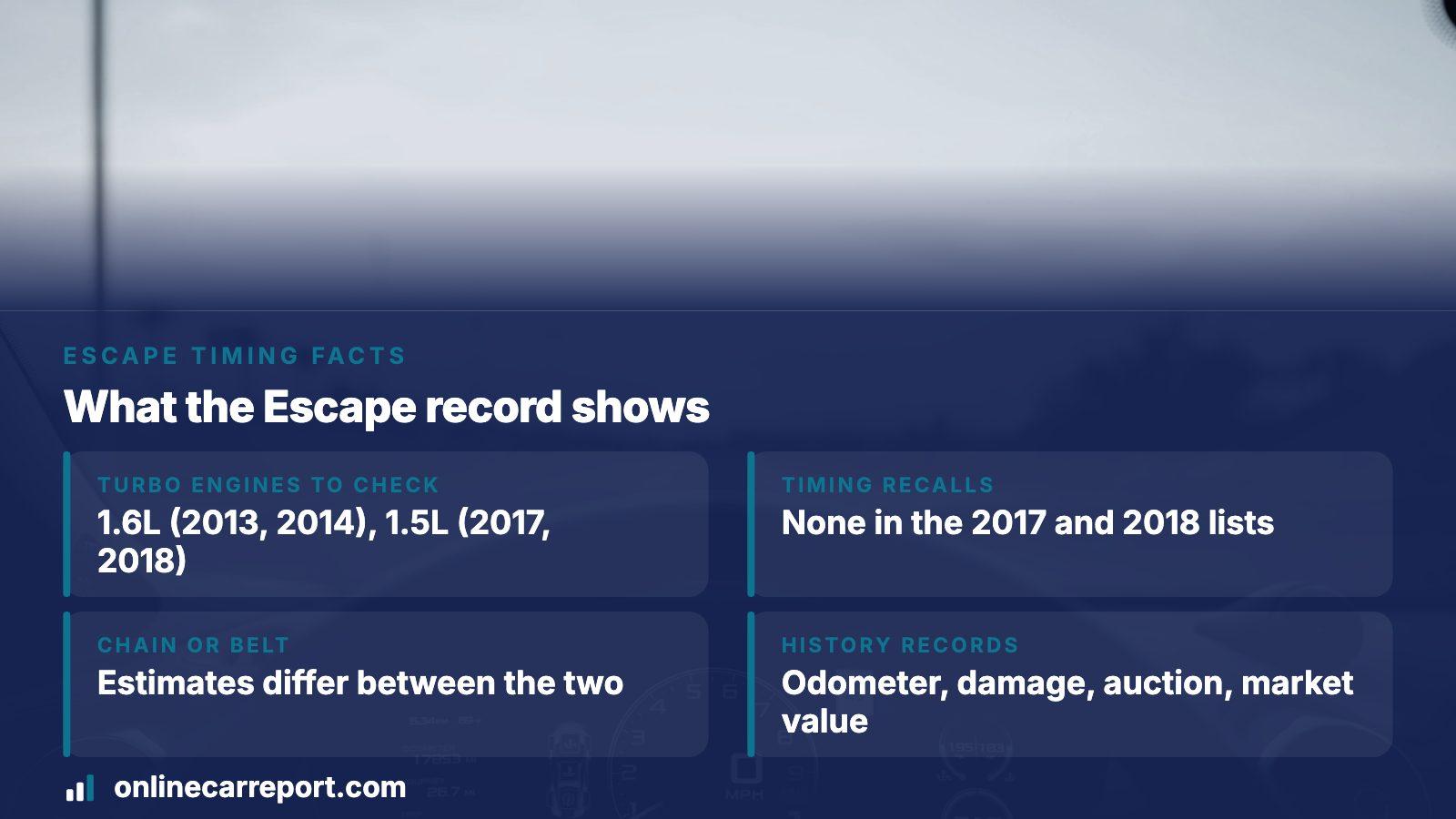
- 1.6L (2013, 2014), 1.5L (2017, 2018)
- Timing recalls found
- None in the 2017 and 2018 lists
Price the repair as a deduction, not a surprise
A used Escape sells for a number that assumes nothing is wrong underneath. Any timing work still ahead of the car comes off that number, and any timing work already done with paperwork can justify holding firm. That is the whole value question on this page.
Published estimates give you the size of the deduction. Its tensioner-and-chain page reads $1,135 to $1,544, covering labor plus parts. A separate belt page shows $1,213 to $1,695. Treat both as estimates from a third party, not quotes, and let a local shop confirm the scope before you argue price with a seller.
Which engine is in the car decides which bill applies
Fueleconomy.gov lists a 2.5L, a 2.0L turbo and a 1.6L turbo for the 2013 and 2014 Escape. For 2017 and 2018 the list is a 2.5L, a 1.5L turbo and a 2.0L turbo. The same model year can therefore hold very different engines.
Research notes for this page say the 2.5L and the 2.0L turbo drive their valves with a chain, while the 1.6L and the 1.5L turbo use an oil-bathed belt. Owners do not agree on the wording: complaints about 2017 and 2018 cars use both belt and chain. So a quote that names the wrong part is a reason to ask what the shop actually opened up.
| Model years | Engines listed | Part the notes name |
|---|---|---|
| 2013, 2014 | 2.5L, 2.0L turbo, 1.6L turbo | Chain on the first two, belt on the 1.6L |
| 2017, 2018 | 2.5L, 1.5L turbo, 2.0L turbo | Chain on the 2.5L and 2.0L, belt on the 1.5L |
Recalls on file: engine fixes, but nothing for timing
Federal records list 18 recall campaigns against 2013 Escapes and 16 against 2014 ones. A handful target the 1.6L: coolant loss from a dislodged cylinder head plug, localized cylinder head overheating, and fuel line splits. One 2014 campaign covers 1.6L engines driven with too little coolant.
For 2017 and for 2018 the lists are shorter, 4 campaigns apiece, and not one title mentions a timing belt or chain. A recall fixes a safety defect at no charge. Normal wear on a timing part is not that, so nobody will repay you for it just because the car has a recall history.
Open recalls still change the price
A campaign that is open on a car you are buying is free work for the next owner, but it is also a trip to the dealer. Run the VIN before you negotiate so both sides argue from the same list.
What owners filed with NHTSA
Complaints are unverified reports, not failure rates. Still, they show how an engine problem actually reaches an owner, which is rarely as a tidy maintenance line.
From an NHTSA owner complaint
An owner of a 2017 Escape said a timing belt or tensioner failed at 46,000 miles and destroyed the engine, with no warning lights first. The car was rarely driven out of town, and the owner reported a dealer estimate of 10,889.23 dollars that Ford would not help with because the car was past warranty.
The lesson for a buyer is that low mileage does not prove a healthy timing system. A 46,000 mile car with no service record on this part deserves the same scrutiny as a car with twice the miles.
From an NHTSA owner complaint
An owner of a 2018 Escape said the timing chain broke near 106,000 miles. The car stopped accelerating at a four-way stop and coasted to the roadside. The tow-in diagnosis was a snapped chain and a dead engine, and the dash had shown nothing beforehand.
An older example: belt and water pump together
From an NHTSA owner complaint
An owner of a 2013 Escape with 73K miles said coolant drained from the water pump, and Ford also replaced a timing belt it found contaminated. The owner reported the repair came to 1600 dollars.
That figure sits close to the RepairPal ranges above, and it shows why shops bundle the pump with the belt once the front of the engine is open. When you read a seller's receipt, look for both lines, not one.
For a related repair that often shows up in the same invoice, see the water pump page linked at the end.
Where the vehicle history changes the number
A timing repair is only one input. The history decides how much weight the rest of the car can carry. A mileage reading that jumps backward, a past auction sale with photos, or a recorded accident each lower the price a careful buyer will pay, and a shop's quote reflects none of them.
- Odometer readings over time: a low-mileage claim next to a hard-failed engine needs an explanation.
- Accident and damage records: front-end damage can hide cooling and timing-cover work.
- Auction and salvage history: a car that changed hands at auction may have skipped its service.
- Market value: the figure you subtract the repair from.
A buying routine for a 2013, 2014, 2017 or 2018 Escape
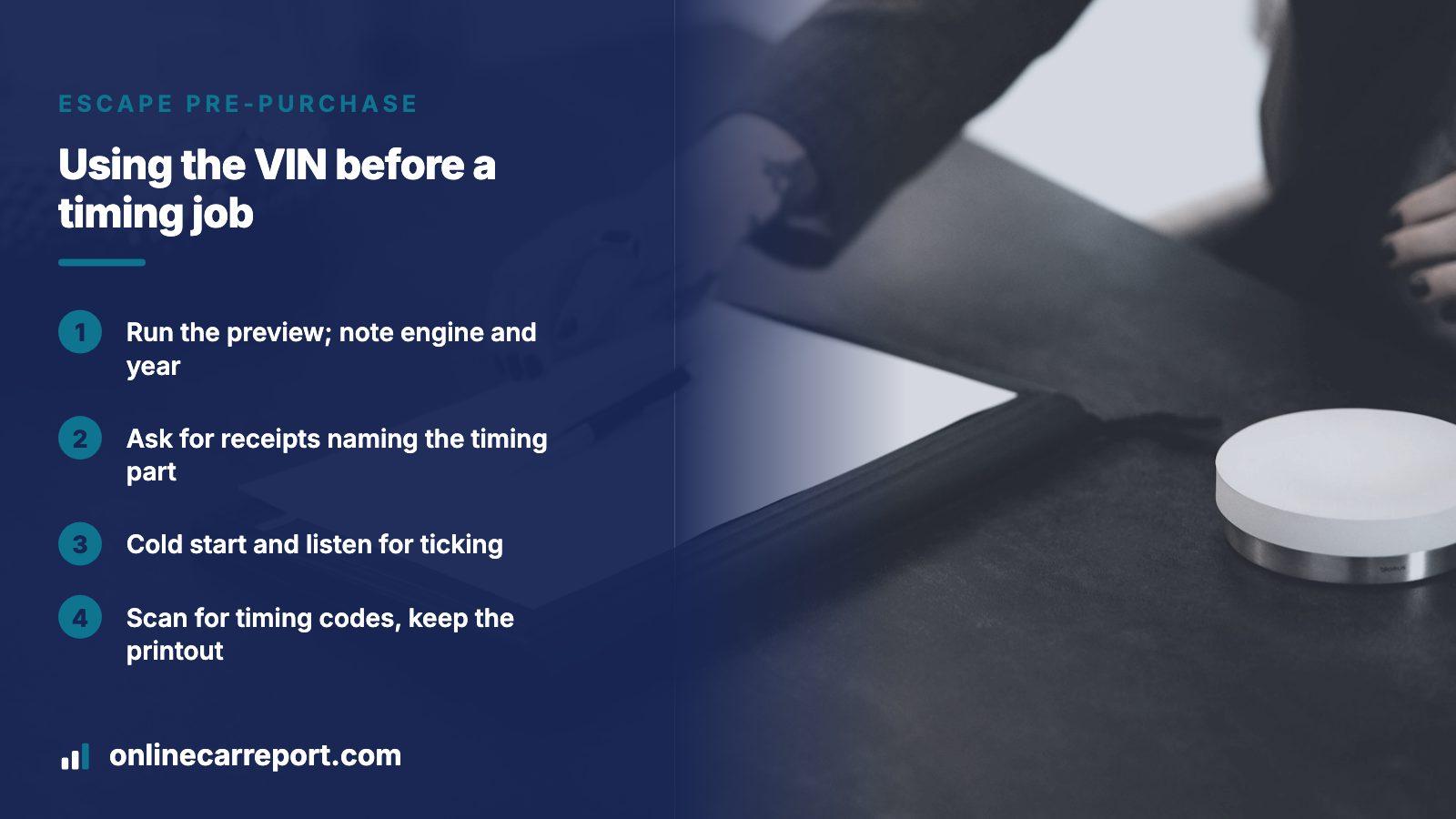
- Run the VIN preview and note the engine and model year.
- Ask the seller for receipts that name the timing part, the water pump and the oil change dates.
- Start the car cold and listen for ticking or rattling before it warms up.
- Have a shop scan for timing codes and keep the printout.
- Subtract the matching estimate from the market value if no receipt exists.
Starting a VIN preview costs nothing here. The complete report is a single purchase with no recurring charge, and the pricing page covers the multi-report packs. The report adds the odometer, accident and auction records that explain why a car looks the way it does.
Turning the estimate into a fair offer
Start from the market value for the car in clean condition. Subtract the estimate that matches the engine, then add a margin for what a shop might find once the cover is off. Sellers tend to accept a number tied to a published range more readily than a vague complaint about reliability.
If the seller has a receipt for the work, ask when it was done and at what mileage. A repair completed recently justifies a higher price; one done years ago on a car with a long gap in its service record deserves a second look.
Where this information comes from
- NHTSA: 2017 Ford Escape complaints and recalls — Owner experience, paraphrased, and the recall list for that year.
- NHTSA: 2018 Ford Escape complaints and recalls — Owner experience, paraphrased, and the recall list for that year.
- NHTSA: 2013 Ford Escape complaints and recalls — Owner experience, paraphrased, and the 1.6L engine campaigns.
- NHTSA: recalls by VIN — The lookup that shows open campaigns on a specific car.
- fueleconomy.gov: Ford Escape engines by year — Engine options per model year.
- RepairPal: Escape timing chain tensioner estimate — The chain job range, quoted from the research notes.
Sources and photos: Facts checked against the sources above in November 2026. Photos by Willian Cittadin, Annika Wischnewsky and Dennis Eusebio on Unsplash; diagrams by OnlineCarReport.
Keep reading
- Ford Escape water pump replacement cost, and what it means for valueThe pump is often replaced in the same visit as the timing part.
- Ford Escape transmission replacement cost, and what it does to the car's valueThe other large Escape repair a buyer should price.
- Car value by VIN: what the number tells you and how history moves itHow VIN, mileage and history become the figure you subtract from.
- Diminished value calculatorHow past damage lowers what a car is worth.
Frequently asked questions
What will a new Escape timing chain run me at a shop?
For the chain job the RepairPal range is $1,135 to $1,544, both labor and parts. A shop quote can land elsewhere depending on whether it replaces only the tensioner or the chain and guides too. Ask for the scope in writing before comparing quotes.
Is my Escape's timing part a belt or a chain?
It depends on the engine. Research notes name a chain on the 2.5L and the 2.0L turbo and a belt on the 1.6L and the 1.5L turbo. Owners of 2017 and 2018 cars use both words, so confirm the part with a shop that has opened the engine.
Should a timing repair change what I pay for a used Escape?
Yes, if no receipt proves the work. Take the estimate that matches the engine and subtract it from the market value. If a recent receipt names the part and the mileage it was done at, you can give that deduction little or no weight.
Is there a recall for the Escape timing chain?
On NHTSA, the 2017 and 2018 Escape lists carry 4 campaigns apiece and none is about timing parts. The 2013 and 2014 lists include 1.6L engine campaigns for coolant loss and overheating. Check the specific VIN, since open campaigns vary by car.
What warning signs come before a timing failure?
Owners describe a ticking or rattling at cold start, a check engine light with camshaft position codes, and rough idle. Several also report no warning at all before the engine stopped. A scan and a cold-start listen are cheap ways to catch it early.
Now check the car itself
The guide explains what to look for. The report shows what this VIN has on record.