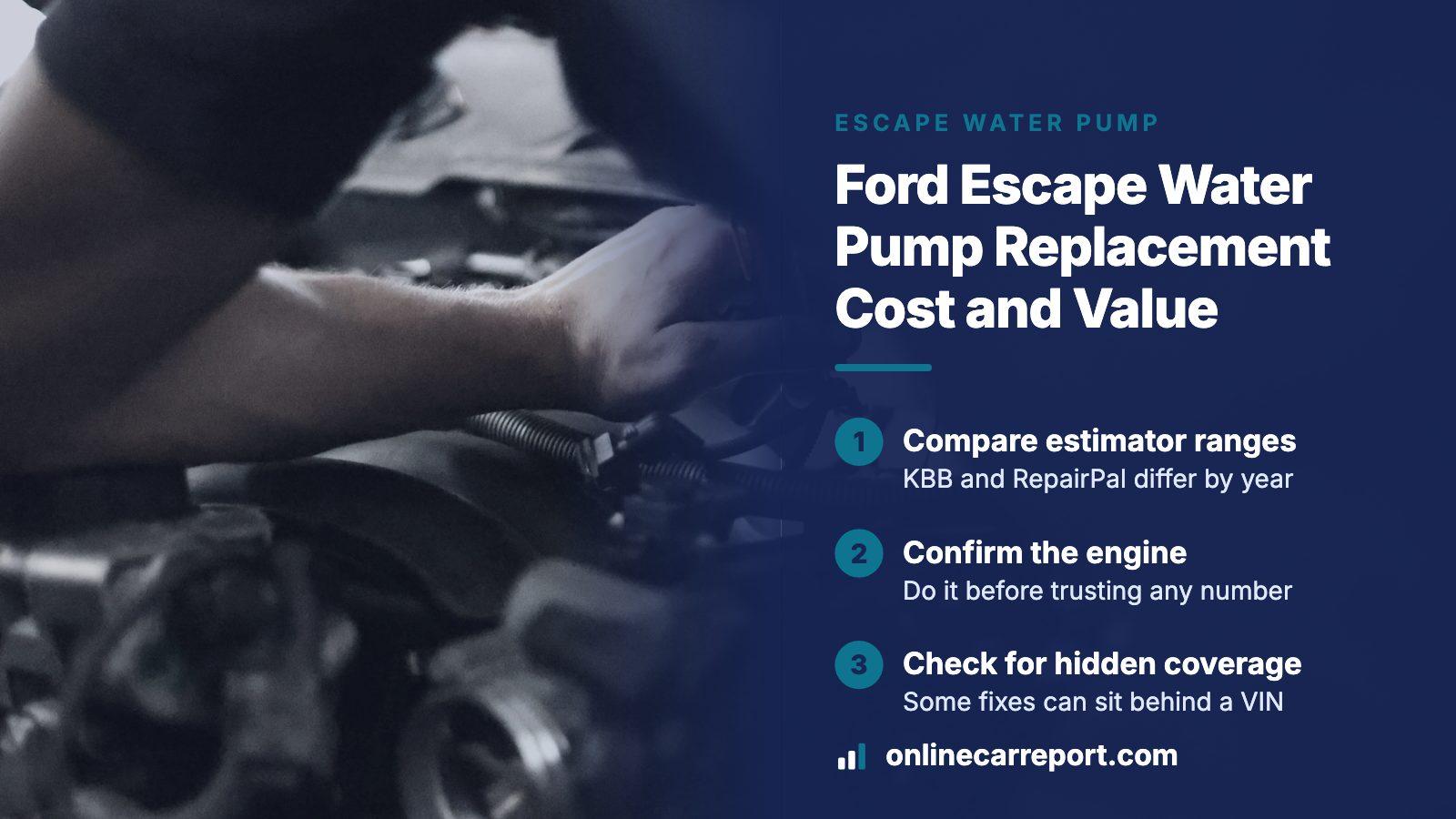
THE SHORT ANSWER
One estimator's page for a 2017 Escape gives $729 to $823 in a single ZIP code, and a second site gives $889 to $1,279 for a 2015 model. Both assume a belt-driven pump. If a 2017 to 2019 car with the 1.5L turbo keeps losing coolant without a visible leak, the bill can become a short block job rated near twenty hours.
- KBB, 2017 Escape
- $729 to $823 (ZIP 43085)
- RepairPal, 2015 Escape
- $889 to $1,279
- Ford labor, 1.5L short block
- 19.7 hours, front-drive
- Recall naming the pump
- None found, 2008 to 2022
Why a pump quote belongs in a value conversation
A used Escape is priced as if the cooling system works. If a seller admits the pump is weeping, or a shop finds it on a pre-purchase look, the repair bill comes off what the car is worth. If the repair is already done and documented, that same bill is a reason to hold your price.
The trouble is that coolant symptoms on this model do not always lead to a pump. So the first job is to learn what the car actually has, then decide how large a deduction is fair.
What the estimators publish, and where
Every dollar figure below belongs to the site that printed it, read in October 2026 through a research file. They are estimates for unbolting one pump and fitting another, not quotes from a shop near you.
| Estimator | Escape | Quoted range |
|---|---|---|
| KBB | 2017, Columbus-area ZIP | $729 to $823 |
| KBB | 2016, South Carolina ZIP | $770 to $870 |
| KBB | 2022, Florida Gulf coast | $650 to $1,087 |
| RepairPal | 2015 | $889 to $1,279 |
| RepairPal | 2017, Seattle shop | $1,713 to $2,287 |
Notice how much a local labor rate moves the Seattle line. KBB splits its 2017 figure into $291 to $329 for parts and $438 to $494 for labor.
Find the engine before you trust any estimate
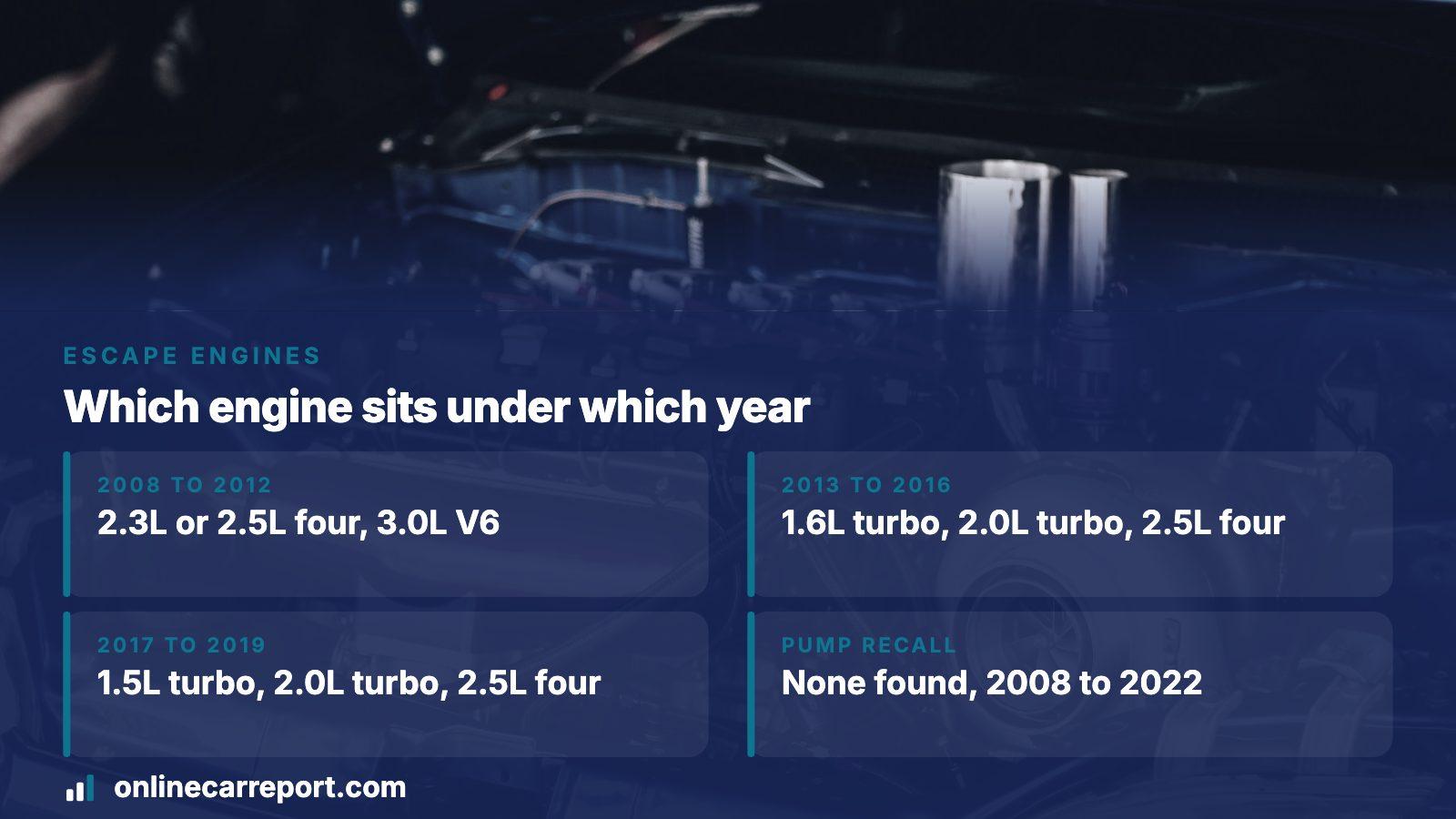
Fueleconomy.gov lists a different set of engines for different Escape years, and the 2017 to 2019 group is the one that causes trouble. Three engines share those model years: a 1.5L turbo four, a 2.0L turbo four and a 2.5L four.
- 2008 to 2012: 2.3L or 2.5L four, 3.0L V6, plus hybrids
- 2013 to 2016: 1.6L turbo, 2.0L turbo, 2.5L four
- 2017 to 2019: 1.5L turbo, 2.0L turbo, 2.5L four
- 2020 to 2022: 1.5L three-cylinder turbo, 2.0L turbo, 2.5L hybrid and plug-in
A VIN decode names the engine in seconds. Do it before anyone writes water pump on a work order, because an estimate built for the wrong engine is just a guess with a total at the bottom.
When the coolant is not leaving through the pump
Ford's bulletin 19-2375 covers 2017 to 2019 Escapes with the 1.5L that lose coolant, puff white exhaust and misfire. Ford blames coolant entering a cylinder. The shop's remedy: swap the short block and head gasket, at 19.7 labor hours front-drive and 21.2 all-wheel drive.
The dealer's test is simple enough to ask about. The warm system is pressurized to 20 psi and left for five hours, and a drop of more than 4 psi leads to a cylinder inspection. A leaking pump leaves a wet trail outside the engine; this failure usually leaves nothing to see.
Ford covered the 2.0L separately in bulletin 19-2346, calling for a long block at 13.6 hours on two-wheel drive and 15.3 on four-wheel drive. No customer program turned up for that engine in the research file.
What owners told NHTSA
Complaints are unverified, but they show what the pump-versus-engine confusion looks like when it lands on a driver. Two 2017 Escape filings from 2026 make the point.
From an NHTSA owner complaint
An owner of a 2017 Escape said the water pump had to be replaced after it leaked coolant into the engine, and that coolant had also reached the cylinders. At 131,000 miles and out of warranty, the car now needed an engine. The owner called it a defect Ford already knew about.
From an NHTSA owner complaint
Another 2017 Escape owner, with only 69,000 miles, had the pump replaced after the engine overheated and then recovered. Spark plugs and an injector followed. White smoke and a vanishing reservoir came next, and the car could not be driven.
The lesson for a buyer: a receipt that says pump replaced on a 1.5L car is not proof the coolant problem was solved.
Free fixes that can sit behind a VIN
No recall for 2008 through 2022 Escapes names the water pump. Ford handled the 1.5L through customer satisfaction programs 19B37 and 21N12 instead. Under 21N12 the short block repair cost the owner nothing within the first 7 years or 84,000 miles of warranty, and later owners inherited that coverage.
The extra grace period and the refund offer for owner-paid repairs ended November 30, 2022, so only some cars still qualify. Block heater recalls 26V011 and 25V685 are also worth clearing, since a leaking heater can look like a pump.
Ask the dealer, not the seller
Whether a given VIN still has program coverage is something only Ford can answer. Get that answer before you count a short block bill into your offer.
Turning the quote into an offer
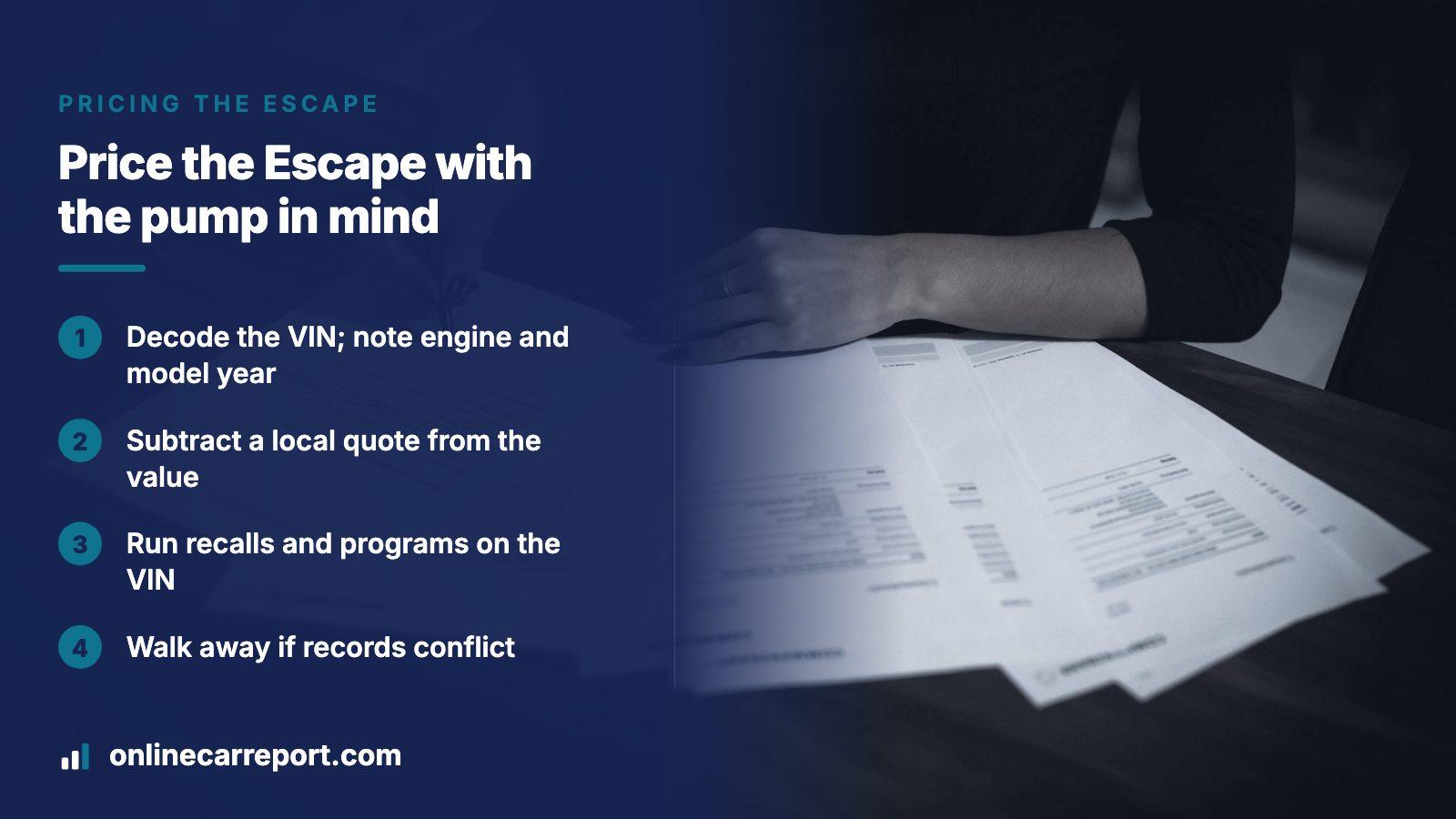
- Decode the VIN and write down the engine and model year.
- On a belt-driven pump, subtract a local shop quote from the market value and treat it as routine.
- On a 2017 to 2019 1.5L that uses coolant, confirm program history or ask for the pressure test result before you pay a seller's asking price.
- Run recalls on the VIN so free work is not priced as a repair.
- Walk away if records conflict with what the car does on a cold start.
Value is only as sound as the VIN record beneath it, which is the starting point for everything OnlineCarReport publishes.
Where a history report helps, and where it does not
A vehicle history report cannot say whether a shop replaced a pump or whether Ford ran a program on the car. It can show open recalls, odometer readings, title brands and accident records, which together tell you whether the engine's story and the car's story fit.
You get a free preview first. A full report is bought once, with no subscription behind it, and the pricing page lists the options. When a seller mentions coolant trouble, add an independent inspection.
Where this information comes from
- NHTSA owner complaint 11754249 — owner experience, paraphrased
- NHTSA owner complaint 11727618 — owner experience, paraphrased
- Ford TSB 19-2375 (NHTSA-hosted) — The 1.5L repair, test and labor hours.
- Ford TSB 19-2346 (NHTSA-hosted) — The 2.0L remedy and its labor hours.
- Ford program 21N12 (NHTSA-hosted) — Coverage terms and the 2022 end dates.
- fueleconomy.gov: find a car — Engines certified for each Escape year.
- Kelley Blue Book: 2017 Escape water pump — The $729 to $823 range for ZIP 43085.
Sources and photos: Facts checked against the sources above in November 2026. Photos by Mustafa Sheikhmouss, Dimitri Karastelev and Willian Cittadin on Unsplash; diagrams by OnlineCarReport.
Keep reading
- Ford Escape timing chain replacement cost and what it does to valueAnother engine repair buyers often price in the same visit.
- Ford Escape transmission replacement cost, and what it does to the car's valueThe other large Escape repair worth pricing before you buy.
- Car value by VIN: what the number tells you and how history moves itHow a VIN and its history become the figure you subtract from.
- Diminished value calculatorHow past damage lowers what a car is worth.
Frequently asked questions
How much does a Ford Escape water pump replacement cost?
It depends on year and ZIP. KBB shows $729 to $823 for a 2017 in one Ohio ZIP; RepairPal prints $889 to $1,279 for a 2015. Seattle labor lifts one 2017 range to $1,713 to $2,287. Get a written local quote that separates parts from labor.
Why is my 2017 Escape losing coolant when nothing is leaking?
On the 1.5L turbo, Ford's own bulletins describe coolant entering a cylinder, with low coolant, white smoke and misfires. A pump would normally leave a trail outside the engine. Have a dealer run the pressure test and check your VIN for Ford program coverage before paying for a pump.
Has Ford recalled the Escape water pump?
Not in the federal records read for 2008 through 2022. Several recalls cover coolant on the 1.6L, and two block heater campaigns can mimic a leaking pump. Run the recall lookup on the exact VIN, because open campaigns differ from car to car.
Does a new water pump lower or raise an Escape's value?
It rarely raises value, but a documented repair removes a deduction a buyer would otherwise take. On a 1.5L car, a pump receipt does not prove the coolant problem is gone, so buyers should still ask about program work and cold-start behavior.
Can a VIN history report tell me if the pump was replaced?
No. Maintenance work at an independent shop usually never reaches a history database. A report does show open recalls, odometer readings, title brands and accident records, which help you judge whether the car's story holds together. Use service receipts for the pump itself.
Now check the car itself
The guide explains what to look for. The report shows what this VIN has on record.