THE SHORT ANSWER
Budget $4,500 to $17,000 installed, with a used engine at the bottom of that range and a new crate engine at the top. Labor alone runs 12 to 24 hours, depending on the engine. Some 2021–2022 trucks with the 2.7L may have the engine paid for by Ford. Whichever route you take, a documented replacement protects more of the truck's value than an undocumented one.
- Seller's installed range
- $4,500 to $17,000, used up to new
- Ford labor allowance
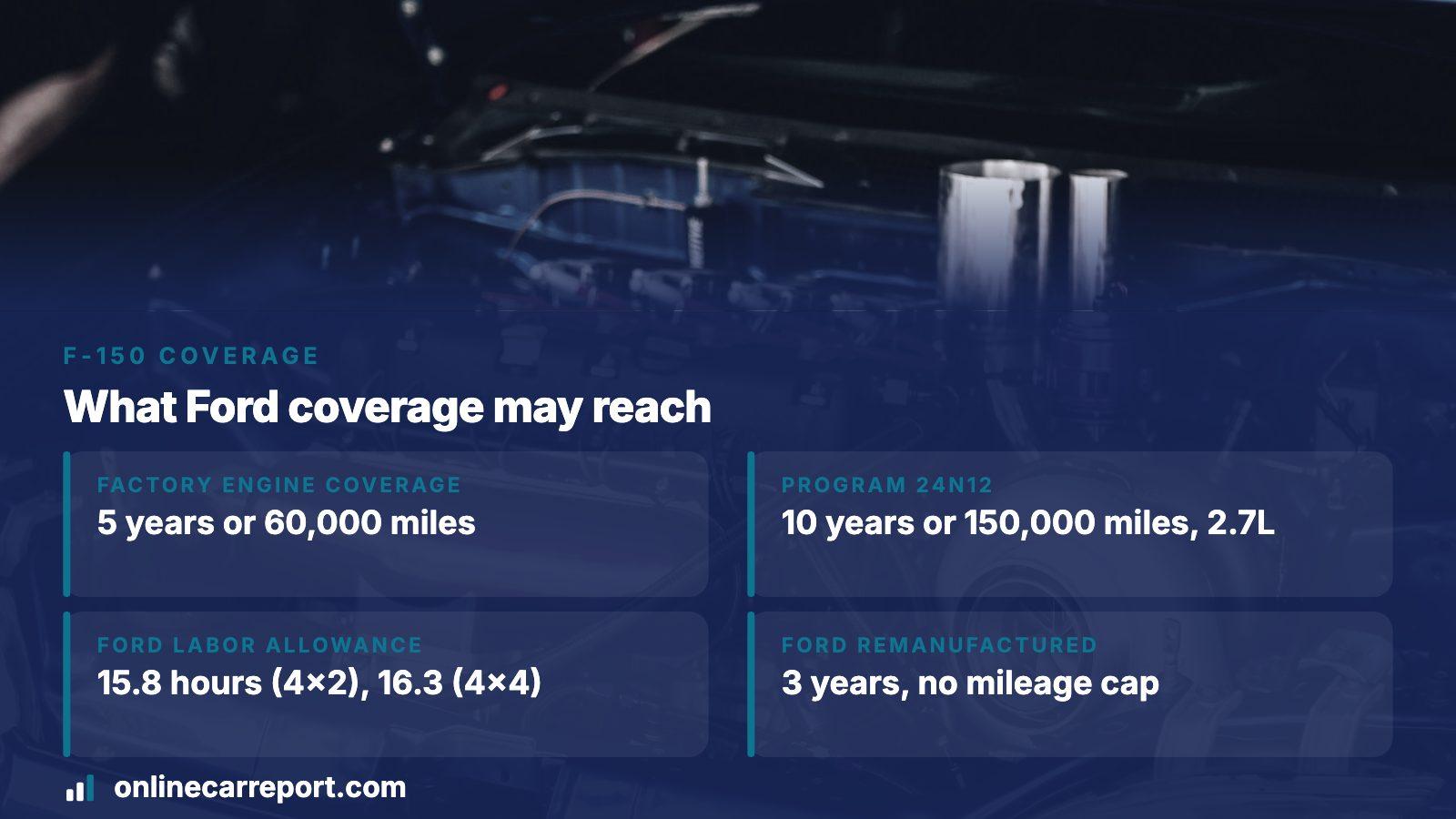
- 15.8 hours (4x2) or 16.3 hours (4x4), 2021–2022 2.7L
- Factory engine coverage
- 5 years or 60,000 miles
- Program 24N12
- Certain 2.7L trucks: 10 years or 150,000 miles
How an engine bill turns into a value problem
A used F-150 is priced from a clean comparable, minus the work it still needs, and a report's market value gives that starting figure. A failing engine, or an estimate nobody can document, comes off the price near face value. A replaced engine with paperwork can hold its value; the table sorts the cases.
| Situation | Effect on the price | What to verify |
|---|---|---|
| Engine failing, no diagnosis | Subtract the full replacement quote | Written diagnosis, VIN recall result |
| Replaced, receipt in hand | Can hold value or add to it | Installer, part, date, warranty left |
| Replaced, nothing in writing | Buyers discount for the unknown | Odometer readings, damage records, title brands |
From an NHTSA owner complaint
Owners who bought a used 2020 F-150 reported that it kept burning oil until it stalled and needed a tow. At about 118,000 miles it was past Ford's limit for customer assistance, and an engine replacement was quoted at $15,000, the figure they put on the truck's value. Ford suggested paying and keeping the receipt in case of a recall, so they sold the truck for parts at a loss.
The lesson for a buyer: put a market value on the truck before you approve a quote that size, because the two numbers can meet.
The price bands, and who published them
The widest figures come from a seller of used engines, Premium Used Auto Parts, so its numbers lean toward its own trade. It ranks the 3.5L EcoBoost highest in every tier and the 5.4L Triton lowest.
| Engine type | Installed, per the seller |
|---|---|
| Crate engine, brand new | $10,000 to $17,000 |
| Remanufactured | $8,000 to $14,000 |
| Used | $4,500 to $9,500 |
Forum owners bracket the same band: one 3.5L EcoBoost quote of about $10,000 with 27 labor hours, and about 25 used 3.5L engines nearby from $2,300 to $6,000. Treat both as anecdotes.
From an NHTSA owner complaint
A 2020 F-150 owner with the 5.0L V8 told NHTSA the truck lost power and stalled after burning through a large amount of oil, with no oil-pressure light or chime beforehand. The dealer's estimate for a full long block replacement was $19,824.56, or $21,491.04 all in.
That is well above the seller's $17,000 top. One dealer estimate can clear a survey's ceiling, so collect a second written quote.
Ford's labor hours as a yardstick for any quote
Ford publishes the time it reimburses dealers. Under Customer Satisfaction Program 24N12, it allows up to 15.8 hours on two-wheel-drive trucks and 16.3 hours on four-wheel-drive ones when a 2021–2022 F-150 needs its long block swapped. At $110 to $180 an hour, the range the seller quotes for independent shops, that is about $1,738 to $2,934 of labor, with fluids and one-time-use hardware extra.
That covers the 2.7L only. A twin-turbo 3.5L has more plumbing to disconnect. The seller's labor guide puts V6 and V8 jobs at 12 to 18 hours and EcoBoost jobs at 16 to 24. Use Ford's hours to frame questions, not as a quote: a labor line far above them needs a list of what else is being replaced.
The 2021–2022 trucks where Ford may owe the engine
Recall 24V635, which Ford numbers 24S55, covers 2021–2022 F-150s with the 2.7L EcoBoost whose intake valves may break and wreck the engine. A dealer tests the engine and replaces it if it fails, at no charge. Ford's dealer letter limits it to certain 2021 build dates.
Passing the test is not the end of it. Under program 24N12, a truck that passed and later shows a cracked intake valve gets one long block replaced at no cost. The cover lasts 10 years or 150,000 miles, counted from when the warranty began, and follows the truck to later owners.
Run the VIN before paying for a 2021–2022 2.7L engine
If the recall is open, the inspection and any needed engine cost you nothing at a Ford dealer. If it is closed, ask a dealer to check program 24N12. NHTSA's lookup is free, and a full report lists open recalls beside the rest of the truck's history.
Warranty windows that decide who pays
Ford's factory powertrain coverage ends at 5 years or 60,000 miles, whichever hits first. It names the cylinder block and heads, the oil pump, the turbocharger and the internal lubricated parts. A failed engine inside that window goes to the dealer under Ford's terms on cause and upkeep, so keep the oil-change receipts.
A replacement engine brings its own cover. Motorcraft's summary gives new and remanufactured gasoline engines 3 years with no mileage cap, labor included. The catch sits with the installer: Ford repays labor on that claim at up to $75 an hour, for the lesser of standard or actual hours. A shop billing $150 an hour eats or passes on the gap, so ask who pays if the engine fails twice.
Buying a truck that has already had its engine replaced
Replaced engines vary. One installed by a shop that names the part, the date and the warranty can leave an older truck in better shape than its odometer suggests; one with no receipt is a blank. Ask for the paperwork, then use the VIN history to test the story around it.
- Factory specs show the engine the truck left the plant with, so you can catch an unmentioned swap.
- Odometer readings that jump or drop near the swap deserve a direct question.
- Accident and damage records, plus salvage and auction photos, show whether a collision, flood or fire explains the new engine.
- Title brands and insurance records reveal a total-loss history, which moves the price in its own right.
Used, remanufactured, rebuilt or new: what each leaves behind
- Used: lowest parts price, unknown history, and a seller warranty that typically runs six months to a year. Mileage on the tag is the donor truck's.
- Rebuilt on your own block: cheapest when damage is limited, but shop hours climb quickly on an EcoBoost.
- Ford remanufactured: 3 years with no mileage cap and labor included, per Motorcraft.
- New Ford assembly: a factory part, priced highest of the four.
Keep the invoice and warranty paperwork with the truck, and ask whether the quote itemizes the timing set, turbos and water pump.
Before you authorize the replacement, or sign for the truck
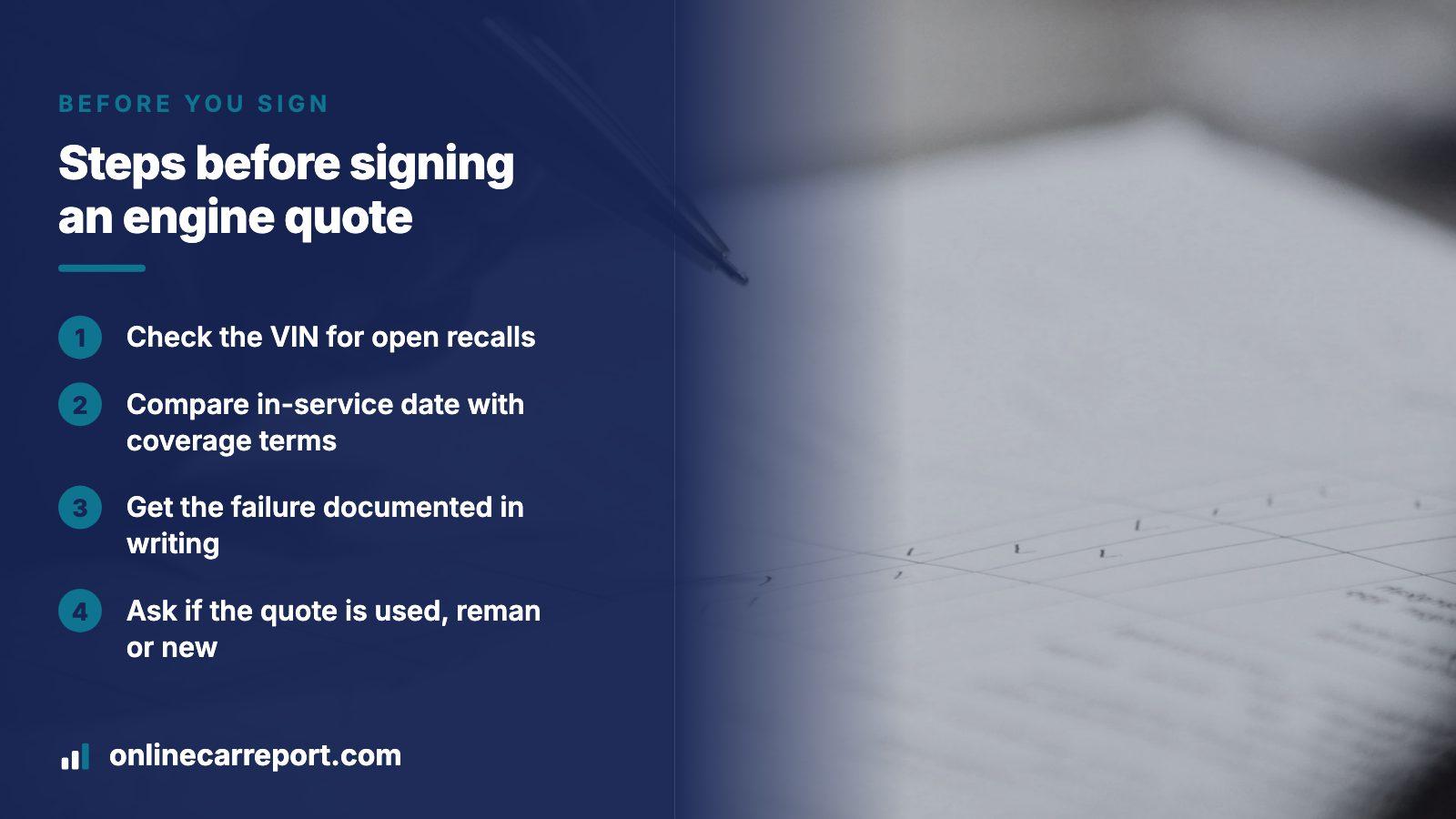
- Check the VIN for open recalls. A 2021–2022 2.7L may qualify under 24S55 or 24N12.
- Compare the in-service date and mileage with the 5-year, 60,000-mile powertrain terms.
- Get the failure documented in writing, with the compression or leak-down readings and borescope photos.
- Ask whether the quote is used, remanufactured or new, and what warranty comes with it.
- Hold the labor hours against Ford's 15.8 to 16.3 and ask what fills any gap.
- Pull the VIN history before agreeing a price on any truck with a replaced engine.
OnlineCarReport runs the VIN history behind that last step. The preview costs nothing to run, a full report is one payment rather than a subscription, and the pricing page lists the options.
Where this information comes from
- NHTSA copy: Ford Customer Satisfaction Program 24N12 — Backs the 15.8 and 16.3 hour long block allowances and the 10-year, 150,000-mile terms.
- NHTSA: recalls by VIN — Where any VIN can be checked for open recalls, including 24V635 and the 2018 campaign 17V672.
- Ford: Powertrain Warranty coverage — The 5-year, 60,000-mile term and the engine parts it lists.
- Motorcraft: Service Parts Warranty Summary, June 2023 — Replacement engine coverage and the installer labor cap.
- Premium Used Auto Parts: F-150 engine replacement cost — A used-engine seller's installed ranges, book times and shop rates, retrieved October 2026.
- NHTSA owner complaint 11762811 — owner experience, paraphrased
- NHTSA owner complaint 11761799 — owner experience, paraphrased
Sources and photos: Facts checked against the sources above in November 2026. Photos by Zoshua Colah, Masjid MABA and Willian Cittadin on Unsplash; diagrams by OnlineCarReport.
Keep reading
- Ford F-150 timing chain replacement cost and what it does to the priceThe shorter repair that often comes before a condemned engine.
- Ford F-150 transmission replacement cost and what it does to valueThe other large F-150 repair bill to price before you buy.
- Car value by VIN: what the number tells you and how history moves itHow a VIN gives a truck its starting value before repairs are subtracted.
- Sample reportSee each section of a VIN history report before you buy one.
Frequently asked questions
What does an F-150 engine swap cost installed?
One used-engine seller's survey gives the widest range, $4,500 to $17,000, from used engines up to new crate engines; the 3.5L EcoBoost costs most in every tier. One dealer estimate in an owner complaint ran higher still. Ask any shop for a written quote naming the engine type, labor hours and warranty.
Does a replaced engine lower an F-150's resale value?
It can go either way. A replacement backed by an invoice, a named part and warranty paperwork reads as maintenance; one with nothing in writing is a risk buyers price in. Odometer readings, damage records, title brands and auction photos around the swap say more than the engine alone.
Is a rebuild cheaper than a replacement engine?
On parts alone, a used engine usually costs least. Rebuilding your own block can win when damage is limited, but machine-shop time and reassembly stack on top of removal labor. Ford's remanufactured option costs more at purchase, though it carries 3 years with no mileage cap, labor included.
Will Ford's warranty cover a failed F-150 engine?
Within 5 years or 60,000 miles, a failed engine goes to the dealer under the powertrain warranty. Beyond that, an open recall such as 24V635 can still pay, and program 24N12 covers one long block for certain 2021–2022 2.7L trucks that passed the recall inspection.
Did Ford recall the 2018 F-150 engine?
Only a small group: 17V672, filed in October 2017, names 22 trucks, all 2018 models with the 3.5L engine. Cylinder heads on those trucks may lack the oil holes feeding the camshaft bearings, and the fix is a new engine. The block heater recalls, 18V894 and 19V278, replace no engine.
Now check the car itself
The guide explains what to look for. The report shows what this VIN has on record.