THE SHORT ANSWER
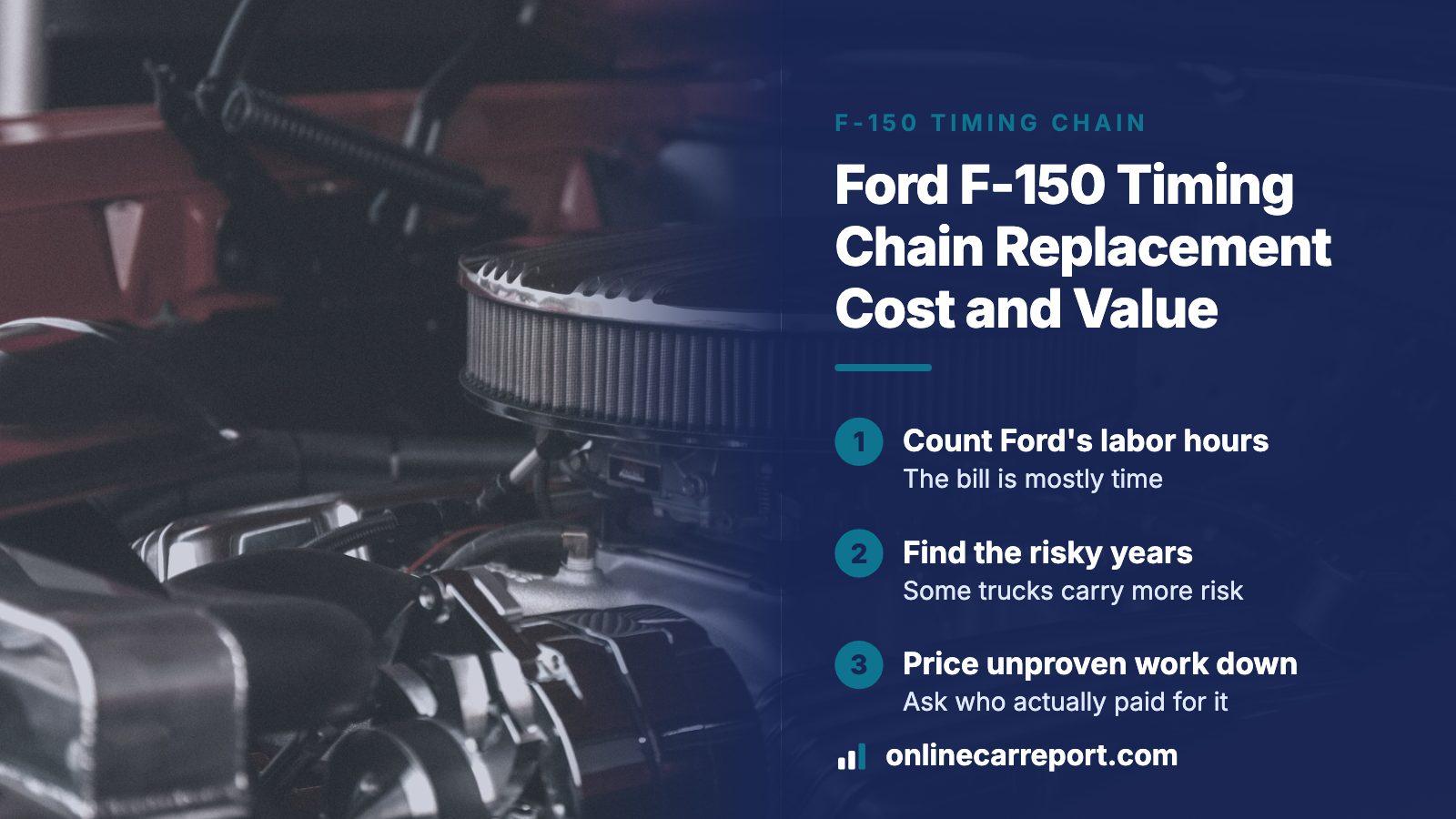
Expect roughly $2,282 to $3,280, mostly labor. Every gasoline F-150 from 2008 through 2022 uses a chain, never a belt. The 3.5L EcoBoost trucks from 2011 to 2014 and 2017 to 2020 are the ones Ford's bulletins name. If the work is unproven, deduct the estimate from the truck's value.
- Published estimate
- $2,282 to $3,280 (RepairPal, F-150)
- Ford labor time
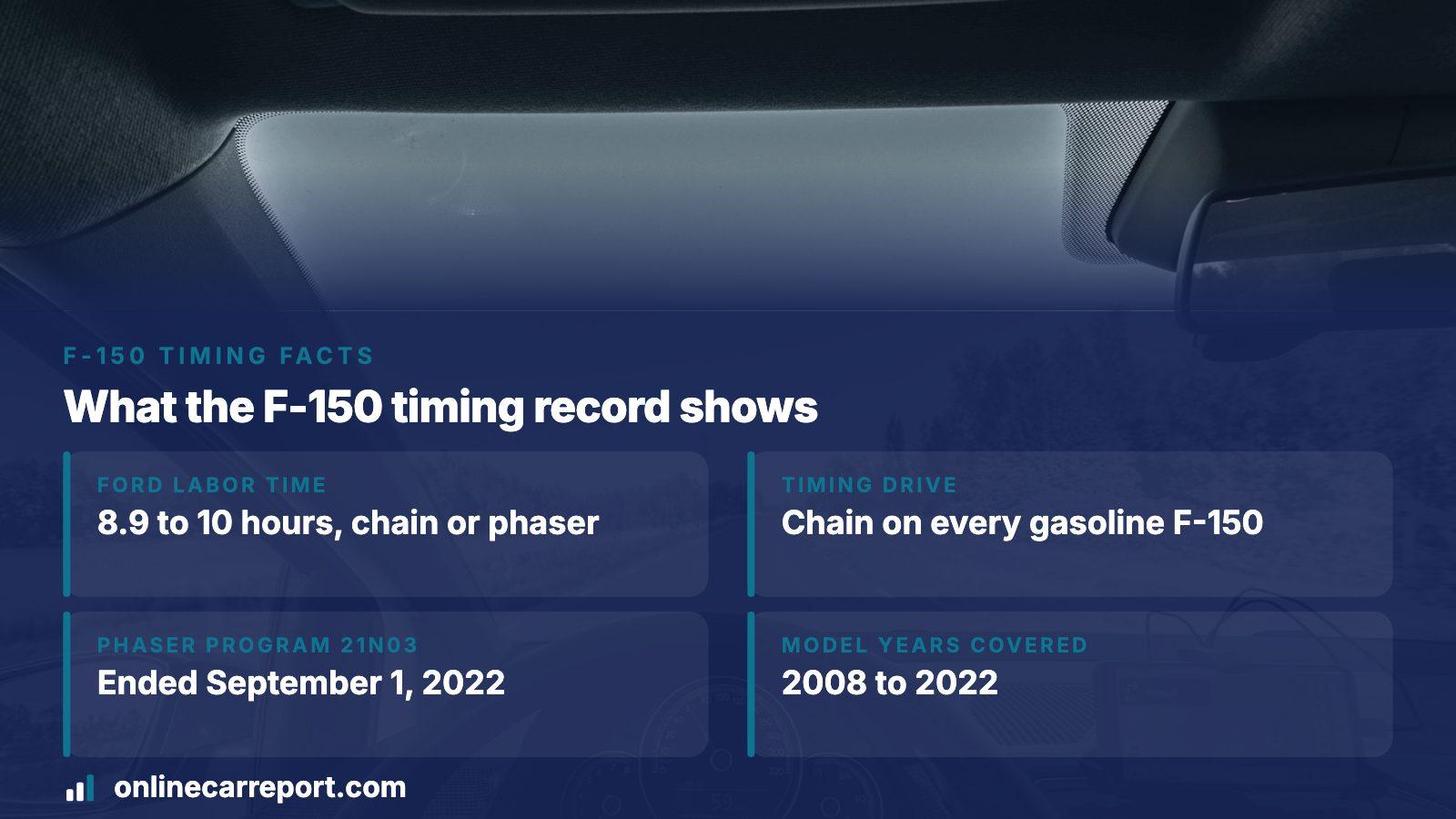
- 8.9 to 10 hours for chain or phaser jobs
- Timing drive
- Chain on every gasoline F-150, 2008–2022
- Phaser program
- 21N03 ended September 1, 2022
Read the repair bill as a deduction from the truck's price
Start with what a clean, comparable F-150 sells for, then subtract what this one still needs. A timing job belongs in that subtraction when Ford has written bulletins on the engine and nothing proves the work was done.
The best-documented price comes from RepairPal. Its figures were pulled in October 2026 from a page last updated October 16, 2025, so confirm them live before citing them to a seller. The page calls the job a timing belt, a mislabel here, so read it as a timing-drive figure.
| Line item | RepairPal figure |
|---|---|
| Whole job | $2,282 to $3,280 |
| Labor | $2,135 to $3,133 |
| Parts | About $147 |
| Tensioner replacement (listed on its 2020 front cover gasket page) | $2,074 to $2,821 |
Why the bill is mostly hours, and what Ford books
Reaching a timing chain or cam phaser means pulling the front of the engine apart, so a shop sells hours, not parts. Ford publishes the hours it pays a dealer for each documented repair under warranty. Independent shops price from their own labor guides, so read these as a yardstick.
| Job | Trucks | Ford hours | Document |
|---|---|---|---|
| Primary chain, diagnosis and replacement | 2011–2014 with the 3.5L EcoBoost | 8.9 | TSB 17-0026 |
| Four VCT units plus a PCM reprogram | 2017–2018 with the 3.5L EcoBoost | 10.0, or 10.1 on a Raptor | TSB 20-2191 |
| Four cam phasers | 2017–2020 with the 3.5L EcoBoost | 9.5 | Program 21N03 |
| Both VCT solenoids | 2007–2010 with the 5.4L three-valve | 3.6 | TSB 12-7-10 |
Multiply your truck's hours by the shop's posted rate and add a modest parts line. A quote far above that is padded or pricing another job. The 5.4L row is the cheap outlier, and Ford's bulletin includes a scan-tool test for whether a solenoid swap alone will do.
Which F-150s carry the risk
Every gasoline engine in the 2008 through 2022 F-150 uses chains, from the 3.3L V6 to the 6.2L V8. The one open question is the 3.0L Power Stroke diesel sold from 2018 through 2021, which secondary reports call belt-driven. No Ford document confirmed that, so have a dealer check that engine by VIN.
The federal complaint record shows where trouble bunches. NHTSA owner complaints on 2008–2022 F-150s number 19,248, and 3,530 are filed under ENGINE. The 2011–2014 and 2017–2020 model years hold 47% and 30% of those engine reports, 77% together.
Complaints are not failures
Unverified owner reports, and ENGINE covers every engine sold that year, 5.0L and 3.7L trucks included. The pattern says where to look, not what failed.
What the history shows, and how to price unproven work
A VIN history cannot hear a rattle, but it narrows what to ask in four ways.
- Engine and model year: the factory specs show which bulletin applies.
- Odometer readings: a rolled-back truck has put more miles on its chain than the seller admits.
- Ownership and use type: owner count and kind of use hint at who might hold service paperwork.
- Title brands, accident records and auction photos: each cuts the price alone, so a branded truck with unproven timing work stacks deductions.
From an NHTSA owner complaint
An owner of a 2018 truck with the 3.5L said a dealer replaced the cam phasers about four years earlier and called the parts a new design. After a P0018 code, the owner says the part pulled out was the old design. The truck had just left warranty, and Ford offered no help with a bill of 3 to 5 thousand dollars.
A past phaser job proves little unless the invoice names the parts, so ask for the paperwork before crediting the repair.
Price two cases. With an invoice or bulletin number for the work, pay the going rate for a truck that has had it. Without proof, subtract the first section's estimate.
The phaser program that ended in 2022
Ford's Customer Satisfaction Program 21N03 paid part of a cam phaser job on 2017–2020 trucks with a build date of November 30, 2019 or earlier. A truck qualified only if it had received the 21B10 PCM reflash by August 31, 2021, and Raptor and Limited models were left out. Coverage stopped on September 1, 2022.
From an NHTSA owner complaint
A 2018 Limited-trim F-150 with the 3.5L EcoBoost developed a cold-start rattle up front near 60,000 miles, its owner reported. At 104,661 miles a dealer diagnosed failed cam phasers and quoted $5,414.11. Ford declined to help, the owner says, because 21N03 excluded the Limited, and the dealer mentioned other denied claims.
That quote sits well above RepairPal's top figure, so price a truck outside the program on the dealer's number.
Ask for the date, not the claim
A seller who says Ford still covers the phasers is relying on old information. Since September 1, 2022 the owner pays unless a dealer grants goodwill, so give the claim no weight.
Recall, program, bulletin, goodwill: who actually pays
NHTSA recall data for 2008–2022 F-150s lists no campaign naming the chain, tensioner or phasers. Two engine recalls look related but are not: 17V672 covers certain 2018 trucks with the 3.5L and missing camshaft-bearing oil holes, and 24V635 covers 2021–2022 trucks with the 2.7L and 3.0L EcoBoost, where intake valves can fail.
| Type | Who pays | The catch |
|---|---|---|
| Safety recall | Ford, through any dealer | The remedy carries no expiry |
| Customer satisfaction program | Ford, within stated dates and mileage | 21N03 closed in 2022 |
| Technical service bulletin | Nobody by itself | Gives steps and labor time only |
| Goodwill | Ford and the dealer, case by case | Usually near warranty's end |
Check the VIN in NHTSA's lookup for anything still open.
Signs to catch early, and questions for the quote
- 2011–2014 EcoBoost: P0016 stored with the check-engine light on, at times with poor drivability
- 2017–2018 EcoBoost: a tick or rattle up front for a few seconds after the truck has sat six hours or longer
- 2017–2020 EcoBoost: a rattle on the first start after sitting, or knocking while idling warm
- 2007–2010 5.4L: a rattle or rough idle that comes and goes once hot, plus P0021, P0022, P0340 or P0341
- Check the engine and build date against the VIN, because TSB 17-0026 stops at October 10, 2014 and TSB 20-2191 at July 10, 2018.
- Scan for codes and keep the printout, since P0016 is the entry condition for the 2011–2014 bulletin.
- Ask which Ford document the shop is working from, and compare its parts list with the quote.
- For a 2017–2020 truck, find out if the quote covers phasers alone or adds chains and guides.

Run the VIN before you set a number
OnlineCarReport shows a free preview from the VIN. One payment buys the full report, or 3, 5 or 10 of them together, and no subscription starts; the pricing page lists what each option costs. For an F-150, the report sets odometer readings and title brands beside accident and auction history with photos, open recalls, owner count and use type, factory specs and a market value.
It will not show a repair invoice, so the timing question still goes to the seller. Use the market value as your reference, subtract the estimate if the work is unproven, and finish with a cold start and a code scan.
Where this information comes from
- NHTSA: Ford TSB 17-0026 — Ford's bulletin on a worn primary timing chain in 2011–2014 3.5L trucks, with the code, the build cutoff and the 8.9 labor hours.
- NHTSA: Ford TSB 20-2191 — The cold-start rattle bulletin for 2017–2018 trucks, with its four-unit repair and 10.0 labor hours.
- NHTSA: Ford Customer Satisfaction Program 21N03 — The prorated cam phaser coverage, its end date and its 9.5-hour labor allowance.
- NHTSA: Recalls by VIN — The official lookup for open campaigns on a specific truck.
- RepairPal: Ford F-150 timing estimate — The source of the published cost range and the labor and parts split, on a page that labels the job a belt.
- NHTSA owner complaint 11766591 — owner experience, paraphrased
- NHTSA owner complaint 11769152 — owner experience, paraphrased
Sources and photos: Facts checked against the sources above in November 2026. Photos by Victor Hughes, Carrie Allen www.carrieallen.com and Sander Jeurissen on Unsplash; diagrams by OnlineCarReport.
Keep reading
- Car value by VIN: what the number tells you and how history moves itHow a VIN, mileage and recorded history combine into a value before you subtract repairs.
- Ford F-150 engine replacement cost and what it does to resale valueThe larger bill, if the engine itself is the problem.
- Ford F-150 transmission replacement cost and what it does to valueThe other big F-150 powertrain repair to price in before an offer.
- Sample reportA sample of the records a VIN report lays out, before you pay for one.
Frequently asked questions
How much does a Ford F-150 timing chain replacement cost?
RepairPal's published range for the F-150 is $2,282 to $3,280. Labor makes up $2,135 to $3,133 of it and parts about $147. Ford books 8.9 hours for the 2011–2014 chain job and 9.5 to 10 for phaser repairs; multiply your truck's hours by the shop's posted rate to test a quote.
Does a timing chain problem lower an F-150's value?
Unproven chain or phaser work on a 3.5L truck from the flagged years lowers what a careful buyer should pay, by about the repair estimate. An invoice for the work removes most of that deduction. Title brands and accident records cut the price separately.
Is there a timing belt on a Ford F-150?
Not on a gasoline truck. Every 2008–2022 gas engine uses a chain, so a quote that says belt is mislabeling a chain, tensioner or phaser job. The 3.0L Power Stroke diesel from 2018 through 2021 is reported to use a belt, but that is unconfirmed, so check by VIN.
Is Ford still paying for F-150 cam phaser repairs?
No. Program 21N03 ended September 1, 2022, and a truck needed the 21B10 reflash by August 31, 2021 to qualify. Ford paid in full through 69,999 miles, then 66% in the next band and 33% in the one after, with nothing past 89,999. A phaser job today is on the owner.
Can a VIN check show whether an F-150's timing chain was replaced?
No. A VIN report covers title, accident, odometer and auction records, not repair invoices. It can confirm the engine and model year and flag a branded title. Proof of timing work has to come from the seller or the shop.
Now check the car itself
The guide explains what to look for. The report shows what this VIN has on record.