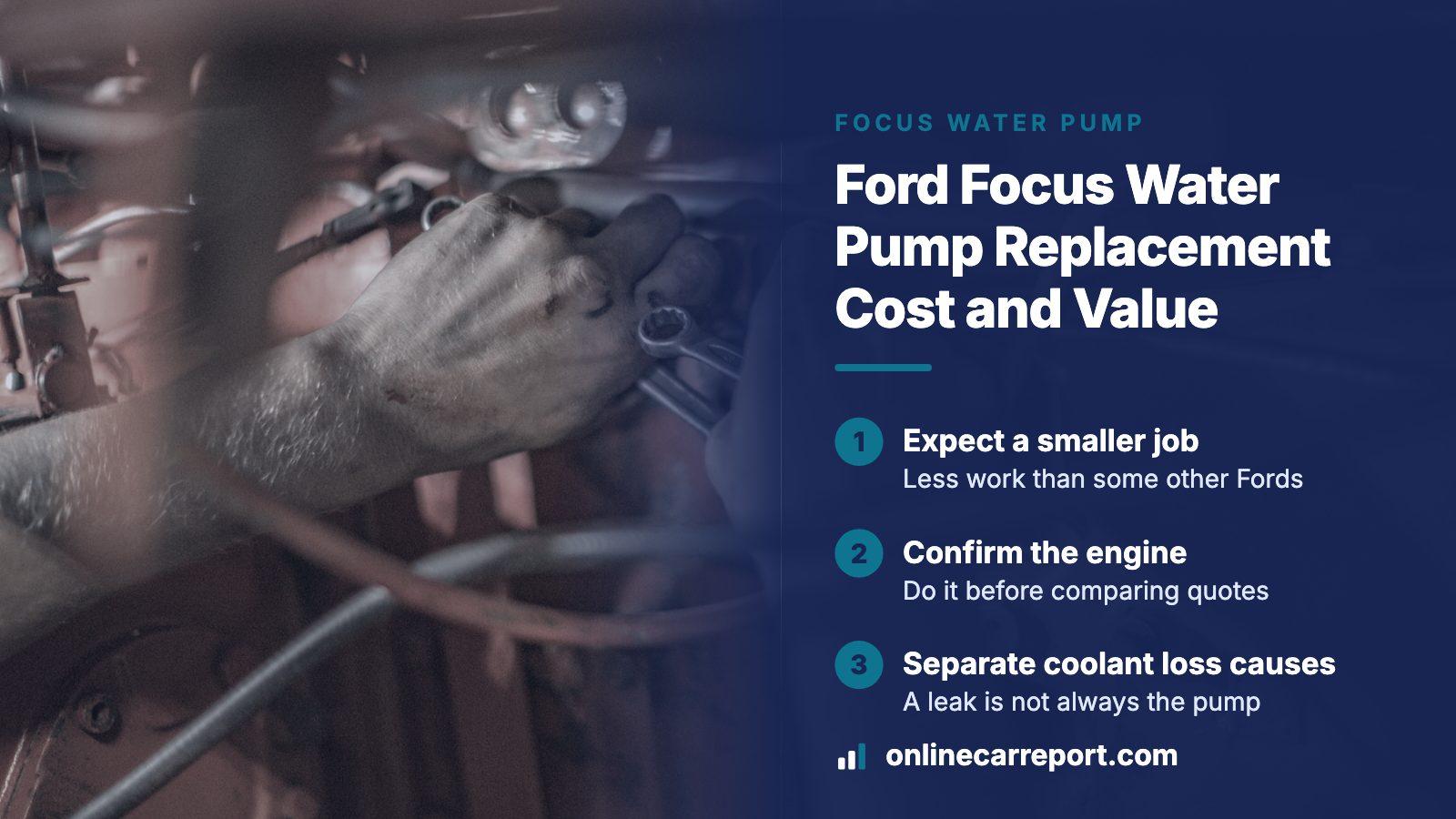
THE SHORT ANSWER
Published estimates for a Focus water pump run from about $490 to $960. Kelley Blue Book lists $719 to $811 for a 2014 model, $288 to $324 of it parts. NHTSA has no recall for the pump. Treat the repair as a modest haggling point, and worry more about coolant that disappears with no leak in sight.
- KBB, 2014 Focus
- $719 to $811, ZIP 43085
- KBB, 2016 Focus
- $633 to $958, near Norfolk, VA
- RepairPal, 2011 Focus
- $493 to $606
- NHTSA recalls naming the pump
- None, 2008 to 2018
What the published estimates say, and who published them
OnlineCarReport sells no repairs, so each figure below belongs to the site that posted it, as read in October 2026. Labor rates differ by shop and ZIP code. Use the ranges to judge a quote, not to predict one.
| Source and car | Range | Notes |
|---|---|---|
| KBB, 2014 Focus | $719 to $811 | ZIP 43085; parts $288 to $324, labor $431 to $487 |
| KBB, 2016 Focus | $633 to $958 | Served for a ZIP near Norfolk, Virginia |
| KBB, 2014 Focus ST | $630 to $864 | ZIP 84058 in Orem, Utah |
| RepairPal, 2011 Focus | $493 to $606 | From its cost table for that year |
Whether the car is an early naturally aspirated four, a later direct-injection one or the turbo ST, the quotes land within a few hundred dollars. That tight spread says something about how the car is built.
Why a Focus pump is a smaller job than some Fords
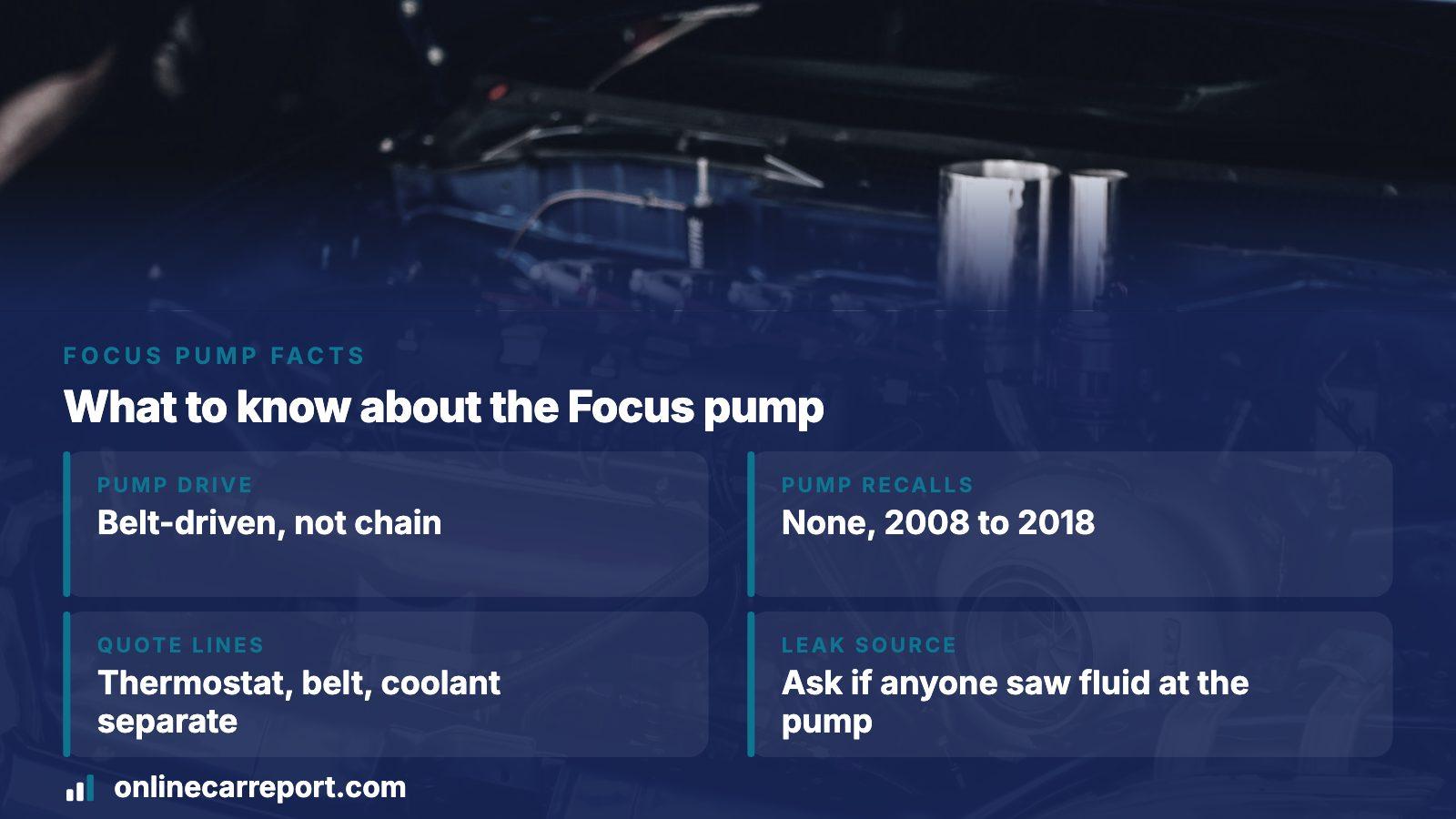
Ford's parts catalog lists a separate pump pulley for each gasoline Focus engine from 2008 through 2018. Because the pump has its own pulley, an accessory belt running along the front of the engine turns it, and the timing chain behind its sealed cover plays no part.
A published repair guide has the mechanic unbolting an engine mount and lifting the engine slightly for room, so it is no driveway five-minute fix. Still, the engine stays in one piece. A dealer parts site lists the 2.0L direct-injection pump assembly at $55.90, which is why most of the bill is shop time. Compare that with our Ford Explorer pump page, where the 3.5L V6 hides its pump inside the engine.
Check which engine the car has before comparing quotes
Federal fuel economy records list the engines Ford certified for each model year. The engine decides which pump and pulley fit.
| Model years | Engines on the EPA list |
|---|---|
| 2008 to 2011 | One 2.0L four |
| 2012 | Direct-injection 2.0L, plus the Electric |
| 2013 to 2014 | Direct-injection 2.0L, turbo ST, Electric |
| 2015 | Adds the 1.0L turbo three-cylinder |
| 2016 to 2018 | Adds the 2.3L turbo RS, with all-wheel drive |
EPA first lists the 1.0L for 2015, so a seller calling a 2014 Focus a three-cylinder EcoBoost has probably misread the car. The 1.0L also carries a second, auxiliary pump, so a diagnosis should say which one failed. A VIN's factory specs settle the engine in seconds.
What owners told NHTSA about Focus pump repairs
Owner complaints are unverified, but they show how a pump bill can drift. Two cases stand out because the repair did not end the trouble.
From an NHTSA owner complaint
A 2012 Focus owner wrote that the car kept overheating and the reservoir needed topping up as often as four times a week. The pump and thermostat were already replaced and no one found a leak. In late 2020, steam poured from under the hood in New York City while the family was aboard.
The lesson is to ask what else the shop checked. A fresh pump on a car that still loses coolant has not fixed the car.
From an NHTSA owner complaint
A 2016 Focus owner said the pump failed on a highway in 2019 and Ford covered it only because the owner had bought a supplemental repair package at signing. The thermostat went next, and damaged hoses were refused for over $1300. A second pump failure left the owner paying out of pocket.
Ask a seller whether any repair package transfers to you. If it does not, a used Focus owner carries pump costs alone.
Coolant loss that is not the pump
A belt-driven pump tends to weep at its seal, which leaves a damp patch or dried residue around the pulley. If the reservoir drains while the engine and the pavement stay dry, suspect something else.
Ford sent dealers Special Service Message 47587 for 2015 to 2018 Focus cars whose 1.0L uses up coolant; NHTSA hosts the 2018 filing. It sends technicians to a pressure test, then to the exhaust manifold for cracks. A second message, 47462, covers the 2.0L EcoBoost in the ST with a similar test and a head gasket inspection. Either repair dwarfs a pump.
- Find out if anyone saw fluid at the pump, or if the shop is guessing from the reservoir.
- On a turbo engine with nothing leaking outside, have the cooling system pressure-tested and the coolant sniffed for exhaust gas.
- Expect the thermostat, belt and coolant as separate lines on the quote.
Recalls that touch coolant, and one that does not
NHTSA's recall database holds no campaign naming the Focus pump for 2008 through 2018. Two 2026 campaigns concern a cracked engine block heater that can leak coolant: 26V011 for 2013 to 2018 cars with the 2.0L, and 26V012 for certain 2016 to 2018 cars. Dealers repair them at no charge, and a heater leak can pass for a pump leak.
Campaign 23V905 involves the belt or tensioner that drives the oil pump on 2016 to 2018 Focus cars. It is not a cooling recall, but a shop already inside the engine area on one of those cars should confirm the work is done. A VIN lookup on NHTSA's site lists every open campaign for that car before you pay a diagnostic fee.
How the repair should change what you offer
Start from what comparable Focus cars sell for, then subtract the work this one needs. A pump job has a published price range, so the deduction is about the quote, not a vague worry.
| Situation | Pricing move |
|---|---|
| Pump and thermostat done, invoice with date and odometer reading | Little or no deduction |
| Pump done, no paperwork | Treat as undone, add a small margin |
| Original pump, no symptoms | Deduct a quote in the published range |
| Overheating in the past, cause unclear | Price an engine risk, not a pump |
On a car this old, an invoice for the pump and thermostat helps the seller. The Focus Electric from 2012 to 2018 is different. It has no engine pump, and none of these figures apply.
Where a VIN record fits before you commit
A history report is not a shop record, so it cannot prove a pump was replaced. It can test the seller's story. Odometer readings show whether the claimed repair date and mileage line up, and accident or title brands reveal hard hits that cut value before any repair counts.
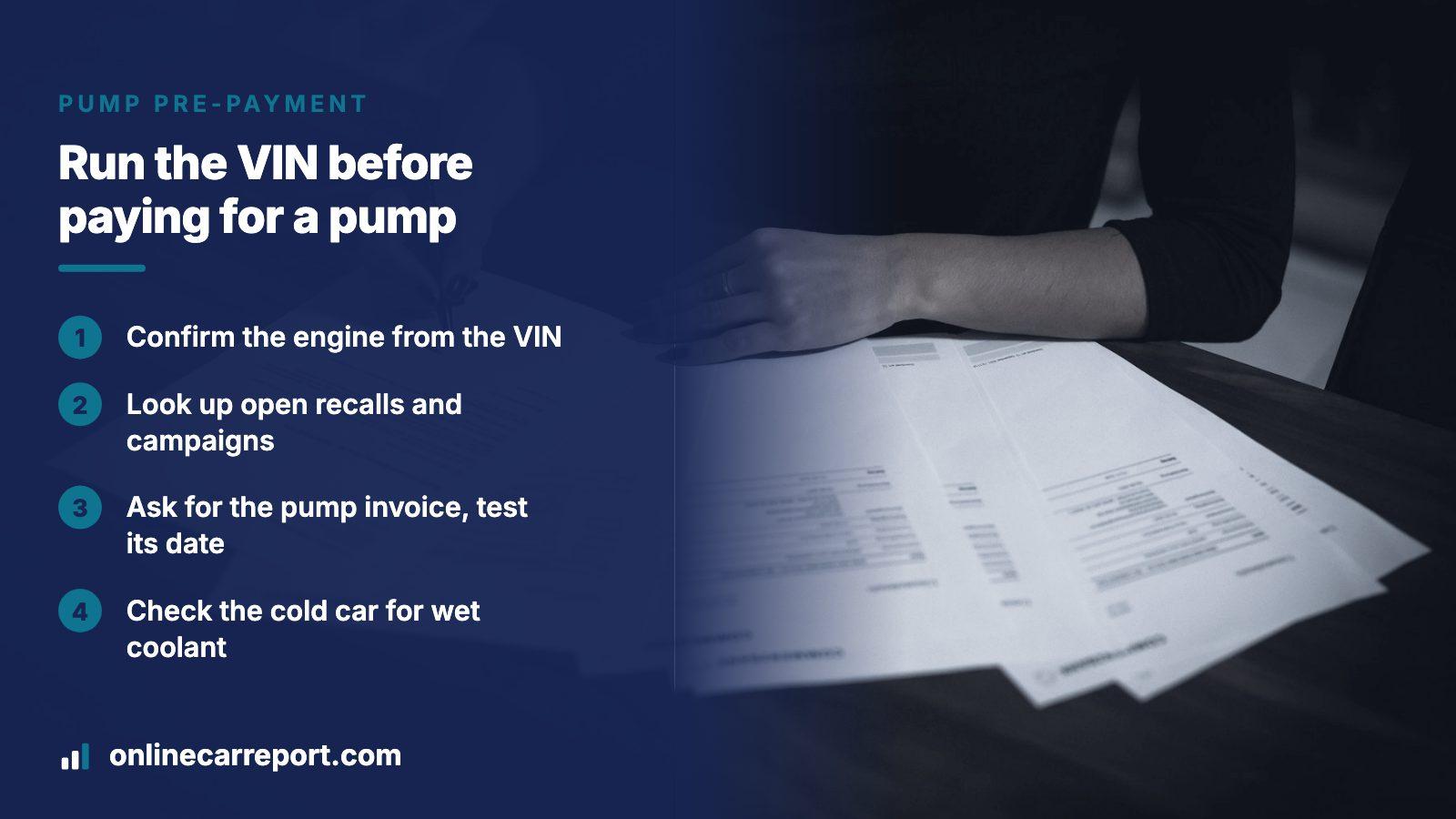
- Confirm the engine from the VIN, so the right pump gets priced.
- Look up open recalls, block heater and oil pump belt campaigns included.
- Ask for the pump invoice and test its date against the odometer record.
- Check the car cold for wet coolant near the pump pulley.
- Subtract a documented quote from your offer.
OnlineCarReport puts a VIN's history next to its market value. You see the preview at no charge, then pay once for a report; packs are listed on the pricing page.
Where this information comes from
- NHTSA: recalls by vehicle and VIN — Where to confirm that no pump recall exists and to check 26V011, 26V012 and 23V905 on a VIN.
- NHTSA owner complaint 11384883 — owner experience, paraphrased
- NHTSA owner complaint 11522048 — owner experience, paraphrased
- Ford Special Service Message 47587 on NHTSA — Dealer instructions for coolant loss on the 1.0L Focus.
- EPA and DOE: fueleconomy.gov vehicle records — Engines certified for each Focus year, behind the engine table.
- Kelley Blue Book: 2014 Focus water pump replacement — The $719 to $811 range and its parts and labor split, read October 2026.
Sources and photos: Facts checked against the sources above in November 2026. Photos by Nina Mercado, Dimitri Karastelev and Willian Cittadin on Unsplash; diagrams by OnlineCarReport.
Keep reading
- Car value by VIN: what the number tells you and how history moves itHow a VIN sets the starting value before a repair quote comes off.
- Ford Focus transmission replacement cost, and what it does to the car's valueThe Focus repair that costs far more than a pump.
- Ford Explorer water pump replacement cost and what it does to valueA Ford whose pump sits inside the engine, for contrast.
- Used car with no service history: what it does to the price and what to checkWhat to do when the seller has no pump invoice.
Frequently asked questions
What should a Focus pump job cost me?
Published estimates run from $493 on RepairPal's 2011 table to $958 on Kelley Blue Book's 2016 page. For a 2014 Focus, KBB gives $719 to $811, of which $431 to $487 is labor. Your ZIP code, engine and shop change the quote, so get it in writing with each part listed.
Is the Focus pump turned by the timing chain?
Not on the gasoline engines from 2008 to 2018, based on Ford's parts catalog. Each lists a pump pulley, meaning an external accessory belt drives it. So the job costs far less than one where a pump sits inside the engine.
Has Ford recalled the Focus water pump?
Nothing in NHTSA's 2008 to 2018 Focus recall list names the pump. Recalls 26V011 and 26V012 cover block heaters that leak coolant, and a Ford dealer does the repair free, so check your VIN before paying for a diagnosis.
How do I tell a pump leak from other coolant loss?
A failing pump usually leaves wet coolant or crust near its pulley. If the reservoir drops and nothing shows on the engine or ground, a pressure test and an exhaust-gas check come first. Ford's service messages describe internal loss on turbo engines that a new pump will not cure.
Does a water pump repair lower a used Focus's value?
A documented repair costs a seller little, because the invoice shows what was done and when. An undocumented one invites buyers to subtract a quote and add a margin. Repeated overheating in the car's past matters more than a replaced pump.
Now check the car itself
The guide explains what to look for. The report shows what this VIN has on record.