THE SHORT ANSWER
Buying a used car with no service history is a judgment call, not a verdict. No national database holds routine servicing, so a missing file does not prove neglect. It does mean the upkeep is unverified, which is a reason to pay less and test more. Run the VIN for title brands, damage and odometer problems, have an outside mechanic inspect it, and subtract the written estimate from your offer.
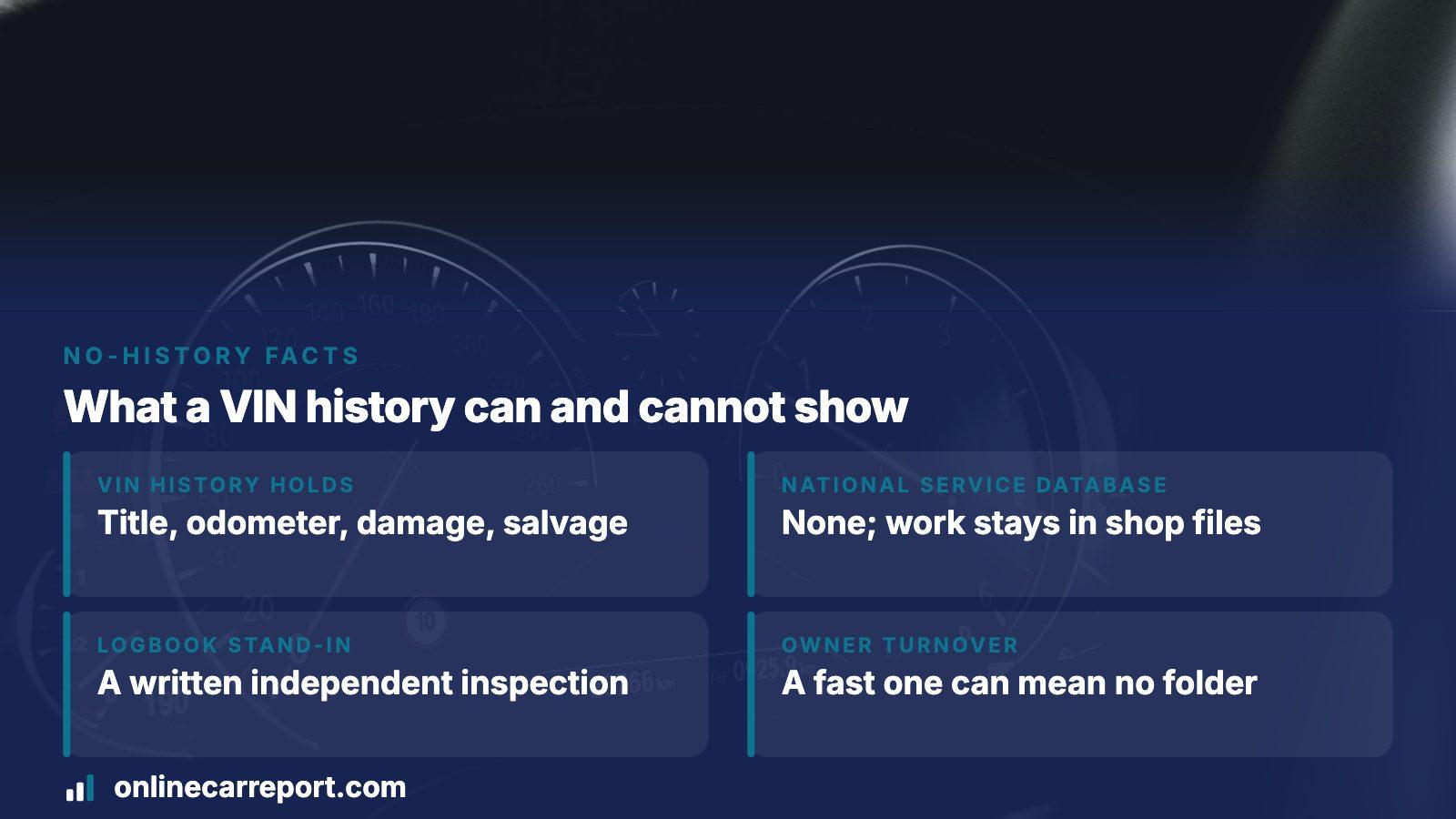
- What a VIN history holds
- Title, odometer, damage and salvage records, not oil changes
- National service database
- None; routine work stays in shop files
- Best stand-in for a logbook
- An independent inspection with a written estimate
- Preview
- Free; the full report is one payment
What a missing service file does to the price
A price rests on the car's condition, and a service file is the proof of it. Without one, every claim about upkeep rests on the seller's word. A title brand or an accident entry earns a discount you can point to in a record. A blank file earns one for something nobody can see, which is harder to argue.
The federal buying guidance cited on this page gives no figure for what a missing file should cost, so a percentage found elsewhere is a guess. A workable method: price the car as a good example of its exact build, subtract what the records and an inspection turn up, then hold back a margin for the years you cannot verify.
What a VIN history can stand in for, and what it cannot
The Justice Department's title system, NMVTIS, lists no repair history among its contents, and private providers selling repair data offer something it was never built to carry. A report that says nothing about servicing is silent, which is different from clean.
| Question | Who holds the record | In a VIN history? |
|---|---|---|
| Was the title ever branded salvage, flood or junk? | State titling records | Yes, when the state reported it |
| Has the mileage ever gone backwards? | Readings logged across the car's life | Yes, as a timeline |
| Was it in a reported crash or sold at auction? | Insurers, salvage yards, auction houses | Yes, often with photos |
| Is a safety recall still open? | The maker's filings with NHTSA | Yes |
| Were the oil changes done on schedule? | Shop invoices and the owner's receipts | No |
| Was the transmission fluid ever replaced? | Shop invoices and the owner's receipts | No |
Reading the records that do exist
- Steadily rising odometer entries back up the dash reading. A long flat stretch or a drop undercuts it.
- A rental or fleet label counts for more when nothing shows the car was cared for.
- A damage or auction entry with photos tells the mechanic where to look first.
- A fast turnover of owners often means no folder was passed along, though each owner is a person you might still reach.
A clean history is good news, within limits. NMVTIS describes its own coverage as incomplete, at 87 percent of the US vehicle population, and a search can come back with no salvage entry only because nobody filed one. When real money is at stake, request the state's own title record as well.
A gap in paper is not a gap in care
Nobody has to file an oil change with anyone, so a missing record is ambiguous. A shop with its own files may have done the work, or the owner may have done it at home. Treat the gap as a reason to examine the car harder, then try to fill it.
- Ask where the car was serviced, then phone those shops to see whether a file survives.
- Ask for photos of any invoice, parts receipt or notebook.
- Get the previous owner's contact details if the seller bought the car recently.
- Ask directly whether the owner did the work personally.
From an NHTSA owner complaint
In August 2026 an owner of a 2015 Hyundai Sonata at 175,000 miles reported that Hyundai turned down an engine claim, citing maintenance records. Two oil changes had been done by the owner, with a receipt for only one. The earlier owner also serviced the car at home and kept no paperwork, and an approach to them turned up nothing, leaving what the owner called about 10k miles that could not be proved.
Work done at home is real work that leaves no trace. If the seller did it, ask for the oil and filter receipts.
When someone asks for the paper after you own the car
The bill for a missing file can arrive after the sale, at a warranty claim or recall appointment, when a manufacturer wants proof about years you never owned the car.
From an NHTSA owner complaint
A second owner of a 2015 Hyundai Sonata told NHTSA in 2019 that the engine began clicking loudly about three weeks after the purchase, on a car bought at 46K miles, with metal fragments in the oil. The warranty claim was refused, the owner wrote, because of "no service records prior to ownership".
From an NHTSA owner complaint
An owner of a 2016 Kia Soul wrote to NHTSA in April 2025 that the dealer would not perform an engine recall repair without maintenance records. The owner picked up the car second-hand in 2019 and said the selling dealership had handled every routine service except tires and brakes, yet it could not produce the paperwork. The owner saw two options: drive on with an unrepaired engine or give up a vehicle.
Both owners learned too late that the paper trail sat with someone else. These are their own accounts, not findings, yet they show why to ask for the folder before paying.
The inspection that stands in for the logbook
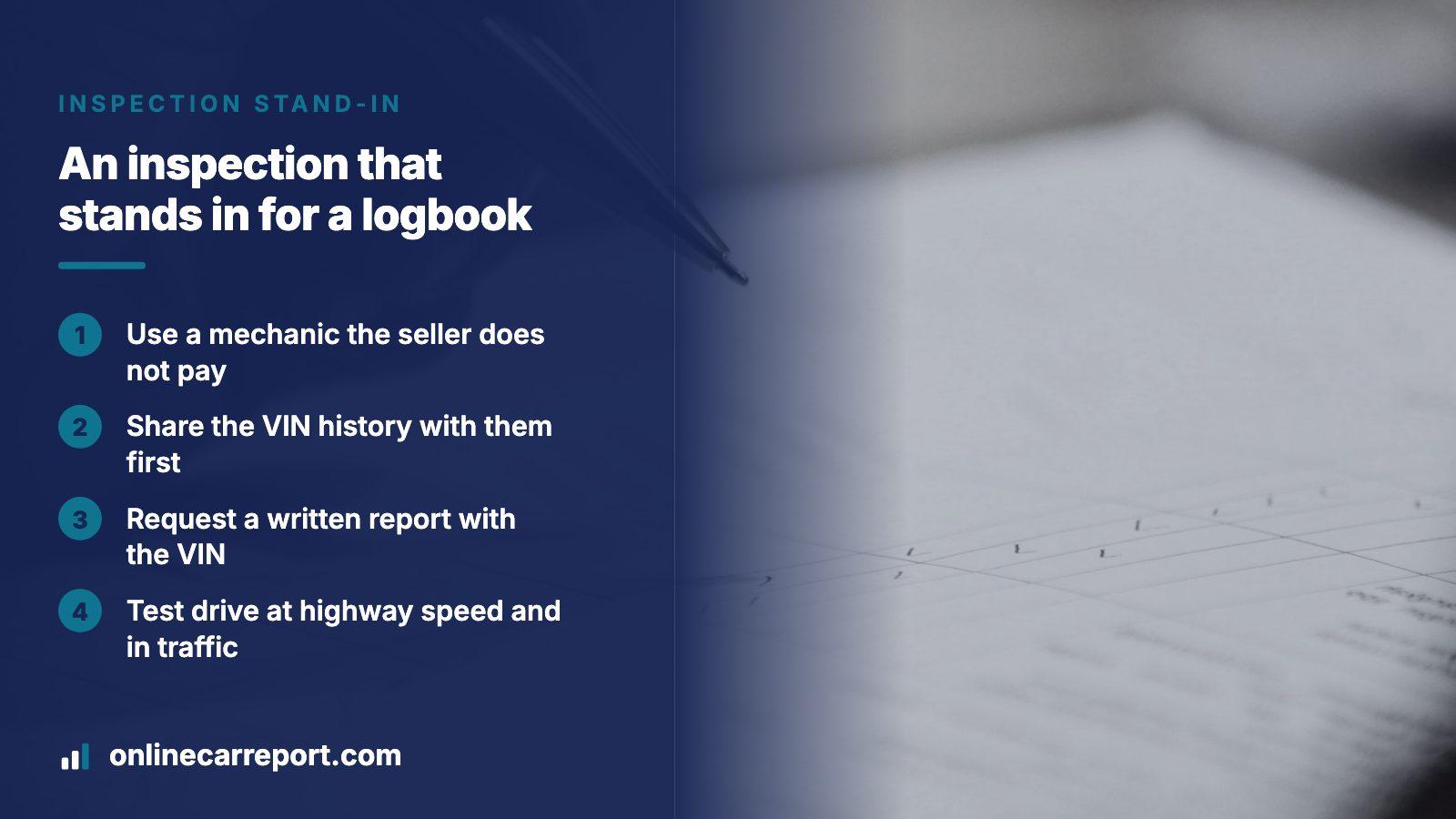
- Use a mechanic the seller does not pay. The FTC advises paying for an independent inspection even when the dealer has certified the car.
- Share the VIN history first, so any damage or auction entry gets checked.
- Request a written report with the make, model and VIN and an estimate against each fault.
- Test drive up a grade, at highway speed and in crawling traffic.
- Should the seller refuse to let a mechanic look at an unproven car, take that as your answer.
The FTC points out that a history report tends to cover wrecks and flooding rather than worn parts, so a car with no service file needs the report and the inspection both.
Turning the unknown into an offer
- Decode the VIN and price the car as a clean example of that exact build.
- Subtract what the records show: a title brand, a damage or auction entry, a hard-use label.
- Subtract the inspection estimate, line by line.
- Hold back a margin for the stretch nobody can prove, wider when the odometer entries have holes.
On a dealer's lot, read the Buyers Guide first. If it reads "As Is - No Dealer Warranty", any repair after the sale lands on you, so the margin in step four is your only cushion. Unless a car is sold as is, implied warranties apply even without written coverage, and in some states they run up to four years. Get every promise written on the Guide, which overrides the sales contract.
Running the VIN check before you make the offer
Copy the 17 characters from the title if the seller will show it. If not, read the label on the edge of the driver's door and match it to the plate visible through the windshield. Different strings mean you stop.
Open the preview and read the title line, then the odometer entries, then any damage or auction record. The full report adds detail and a market value beside the records; payment is a single charge, and the pricing page has the choices. Also run NHTSA's recall lookup on the VIN, which costs nothing: an open recall is one more job a former owner left undone.
Where this information comes from
- FTC: Buying a used car from a dealer — Basis for the as-is label, implied warranties, the independent inspection and the written repair estimate.
- NMVTIS: Understanding a vehicle history report — What a federal title-record report holds, and the statement that repair and maintenance data sit outside it.
- NMVTIS: Information for consumers — Coverage limits, false negatives and the advice to pull the state's own title record.
- NMVTIS: Buying tips — Where to ask for maintenance records and how to test drive an unfamiliar car.
- NHTSA owner complaint 11253320 — owner experience, paraphrased
- NHTSA owner complaint 11655871 — owner experience, paraphrased
- NHTSA owner complaint 11759964 — owner experience, paraphrased
Sources and photos: Facts checked against the sources above in November 2026. Photos by Nina Mercado, Masjid MABA and Viktor Theo on Unsplash; diagrams by OnlineCarReport.
Keep reading
- Car value by VIN: what the number tells you and how history moves itHow the VIN build and the recorded history combine into one value.
- Kelley Blue Book value by VIN: how the history changes the numberPrice the clean version of the car before you subtract the unknowns.
- Diminished value calculatorWhat a recorded accident does to a car's worth even after a good repair.
- Sample reportSee how the title, damage and mileage records are laid out before you buy.
Frequently asked questions
Is it safe to buy a used car with no service history?
It can be when the price and the inspection reflect the unknown. A missing file proves nothing about how the car was treated, but it removes your evidence. Run the VIN, get an independent inspection, and walk away if findings and price do not line up.
Can I get a car's service history from the VIN?
Not in full. No national database collects routine work, and NMVTIS carries no repair history. Ask the seller where the car was serviced, because the shop that did the bulk of the work might open its records. A VIN history covers titles, damage, mileage and recalls instead.
How much cheaper should a car with no service history be?
No official source gives a figure, and the federal guidance cited here does not either. Begin with the clean price for the exact build, subtract what the records and inspection show, then keep a margin for the unprovable stretch, wider when the odometer entries have gaps.
Does a clean VIN report make up for missing service records?
No. Clean means no brand or salvage entry reached the database, but it says nothing about oil, belts or fluids. NMVTIS also cautions that coverage is incomplete and that a search can give a false all-clear. The report and the inspection answer different questions.
What should I ask the seller for when there are no records?
Ask which shops serviced the car and phone them to see if a file exists. Request photos of any invoices, receipts or a notebook, and the previous owner's contact details if the seller bought recently. Ask whether the owner did the work personally.
Now check the car itself
The guide explains what to look for. The report shows what this VIN has on record.