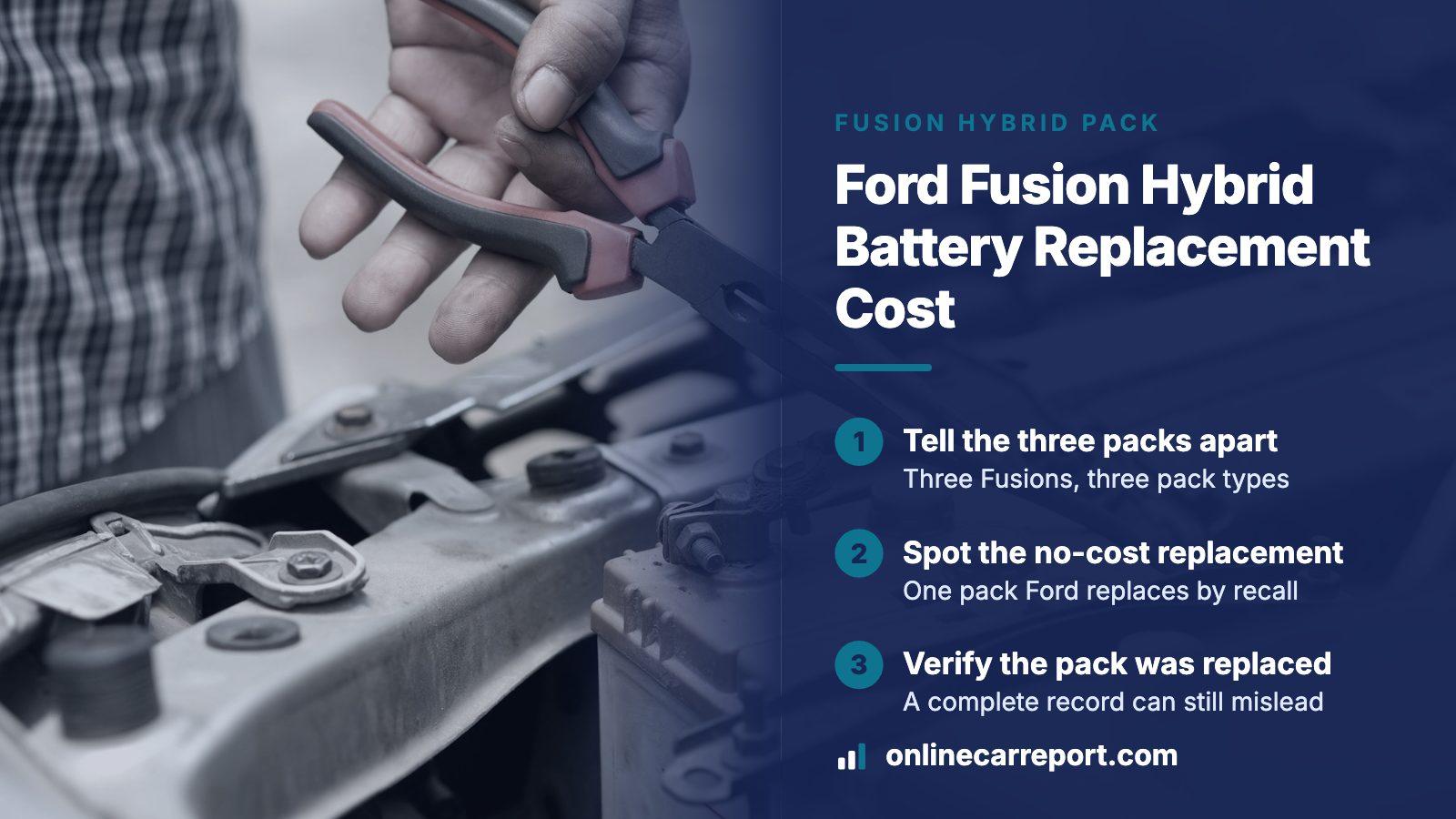
THE SHORT ANSWER
Expect roughly $1,949 to $2,149 for an aftermarket Fusion Hybrid pack, plus labor, or $3,224.71 for Ford's remanufactured 2013-2020 pack, which was listed as unavailable. A 2019 or 2020 Fusion Energi is different: recall 23V440 replaces its high-voltage battery without charging the owner. Before paying anyone, put the VIN into NHTSA's recall search.
- Aftermarket hybrid pack
- $1,949 to $2,149, labor extra
- Ford remanufactured pack
- $3,224.71 MSRP, 2013-2020
- Energi recall
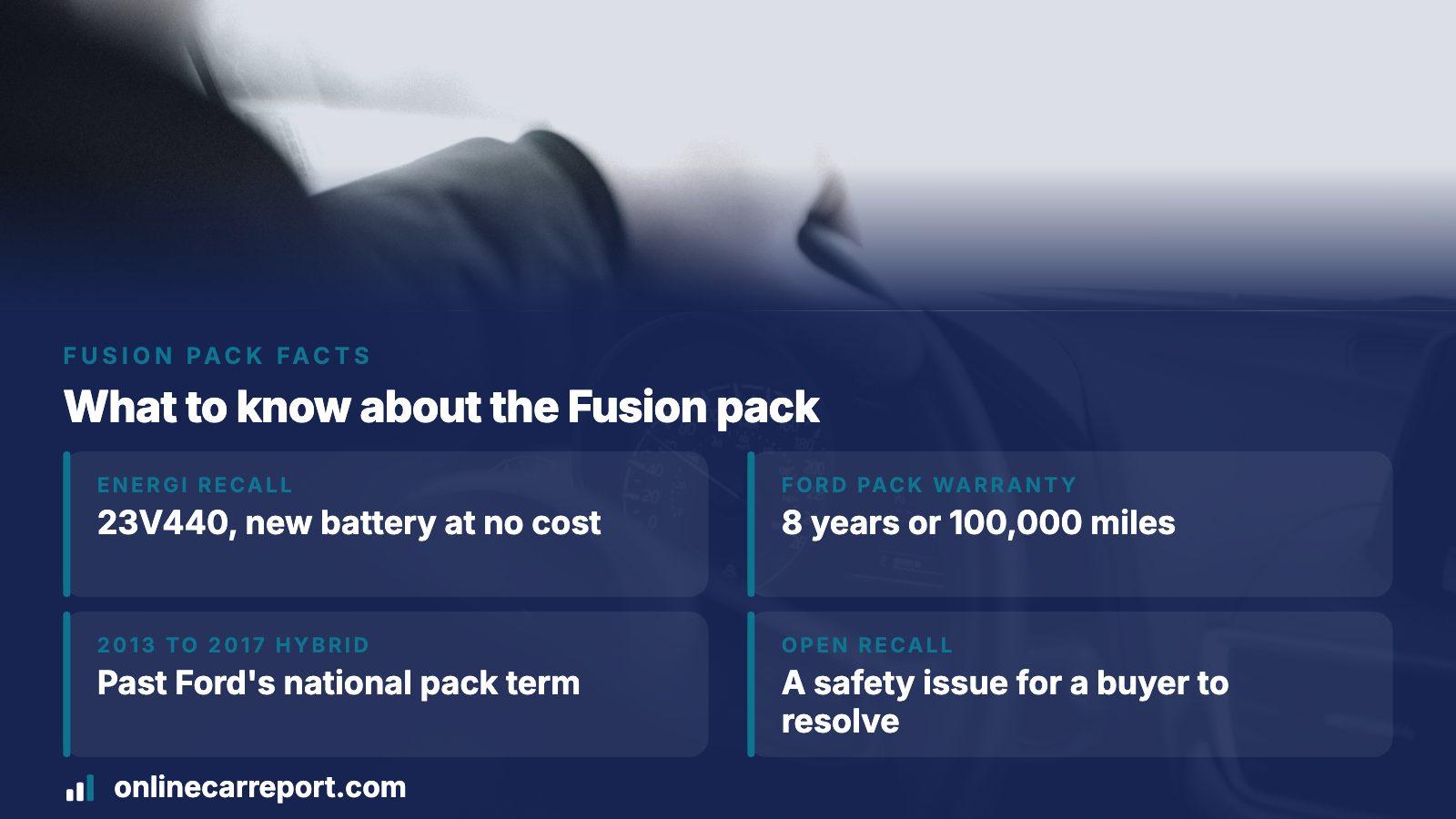
- 23V440, new battery at no cost
- Ford pack warranty
- 8 years or 100,000 miles
What the listings say, and whose figures they are
Prices below were read in late October 2026 from sellers, not from Ford's service department, and a seller can change a listing overnight. None of them includes the shop's time.
| Pack | Listed figure | Detail |
|---|---|---|
| Hybrid 2010-2012 (aftermarket) | $1,949 | Three-year warranty, old pack returned |
| Hybrid 2013-2015 (aftermarket) | $2,049 | Same terms |
| Hybrid 2016-2020 (aftermarket) | $2,149 | Same terms |
| Ford remanufactured, 2013-2020 | $3,224.71 MSRP | Listed as unavailable on a parts site |
| Fusion Energi (aftermarket) | $4,849 | No warranty or install terms on the listing |
Ford sells its lithium-ion hybrid pack as a remanufactured unit rather than a new one, and the listing sits about a thousand dollars above the aftermarket price. No published labor time or new-pack price turned up, so ask any shop to put labor on its own line.
Three Fusions, three different packs
EPA and Department of Energy data on the 2011 Fusion Hybrid show a 275-volt nickel-metal hydride battery, the design used through 2012. The redesign for 2013 moved to lithium-ion, and the 2015 and 2018 records show 280 volts. The Energi, a plug-in sold from 2013, carries a much larger lithium-ion pack: 7.6 kWh of usable capacity at first and 9.0 kWh for 2019, built from 84 cells.
These parts do not swap. A quote that names only the badge on the trunk is a guess, so make the seller work from the VIN decode and the model year. Mixing up a hybrid and an Energi quote is the easiest way to be off by thousands.
The one pack Ford replaces at no cost
In June 2023 Ford filed recall 23S33, which NHTSA tracks as 23V440, on 2019-2020 Fusion Energi cars. A fault inside a high-voltage cell can overload the battery energy control module. Ford says that can cost the car its drive power or start a fire in the trunk area. Ford's fix is a replacement battery with updated software, or a vehicle refund, and owners were at first told to stop charging.
The wait was long. An interim repair with a fuse block and software was authorised for cars running normally, and Ford's dealer notice of March 18, 2025 said the final parts had arrived.
Do not pay for this pack
If a 2019 or 2020 Energi needs a high-voltage battery, look up the VIN for recall 23V440 first. Paying a shop for a pack Ford owes the owner is the costliest mistake on this page.
How a pack, or a recall, moves the price you can get
A pack invoice is a one-time cost. A recall that sits open, a pack nobody can document, or a history that does not match the story moves the sale price every time the car changes hands.
- An open 23V440 on an Energi is a safety issue a buyer must be told about, and it narrows the pool of people who will take the car.
- A 2013-2017 hybrid is past Ford's national pack term, so buyers price in a possible pack as a known cost.
- A newer pack with paperwork supports a higher asking price than the same car with a warning light and no diagnosis.
- A title brand or auction record on top of a weak battery stacks two discounts.
Start from the market value for the specific trim and year; the history then explains why one Fusion belongs above that number and another below it.
An owner stuck with a car nobody wanted
Owners file complaints with NHTSA, and the agency publishes them. Nobody has checked them, yet they show how a recall lands on the person trying to sell.
From an NHTSA owner complaint
A 2019 Fusion plug-in owner wrote in March 2024 that the car had sat under recall 23V440 since June of the year before, with no remedy and no firm date from Ford. The owner said resale value had "plummeted" and that they had owned the car only 3 months when the recall landed. Ford, they added, said state lemon laws gave them no claim.
Takeaway: a plug-in Fusion with an unresolved recall is hard to sell at any price, so a buyer should confirm the recall is closed, and a seller should have proof of the remedy.
When the record says complete but the pack was never replaced
From an NHTSA owner complaint
A 2019 Fusion owner reported in March 2026 that a dealer had done only the interim repair, since the final parts were not yet available. The dealer later told the owner the recall was marked completed. Ford's own history showed just the interim step, and the owner filed a complaint against the dealer.
Takeaway: ask for the repair order and see which remedy was performed. A closed recall line alone does not prove the battery was replaced.
Ford's warranty clock decides who pays
Ford's support page sets hybrid component coverage at eight years or 100,000 miles, starting on the warranty's first day, and the earlier limit ends it. The 2017 hybrid warranty guide adds 10 years or 150,000 miles for the high-voltage battery on AT PZEV cars where California's rules are enforced, with normal lithium-ion capacity loss excluded.
| Fusion | Pack status in 2026 |
|---|---|
| 2010-2012 Hybrid | Out of both terms |
| 2013-2017 Hybrid and Energi | Out on the national term; a few AT PZEV cars may still hold a longer one |
| 2018-2020 Hybrid | Possibly still covered, depending on in-service date and miles |
| 2019-2020 Energi | Recall 23V440 covers the pack whatever the warranty says |
Delivery to the first owner starts the clock, not the model year, and only the 2017 edition of the guide was consulted here.
Checks before anyone sells you a pack
Treat a hybrid warning as a puzzle to diagnose before it becomes a parts order. The battery computer and the ordinary 12-volt battery fail more often than the cells, and the 12-volt one costs hundreds.
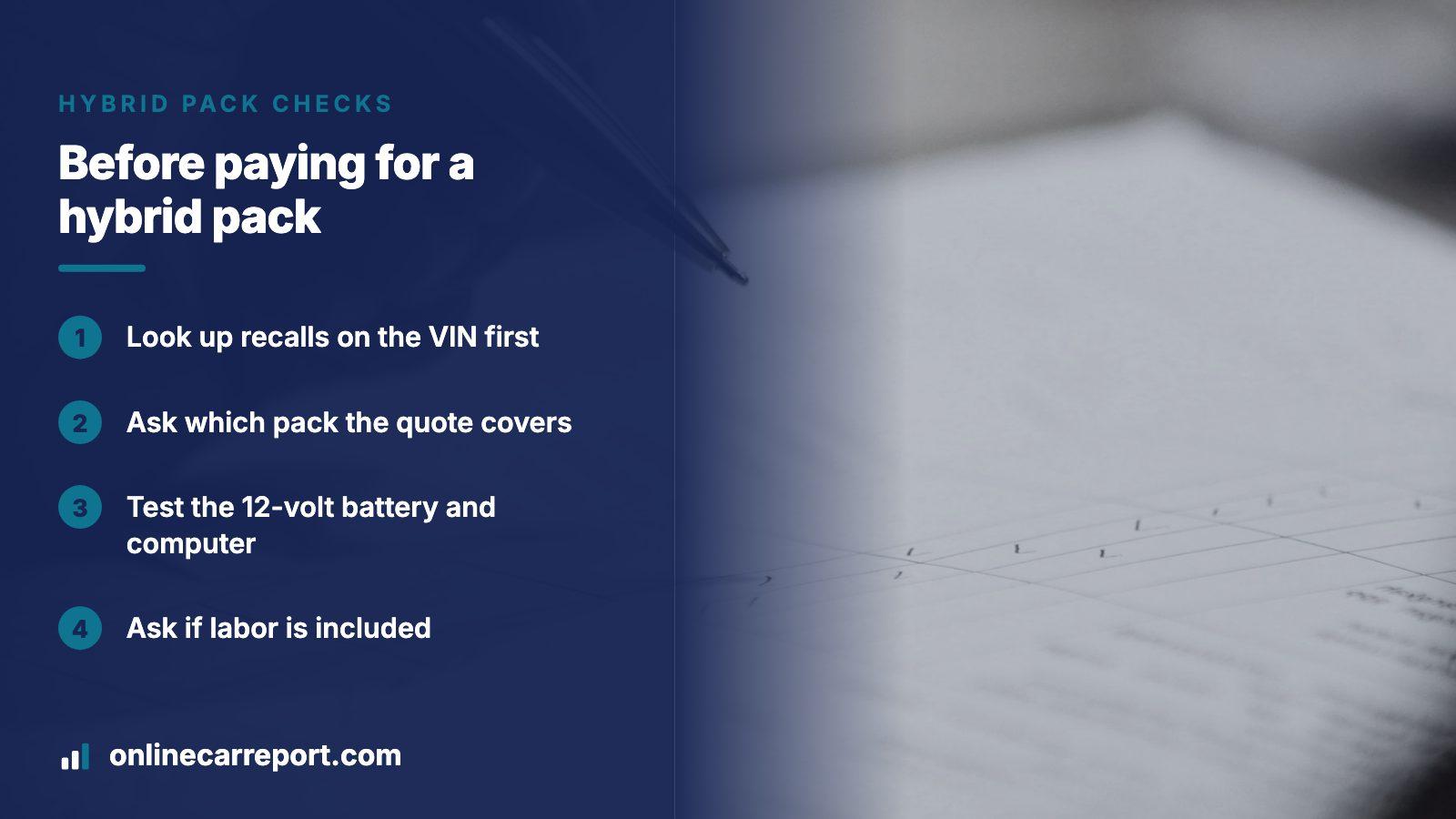
- Look up recalls on the VIN, and do it first on a 2019-2020 Energi.
- Ask which pack the quote covers: nickel-metal hydride, lithium-ion hybrid or Energi.
- Have the 12-volt battery and the battery computer tested and the stored codes written down.
- Ask whether the quote includes labor and a charge if the old pack is not returned.
Where the VIN record comes in
A vehicle history report does not test a battery. What it shows is the context around the car: odometer readings that confirm the mileage against the warranty term, open recalls, title brands, damage entries, salvage and auction records with photos, and whether it was a rental or fleet car. Those entries explain why a Fusion is priced where it is, and a seller who has fixed the battery can use the same record to back up the asking price.
Here, a VIN gets a preview at no charge, and the report behind it is one payment that sets a market value beside the history. Pair it with a hybrid battery health test at a shop that can read pack data, since neither one replaces the other.
Where this information comes from
- NHTSA: recall lookup by vehicle and VIN — Where recall 23V440 can be checked against a specific VIN.
- Ford Part 573 report for recall 23V440 (NHTSA) — The defect and the no-cost battery remedy for 2019-2020 Energi cars.
- FuelEconomy.gov: 2011 Ford Fusion Hybrid — Lists the first-generation pack as nickel-metal hydride.
- Ford 2017 Hybrid Car and Electric Vehicle Warranty Guide — The 8-year term and the AT PZEV battery extension.
- Best Hybrid Batteries: Ford Fusion packs — Aftermarket pack prices and warranty terms as listed in October 2026.
- NHTSA owner complaint 11575484 — owner experience, paraphrased
- NHTSA owner complaint 11721636 — owner experience, paraphrased
Sources and photos: Facts checked against the sources above in November 2026. Photos by Towfiqu barbhuiya, Masjid MABA and Miles Loewen on Unsplash; diagrams by OnlineCarReport.
Keep reading
- Car value by VIN: what the number tells you and how history moves itHow a VIN gives the car its starting value before any repair bill.
- Ford Fusion transmission replacement cost, and what the car is worth afterThe other big Fusion repair, priced the same way.
- Toyota Camry Hybrid battery replacement cost, and what it does to the car's valueA rival hybrid pack with its own price and warranty.
- Honda Accord Hybrid battery replacement cost and what it does to valueAnother midsize hybrid pack, compared on cost and term.
Frequently asked questions
What should I budget for a Fusion Hybrid battery?
One aftermarket seller listed three generations of hybrid pack from $1,949 up to $2,149, with a three-year term, and shop labor billed separately. Ford's remanufactured 2013-2020 pack showed $3,224.71 and was listed as unavailable. These are seller figures, so get a written quote with labor itemized.
Does a recall cover the Energi battery?
For 2019 and 2020 cars, yes. Recall 23V440 covers a cell fault that can damage the battery energy control module. The remedy is a replacement high-voltage battery with software, at no charge, or a refund. Cars from 2013 through 2018 are not part of that recall, so their pack falls to the owner.
Which battery chemistry does my Fusion Hybrid have?
It depends on the year. The 2010-2012 cars use a 275-volt nickel-metal hydride pack, while the 2013-2020 redesign uses lithium-ion at 280 volts. The Energi has its own, larger lithium-ion pack. The packs are not interchangeable, so read the model year off the VIN before you order.
Will a bad hybrid battery lower what my Fusion is worth?
Yes, mostly through what buyers can see. An open recall, an undocumented pack or a warning light with no diagnosis pushes the price down, while a documented replacement supports it. Market value for the exact build, plus the history, shows where your car should sit.
Can a VIN check tell me if the hybrid battery is bad?
No. A history report shows recalls, odometer readings, title and damage entries, but it cannot read pack health. Use it to confirm recall status and mileage, then get a hybrid battery test from a shop that can pull the pack's data.
Now check the car itself
The guide explains what to look for. The report shows what this VIN has on record.