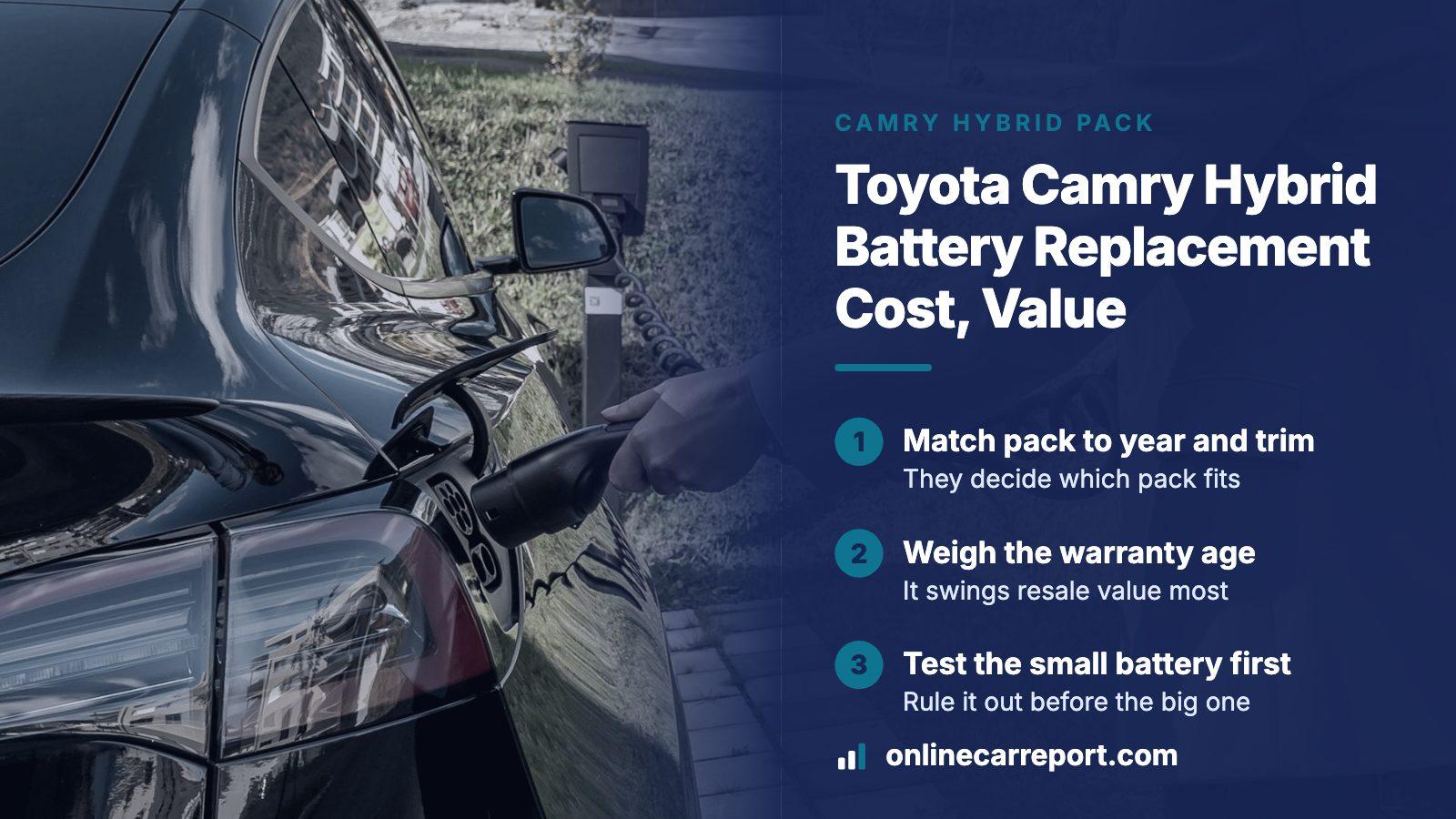
THE SHORT ANSWER
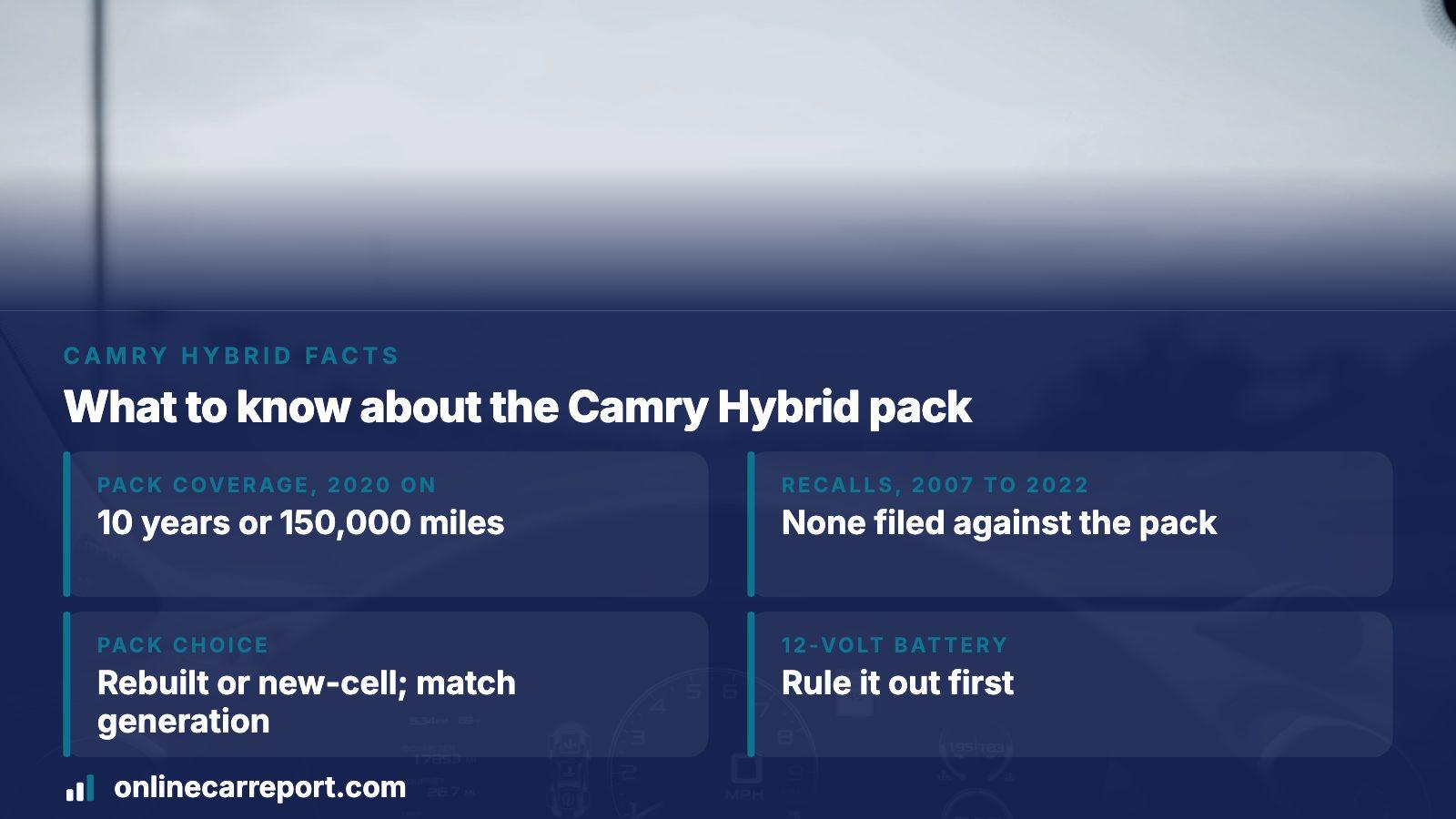
Sellers list aftermarket packs between $1,599 and $2,999, parts only. RepairPal prices a full installed job on a current-generation car at $6,006 to $6,205. Toyota's pack coverage lasts 150,000 miles or ten years on 2020 and later cars; earlier ones got 100,000 miles or eight years. NHTSA shows no recall that replaces the pack.
- Rebuilt or new-cell pack
- $1,599 to $2,999, parts only
- Installed estimate, 2025-2026
- $6,006 to $6,205
- Toyota pack coverage, 2020 and newer
- 10 years or 150,000 miles
- Hybrid-system recalls, 2007-2022
- None filed against the pack
Four price sources, four different purchases
Every figure below was read by another publisher on October 25, 2026, and each one prices something slightly different. Do not average them. Treat each as a quote for a specific job.
| Source | What it prices | Listed figure |
|---|---|---|
| Greentec Auto | Remanufactured pack, 2007-2011 and 2012-2016 | $1,599 |
| Greentec Auto | New cells, 2007-2016 and 2018-2021 | $2,199 to $2,999 |
| Best Hybrid Batteries | Pack by generation, 3-year unlimited-mileage warranty | $1,849 to $2,149 |
| RepairPal | Installed estimate, 2025-2026 Camry | $6,006 to $6,205 |
The first three are parts prices. The last one includes labor of $427 to $627, which means the pack itself is most of the bill on a current car. J.D. Power gives a summary band between $3,000 and $5,000, which matches neither a rebuilt pack nor a new factory unit.
The pack depends on the model year and trim
The 2007-2011 and 2012-2017 cars used nickel-metal hydride packs, and sellers stock one part per span. The 2018 redesign split by trim: the LE got a lithium-ion pack, and the other two trims stayed with nickel-metal hydride. The 2025 redesign dropped the gasoline Camry entirely in the US.
For a value-minded buyer this is more than trivia. A seller advertising a 2018 Camry Hybrid has to say which pack is under the seat, and a quote that does not name the chemistry has not been written for your car. A VIN decode settles trim and drivetrain from the factory record, so the order matches what is installed.
Name the pack type
For anything built since the 2018 redesign, have the shop put the battery type on the quote. The two designs are not interchangeable.
Warranty age is the biggest swing in resale value
Toyota announced in October 2019 that its 2020 hybrids would get a longer pack term, and later owners inherit it. The older terms had been eight years or 100,000 miles. The new one is ten years or 150,000 miles. Three electronic parts, the inverter with converter plus the hybrid and battery control modules, kept the old shorter term.
| Camry Hybrid years | Pack coverage in 2026 |
|---|---|
| 2007-2011 | Beyond every term offered; any pack is the owner's cost |
| 2012-2017 | The 8-year term is long over; only a late 2017 in a California-rule state might sit near a 10-year term |
| 2018-2019 | Eight years or 100,000 miles; a 2019 can last into 2027 if mileage stays low |
| 2020 and newer | Ten years or 150,000 miles, which carries a 2020 car toward 2030 |
Coverage begins when the first owner took delivery, so the rows above are rough, model-year estimates. Two Camrys of the same body and mileage can carry very different risk, and a 2020 or newer car with years of coverage left deserves a stronger asking price than a 2019 that is about to age out.
What an owner reported at 53,000 miles
From an NHTSA owner complaint
An owner of a 2015 Camry Hybrid told NHTSA that the car refused to start in January 2017 and the check hybrid system light came on. A dealer diagnosed a failed battery that needed replacing, and the filing says the car was not repaired. The failure came at about 53,000 miles. The complaint says only the word battery, with no price and no word on whether it meant the traction pack or the 12-volt unit.
One filing proves nothing about how often packs fail, and it does not show a cost. What it does show is how a pack problem arrives for an owner: a no-start with a warning light, then a dealer verdict. A buyer should ask any seller whether that kind of warning ever appeared, and read the sale record for a gap or an odd mileage jump that might line up with a long shop stay.
Rule out the small battery before pricing the big one
Beside the big pack, the car has a plain 12-volt battery. It boots the computers and shuts the high-voltage relays. Let it weaken and the Camry will not go into ready mode, which feels to a driver just like a dead hybrid system.
Some online estimators titled for the Camry Hybrid battery appear to be pricing this small unit, which explains quotes of a few hundred dollars. Have the 12-volt tested first. If it is the culprit, you have avoided a four-figure repair, and the car's history does not change at all.
No recall pays for the pack
A recall is the one path where the owner pays nothing, whatever the age. NHTSA's recall data for Camry Hybrid model years 2007 to 2022 contains zero campaigns under hybrid propulsion. As a sanity check, the same lookup on a 2012 Prius turns up two inverter-related campaigns, so the lookup does work.
The recalls on record for this car cover unrelated parts. One is a front drive shaft on 2016 models that could come apart. Another is a 2019 fuel filler pipe left disconnected after an inspection. Neither involves the pack, though an open one on a car you are buying is a negotiating point. Campaigns get added over time, so run the VIN yourself.
Comparing a dealer quote with a rebuilt one
The gap between $1,599 and about $6,000 is mostly the pack. Ask each shop the same questions before comparing totals.
- Who built the pack: Toyota, an aftermarket maker with fresh cells, or a rebuilder reusing old modules?
- Does the chemistry match a 2018 or newer car?
- Does the warranty count months alone, or miles as well?
- Does the price include fitting, and must you return the old pack?
- Were the inverter and battery computer tested?
Warranty lengths vary widely. Greentec lists 18 months on a rebuilt 2012-2016 pack and 48 months on a new-cell 2007-2011 pack, while Best Hybrid Batteries lists three years with no mileage cap. Divide each price by its months of coverage and the ranking often changes.

Fold the pack into the car's value, then check its record
If you are buying a used Camry Hybrid outside coverage, treat the pack as a known possible cost: the aftermarket price listed for that generation, and a couple of hours at a shop. If the car is inside coverage, the remaining years are worth something to you and to whoever buys it next.
That adjustment sits on top of the car's baseline value, and the baseline moves with what the VIN record shows: a salvage or other title brand, accident and damage entries, auction photos, odometer readings that do not climb steadily, and open recalls. A report from OnlineCarReport starts with a free preview, then a single purchase for the full record, so you can see the history before you set a number for the pack.
Where this information comes from
- NHTSA: recalls by vehicle, Camry Hybrid — basis for the no-pack-recall finding and the drive shaft campaign
- NHTSA owner complaint 10949075 — owner experience, paraphrased
- Toyota: battery warranty extension for model year 2020 — source for the longer pack term and the parts left on the shorter one
- California Air Resources Board: warranty periods — the longer battery term for California-certified cars
- Greentec Auto: Camry Hybrid battery prices — rebuilt and new-cell pack prices and warranty months
- RepairPal: Camry Hybrid high-voltage battery estimate — the installed estimate and labor range
Sources and photos: Facts checked against the sources above in November 2026. Photos by smart-me AG, Owen Michael Grech and Dennis Eusebio on Unsplash; diagrams by OnlineCarReport.
Keep reading
- Car value by VIN: what the number tells you and how history moves itHow a VIN-based value is built, and which history entries pull it down.
- Toyota RAV4 Hybrid battery replacement cost, and how it moves the car's valueThe same pack question for Toyota's best-selling hybrid SUV.
- Honda Accord Hybrid battery replacement cost and what it does to valueA competing hybrid sedan with a different warranty term.
- Car trade-in value by VIN number: what a dealer sees and what history changesWhat a dealer may offer once the pack and the record are known.
Frequently asked questions
What should I expect to pay to replace the hybrid pack in a Toyota Camry?
Parts-only listings begin at $1,599 for a remanufactured pack and top out at $2,999 for new cells. RepairPal's installed figure for the newest cars is $6,006 to $6,205, and J.D. Power's guide sits between $3,000 and $5,000. Mostly the gap is rebuilt versus factory-new.
Will Toyota still cover the pack on my Camry Hybrid?
Likely yes for 2020 and later cars, whose pack term is ten years or 150,000 miles. Cars from 2019 and before got only 100,000 miles or eight years, and most have aged out by now. The count begins at first delivery, and a dealer can state the exact term for a given VIN.
Do newer Camry Hybrids come with lithium-ion packs?
Some do. Launch coverage of the 2018 model says the LE trim received lithium-ion and the other trims kept the older chemistry. Aftermarket sellers list the two as separate products and ask for a VIN before shipping, since a wrong pack will not fit. Confirm yours first.
Has Toyota recalled the Camry Hybrid pack for free replacement?
None turned up in NHTSA's records for model years 2007 to 2022, from a lookup on October 25, 2026. Existing recalls involve a drive shaft and a fuel filler pipe. New campaigns appear over time, so run your VIN on NHTSA's lookup before paying for anything.
Does a hybrid battery replacement change what the car is worth?
A pack still under Toyota's coverage supports a stronger asking price, while an out-of-term car should be priced with a possible replacement in mind. Title brands, accident entries and odometer readings in the VIN record then adjust that baseline up or down, so check both before negotiating.
Now check the car itself
The guide explains what to look for. The report shows what this VIN has on record.