THE SHORT ANSWER
Expect $382 to $1,132 for the actuator or tensioner repair that Honda's bulletins call for. A true chain job is different: RepairPal's generic page, which names no model, shows $1,334 to $1,957 of labor and a further $786 to $807 for parts. Honda allows 2.0 hours for the 2008 to 2012 actuator fix and 0.6 hour for the 2014 to 2017 four-cylinder tensioner. Confirm year and engine by VIN before accepting any quote.
- Tensioner-sized job
- $382–$1,132 at RepairPal, by model year
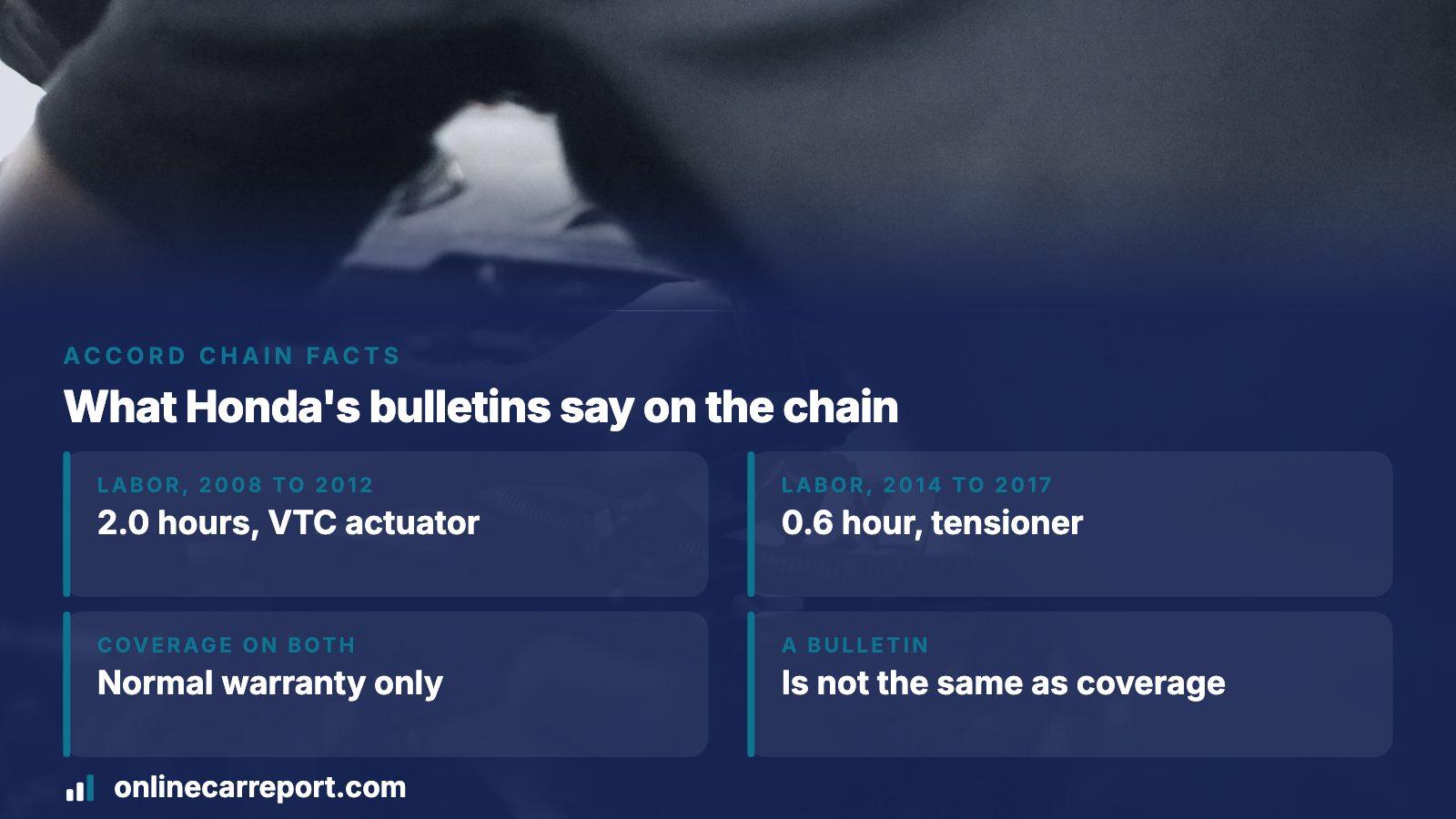
- Honda labor, 2008–2012
- 2.0 hours for the VTC actuator
- Honda labor, 2014–2017 L4
- 0.6 hour for the tensioner
- Coverage on both fixes
- Normal warranty only
What the estimates say, and what Honda allows for labor
RepairPal does not publish one Accord timing chain number. Its Accord page for the chain tensioner, as recorded in September 2026, lists $830 to $1,132 for 2008 to 2011 cars and $382 to $494 for 2013 and later ones. A separate generic page prices a full chain job without naming a model.
| Job | Source | Figure |
|---|---|---|
| Tensioner job, 2008 to 2011 | RepairPal, Accord page | $830 to $1,132 |
| Tensioner job, 2013 and later | RepairPal, Accord page | $382 to $494 |
| Full chain job, no model named | RepairPal, generic page | Labor $1,334 to $1,957, parts $786 to $807 |
| VTC actuator labor, 2008 to 2012 | Honda bulletin 09-010 | 2.0 hours |
| Tensioner labor, 2014 to 2017 four-cylinder | Honda bulletin 19-019 | 0.6 hour, plus 0.1 hour for the filter |
The Honda lines are labor allowances for dealer technicians, not prices. To compare a quote, take those hours times the shop's rate and add the part.
Two Honda bulletins that come before a chain job
Honda has written up this noise twice. Bulletin 09-010, in the version dated March 17, 2016 that NHTSA hosts, covers every 2008 to 2012 Accord. The symptom is a loud rattle for about 2 seconds at cold start, and the cause is a defective variable valve timing control actuator, the VTC actuator. The fix is a new actuator, and Honda says it does not require removing the whole cam chain and its parts.
Bulletin 19-019, dated February 21, 2019, covers four-cylinder Accords: every 2015 to 2017 car, and 2014 cars inside VIN ranges listed by trim. It describes a knock or click at cold start. A worn check valve in the cam chain tensioner lets oil pressure leak off, so the chain goes slack once the engine is shut down.
| Bulletin | Cars | Part replaced | Honda part number |
|---|---|---|---|
| 09-010 | 2008 to 2012 Accord, all trims | VTC actuator | 14310-R5A-305 |
| 19-019 | 2014 Accord by VIN range, 2015 to 2017 four-cylinder | Cam chain auto-tensioner | 14510-5A2-A02 |
Neither is a recall. NHTSA files both as manufacturer communications, and each says only the normal warranty applies.
When the chain itself has stretched
A rattle that comes and goes is the bulletin pattern; a stretched chain tends to show up on the dashboard.
From an NHTSA owner complaint
A 2008 Accord owner described a dashboard warning that flickered on and off from early 2016, always paired with camshaft position codes P1009 and P0341. By August the car was stalling, standing still and moving. A Honda dealer diagnosed a stretched timing chain at 41,059 miles, and the job cost $1,562.90. Honda offered nothing toward it, though the owner argued the mileage sat well under the 60,000-mile powertrain limit.
What to take from it: the codes and the stalling, not the sound, led to the chain. A shop proposing a chain job should be able to show the scan results behind the quote.
What owners reported, by model year
NHTSA's complaint files hold unverified owner reports with no category for timing parts, so a text search of the owners' words is the nearest read. Counts as of November 5, 2026.
| Model years | Complaints on file | Mention VTC or variable timing | Mention a timing chain or cam chain |
|---|---|---|---|
| 2008 to 2012 | 3,506 | 116 | 14 |
| 2013 | 1,427 | 4 | 1 |
| 2014 to 2017 | 2,737 | 4 | 1 |
The actuator wording sits in the first window, which fits bulletin 09-010. Chain mentions are scarce everywhere. Some hits are passing ones, and none of this is a failure rate.
A bulletin does not mean Honda pays
Honda's text for 09-010 names powertrain coverage of 5 years or 60,000 miles, California emissions coverage of 7 years or 70,000 miles, and PZEV coverage of 15 years or 150,000 miles. A car past its terms pays its own bill.
From an NHTSA owner complaint
A 2010 Accord owner reported a cold-start rattle that began after an oil change, and a Honda technician agreed it was the VTC actuator. The dealership said the car fell outside the bulletin's claim information, though the owner believed it carried the 15-year PZEV powertrain coverage. At 144,000 miles the quote was nearly $1,900 for parts and labor.
A bulletin number tells a shop what to fix. Only a dealer's lookup by VIN tells you who pays, so get that answer before work starts.
What an open question under the hood does to the price
A buyer prices a repair as the next bill plus a margin for not knowing. A confirmed actuator or tensioner subtracts about its quote. A car that rattles with no diagnosis subtracts more, because nobody can tell a small fix from a chain until the engine is opened.
From an NHTSA owner complaint
A 2017 Accord Sport owner wrote in April 2025 that the engine died on the highway at roughly 101,000 miles, after a jerk and a flashing check engine light. A mechanic reported a cylinder 3 misfire, a broken valve spring, a bent valve and a loose timing chain, and said the car needed an engine. The owner knew of the 2019 tensioner bulletin but could not say whether the car had been serviced for it since buying it in 2021.
The gap in that story is the lesson: ask for the paperwork before agreeing a price.
What a VIN history adds, and what it cannot
| Question | Where the answer lives |
|---|---|
| Which year, engine and trim, so which bulletin applies | Factory specs decoded from the VIN |
| Is a recall still open | Recall status for that VIN |
| Do the mileage readings fit the car's age and the seller's account | Odometer entries over time |
| Has the car been wrecked, auctioned or branded | Title, damage and auction records, with photos |
| What is it worth once a repair is allowed for | Market value, set beside those entries |
| Was the chain, tensioner or actuator ever replaced | The seller's invoice, since shop work is not in a VIN history |
OnlineCarReport lays these entries beside the car's market value. A preview costs nothing and comes first; the report itself is one payment, never a subscription, and its pack options live on the pricing page. A recall lookup will not surface either bulletin, because they are not recalls.
Before you pay for the repair or the car
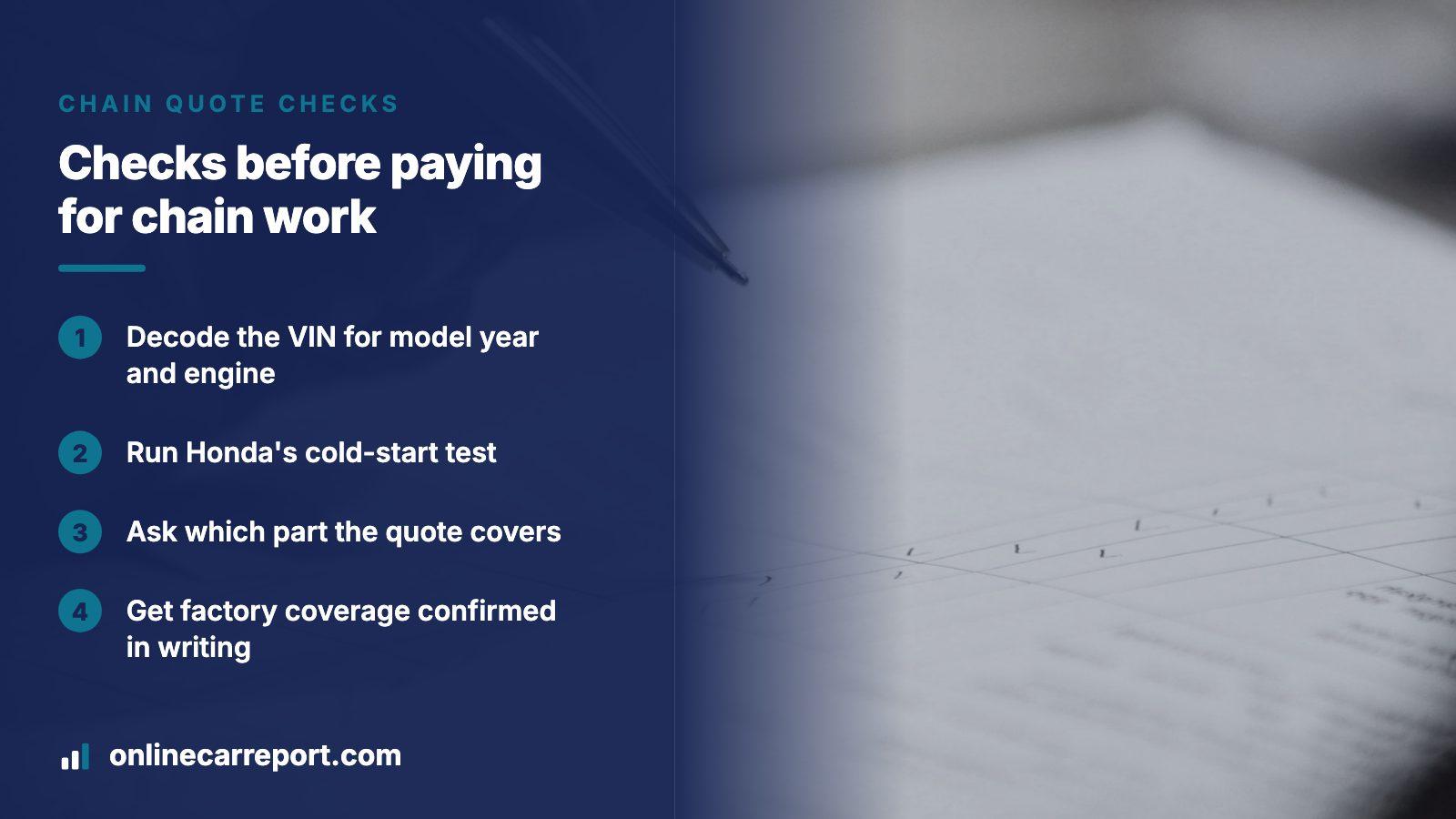
- Decode the VIN for model year and engine. Bulletin 19-019 reaches only four-cylinder cars from 2014 to 2017, and neither bulletin lists a 2013 Accord.
- Run the cold-start test from Honda's 09-010 diagnosis: leave the engine off at least 6 hours, start it, and listen during the first 2 seconds.
- Ask which part the quote covers, actuator, tensioner or full chain, and compare its hours with Honda's 2.0 and 0.6.
- If the check engine light has been on, ask for the scan printout.
- Have a Honda dealer confirm in writing what the factory covers on that VIN.
- Run the VIN for open recalls, then odometer, title, damage and auction entries, before you settle on a price.
Where this information comes from
- Honda Service Bulletin 09-010, version 4 (NHTSA copy) — The 2008 to 2012 actuator fix, its 2.0-hour allowance, the part number and the warranty line.
- Honda Service Bulletin 19-019 (NHTSA copy) — The 2014 to 2017 four-cylinder tensioner fix, its 0.6-hour allowance and the affected VIN ranges.
- RepairPal: Honda Accord timing chain tensioner estimate — The per-year Accord ranges, as recorded in September 2026.
- RepairPal: timing chain replacement estimate — The generic full chain labor and parts figures, which name no model.
- NHTSA owner complaint 10915238 — owner experience, paraphrased
- NHTSA owner complaint 11012331 — owner experience, paraphrased
- NHTSA owner complaint 11656921 — owner experience, paraphrased
Sources and photos: Facts checked against the sources above in November 2026. Photos by Victor Hughes, Masjid MABA and Mustafa Sheikhmouss on Unsplash; diagrams by OnlineCarReport.
Keep reading
- Car value by VIN: what the number tells you and how history moves itHow a VIN gives an Accord its starting value before a repair bill comes off.
- Honda CR-V timing chain replacement cost, and what a quote means for the car's valueBulletin 19-019 also covers 2015 to 2017 CR-Vs, so the same tensioner question applies.
- Used car with no service history: what it does to the price and what to checkWhat to do when a seller has no invoices for work like this.
- Honda Accord head gasket replacement cost, and what a leaking one does to valueAnother costly Accord engine repair, priced the same way.
Frequently asked questions
What should a Honda Accord timing chain job cost?
RepairPal's generic page, which names no model, puts the labor on a full chain job at $1,334 to $1,957, with $786 to $807 more for parts. Its Accord tensioner estimate is lower, from $382 to $1,132 across the model years. One 2008 owner's dealer bill for a stretched chain was $1,562.90.
Is a cold-start rattle on my Accord a timing chain problem?
Usually Honda points elsewhere. Bulletin 09-010 blames a defective VTC actuator on 2008 to 2012 cars, and bulletin 19-019 blames a worn tensioner check valve on 2014 to 2017 four-cylinders. Camshaft position codes or stalling are the signs that move suspicion toward the chain.
Does Honda pay for a timing chain, tensioner or actuator repair?
Not as a recall. Both bulletins say the normal warranty applies. Honda's 09-010 text lists 5 years or 60,000 miles of powertrain coverage, with longer emissions coverage in California and for PZEV cars. A car outside those terms pays its own bill, so ask a dealer to check by VIN before work starts.
Which Accord model years do Honda's two bulletins cover?
Bulletin 09-010 lists every 2008 to 2012 Accord, all trims. Bulletin 19-019 lists four-cylinder Accords: all of 2015 to 2017, and 2014 cars inside VIN ranges set by trim. Neither lists a 2013 Accord, so a quote on that year needs its own diagnosis.
Can a VIN report show whether an Accord's timing chain was replaced?
No. Shop work is not part of a VIN history, so the seller's invoice is the only proof. The report does show what moves the price around that repair: odometer readings, title brand, damage and auction records, open recalls and market value.
Now check the car itself
The guide explains what to look for. The report shows what this VIN has on record.