THE SHORT ANSWER
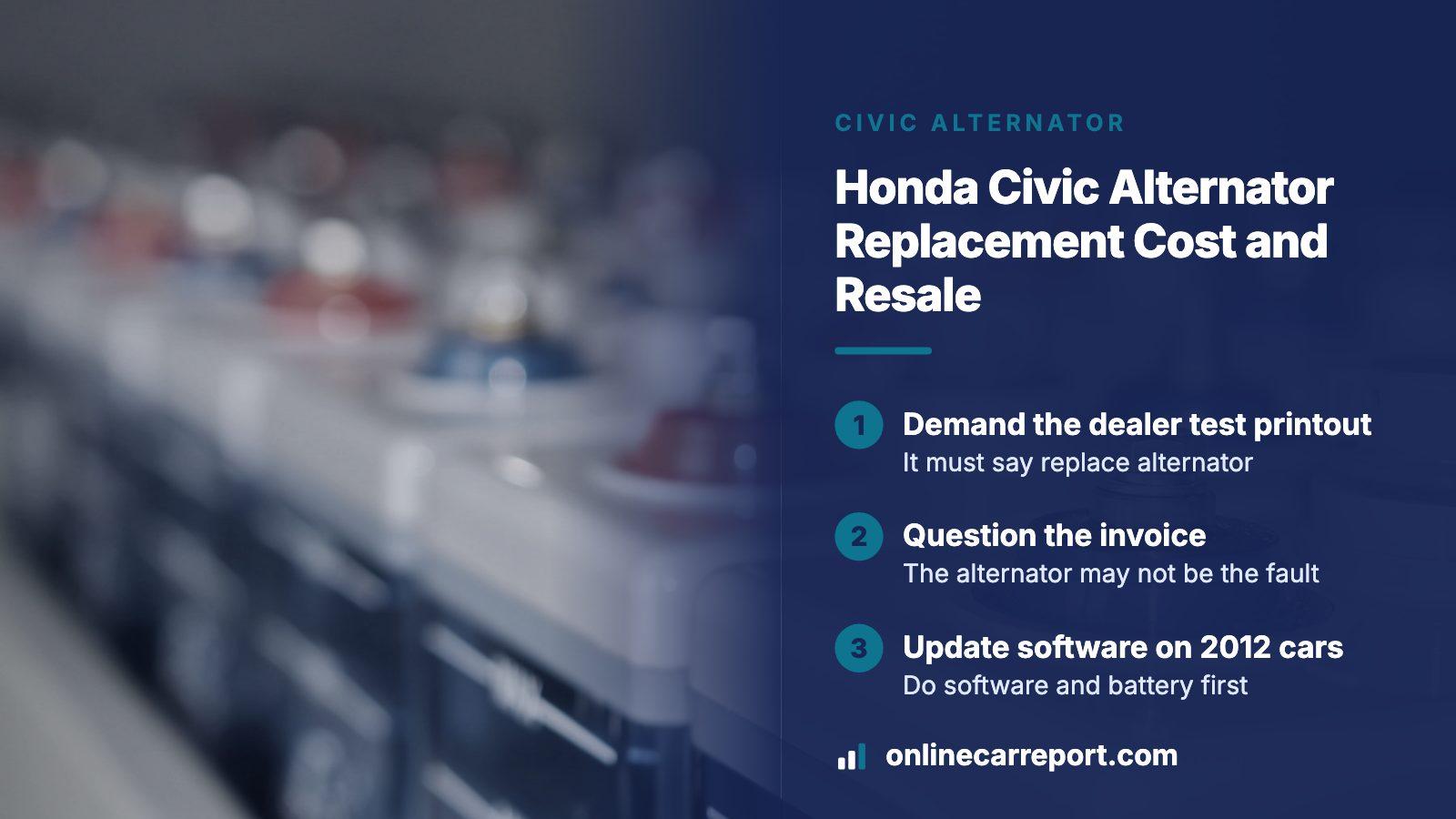
Plan on roughly $770 to $1,220 for a Civic alternator, labor included, according to one estimate site, with tax extra. Borrow Honda's dealer rule: get a printed charging-system result that says the alternator failed before approving the part. On a 2012 car the software and battery come first, and on a Civic Hybrid a charging warning can point to a different part altogether.
- Estimate range
- $770 to $1,220 installed, before tax
- Honda's alternator test
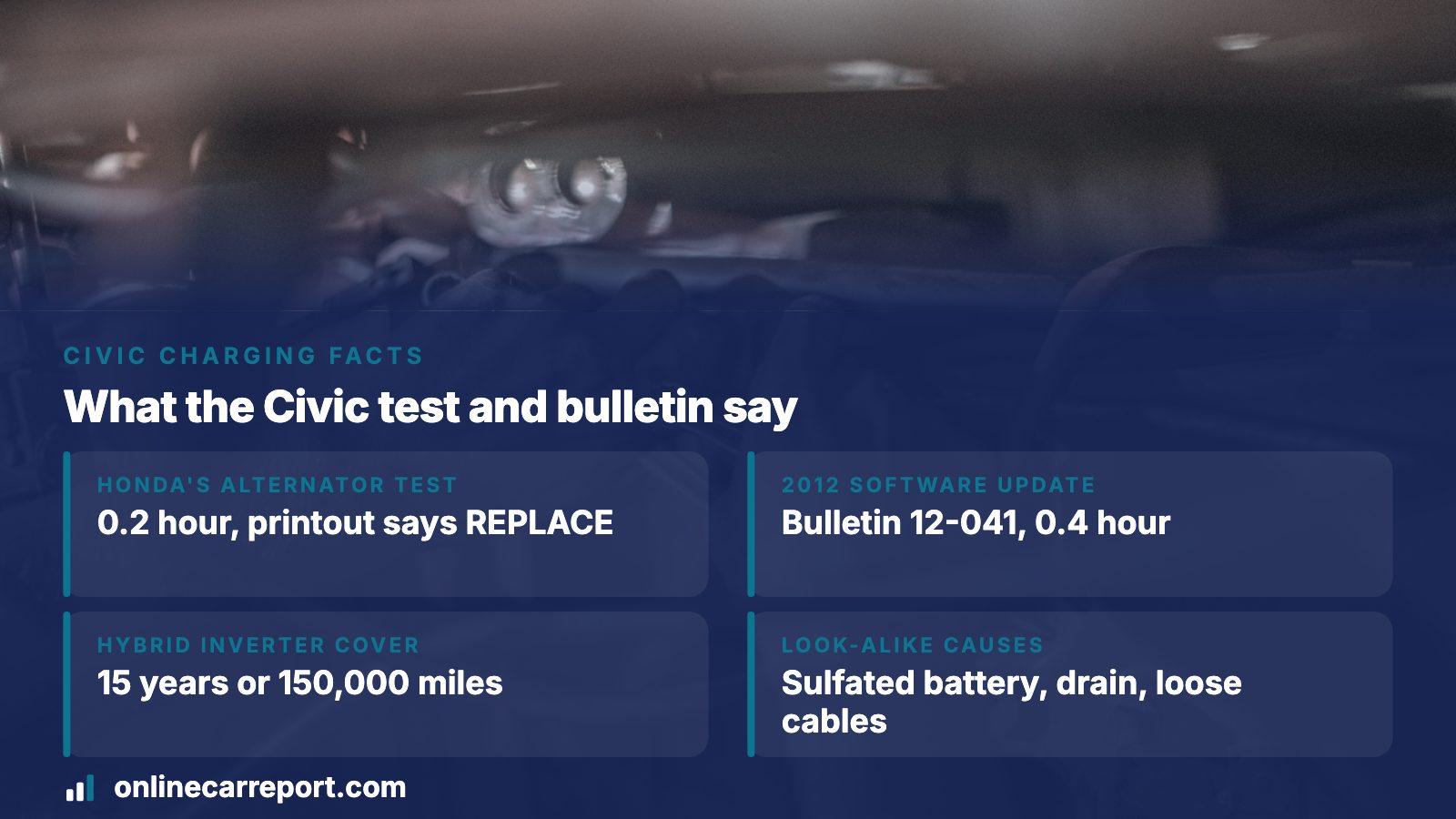
- 0.2 hour, printout must say REPLACE ALTERNATOR
- 2012 software update
- Bulletin 12-041, 0.4 hour
- Hybrid inverter cover
- 15 years or 150,000 miles
One estimate, and what a parts seller lists
RepairPal's Civic alternator page averages $770 to $1,220, made up of $207 to $303 in labor and $563 to $917 in parts, with tax left out. For a 2021 Civic the same site lists $734 to $1,148. Those figures were read from search listings in October 2026, because the page itself turns away direct requests. Treat them as one source's average, not a quote for your car.
| 2018 Civic part number | Trims it is listed against | List price |
|---|---|---|
| 31100-5BA-A01, new Honda | LX, Sport, EX and SE | $769.88 |
| 31100-5PA-A01, new Honda | EX-T, Si and Touring | $742.81 |
| 31100-5BA-A01RM, Honda rebuilt | The rebuilt version of the first number | $643.85 list, with a $75.00 core charge added |
Retail sites often sell under list, and aftermarket rebuilt units cost less. Honda's own labor time for the job was not found, so the estimate site's labor range is the only labor figure here. Have any quote split into part, labor, tax and core.
Prove the alternator failed: the test Honda makes dealers run
Honda Service Bulletin 12-002, dated January 12, 2012 and written for 2005 to 2012 models, requires its GR8 tester for any alternator warranty job. The tester produces a 15-digit code, and the claim goes back unpaid unless the attached printout reads REPLACE ALTERNATOR. Honda books the test at 0.2 hour.
The first step is a conversation, not a tool: the technician asks what led up to the trouble. The bulletin names headlights or cabin lights left on, normal headlight flicker and add-on accessories that drain the battery as frequent causes of charging complaints. Step two is a look at the battery cables and ground straps for dirt or looseness.
Use Honda's rule on your own bill
Ask the shop for the printed charging test and a battery test result before you approve the part. If neither exists, you are paying for a guess.
When the alternator on the invoice was not the fault
An invoice with an alternator on it proves a part was sold. It does not prove the car's problem was solved, as one federal owner complaint shows.
From an NHTSA owner complaint
A 2012 Civic owner told NHTSA in March 2021 that the steering locked while exiting a highway in December 2020. The mechanic blamed the alternator, fitted one and billed for it. After a return visit the steering motor was replaced, yet the wheel still locks after startup, with about 81,491 miles on the car. The owner wrote, "I was charged for the alternator," and asked Honda for reimbursement.
The takeaway: on a used Civic, an alternator line on a service record shows what was bought, not whether the original fault was found.
2012 Civics: software and battery come before the part
On the 2012 Civic, a battery sensor reports to the engine computer, which sets how the battery is charged. Honda's July 23, 2014 revision of Service Bulletin 12-041 says the computer may pick the wrong mode when the battery has sulfated and the car is driven in certain ways, and the car may then refuse to start on a low battery. Coverage is set by VIN range and includes 2012 coupes and sedans, the Hybrid, Natural Gas and Si.
The remedy is a software update with a battery check, booked at 0.4 hour and paid only under normal warranty. Honda adds that a jump-start should get the car to a dealer rather than charge the battery, and that repeated jump-starts have other causes to rule out:
- the alternator itself
- a battery weakened by sulfation
- a slow electrical drain with the car off
- loose battery cables
What a true alternator failure looks like
A battery that is flat at dawn but charges up on a drive usually suggests a drain or an aging battery. An alternator fault tends to show while the engine runs: a warning that stays lit, lights dimming, or a car that quits in traffic.
From an NHTSA owner complaint
A 2019 Civic owner reported in June 2025 a 12-volt charging warning on the road. Within about a mile came tire-pressure, brake and power steering alerts, then the steering assist failed and the wipers stopped in heavy rain. Roadside diagnostics found "the alternator was dead," and the car was towed, leaving the owner unable to drive to work.
Read it as a pattern: the car runs on stored battery power while one system after another drops out as voltage sags.
Civic Hybrid: the charging light can point elsewhere
Honda's December 18, 2020 dealer message announces a warranty extension for certain 2012 to 2015 Civic Hybrids, covering the intelligent inverter unit. A solder joint on its circuit board can break over time, and Honda says such a break can switch on the 12-volt battery warning light and leave that battery getting less power. The warranty runs for 15 years from purchase or 150,000 miles, whichever arrives first.
From an NHTSA owner complaint
A 2013 Civic Hybrid owner wrote in September 2025 that the hybrid system's DC-to-DC converter failed on August 27 and took the car's 12-volt supply with it. The owner stressed the car has no traditional alternator, said Honda's bulletin and extended warranty did not reach this VIN range, and noted a scan returned the codes that bulletin lists.
A quote for an alternator on a Hybrid whose charging light is lit deserves one question first, namely whether a Honda dealer has run the VIN against this extension.
How the car's history changes what the repair is worth
A used Civic's value starts from its build and the local market, then moves with its record. A documented alternator swap usually subtracts about the bill, since the next owner would otherwise pay it. Charging trouble nobody diagnosed costs more, because buyers price the doubt too. A title brand, damage entries, odometer readings and auction history tend to move the price further than a single repair, so the VIN record belongs beside the quote.
- A VIN history shows the title brand, damage entries, odometer readings, auction listings with photos, open recalls and a market value.
- It does not hold a shop's parts invoice. For that, ask the seller for paperwork showing part, date and mileage.
OnlineCarReport pairs a VIN's history with its market value. Begin with the preview, which costs nothing; a full report is one payment rather than a subscription, with the pricing page covering the options.
Six checks before you pay, or before you buy the car
- Ask for the printed charging test and a battery test, with dates.
- Look up open recalls on the VIN before paying for electrical work.
- On a 2012 car, confirm with a dealer that the 12-041 update has been installed.
- On a Hybrid, have a dealer match the VIN to the inverter extension.
- Get the part's source in writing: new Honda, Honda rebuilt or aftermarket rebuilt, and the core terms.
- Keep the invoice with part, date and odometer reading for the next buyer.
As a buyer, turn the list into questions for the seller. A new alternator with no paperwork deserves a lower offer.

Where this information comes from
- Honda Service Bulletin 12-002 (NHTSA copy) — The tester code, the REPLACE ALTERNATOR printout and the 0.2-hour test time.
- Honda Service Bulletin 12-041 (NHTSA copy) — The 2012 charge-mode software update, its VIN ranges and the other causes of repeated jump-starts.
- Honda dealer message, December 2020 (NHTSA copy) — The Civic Hybrid inverter warranty extension and its coverage limits.
- RepairPal: Honda Civic alternator replacement estimator — The $770 to $1,220 average, read from search listings in October 2026.
- NHTSA owner complaint 11399216 — owner experience, paraphrased
- NHTSA owner complaint 11665531 — owner experience, paraphrased
- NHTSA owner complaint 11688991 — owner experience, paraphrased
Sources and photos: Facts checked against the sources above in November 2026. Photos by Vanya Smythe, Scott Graham and Nina Mercado on Unsplash; diagrams by OnlineCarReport.
Keep reading
- Car value by VIN: what the number tells you and how history moves itHow a VIN gives a Civic its starting value before any repair is subtracted.
- Honda Civic starter replacement cost, and what it does to a used Civic's valueThe other part blamed when a Civic will not start.
- Honda Civic Hybrid battery replacement cost, and what it does to the car's valueThe Hybrid's high-voltage pack, priced apart from its 12-volt supply.
- Used car with no service history: what it does to the price and what to checkWhat to do when a seller cannot show invoices for repairs like this one.
Frequently asked questions
How much does a Honda Civic alternator replacement cost?
One estimate site averages $770 to $1,220 installed, before tax, and $734 to $1,148 for a 2021 Civic. Parts drive the spread: a Honda parts seller listed a 2018 Civic's new unit at $742.81 or $769.88 by trim, and a rebuilt Honda unit at $643.85 with a $75.00 core charge on top.
Alternator or battery: how do I know which one my Civic needs?
Ask for the charging-system test. Honda wants a printed REPLACE ALTERNATOR verdict before it pays dealers for the part, and its bulletin lists lights left on and battery-draining accessories as common causes. Have the battery tested too, since a weak battery is the cheaper repair.
Does a Civic Hybrid use a regular alternator?
One owner's NHTSA complaint says it has no traditional alternator, and Honda's 2020 dealer message ties a charging warning on certain 2012 to 2015 Hybrids to the inverter unit. Before paying for an alternator on a Hybrid, have a dealer check the VIN for that extension.
Will a new alternator raise my Civic's resale value?
It mostly removes a deduction rather than adding value, because buyers expect charging to work. A kept invoice with date and mileage helps. The price still follows the wider record: title brand, damage entries, odometer readings and open recalls.
Can a VIN history report show whether the alternator was replaced?
No. Repair invoices stay with the shop and the owner. A VIN history covers title brands, damage, odometer readings, auction records and open recalls, which show how much a charging repair matters. For the repair itself, ask the seller for paperwork.
Now check the car itself
The guide explains what to look for. The report shows what this VIN has on record.