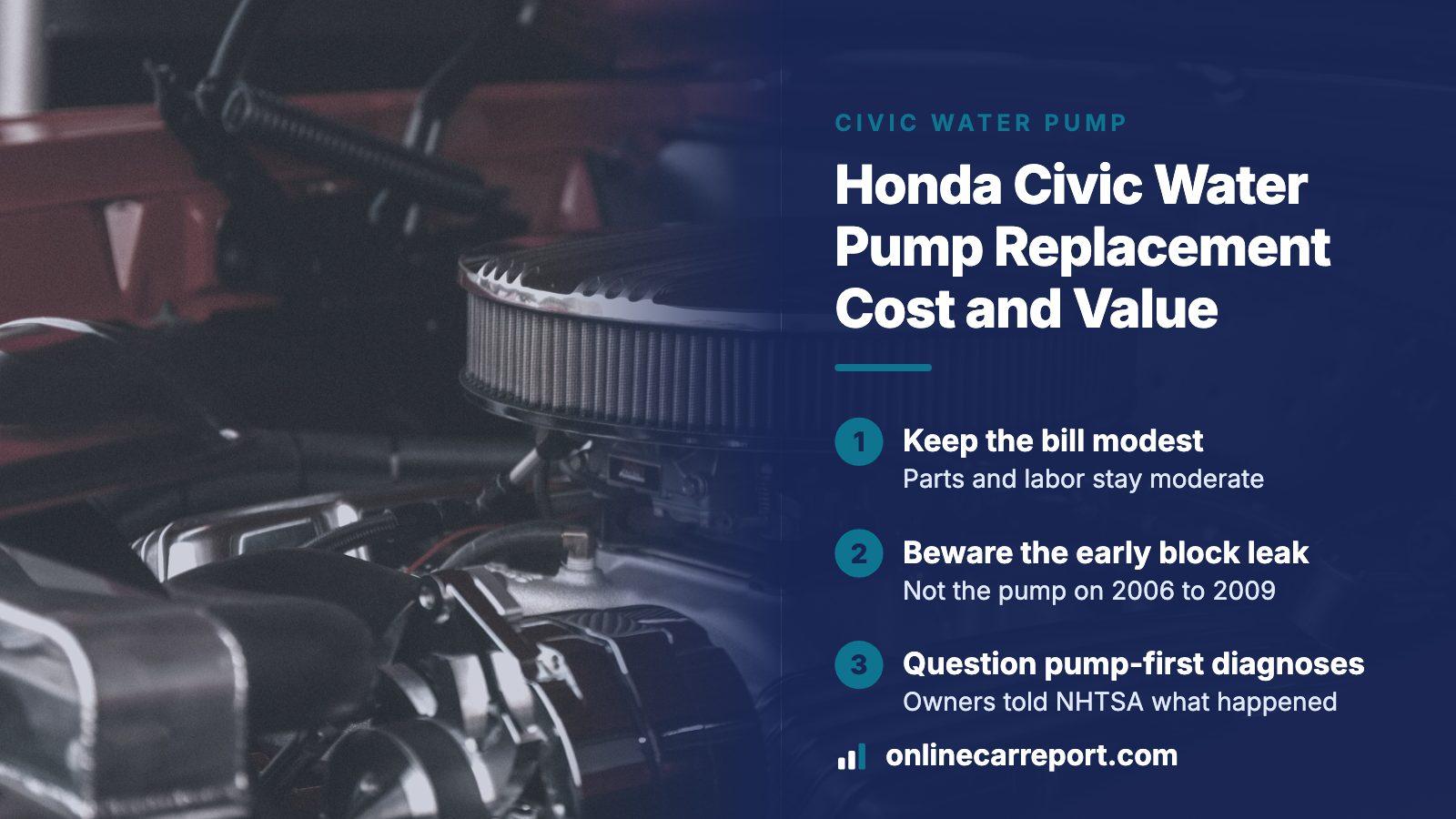
THE SHORT ANSWER
Plan on roughly $641 to $807 at a shop, per RepairPal, with $334 to $356 of it for the part and $307 to $451 for labor. Kelley Blue Book posts a looser $375 to $787 with no ZIP code supplied. No NHTSA recall names the pump. On a 2006 to 2009 Civic, rule out a cracked block before buying a pump, since the block is the costly repair.
- RepairPal average
- $641 to $807
- Parts / labor
- $334 to $356 / $307 to $451
- Block bulletin
- Honda 10-048, 2006 to 2009
- Pump recalls
- None found, 2006 to 2022
What shops charge for a Civic pump, and whose numbers they are
Three public estimators give three different ranges, and none of them repairs cars. RepairPal's Civic page averages $641 to $807, split between $307 to $451 of labor and $334 to $356 of parts, before taxes and fees. Kelley Blue Book prints $375 to $787 if you give it no location. Haynes covers Civic generations back decades and says $50 to $600, with 30 minutes to 6 hours of work.
| Source | Range for a Civic pump | Note |
|---|---|---|
| RepairPal | $641 to $807 | Average, parts and labor split out |
| Kelley Blue Book | $375 to $787 | Shown without a ZIP code |
| Haynes | $50 to $600 | Spans many Civic generations |
A quote far outside the RepairPal band deserves a question about what else is on the invoice.
Why the Civic pump bill stays modest
Pump bills are mostly labor, and labor depends on how much engine sits in front of the pump. On the 1.8-liter Civic, Honda's parts catalog sells a separate pump pulley, a sign that the pump turns off the accessory belt where a mechanic can reach it. The 2.0-liter pump carries a part number that shows up in Acura bulletin 17-030, a belt-side job that Honda books at 1.2 to 1.4 hours. That bulletin never names the Civic, so treat it as scale only.
Nothing here calls for a timing belt: all 2006 to 2022 gas Civic engines use a chain. For the 1.5-liter turbo I found no Honda document on the pump drive, so have the shop write the part number and labor hours on the estimate.
The 2006 to 2009 trap: a leak that is not the pump
Honda bulletin 10-048 covers an engine block that can crack and weep coolant on some 2006 to 2008 and early 2009 Civics. A low reservoir, a damp engine front and a rising gauge are what owners see, which is exactly what a failing pump looks like. Honda lengthened the block warranty to 10 years counted from the purchase date, no mileage cap, and left out any car that had been a total loss or carried a branded title.
That coverage has run out on every eligible car. Honda's dealer flat rate for a replacement block is 12.6 hours, since the engine and transmission come out together. Next to a belt-side pump, that is a different size of bill, and on an old Civic it may settle whether repair makes sense at all.
What owners told NHTSA about pump-first diagnoses
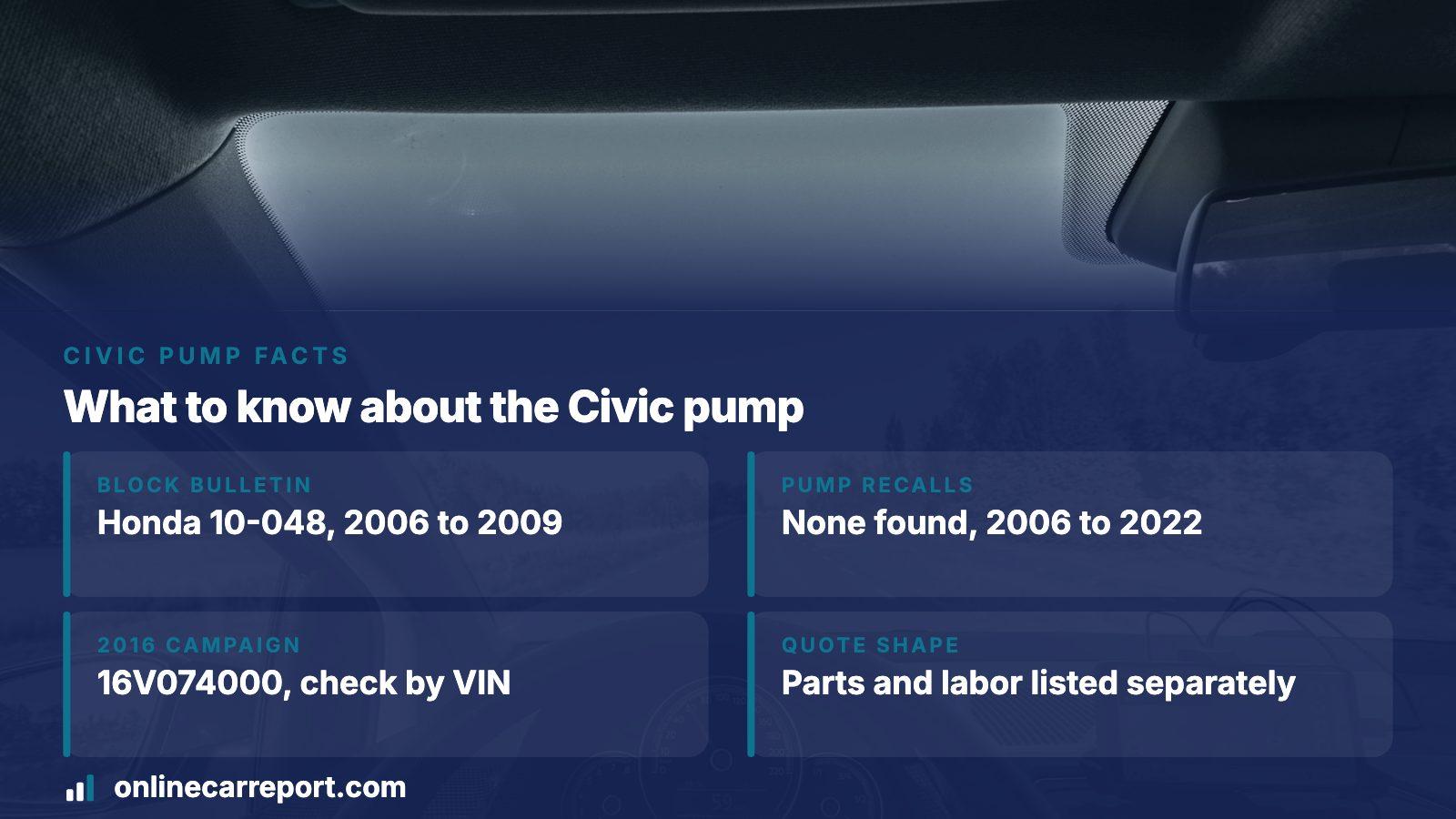
NHTSA keeps no separate pump category, so these cases sit under the engine heading. In the 2008 and 2009 Civic complaints a pattern repeats: a shop replaces the pump, the trouble returns, and then somebody finds the crack.
From an NHTSA owner complaint
The owner of a 2009 Civic Si described an overheating car that a mechanic and then the dealer both blamed on the pump. That repair cost $730, and the overheating returned the same night. The dealer finally found the block leak, but the VIN was not on Honda's eligible list, so a $5500 repair landed on a family that still owed $10,500 on the car. Before paying for a pump on a 2006 to 2009 Civic, ask the shop to inspect the block and check the VIN against the bulletin.
Pumps do fail, but on these cars the invoice proves little until the block has been examined.
How a cooling problem changes the car's value
A used Civic is priced from similar cars in sound shape, then marked down for work it needs. A confirmed pump job is a small markdown, about the size of the quote. An unexplained coolant loss on a 2006 to 2009 car is bigger, because the buyer is pricing a possible block and the warranty that once covered it has expired.
History matters here too. Honda's bulletin excludes branded-title cars, so a salvage brand can remove the one coverage that would have paid for a block. A VIN report that surfaces any brand on the title, the mileage trail and auction listings lets you value the car from its documented record, not the seller's account.
When the seller says the engine was already replaced
Some sellers say Honda already fitted a new block. Ask for proof.
From an NHTSA owner complaint
A buyer of a used 2008 Civic wrote that the dealer claimed Honda had already swapped the block under the leak program. Three days after the sale the gauge went to hot, and the dealer called it a loose wire. Months later the car would not start, a garage replaced a pump, and the block proved to be cracked. The Honda dealer then wanted $110 just to look. Ask to see the repair order for a block replacement, and have the car pressure-tested before you pay.
A record you can read beats a promise at the counter. A history report adds the title and mileage picture around it.
Prove the pump is at fault before paying
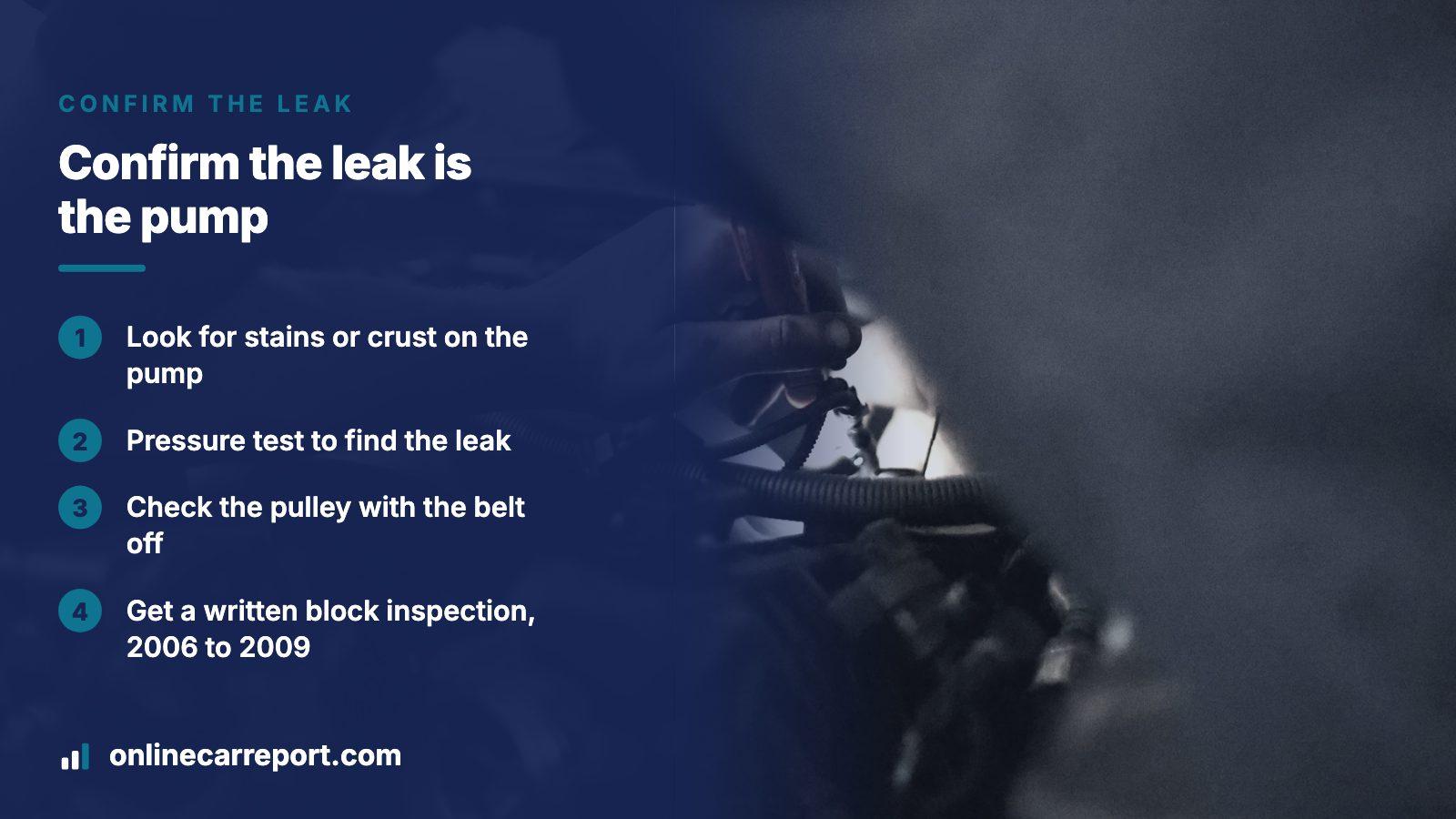
Several parts can leave the same puddle, so a good shop locates the source first.
- Coolant stains or crust on the pump body itself, rather than elsewhere on the engine.
- A pressure test that shows where the system loses coolant.
- A rough or loose pulley with the belt removed, or a growl that rises with engine speed.
- On a 2006 to 2009 car, a written inspection of the block for the cracks the bulletin describes.
- On a 2016, the VIN run for campaign 16V074000, and on a 2017 hatchback, for Honda update 17-020.
Dried residue at the weep hole is normal on a worn engine; a live drip is not.
Recalls and bulletins near the cooling system
Free replacement regardless of age happens only through a recall. NHTSA's data for 2006 through 2022 Civics lists none that mentions the pump, coolant loss or overheating. It does list 16V074000, an engine campaign for some 2016 Civics built with the 2.0-liter, over piston pin clips. That is unrelated to the pump, yet it justifies running the VIN ahead of any engine work.
Honda's update 17-020 of April 5, 2017 applies to 2017 Civic 5-Door cars with a three-way coolant joint that may be blocked. A bulletin, unlike a recall, pays only while a warranty applies.
Before you buy a used Civic, or price your own
At high mileage a pump receipt barely moves the price. On a 2006 to 2009 car, a documented block replacement is the receipt that counts. Run the VIN first. You see a preview at no charge, then decide on a one-time purchase, no subscription; options sit on the pricing page.
On this topic the useful sections are the title record, mileage readings, accident entries, salvage photos, open recalls and the estimated value. It cannot say whether a pump or block was replaced, so pair it with service records and an independent inspection.
Where this information comes from
- Honda bulletin 10-048: Warranty Extension, Engine Block — block coolant leaks on 2006 to 2009 Civics; 10-year coverage; 12.6-hour flat rate
- NHTSA recalls by vehicle, 2016 Civic — shows recall 16V074000; no pump or coolant campaign found
- RepairPal: Honda Civic water pump replacement — the $641 to $807 average and its parts and labor split
- Kelley Blue Book: Civic water pump replacement — the general $375 to $787 range
- Haynes: change the water pump, Honda Civic — wide time and cost range across Civic generations
- NHTSA owner complaint 10981345 — owner experience, paraphrased
- NHTSA owner complaint 11112536 — owner experience, paraphrased
Sources and photos: Facts checked against the sources above in November 2026. Photos by Victor Hughes, Mustafa Sheikhmouss and Sander Jeurissen on Unsplash; diagrams by OnlineCarReport.
Keep reading
- Honda Civic head gasket replacement cost, and who may be paying itThe other coolant-loss repair buyers confuse with a pump.
- Honda Civic starter replacement cost, and what it does to a used Civic's valueAnother common Civic repair bill to price into an offer.
- Car value by VIN: what the number tells you and how history moves itSee how a VIN-based value is built from the car's record.
- Diminished value calculatorUnderstand how history and repairs pull a price down.
Frequently asked questions
How much does a Honda Civic water pump replacement cost?
RepairPal's Civic page lists $641 to $807 on average, with $334 to $356 for parts and $307 to $451 for labor, before taxes and fees. Kelley Blue Book shows $375 to $787 without a ZIP code. Those are the publishers' figures, so get a written local quote that names the part number and the hours.
Does a Civic water pump come with a timing belt job?
No. Gas Civic engines built from 2006 to 2022 all run a timing chain, leaving no belt to swap. The 1.8-liter engines have their own pump pulley in Honda's catalog, so the pump spins on the accessory belt. A quote that includes a timing belt kit for one of these cars was written for the wrong engine.
Why does my 2008 Civic lose coolant when the pump is new?
Suspect the block. Honda bulletin 10-048 describes cracked casting on some 2006 to 2008 and early 2009 Civics, and owners told NHTSA they paid for a pump before another shop found the crack. Request a pressure test with a direct inspection of the block, then weigh the repair against the car's worth.
Is there a recall on Honda Civic water pumps?
Not that I found. NHTSA recall data for 2006 through 2022 Civics lists no campaign about a water pump, coolant or overheating. Enter your VIN on NHTSA's recall page anyway, because campaigns are added over time and 2016 and 2017 cars have engine and coolant items worth checking.
Can a vehicle history report tell me if the pump was replaced?
No. A VIN report shows title brands, odometer readings, accident and salvage records, open recalls and market value, but not shop work. It helps you judge the car around a repair claim. For the repair itself, ask for the service invoice and get an independent inspection.
Now check the car itself
The guide explains what to look for. The report shows what this VIN has on record.