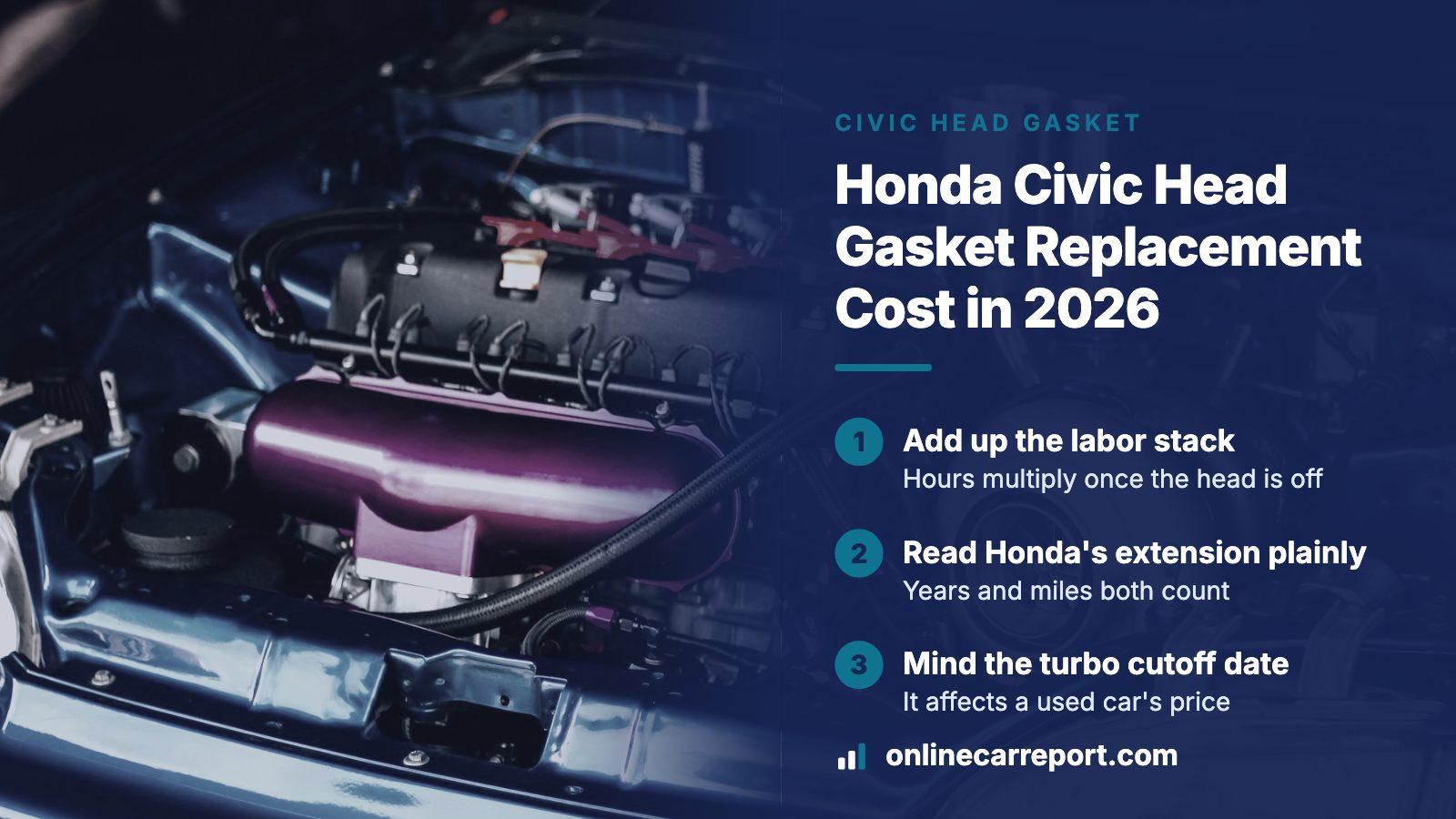
THE SHORT ANSWER
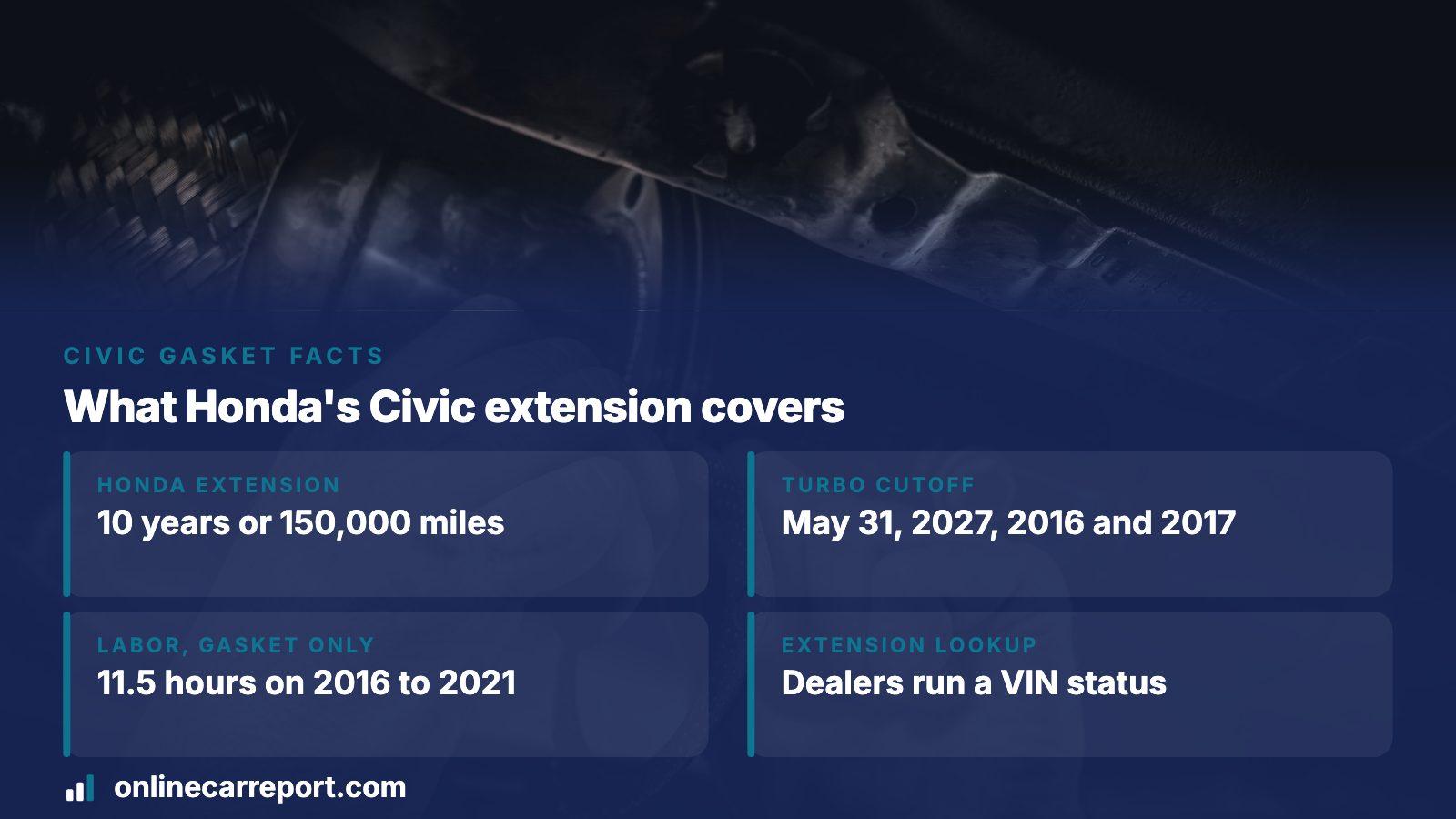
RepairPal's average sits between $2,275 and $3,099 before tax and fees. Honda's extension may apply, up to 150,000 miles or 10 years, to a 2016-or-later Civic with the 1.5-liter turbo, plus the Si. Turbo cars from 2016 and 2017 have a shorter window, closing May 31, 2027. Civics with the non-turbo 2.0-liter, 2016 through 2024, are left off Honda's list. Have a dealer look up your VIN before you pay a shop.
- RepairPal average
- $2,275 to $3,099
- Honda extension
- 150,000 miles or 10 years
- 2016 and 2017 turbo cutoff
- May 31, 2027
- Honda labor, gasket only
- 11.5 hours on 2016 to 2021 cars
What a shop quote should look like
RepairPal's Civic page splits the average into $1,546 to $2,268 of labor and $729 to $831 of parts, with tax and fees left out. The gasket is a small part of that. Most of the invoice pays a technician to drain the coolant, disconnect the intake and turbo plumbing, and lift the head.
Use the range as a yardstick, not a promise. A quote far above it should come with the reason in writing, and the likeliest reason is a head or engine block that turns out to be warped.
How the hours stack up once the head is off
Honda pays its dealers by the hour under the extension, and those hours show how a repair snowballs. They are flat-rate figures, not what you would be charged at a retail counter.
| Outcome after inspection | Honda hours, 2016 to 2021 1.5T |
|---|---|
| Gasket only | 11.5 |
| Gasket and a new head | 11.9 |
| Gasket and a short block | 14.7 |
| Head and short block both | 14.8 |
The short block is the expensive branch. Driving on a car that is losing coolant is the quickest way to land on it, so tow it instead.
Honda's August 2026 extension, in plain terms
Dealers received word from Honda on August 26, 2026 that head gasket coverage was being stretched for certain Civic, Accord and CR-V models. A Civic gasket is now covered for 150,000 miles or 10 years from first purchase, whichever ends sooner. Honda revised the bulletins on September 25, 2026.
That revision matters to anyone buying used. Honda also dropped any title test: a car that was once totaled, auctioned as salvage or branded is still eligible. A rebuilt-title Civic is therefore not shut out, though its title history still pulls the price down.
Bulletins by car
26-008 and 26-009 cover 2016 to 2021 turbos, and the Si from 2017 to 2020. 26-011 and 26-010 cover 2022 to 2024 turbos. Honda's list names the turbo engine and the Si only.
The 2016 and 2017 cutoff and what it does to a used price
Most 2016 cars have passed 10 years, so Honda issued a separate pair: 26-099 for cars with the CVT, and 26-097 for stick-shift cars and the 2017 Si. Both expire on May 31, 2027, and the third version drops the age and mileage limits entirely. Repair orders written after that date are not valid.
For a shopper, that makes the calendar part of the price. A 2016 or 2017 turbo with a head gasket not yet done carries a liability that grows heavier every week after next spring. Ask what has been repaired, and when.
What owners filed with NHTSA
NHTSA keeps no head gasket category, but owner narratives mention it. Two 2017 Civic filings from 2026 show how the failure looks from the driver's seat.
From an NHTSA owner complaint
A 2017 Civic owner reported losing power on the road in April 2026 and crawling to safety below 15 miles an hour. A dealer replaced fuel injectors for a cylinder three code, but the fault came back twice before a crack in the head gasket turned up.
The lesson: a misfire code can send a shop after the wrong part first. If coolant keeps vanishing, ask for a pressure test and a camera look into the cylinders.
From an NHTSA owner complaint
Another 2017 owner wrote that the gasket failed at 110,000 miles, was fixed by a Honda dealer, and failed again after 36,000 more. The car went into "limp mode" at highway speed with no earlier warning.
A repeat failure shows why a repair order, with the date and mileage, belongs in the file for the next owner.
How a dealer decides the claim is valid
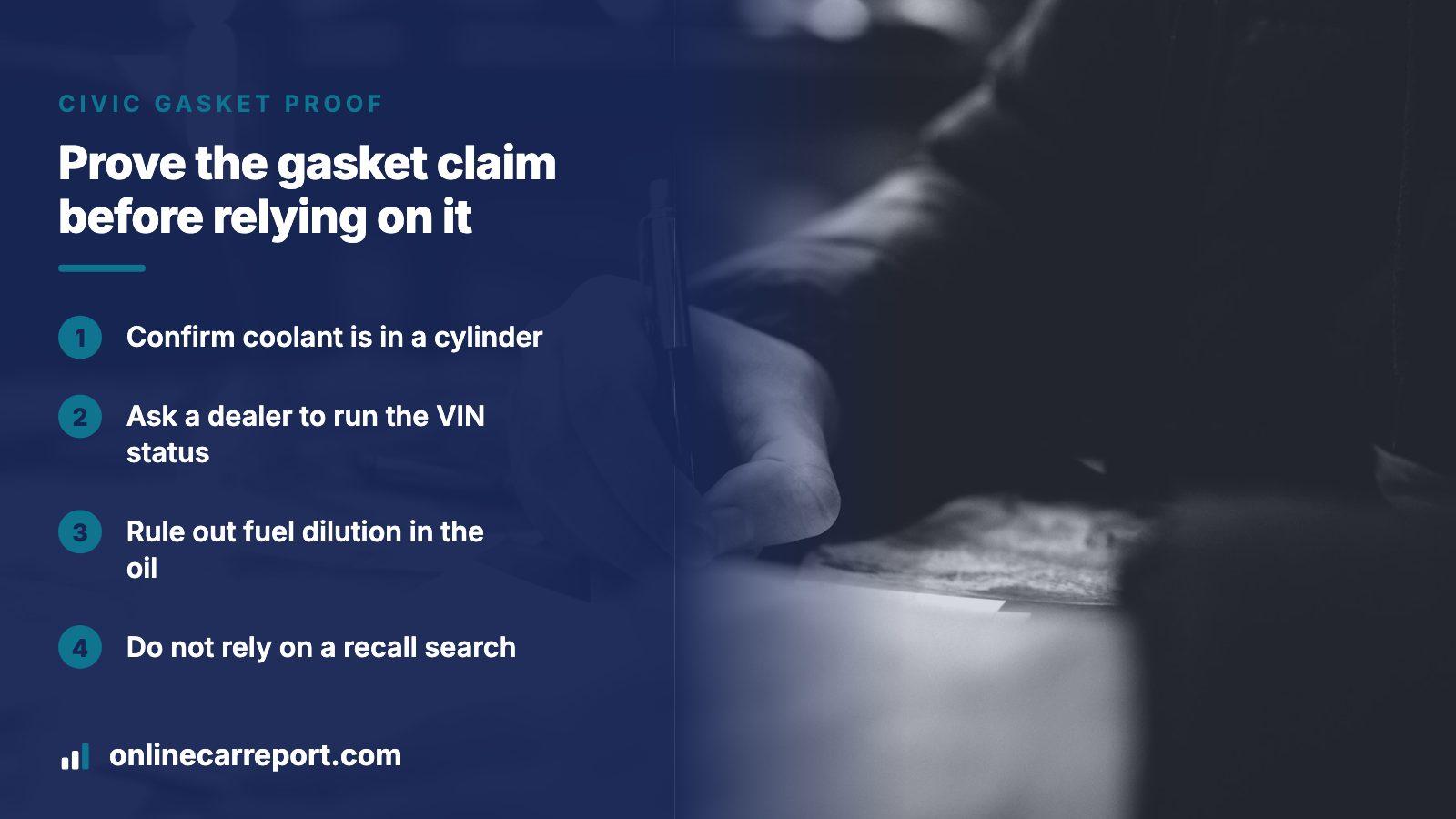
The bulletin sets a test. A technician pressurizes the cooling system to 18 psi once the engine is warm, pulls the spark plugs and runs a camera down each cylinder. Coolant on a cylinder wall is the trigger, and the shop photographs it with the VIN and repair order.
- No coolant in a cylinder means the bulletin does not apply.
- No letter in the mail proves nothing; dealers run a VIN status inquiry.
- Oil that climbs and smells of fuel is dilution, a different 1.5T fault.
- A recall search will not show the extension, since none names a gasket.
How a vehicle history report helps with this repair
A history report does not list shop work, so it cannot tell you whether a gasket was replaced. What it does show is the record that decides the car's market value: any title brand, logged damage, odometer readings and auction sales. Because Honda's coverage ignores a branded title, those entries set what the car is worth even when they leave the repair untouched.
OnlineCarReport matches a VIN's history to its market value. Start with the free preview; if it fits, buy the paid report one time; the pricing page spells out the details. Use it alongside the seller's invoices and a dealer's VIN inquiry.
Where this information comes from
- Honda dealer message, August 26, 2026 (NHTSA copy) — The list of Civic bulletins and the terms of the extension.
- Honda Service Bulletin 26-099 (NHTSA copy) — The 2016 and 2017 CVT coverage ending May 31, 2027, plus the inspection steps.
- Honda Service Bulletin 26-008 (NHTSA copy) — Flat-rate hours by repair outcome and the branded-title wording.
- RepairPal: Civic head gasket replacement estimate — The average cost range, as listed in October 2026.
- NHTSA recalls API: 2016 Honda Civic — Used to confirm no recall names a head gasket.
- NHTSA owner complaint 11735784 — owner experience, paraphrased
- NHTSA owner complaint 11726123 — owner experience, paraphrased
Sources and photos: Facts checked against the sources above in November 2026. Photos by Willian Cittadin, Owen Michael Grech and Martin Fennema on Unsplash; diagrams by OnlineCarReport.
Keep reading
- Honda Accord head gasket replacement cost, and what a leaking one does to valueThe same Honda extension, mapped across the Accord.
- Honda Civic water pump replacement cost, and what a leak does to the car's valueAnother cooling repair that can look like a failing gasket.
- Car value by VIN: what the number tells you and how history moves itHow a VIN's title and damage record sets a starting price.
- Subaru Forester head gasket replacement cost, and what the job does to the car's valueA head gasket repair on an engine with a longer track record.
Frequently asked questions
What should a Civic head gasket repair run me?
RepairPal lists $2,275 to $3,099 on average, before tax and fees, and labor is the biggest piece. Warpage in the head or block pushes the total up. On a covered 1.5-liter turbo, Honda's extension may pay instead, so have a dealer check the VIN first.
Did Honda recall the Civic for head gaskets?
Not one that names a head gasket. NHTSA's recall data for Civic model years 2008 through 2022 shows none. Honda used warranty extensions in August 2026, which a recall search will not list. A dealer's VIN status inquiry is how you learn whether your car is on one.
Does age rule out my 2016 or 2017 Civic?
Not when the engine is the 1.5-liter turbo. Bulletins 26-099 and 26-097 reach those cars through May 31, 2027, whatever the age or mileage. After that date a repair order under them is not valid. Book the inspection early rather than waiting for a deadline week.
Does a salvage or rebuilt title cancel Honda's coverage?
No. Honda's September 2026 revisions say a title brand or past total loss does not remove eligibility. The brand still lowers what the car is worth, so read the title record before you negotiate.
Will a vehicle history report show a head gasket repair?
No. Shops and owners hold repair invoices. A report covers title brands, damage entries, odometer readings, auction records and open recalls. Ask the seller for the repair order, which should list the date, mileage and the work done under Honda's bulletin.
Now check the car itself
The guide explains what to look for. The report shows what this VIN has on record.