
THE SHORT ANSWER
Expect somewhere around $166 to $208 as a general estimate, with older trucks priced lower and a 2021 priced higher. The exact job depends on trim, because 2016 to 2022 Pilots mix a 6-speed and a 9-speed automatic. A decode by VIN settles which one you have. For value, a documented fluid service helps a little, while a replaced transmission or an unexplained gap in records weighs on the price.
- General estimate
- $166 to $208 (RepairPal)
- 2016-2022 split
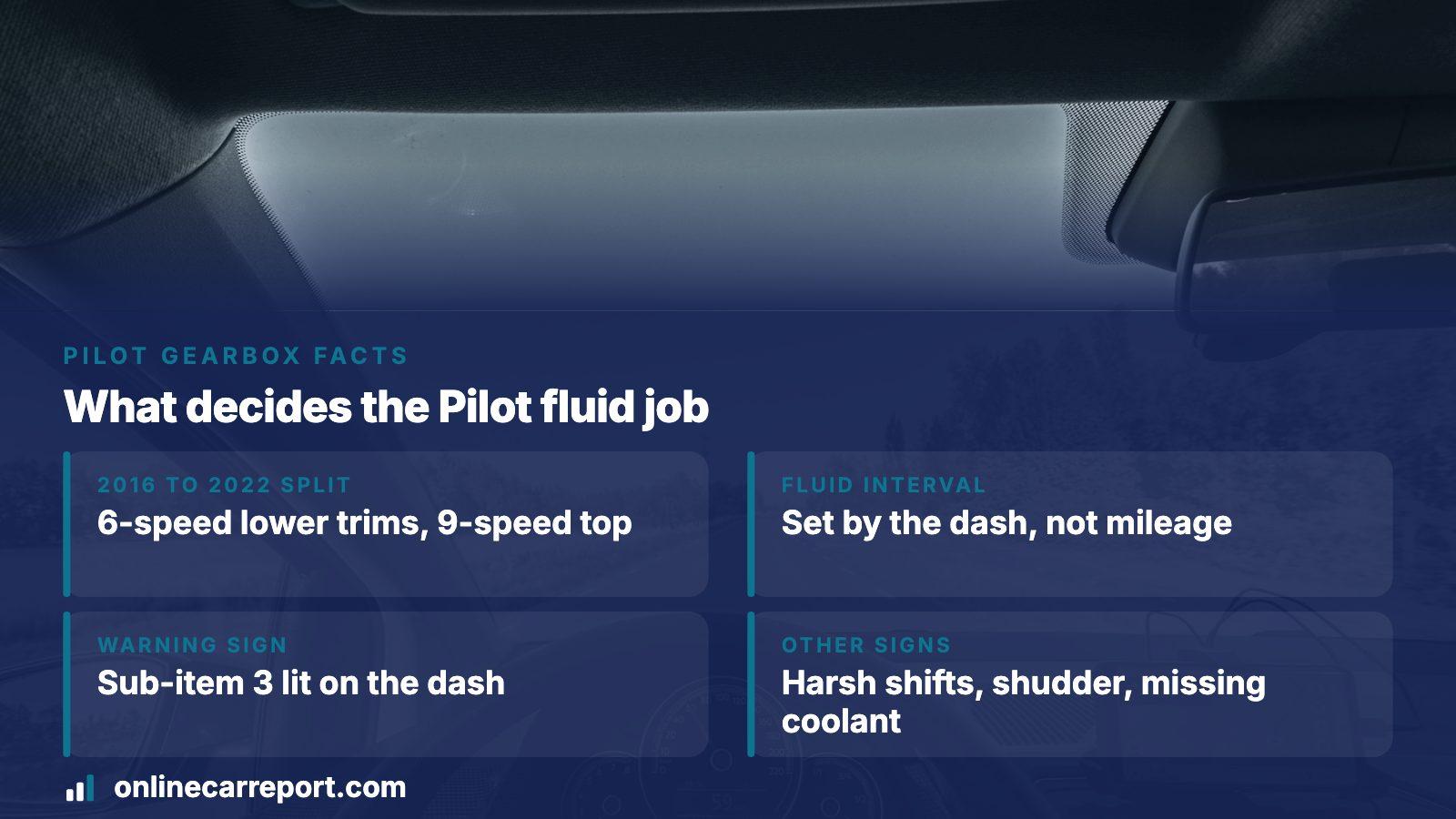
- 6-speed on lower trims, 9-speed on top trims
- Fluid interval
- Set by the dash, not a fixed mileage
- Preview
- Free; the full report is one payment
What the published estimates say, and who wrote them
RepairPal gives a general figure of $166 to $208 for this job on a Pilot. Break it down by year and the spread widens. Older trucks (2012, 2015) show $105 to $133, a 2016 shows $143 to $194, and a 2021 climbs to $247 to $321. Kelley Blue Book prints a single 2012 dealer quote of $245 to $395, made up of $151 to $177 in parts plus $185 to $218 of labor time.
These are other companies' estimates, and OnlineCarReport does not sell repairs or quote any. Use them to sanity-check a shop's number, then ask for the quote broken down by fluid, quantity and labor. A single flat line called a transmission service hides the part you most want to compare.
Trim decides which transmission you are paying to service
On the 2016 to 2022 Pilot, the split runs by trim rather than by year. LX, EX and EX-L trucks carry a 6-speed automatic, and Touring and Elite trucks carry a 9-speed. A 2017 EX and a 2017 Elite share a model year and a badge, yet they are different fluid jobs.
| Trim, 2016-2022 | Automatic transmission |
|---|---|
| LX | 6-speed |
| EX and EX-L | 6-speed |
| Touring | 9-speed |
| Elite | 9-speed |
A year-only estimator cannot ask which one you drive, so it averages. A VIN decode reads the trim straight from the number and removes the guesswork before any quote.
What a fluid service does to the price a Pilot can sell for
Buyers pricing a used Pilot compare it to a market figure for its year, mileage and trim, then adjust for what they can prove. A receipt showing the transmission fluid was changed on schedule is a small plus. It will not add a dollar amount you can count on, but it takes away a reason to haggle.
The reverse costs more. A truck with no paperwork and a trim known for expensive power-train repairs hands the buyer an easy discount argument. A value estimate built only from year and mileage assumes an average history, so it overstates a Pilot that has skipped service and understates one with a clean file.
The model years where the transmission record gets crowded
NHTSA's owner complaint file for the 2008 to 2022 Pilot holds 6,265 reports. Power train is named in 493 of them, about 8% of the total, well behind engine and electrical complaints. What stands out is the clustering: 471 of those 493 sit in five model years, 2012 and 2013 plus 2016, 2017 and 2018.
The 2016 year has the highest raw count at 198, though that is only 12% of its own complaints. The 2013 year has the highest share of its own total at 20%. Owners file these without anyone verifying them, so they are no failure rate. Even so, a Pilot from one of those windows deserves a hard look at its service file before you pay full market price.
What owners of these trucks say a fluid change did not fix
From an NHTSA owner complaint
The owner of a 2017 Pilot Touring with the 9-speed described about three years of sudden power loss, jerking and harsh shifting. Every dealer-recommended service had been done, transmission fluid changes included, and the symptoms stayed. The owner also checked for recalls and found none. Fluid on schedule is not proof that nothing else is wrong.
From an NHTSA owner complaint
Another 2017 owner took the truck in for a torque converter recall, then saw a transmission too-hot warning inside 1,000 miles. According to the owner, the dealer blamed burned clutches on missed servicing and called for a new transmission. A gap in service records can be used against a seller, or against you later.
Both are one person's account, not a finding about every Pilot. They show why a buyer wants proof of service and a test drive, and why a seller wants the receipts kept.
Recall, warranty extension and bulletin are three different things
NHTSA's recall list for the 2016, 2017 and 2018 Pilot shows 8, 4 and 7 campaigns, and none of the entries for those years involves a transmission. That fits the way Honda handled a transfer-fluid warmer problem on some 2016 and 2017 nine-speed trucks, which was a warranty extension of 10 years with no mileage cap on the part rather than a numbered recall.
| Program | What it does |
|---|---|
| Safety recall | Free dealer remedy for a safety defect |
| Warranty extension | Honda pays for a known part past normal coverage, within its terms |
| Technical service bulletin | Repair guidance for dealers; pays nothing on its own |
| Routine fluid service | Maintenance you pay for; not a defect remedy |
A third 2017 owner linked a bucking problem to service bulletin 16-091, which concerns lock-up clutch judder in the torque converter, after repeated flushes failed. Whether any of these still applies to a given truck depends on its VIN.
When the dash says it is due, and what to listen for first
Honda does not print one mileage for every Pilot. Its Maintenance Minder tracks driving and shows a main code plus numbered sub-items, and the transmission fluid is sub-item 3. Two identical trucks can be called in at very different mileages, which is why printed tables only approximate.
- Harsh or hesitant shifts, mostly pulling away from a stop
- A shudder under light throttle
- Sub-item 3 lit on the dash
- Coolant going missing with no visible leak, plus milky fluid
Any of these before a purchase is a reason to renegotiate or walk. Before a sale, fix or document it, because buyers read it as a larger bill waiting.
Where a VIN history report fits in the decision
A Pilot's value depends on more than its gearbox. A report for the VIN pulls together branded titles, crash and damage entries, mileage readings, auction photos, open recalls and a market value, with factory specs that name the trim. That makes it the quickest way to learn which transmission a truck has and whether a salvage brand or an odometer jump is already dragging its worth down.
With OnlineCarReport you see a free preview before anything is charged, and the full report is bought once, never as a subscription. The pricing page has the current amounts. A report will not say when the fluid was last changed, so pair it with the seller's receipts.
A short list before you pay for the service or the truck
- Decode the VIN to confirm trim and transmission.
- Check what code the dash is showing rather than a number from a search result.
- Ask a 2016 or 2017 seller whether the warmer update was done.
- Look up open recalls on that VIN before paying for any repair.
- Get the quote itemized by fluid, quantity and labor.
- Compare asking price with a VIN-based value, not a year-only guess.

Where this information comes from
- NHTSA: Honda Pilot recalls by vehicle — Source for the recall counts by model year and the absence of a transmission item.
- NHTSA: 2016 Honda Pilot complaints — The federal complaint record behind the power-train counts, browsable by year.
- NHTSA owner complaint 11684837 — owner experience, paraphrased
- NHTSA owner complaint 11657860 — owner experience, paraphrased
- RepairPal: Pilot transmission fluid change estimate — Where the per-year price ranges come from, as retrieved in September 2026.
Sources and photos: Facts checked against the sources above in November 2026. Photos by Nina Mercado, Dimitri Karastelev and Sander Jeurissen on Unsplash; diagrams by OnlineCarReport.
Keep reading
- Car value by VIN: what the number tells you and how history moves itHow title, damage and mileage entries turn into a figure you can negotiate from.
- Honda Odyssey transmission replacement cost, and what it does to the van's valueWhat it looks like when the transmission, not the fluid, is the bill.
- Honda CR-V transmission fluid change: cost, the 2015 switch, and used valueThe same service question on a smaller Honda.
- Used car with no service history: what it does to the price and what to checkHow to price a car when the seller has no receipts.
Frequently asked questions
What should I budget for a Pilot transmission fluid change?
The general RepairPal estimate is $166 to $208. Split by year, the range starts near $105 to $133 for older trucks and tops out at $247 to $321 for a 2021. Treat them as a yardstick only. Get an itemized quote that names the fluid, how much goes in and the labor, since trim changes the job.
Does a Honda Pilot have a 6-speed or 9-speed transmission?
Both, in the same years. From 2016 to 2022, LX, EX and EX-L trims have a 6-speed automatic, and Touring and Elite trims have a 9-speed. The VIN carries the trim, so decoding it shows which unit your truck has before any shop quotes the service.
Does changing the fluid raise what my Pilot is worth?
Slightly, and mostly by removing doubts. A receipt shows care and weakens a buyer's discount argument. It does not offset a salvage brand, an odometer problem or a replaced transmission. Pair the receipt with a VIN history so a buyer can see the whole record, not just one service.
Is there a recall on the Pilot transmission?
NHTSA's recall list for the 2016, 2017 and 2018 Pilot shows no transmission entry. Some 2016 and 2017 nine-speed trucks got a warranty extension on a fluid warmer instead. Enter the VIN in NHTSA's recall search to see which campaigns are still open on that particular truck.
How often should I change the transmission fluid?
Honda ties it to the Maintenance Minder, which shows sub-item 3 when the fluid is due. The interval therefore differs between trucks driven differently. If a shop quotes a flat mileage, ask what the dash on that truck is showing and which fluid its transmission takes.
Now check the car itself
The guide explains what to look for. The report shows what this VIN has on record.