THE SHORT ANSWER
Plan on $761 to $940 by RepairPal's estimate, or $806 to $910 in Kelley Blue Book's 2022 figure for one Ohio ZIP code. Labor is the larger share and coolant is often extra. Stellantis asks dealers to photograph a suspected 3.6L pump leak before swapping the part, so pin down the real source first. No NHTSA recall covers the pump, which makes the bill a pricing point on a used Grand Cherokee.
- RepairPal estimate
- $761 to $940
- KBB, 2022 model, ZIP 43085
- $806 to $910
- NHTSA recalls naming the pump
- None, 2008 through 2023
- Stellantis pump notice
- 9100337, 2016 through 2022 models
The estimates, and whose figures they are
RepairPal and Kelley Blue Book supply the only prices used here, and OnlineCarReport sells history reports, not repairs. Treat the ranges as a yardstick, because shop labor rates vary.
| Source | Range | Note |
|---|---|---|
| RepairPal, Grand Cherokee page | $761–$940 | Water pump replacement, read in October 2026 |
| Kelley Blue Book, 2022 model, ZIP 43085 | $806–$910 | Labor $530–$586, parts at $276–$324 |
| Kelley Blue Book, same page without a ZIP | $375–$787 | FAQ line only; no local pricing loaded |
Labor outweighs parts in the Ohio example. Coolant is usually extra, and a shop may add a belt and thermostat while the belt is off, so ask what each quote contains.
Rule out the lookalike leaks before paying
Dealer notice 9100337 lists the 3.6L Pentastar Upgrade engine, 2016 through 2022 Grand Cherokees included, and requires technicians to follow a separate inspection routine and upload photos of the wet area before any pump goes in.
| Suspect | What the record says | What to ask for |
|---|---|---|
| Water pump | Notice 9100337: a little coolant crust at the weep hole plug can be normal; a drip from it is not | A leak photo and a pressure test |
| Oil filter housing | Bulletin 09-008-15 (2014 trucks, 3.6L, built by January 20, 2014): oil can pool beneath the lower intake, almost a quart, unseen; roughly 10 mm on a dowel means the housing may need replacing | A dowel check of the valley |
| EcoDiesel EGR cooler | Recall 20V699 (2014 through 2019 diesels): a cracked cooler can pass coolant into the EGR system, and dealers replace it at no charge | Whether the recall is open on that VIN |
That bulletin concerns oil, not coolant, so a coolant leak from the housing is unconfirmed by Stellantis. A shop that pressure tests the system and photographs where fluid starts settles it fast.
What owners tell NHTSA about Grand Cherokee pumps
NHTSA complaints are owners' own words, so they show where pumps get mentioned, not how many fail. We pulled every Grand Cherokee complaint for model years 2008 through 2023 and counted the summaries containing the words water pump.
| Model years | Complaints on file | Mention a water pump |
|---|---|---|
| 2008–2010 | 990 | 2 |
| 2011–2015 | 7,848 | 21 |
| 2016–2022 | 2,932 | 40 |
| 2023 | 409 | 0 |
The 2011 through 2015 trucks draw far more complaints, yet 2016 through 2022, the span Stellantis's pump notice covers, hold 40 of the 63 mentions, and 2018 leads with 12. Treat that as a cue to ask about pump history on a late-model truck; publicity and recalls also move how many owners file.
When the pump is only the first symptom
From an NHTSA owner complaint
A 2020 Grand Cherokee owner with the 3.6L V6 told NHTSA that at 115,000 miles a do-it-yourself coolant flush and refill was followed within days by a leaking pump weep hole. The owner fitted a new pump and fresh spark plugs, but a misfire code appeared and the coolant level kept falling with no sign of a leak and "No indication of overheating." A Jeep service department ran a borescope and a leak-down test, found coolant going into a cylinder and said the engine had to be replaced.
A fresh pump receipt does not say which problem a seller fixed, so ask what led to it and whether the coolant level held afterward. A level that keeps dropping over a dry driveway is an engine question a shop can test for.
A stack of pump invoices is a warning of its own
From an NHTSA owner complaint
A 2017 Grand Cherokee owner told NHTSA the pump had been replaced three times, at a cost the owner put near $1,000. No warning light came on at any point; the only sign was a coolant odor the owner's fiance picked up. The owner asked whether the only option is to wait for overheating and a breakdown at the roadside.
One account proves no design fault. It does frame the buyer's question: a pump job on paper means the leak happened, not that it is solved. Match invoice dates to the odometer record to see how far the newest pump has gone, and price in another repair if several show up.
Turning a quote into a number on the price tag
Start from what comparable Grand Cherokees sell for in sound condition, then subtract the work this one needs. A pump is a quotable job. An engine question is not.
| Situation | How to price it | Proof to ask for |
|---|---|---|
| Recent pump job, invoice on hand | Small or no deduction | Dated invoice with mileage, matched to the odometer record |
| Pump work claimed, nothing in writing | Treat it as undone | Recorded odometer readings near the claimed date |
| Original pump, high mileage | Deduct a quote inside the ranges above | A written estimate that names the engine |
| Coolant vanishing, no visible leak | Price an engine risk, not a pump | Pressure and leak-down test results |
What the VIN record adds to a pump quote
A pump invoice speaks for one part. The VIN record covers the whole life of the SUV.
- Factory specs name the original engine, which decides which notice or recall applies.
- Open recalls show whether the diesel EGR cooler campaign is still waiting.
- Odometer readings test a seller's story about when the work was done.
- Accident, damage and title records can cut value before any repair counts.
- Market value gives the figure a quote comes off.
A history report is not a service record, so proof of pump work comes from the seller's invoice. The ranges above are not split by engine, and the research behind this page found no Stellantis document on how the Hemi or SRT pumps are driven, so have a shop confirm the engine first.
Recall or warranty: who pays for the pump
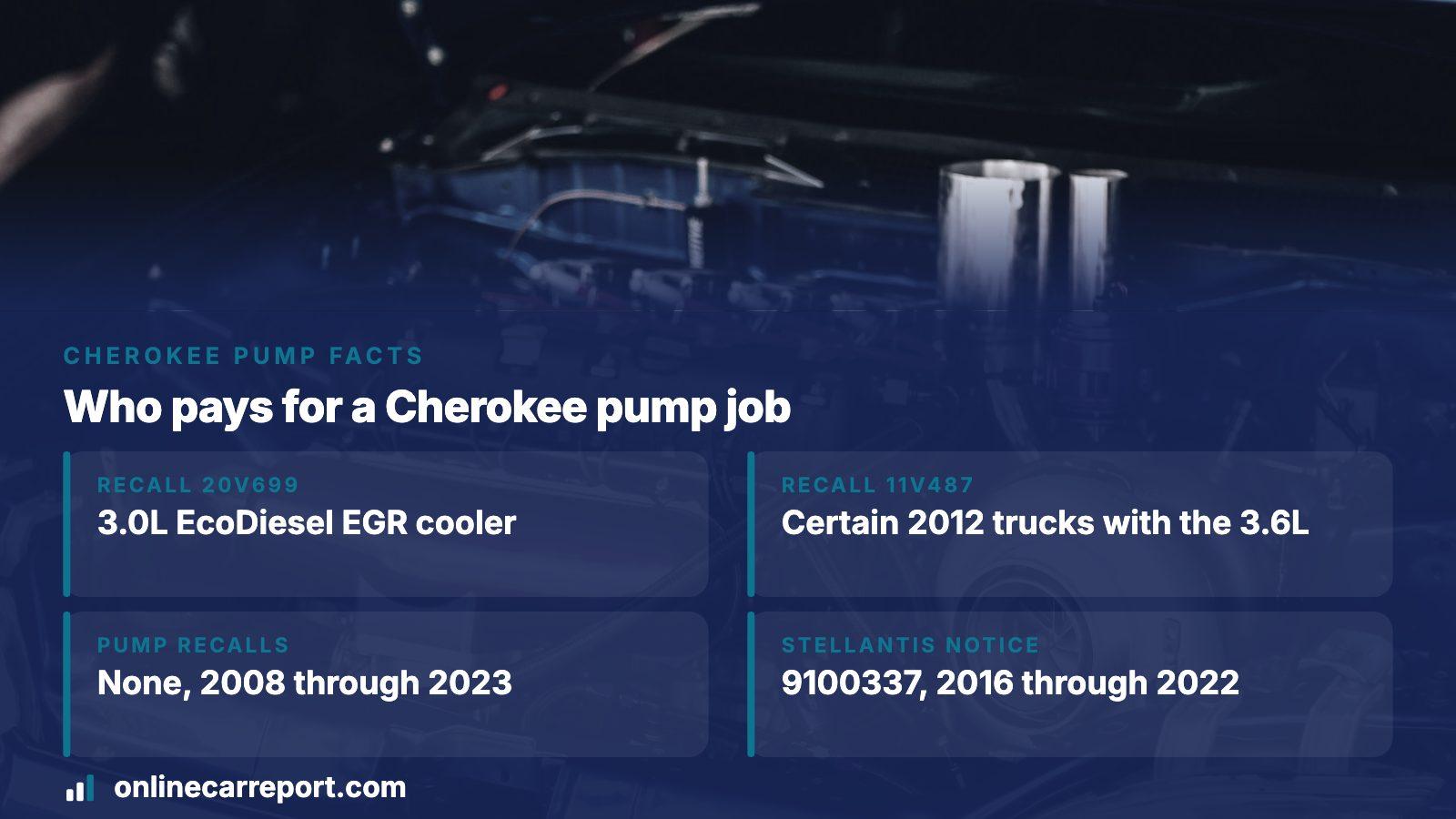
Across Grand Cherokee model years 2008 through 2023, NHTSA's recall data holds no campaign that names a pump, thermostat, radiator or coolant hose. Some sit under the engine and cooling heading without being pump faults.
- Recall 20V699: the 3.0L EcoDiesel EGR cooler, 2014 through 2019, replaced at no charge.
- Recall 11V487: certain 2012 trucks with the 3.6L built from August 31 to September 13, 2011, for connecting rod bearings, with a new engine as the remedy.
No campaign on that list pays for a pump. Bulletins are guidance for technicians; the 2015 oil bulletin says it is information only and no authorization for repair. Enter the VIN at NHTSA's recall page for open items, then ask a dealer what coverage remains.
Checklist before you pay for a used Grand Cherokee
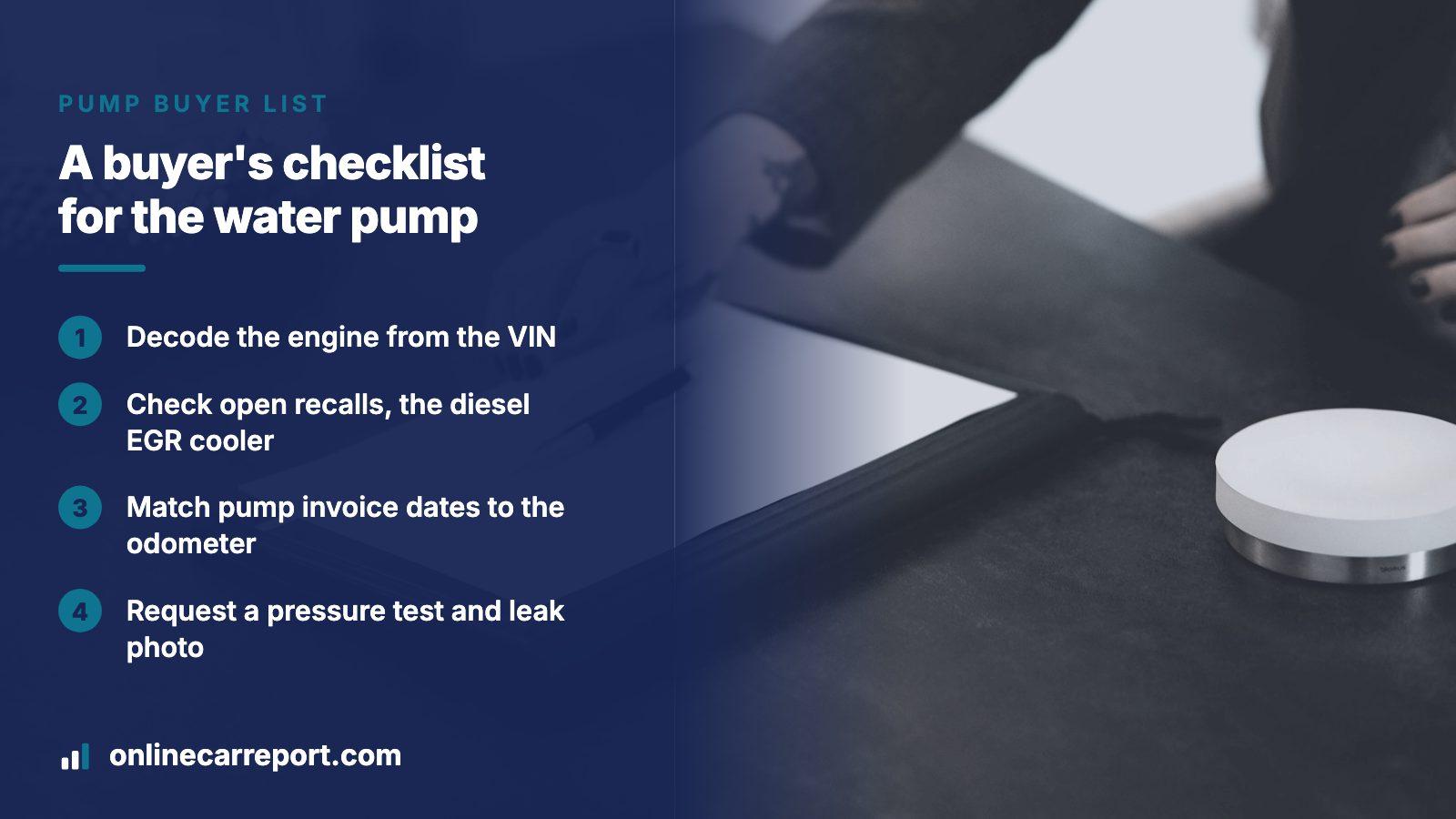
- Decode the engine from the VIN: Pentastar V6, V8 or diesel.
- Check open recalls, the diesel EGR cooler campaign in particular.
- Ask for pump invoices and match their dates to odometer readings.
- Ask whether coolant drips from the pump's weep hole or only leaves a crust.
- Request a pressure test and a photo of the leak source before any pump is replaced.
- Subtract the quote from your offer, and rethink the offer if coolant keeps vanishing.
OnlineCarReport sets a VIN's history next to its market value, so a repair quote is weighed against the whole record. Begin with the free preview; one report is a single payment, and the pricing page lists packs.
Where this information comes from
- NHTSA: recalls by vehicle and VIN — Official recall lookup. The recall search for 2008 through 2023 and the complaint counts used NHTSA's public data feeds.
- Stellantis notice 9100337 (NHTSA copy) — Dealers inspect and photograph a suspected 3.6L pump leak before replacing it; weep hole residue may be normal.
- Stellantis bulletin 09-008-15 (NHTSA copy) — The oil pooling check in the engine valley of a 2014 Grand Cherokee 3.6L.
- NHTSA owner complaint 11667318 — owner experience, paraphrased
- NHTSA owner complaint 11584870 — owner experience, paraphrased
- RepairPal: Jeep Grand Cherokee repair costs — The water pump range, read in October 2026.
- Kelley Blue Book: 2022 Grand Cherokee water pump replacement — The ZIP 43085 range with its parts and labor split, and the FAQ line shown without a ZIP.
Sources and photos: Facts checked against the sources above in November 2026. Photos by JavyGo, Annika Wischnewsky and Willian Cittadin on Unsplash; diagrams by OnlineCarReport.
Keep reading
- Car value by VIN: what the number tells you and how history moves itHow a VIN sets the starting figure before any repair quote comes off.
- Used car with no service history: what it does to the price and what to checkWhat to do when the seller has no pump invoice or other paperwork.
- Jeep Grand Cherokee starter replacement cost and what a receipt means for valueA second Grand Cherokee repair bill to weigh against an asking price.
- Jeep Grand Cherokee transmission fluid change: cost, fluid and resale valueDrivetrain upkeep on the same SUV, handy when comparing maintenance records.
Frequently asked questions
What should I budget for a Grand Cherokee water pump?
RepairPal puts it at $761 to $940. Kelley Blue Book's 2022 estimate for ZIP code 43085 was $806 to $910, with parts at $276 to $324 and labor at $530 to $586. Coolant usually costs extra, and an added belt or thermostat lifts the total.
Does coolant at the weep hole mean the pump is bad?
Not on its own. Stellantis notice 9100337 says a bit of residue around that plug can be normal, while a steady drip is not. If a technician cannot tell, the notice suggests a pressure test of the cooling system.
Is there a recall for the Grand Cherokee water pump?
None that names the pump appears in NHTSA data for model years 2008 through 2023. The coolant-related campaign is 20V699, covering 2014 through 2019 trucks with the 3.0L EcoDiesel, where dealers replace a cracking EGR cooler at no charge.
Does a pump repair lower a Grand Cherokee's value?
A documented repair costs the seller little, since the invoice shows what was replaced and when. An undocumented one invites buyers to subtract a quote and add a margin for doubt. Overheating, a misfire or vanishing coolant weighs more, because it points at the engine.
Which Grand Cherokee years do owners link to the pump?
Among NHTSA complaint summaries naming a water pump, 2018 leads with 12, and 2016 through 2022 hold 40 of the 63 found for 2008 through 2023. Those counts show what owners chose to report, not failure rates.
Now check the car itself
The guide explains what to look for. The report shows what this VIN has on record.