THE SHORT ANSWER
Published figures start at $163 (YourMechanic) and reach $292 on RepairPal's general range, with KBB's dealer ranges higher. Both automatics, the 4-speed before 2012 and the 5-speed after, take ATF+4; the manual takes another lubricant. A used Wrangler with no invoice probably owes the service, so take roughly its cost off the price. On a 2012 or 2013, also run the VIN for the cooler tube recall.
- RepairPal estimate
- $233 to $292, general range
- Fluid, both automatics
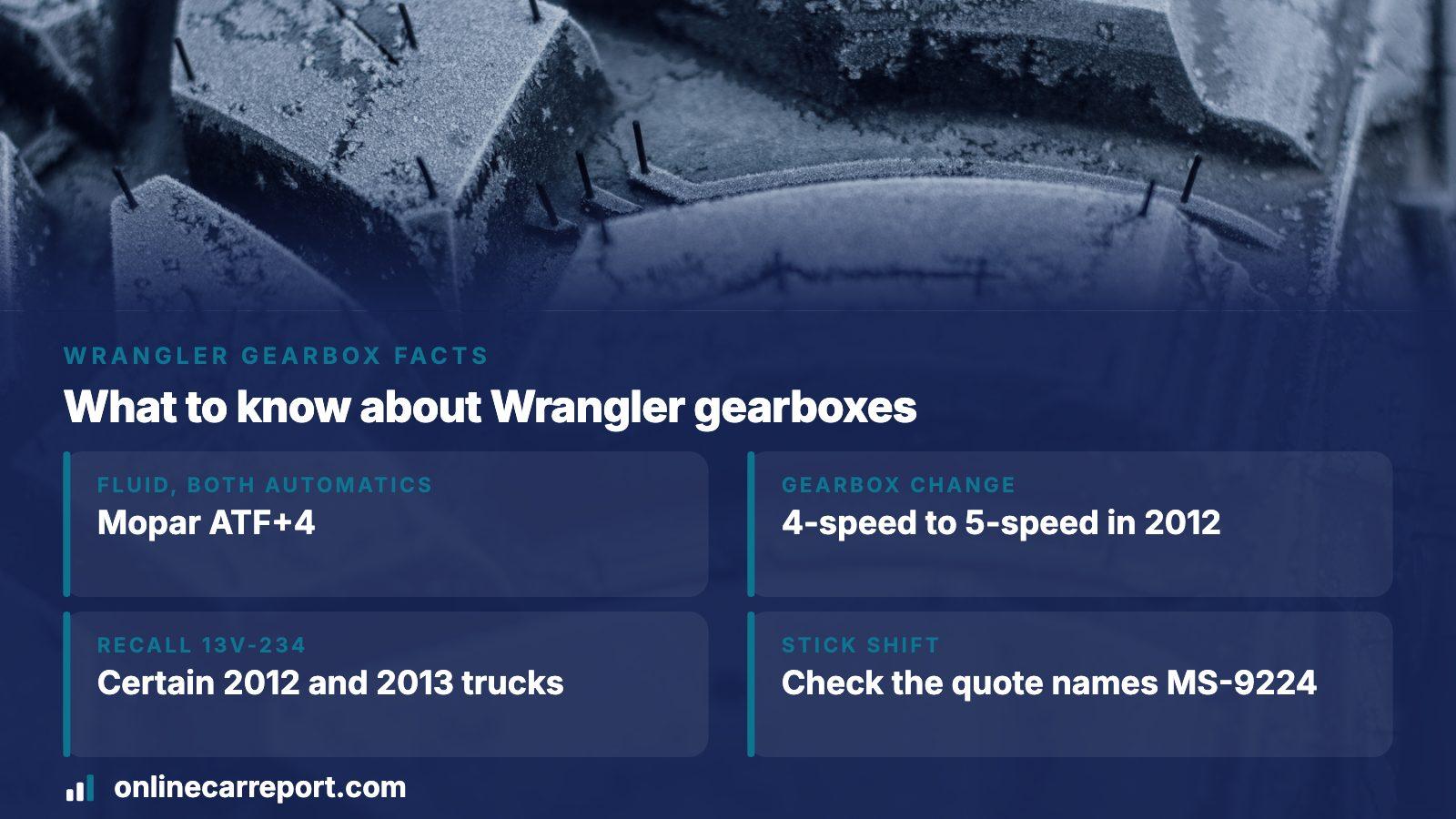
- Mopar ATF+4
- Gearbox change
- 4-speed to 5-speed in 2012
- Recall to look up
- 13V-234 on certain 2012 and 2013 trucks
What the published prices say, and whose they are
OnlineCarReport does not repair cars, so the dollar amounts below are the publishers' own, as captured in September 2026. They differ because each answers a separate question: an average across shops, the price a quote starts from, or what a dealer's hourly rate does in your area.
| Publisher | What it lists for a Wrangler |
|---|---|
| RepairPal, general estimate | $233 to $292 |
| RepairPal, per-year pages for older JK-generation trucks | about $210 up to $310 |
| YourMechanic | service starting from $163 |
| KBB, dealer range for a 2023 Wrangler | $266 to $476, varies by ZIP code |
RepairPal's breakdown for a recent Wrangler puts labor near $110 to $161 and parts near $110. Use the ranges to test a quote, not to predict one.
Check the model year before you check the fluid
Jeep swapped the 3.8L V6 for the 3.6L Pentastar in the 2012 model year, and a new 5-speed automatic arrived with it. FuelEconomy.gov lists a 4-speed automatic and the 3.8L on 2007 and 2011 trucks, and a 5-speed with the 3.6L on 2012 and 2018 trucks. Dealer and parts-supplier accounts call the units 42RLE and W5A580.
| Model years | Automatic | Engine | Fluid and rough fill |
|---|---|---|---|
| 2007 to 2011 | 4-speed (42RLE) | 3.8L V6 | Mopar ATF+4, about 4 quarts |
| 2012 to 2018 | 5-speed (W5A580) | 3.6L V6 | Mopar ATF+4, about 5 quarts |
The fluid stayed put while the hardware and fill changed, so have the shop name the year it is quoting. The quart figures come from a parts retailer, not Jeep.
A stick shift is a different job with a different fluid
The 6-speed manual (NSG370) is serviced differently. Parts listings and owner forums name a gear lubricant built to Chrysler's MS-9224 spec, about 1.6 quarts, in place of ATF+4. Forum owners often mention roughly 30,000 miles between changes, which is habit, not a Jeep figure.
From an NHTSA owner complaint
A 2017 owner filed in October 2025 after metal bits turned up at the bottom of the manual gearbox during a fluid change. The owner suspected a synchronizer, called this apparently not uncommon, and noted that no warning light had come on.
Take this from it: a drain is when a manual shows what it has been wearing, so ask a seller what the shop saw in the pan.
Long-service fluid is not lifetime fluid
Neither automatic is a sealed, no-service unit, and both have a dipstick, so level and color can be read at the curb. Chrysler describes ATF+4 as a long-service product, which some owners hear as permission to skip the job. Owner forums mostly say to change it on a normal schedule anyway. This page quotes no interval; the manual for your year and use has the right figure. An invoice stating the odometer reading is the only proof one was kept.
What the 2012 and 2013 complaint spike is about
On NHTSA's complaint record, power train is the biggest category for the 2012 Wrangler, at 282 of 836 filings, and again for 2013, at 230 of 657. The neighbors look calm: 40 of 485 for 2011 and 88 of 658 for 2014. That reads like a verdict on the new 5-speed, but the owners' words point elsewhere.
In those power train summaries, 210 of the 282 for 2012 and 166 of the 230 for 2013 mention the oil cooler tube on the transmission, recall 13V-234 or Chrysler's code N28. Complaints are unverified, and the category also covers driveline parts, so this is no failure rate. It does suggest the spike is mostly fluid leaving the transmission.
The cooler tube recall and what it does to a used price
NHTSA lists the recall for certain 2012 and 2013 trucks with the 3.6L and an automatic, with build dates from January 23, 2011 to February 23, 2013. A power steering line can rub through the transmission's cooler line and drain it, risking loss of transmission function and a crash. The fix is a new power steering return tube assembly, installed at no cost to the owner.
From an NHTSA owner complaint
A 2012 owner wrote that the cooler tube part had been on order for nearly a year, with several calls never moving them up the dealer's list. The owner also tried trading the Jeep, described as only a year old, for a newer one and said the dealer would not make a decent deal.
Take this from it: an unfinished recall can sideline a truck and sink a trade-in offer.
Signs on a test drive that point past the fluid
- A rumble-strip vibration near 45 mph, which forums blame on torque converter shudder
- Harsh, late or flaring shifts when moving off or climbing
- Dark, scorched-smelling fluid when the dipstick comes out
- Fluid on the ground or a wet-looking underside, the leak the recall describes
- Any warning light tied to the transmission
From an NHTSA owner complaint
A 2018 owner reported a Wrangler that would not leave Park although the shifter moved. A dealership blamed the control module, replaced it and added a transmission flush. About 130 miles later the Jeep still seemed to hunt for a gear, and after a restart it again would not engage one.
Take this from it: a flush on an invoice can be a first attempt rather than the cure, so ask which fault it was meant to fix.
What the paperwork and the VIN record do to the price
A used Wrangler is priced from mileage, condition and the work still owed. The market value in a history report is only the starting figure, since it cannot see the seller's invoices.
| What you find | What it suggests | Move on the offer |
|---|---|---|
| Dated invoice naming ATF+4, odometer written on it | Service done, mileage on record | No deduction |
| No invoice and a high odometer | Service probably owed | Subtract about the published service cost |
| Open cooler tube recall on a 2012 or 2013 | Repair not yet done | Ask for the recall repair before you buy |
| Flush invoice with no stated reason | An earlier fault may have been chased | Ask for the repair order behind it |
| Title brand, or an accident or damage entry | Past damage of unknown repair quality | Moves value far more than any fluid service |
A report will not say whether the fluid was changed. It does show odometer readings, title brands, accident and damage entries and open recalls, which test the seller's story.
Before you book the service or make an offer
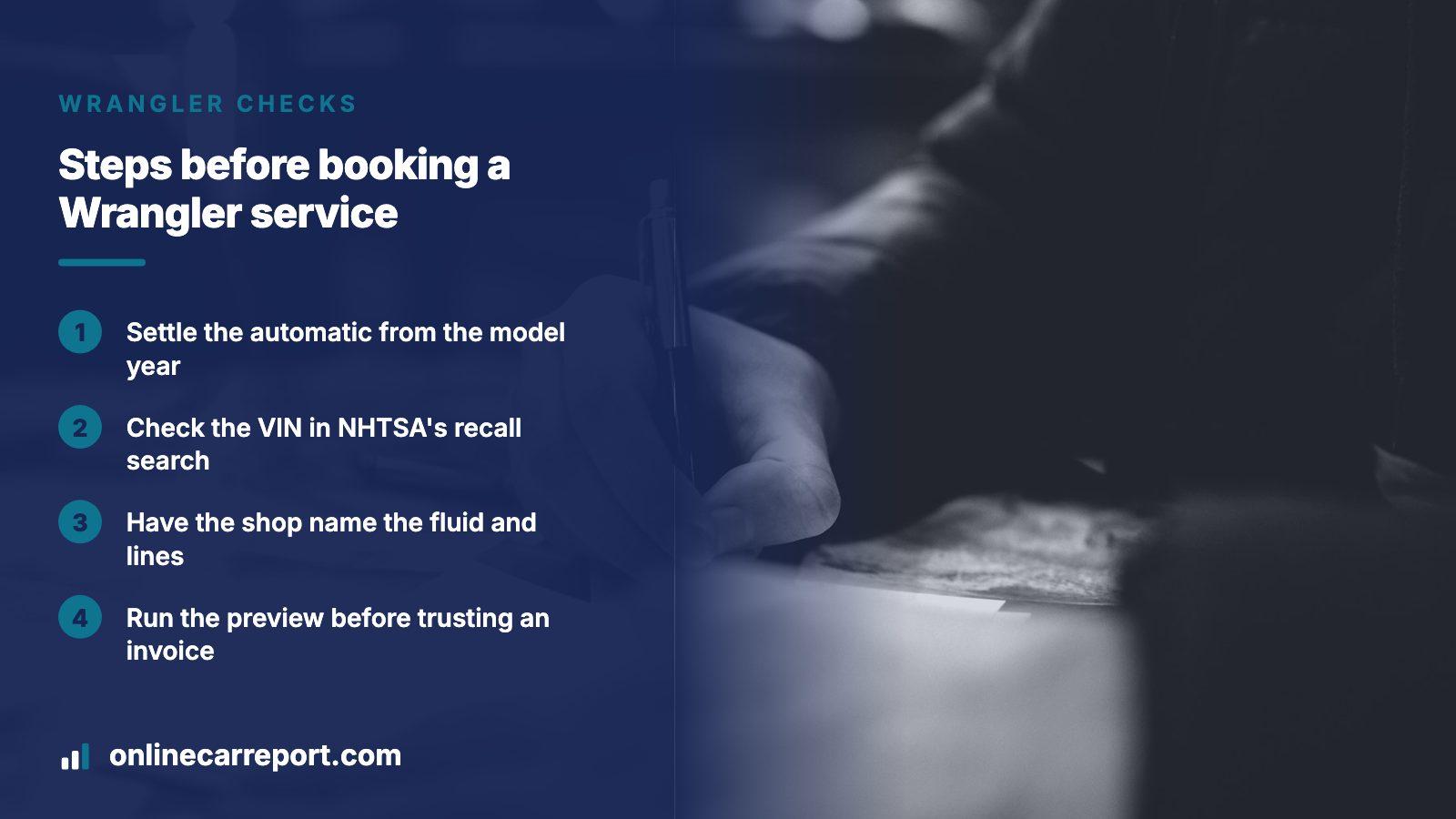
- Settle the automatic from the model year, or confirm a manual, before any shop names a price.
- Check the VIN in NHTSA's recall search (no charge), and on a 2012 or 2013 watch for 13V-234.
- Have the shop name the fluid and list fluid, quantity and labor on separate lines.
- On a stick shift, check the shop is quoting the MS-9224 gear lubricant, not ATF+4.
- Before trusting a seller's invoice, run the preview on the VIN and read the odometer, title, damage and recall entries.
The preview step costs nothing. One payment buys the full report for that VIN, packs suit anyone comparing several trucks, and there is no renewal. Prices are listed on the pricing page.
Where this information comes from
- NHTSA: recalls by VIN — The official lookup that shows whether a specific Wrangler has an open recall, including 13V-234.
- FuelEconomy.gov: 2012 Wrangler 4WD options — Federal listing of the 5-speed automatic and the 3.6L engine; its 2011 and 2007 entries show the 4-speed and the 3.8L.
- RepairPal: Wrangler transmission fluid change estimate — Source of the general range and the labor and parts split, as captured in September 2026.
- KBB: Wrangler transmission fluid change cost — Year-specific dealer ranges, which KBB says vary by ZIP code.
- NHTSA owner complaint 10598352 — owner experience, paraphrased
- NHTSA owner complaint 11693818 — owner experience, paraphrased
- NHTSA owner complaint 11301713 — owner experience, paraphrased
Sources and photos: Facts checked against the sources above in November 2026. Photos by Ahmet Yüksek ✪, Owen Michael Grech and Joan on Unsplash; diagrams by OnlineCarReport.
Keep reading
- Used car with no service history: what it does to the price and what to checkWhat to do when a seller cannot produce a single invoice.
- Jeep Grand Cherokee transmission fluid change: cost, fluid and resale valueThe same service question on the larger Jeep.
- Car value by VIN: what the number tells you and how history moves itHow mileage, damage and title records turn into a number you can bargain from.
- Sample reportSee which records a report returns before you decide to pay.
Frequently asked questions
How much should a Jeep Wrangler transmission service run?
On RepairPal the general figure is $233 to $292, with per-year pages from about $210 to about $310. YourMechanic lists service from $163, and KBB shows dealer ranges by year, $266 to $476 for a 2023. None are OnlineCarReport prices, so ask for fluid, quantity and labor itemized.
Does a 2012 or newer Wrangler take a different transmission fluid?
No. Parts listings show Mopar ATF+4 for the 4-speed automatic used through 2011 and the 5-speed used from 2012. The hardware and the fill changed, not the fluid. The manual is the exception, taking a gear lubricant to the MS-9224 spec.
Is Wrangler transmission fluid lifetime fluid?
Not on either automatic. Both have a dipstick, and ATF+4 is only labeled long-service. Owner forums advise a normal schedule regardless. Check the manual for your year, and treat a Wrangler with no service invoices as one that owes the work.
Will a VIN report show whether the transmission fluid was changed?
No, because shop invoices are not part of a history report. It shows odometer readings, title brands, accident and damage entries and open recalls, which tell you how far to trust an invoice a seller hands you.
How do I find out whether the cooler tube recall was done on a Wrangler?
Enter the VIN in NHTSA's recall search, which lists open campaigns for that truck at no charge. Recall 13V-234 covers certain 2012 and 2013 trucks built through February 23, 2013, and dealers perform the repair without charging the owner. Should a seller claim it was done, ask to see the repair order.
Now check the car itself
The guide explains what to look for. The report shows what this VIN has on record.