THE SHORT ANSWER
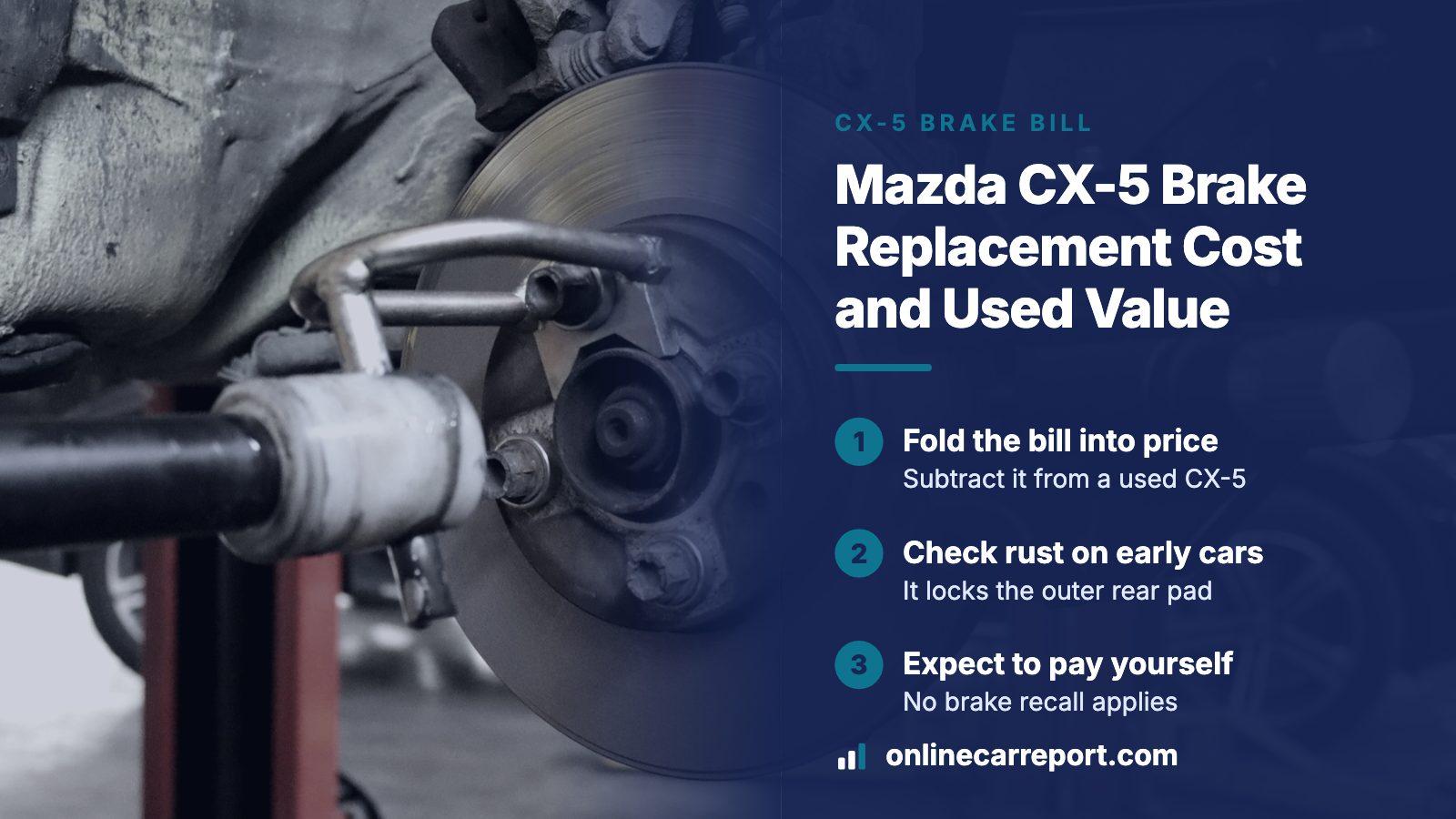
Expect $240 to $308 for one axle of pads on a 2017 CX-5 and $421 to $506 on a 2019 (Kelley Blue Book), with rotors and the other axle extra. No recall covers CX-5 brakes, so the owner pays once the warranty ends. Subtract about the quote from a used car's price, less if an invoice proves the rear work is done.
- 2017 pads, one axle
- $240 to $308 (KBB, ZIP 45401)
- 2019 pads, one axle
- $421 to $506 (KBB, ZIP 98055)
- Brake recalls
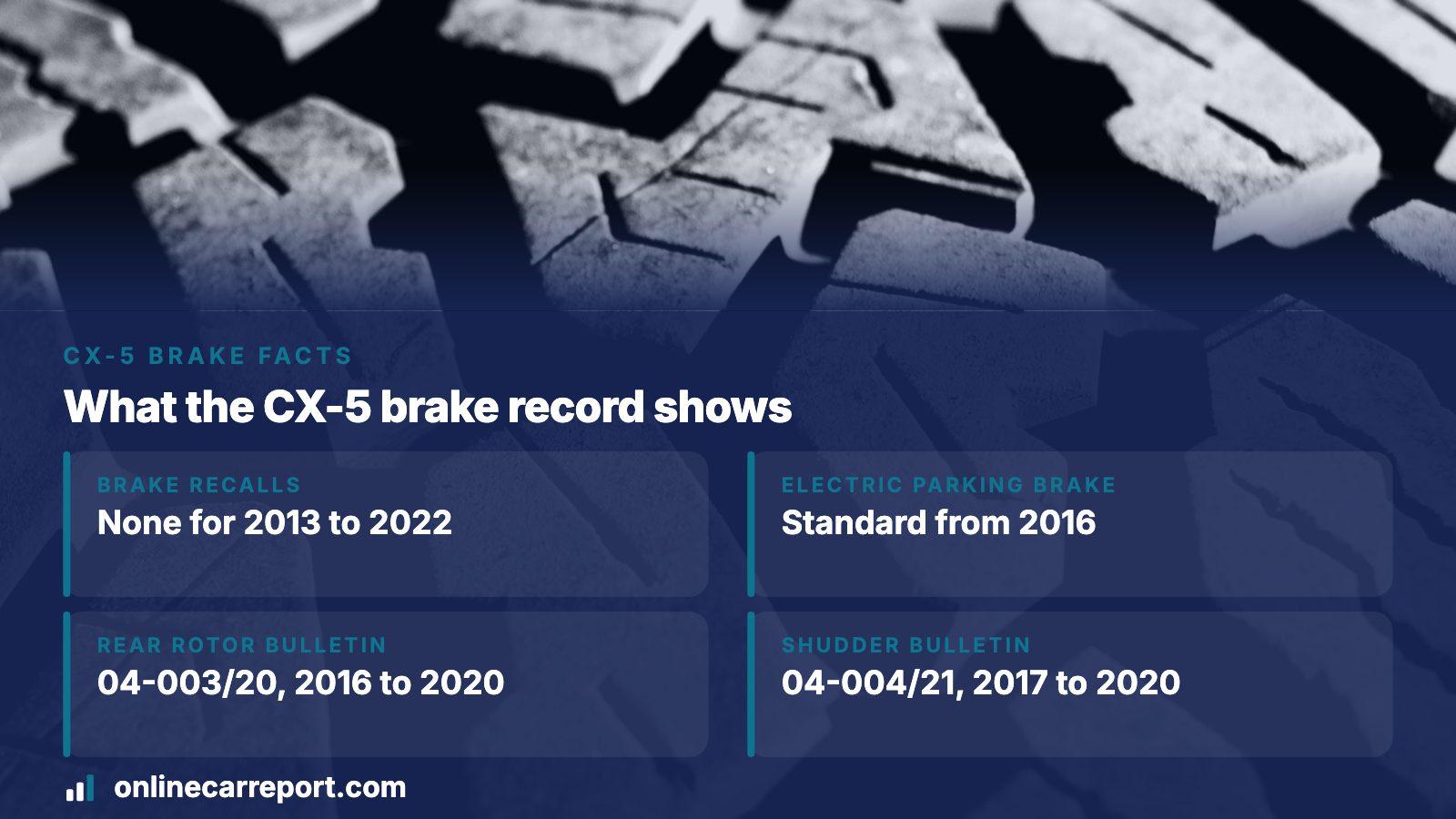
- None for 2013 to 2022
- Electric parking brake
- Standard from 2016
What the published CX-5 brake prices actually cover
Two price guides publish numbers for this car, and both are narrower than they look. Kelley Blue Book prices pad replacement by model year and ZIP code, and says the amount holds for either the front or the rear brakes. Each range is one axle, pads only; rotors and the other axle come on top.
| Car | Price guide | Range |
|---|---|---|
| 2017 model, Dayton, Ohio (ZIP 45401) | Kelley Blue Book | $240 to $308 |
| 2019 model, Renton, Washington (ZIP 98055) | Kelley Blue Book | $421 to $506 |
| 2015 model | RepairPal | $318 to $367 |
| 2022 model | RepairPal | $305 to $355 |
These are the publishers' figures as captured in late October 2026. KBB varies by ZIP code, and its two lines come from different cities, so the step from 2017 to 2019 says nothing about model years.
How to fold a brake bill into a used CX-5's price
A market value assumes ordinary wear, and worn pads are ordinary wear, so subtract about the quote and little more. Extra cuts are earned by doubt: a hot rear wheel, a seller who cannot say what was replaced, or a history entry hinting the car was hit.
| What the seller shows | Pricing |
|---|---|
| Dated rear pad and rotor invoice, with mileage | Little or no deduction |
| Worn pads and a measured shop quote | Subtract about the quote |
| Says it needs brakes, nothing measured | Start at the top of the range |
| Rear pads gone early on a 2013 to 2016 car | Budget for calipers or brackets too |
An invoice mileage that conflicts with the odometer readings on record, a title brand or a damage entry usually moves the price by more than one axle of pads. The VIN history shows those, not the quote.
Early cars, 2013 and 2014: rust locks the outer rear pad
Mazda bulletin 04-005/15 targets early builds: 2013 and 2014 CX-5s assembled before October 9, 2013. In salted-road regions, rust can seize the outer rear pad against its bracket, so the brake drags and wears that pad alone. The repair covers the backing plate, cleaning and greasing, new retainers and revised pads.
From an NHTSA owner complaint
A 2013 CX-5 bought used in December 2015 got rear pads and rotors for rust in April 2017, its owner told NHTSA. By late June 2019 the screech was back, the left rear in far worse shape than the right, and the mechanic thought the caliper "might have gone bad." No one mentioned a Mazda notice.
For a buyer, new pads on one of these cars prove little. Ask where it spent its winters and whether the brackets were cleaned and greased, since fresh pads alone can leave the rust in place.
2016: when the hand lever gave way to a motor
For 2016 the hand lever gave way to an electric parking brake, a small motor on each rear caliper. Complaints follow the change: that year alone holds 69 of the 138 brake complaints counted for 2013 through 2022. The sample is small, so use it to choose questions, not to estimate odds.
| Bulletin | 2016 cars built | What Mazda found |
|---|---|---|
| 04-002/15 | Before June 9, 2015 | Warning light; brake stays applied in deep cold |
| 04-005/16 | Before Feb. 22, 2016 | New control module to cure rear drag |
| 04-001/18 | Before Sept. 9, 2016 | Modified rear calipers replace that fix |
From an NHTSA owner complaint
On a 2016 CX-5 the rear caliper on the driver's side failed near 15,000 miles, says a filing made for its owners, and the brake dragged through a 400-mile holiday drive with no warning light. Mazda replaced the caliper under warranty but refused the scored rotor and worn-out pads, which the complainant put at $500.
Even when the maker pays for the caliper, the pads and rotor it ruined can stay with the owner. That bulletin's coverage ran 36 months or 36,000 miles, long past for every 2016 car.
2016 through 2021: grinding, grooved rotors and uneven wear
- 04-003/20, 2016 to 2020: new rear rotors scored by metal debris; Mazda changed the rotor surface finish.
- 04-002/21: 2016 cars built before December 21, 2016, and 2017 to 2020 cars built before March 18, 2020. Grinding from hardened black rust, answered with a new pad material.
- 04-004/21, 2017 to 2020 and certain 2021 cars: a shudder as the parking brake releases itself, plus lopsided rear pad wear, answered with new control-module logic.
Grinding is the noise most owners hear. Mazda's explanation is that the original friction material never cleaned the rust film from the rotor face, so it baked hard under braking. The cure is a revised pad compound with new rear rotors. For a car built in those windows, ask which pad the shop is installing.
No brake recall, so the owner usually pays
NHTSA's recall listings for 2013 through 2022 CX-5s show nothing on the service brakes or parking brake; the campaigns that exist cover the liftgate, steering, fuel filler pipe and fuel pump.
The gap is a matter of dollars: a recall repair costs the owner nothing at any age, while Mazda paid for these brake bulletins only inside the new-vehicle warranty.
From an NHTSA owner complaint
Rear brakes seized on a 2014 CX-5 around 30,000 miles, its owner reported, trailing highway smoke and heating a tire enough to trip the pressure warning. The owner was told road salt and sand were to blame, paid $208.95 for rear brakes and rotors, then asked Mazda for a refund, citing the 36,000-mile coverage in bulletin 04-005/15.
The complaint does not say how the request ended, so treat a bulletin as a talking point at the service desk, not a promise of payment. Run the VIN anyway for open recalls elsewhere.
What to ask before a rear job on a 2016 or newer CX-5
Each rear caliper has its own parking-brake motor, so the job runs through the electronics. Mazda's alert SA130 for the 2016 model requires maintenance mode before and after rear brake work, or the parking brake may misbehave. For 2017 and 2018 cars, a further alert allows only one turn of the manual release, or the caliper can be damaged.
Labor is short: for a 2016 CX-5, Mazda's warranty allowance is 0.5 hours to do rear pads with one rotor, and 0.7 hours for both sides.
- Which axle, and whether rotors are included
- Inner and outer rear pad thickness, each measured
- Whether the rear rotors spin freely by hand
- Mazda's revised pad, or the aftermarket one being substituted
- Maintenance mode written on the work order
- Bracket cleaning on salted-region 2013 and 2014 cars
Check the VIN and the paperwork before you set a number
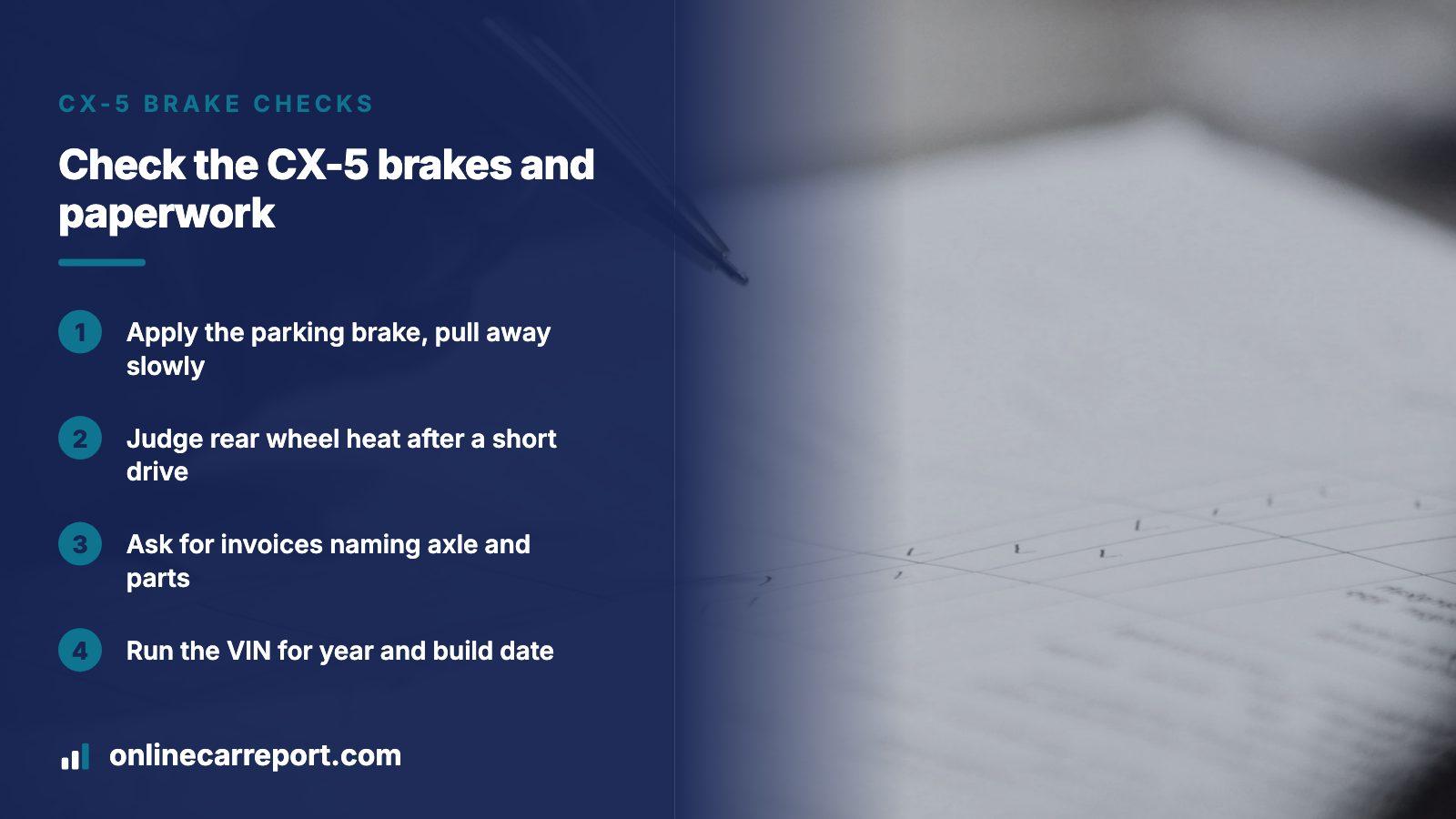
- Apply the parking brake, pull away slowly, and notice if the car pulls to one side as the brake lets go.
- After a short drive, judge the rear wheels' heat from a safe distance. One far hotter than the other points to drag.
- Ask for invoices naming the axle, the parts and the odometer reading.
- Run the VIN so the model year and build date are certain, since they decide which bulletins apply.
OnlineCarReport turns a VIN into a market value and the history behind it. The odometer readings test an invoice's mileage, and the accident and damage records show whether a past collision could explain rear damage. It cannot show which bulletins a dealer performed, so invoices still matter. Preview first, at no charge. Buying is a one-time payment for a report or a pack, nothing recurring, and the pricing page lists the options.
Where this information comes from
- Kelley Blue Book: 2017 Mazda CX-5 brake repair — Pad range for ZIP 45401, with its statement that pricing covers the front or the rear brakes.
- NHTSA: recalls by vehicle — Recall campaigns by model year, checked for any brake or parking-brake entry.
- NHTSA copy: Mazda bulletin 04-005/15 — Mazda's account of the rust-stuck outer rear pad on early cars.
- NHTSA copy: Mazda bulletin 04-001/18 — The 2016 rear-drag procedure and the modified calipers.
- NHTSA owner complaint 11230933 — owner experience, paraphrased
- NHTSA owner complaint 10809253 — owner experience, paraphrased
- NHTSA owner complaint 11290975 — owner experience, paraphrased
Sources and photos: Facts checked against the sources above in November 2026. Photos by Media Digital, Masjid MABA and Marvin Sagisi on Unsplash; diagrams by OnlineCarReport.
Keep reading
- Car value by VIN: what the number tells you and how history moves itHow a VIN sets a starting market value before any repair bill comes off.
- Kelley Blue Book value by VIN: how the history changes the numberWhat a guide's value figure assumes about the car's history.
- Mazda CX-5 transmission fluid change: cost, and what it does to valueThe other service question owners raise about this same model.
- Diminished value calculatorHow a past collision, rather than wear, can lower what a car is worth.
Frequently asked questions
How much does a Mazda CX-5 brake job cost?
Between $240 and $506 for one axle of pads in the guides above, depending on year and ZIP code. Rotors and the second axle add to that, so ask for a quote naming the axle and the parts.
Does the CX-5 have an electric parking brake?
Yes, from the 2016 model year; 2013 to 2015 cars have a hand lever. Pick a shop that knows the maintenance-mode step, since skipping it can ruin a caliper.
Which model year draws the most CX-5 brake complaints?
The 2016. First-generation cars from 2013 to 2016 hold 109 of the 138 counted, against 29 for the redesign. Years that missed the top five are undercounted, so 138 is a floor.
Is there a recall on CX-5 brakes?
No. Mazda used service bulletins, which instruct dealers and do not entitle owners to a repair. Run the VIN anyway for recalls on other systems.
Will worn brakes change what a used CX-5 is worth?
By about the repair bill when worn pads are the whole story, and less if an invoice shows the rear work was done. An unexplained rear-brake fault, or title and damage entries, can cut deeper, so read the VIN history first.
Now check the car itself
The guide explains what to look for. The report shows what this VIN has on record.