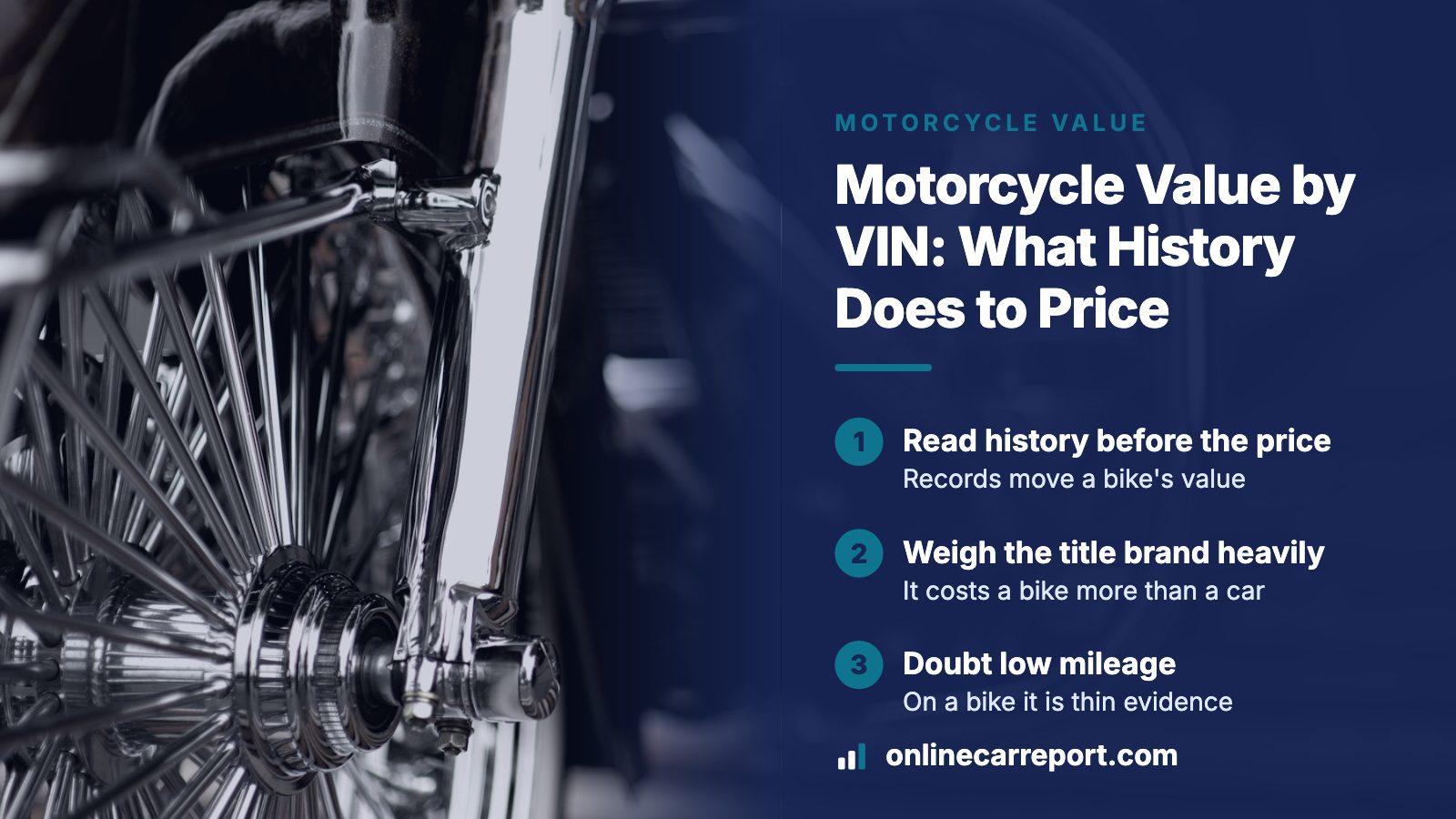
THE SHORT ANSWER
A VIN cannot price a motorcycle. It identifies the year, model and variant, and a value table does the rest. After that, condition and recorded history move the price: a salvage or rebuilt brand, crash damage, auction sales, and odometer readings that do not add up. Low mileage is weak evidence on a bike, since many sit for whole seasons. Test any number against two price guides and the bike itself.
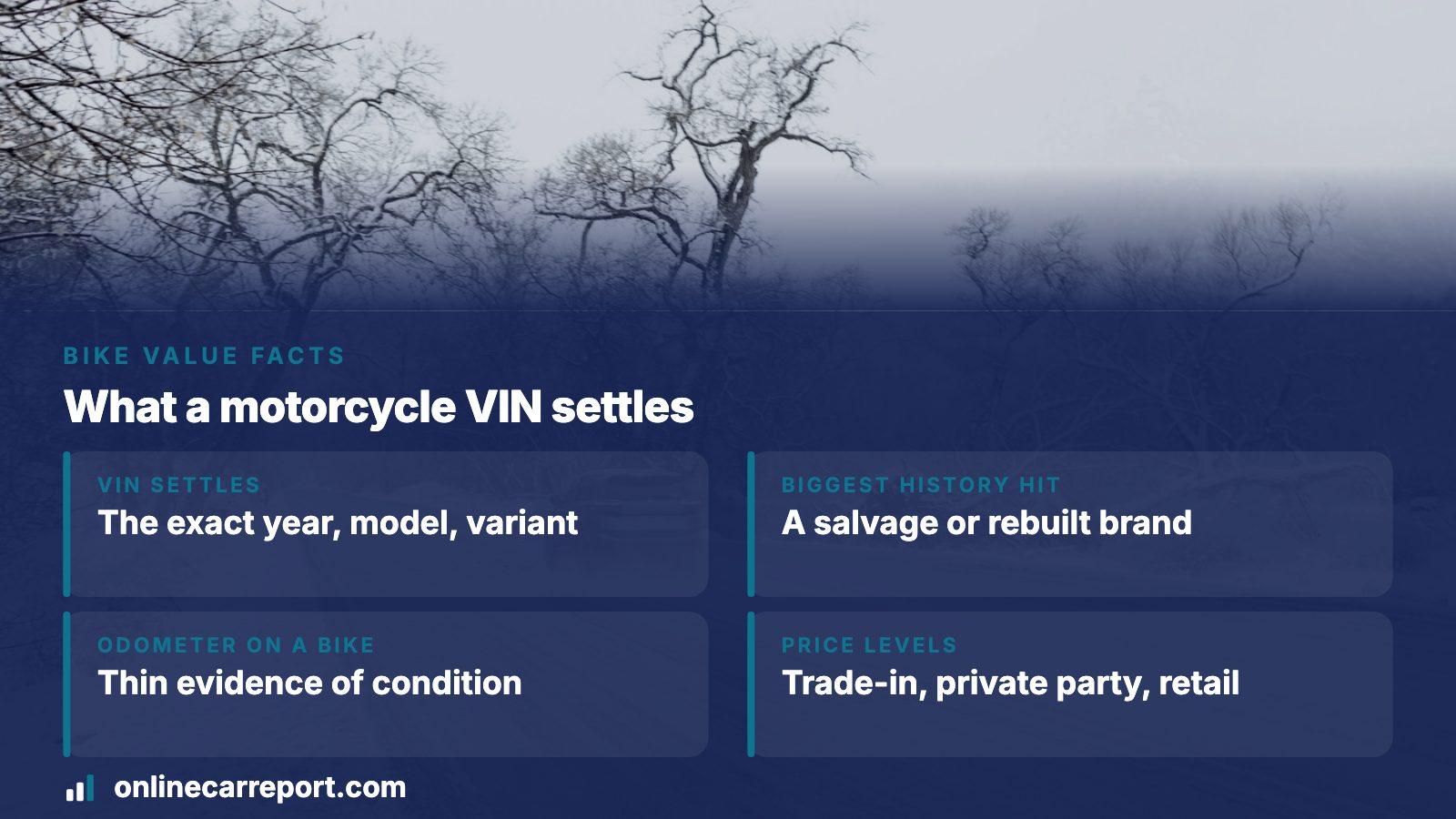
- What the VIN settles
- The exact year, model and variant
- Biggest history hit
- A salvage or rebuilt brand
- Odometer on a bike
- Thin evidence of condition
- Preview
- Free; the full report is one payment
What the VIN settles on a motorcycle, and what it leaves out
The seventeen characters tell a pricing table which machine you mean: maker, model, engine and year. That counts for more on two wheels than on four, because closely related models share similar names and sell for very different money, and a listing may blur the line. NHTSA's public decoder, vPIC, shows what a VIN describes; run it before any price talk.
After that the number stops helping. It says nothing about storage, riding or repairs. A garaged, serviced bike and one left outside for four winters get the same figure from a value tool, and several well-known valuation sites skip the VIN and let you pick year, make and model from menus. Read any result as the price of a correctly identified bike in unknown condition.
How recorded history moves the price
A price guide assumes an ordinary past. The records show whether yours was.
| Record | What it tells you | Pull on the price |
|---|---|---|
| Title brand | A salvage, rebuilt or similar state mark | Usually the largest cut, and it follows the bike |
| Damage and accident record | A reported crash, sometimes with severity | Lowers the price, more if the frame took the hit |
| Auction or salvage sale | A write-off or trade sale, often with photos | Sets the seller's story against the bike on sale day |
| Odometer readings | Mileage logged on different dates | Shows whether the miles are real |
| Theft record | A bike reported stolen, even if recovered | Raises questions about the frame and papers |
| Liens and impounds | A lender's claim or a tow-yard stay | Can stall the sale until cleared |
Why a title brand costs a bike more than a car
Cars are built to crush in stages, so a hard knock is spent in the panels before it reaches anything structural. A motorcycle has almost no buffer like that. A crash lands directly on the fork, the wheels and the frame, so a branded title on a bike more often points at structural trouble. Buyers discount it harder for that reason.
A bent frame is also tougher to spot than a repaired fender on a car. If the record is murky, pay a motorcycle shop to confirm the frame is straight before you settle on a figure. A brand is a reason to bid lower, or to get that check first.
Low mileage on a bike is thin evidence
Bikes pile up miles slowly and spend whole seasons parked, so the odometer says less about a motorcycle than about a car. A bike with few miles for its age was usually standing, not pampered. Standing dries seals, perishes tires, ages brake fluid and flattens batteries, and none of it shows on the dash.
From an NHTSA owner complaint
The 2012 Honda Gold Wing in this NHTSA filing was bought used in December 2015 with only 1,685 miles showing. The previous owner had told the buyer that the engine stumbled. The owner says it hesitates, then lunges forward as fuel arrives, has nearly dropped the bike twice, and has done so many times.
The odometer told this buyer nothing about the bike's state; the previous owner's remark was the real clue. Ask what the last owner knew, then back the answer with the record check and NHTSA's recall lookup by VIN.
A state tax office prices bikes from the VIN alone
Texas gives a tidy illustration. It taxes motor vehicle sales against a Standard Presumptive Value, a figure the Legislature created in 2009. Black Book supplies it from Texas sales data and updates it weekly. The state's online preview wants the VIN and the mileage, then adds that motorcycles do not need the mileage.
Two points follow. Mileage adds so little to a bike's number that the state does not bother to collect it. And the figure is a wholesale average meant for estimates, with the actual tax worked out at the county tax office. Treat it as a floor for one state, not a price to sell against.
Wholesale, private party and retail for the same bike
One bike carries three honest prices on the same day, and most price arguments come from two people quoting different ones.
- Trade-in or wholesale: what a dealer pays before preparing the bike for sale
- Private party: what a seller can realistically get from another rider, sold as it stands
- Retail: what the same bike asks on a dealer floor once it is reconditioned
On motorcycles the gap runs wide: season swings retail hard, and the trade marks down a bike that has stood. J.D. Power, formerly NADA, lists motorcycles and is what lenders often use. Name which of the three you mean, for which variant and month, before you quote a number.
Running the check before you agree on a price
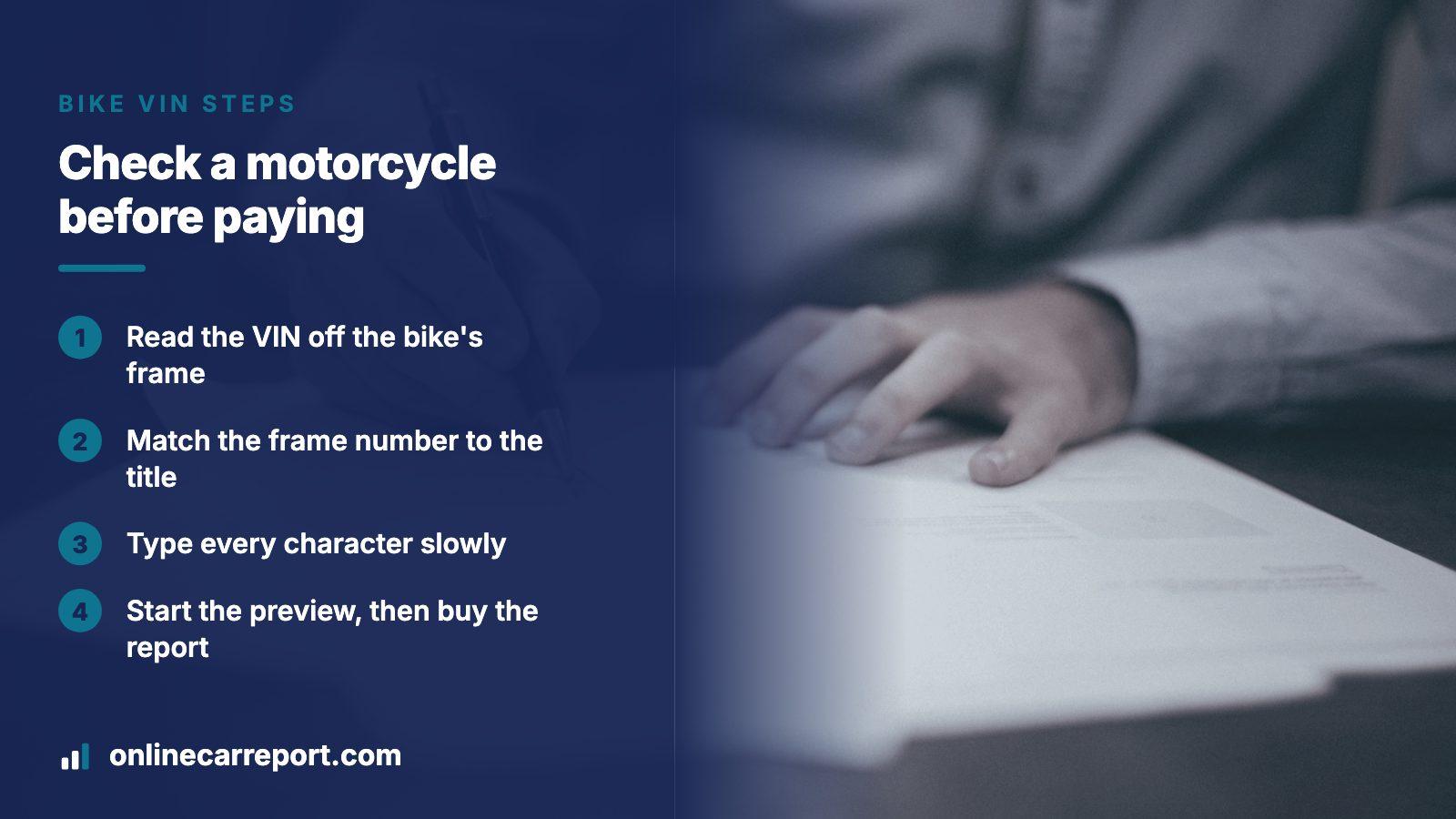
- Read the VIN off the bike, usually stamped on the frame near the steering head, and again off the title. The engine carries a separate number that is not the VIN.
- Confirm the frame number matches the title and registration. A mismatch is a reason to stop, whatever the price.
- Type the seventeen characters slowly. A VIN is built without the letters I, O and Q, so seeing one in your entry means a slip.
- Start the preview at OnlineCarReport. Nothing is charged at that stage.
- If the bike still looks right, buy the report and read the history before the market value.
Red flags that should lower your offer or end the talk
- A salvage, rebuilt or other title brand the listing never mentioned
- Auction or salvage-sale photos showing damage near the forks or frame
- Odometer readings that fall, repeat or jump
- A very low reading on an old bike, with no service receipts
- A theft record, even for a recovered bike
- An open lien or an impound entry
- An open recall the seller never had done
- Heavy modification with the original parts gone, since changes rarely earn back their cost
None of these proves a bad bike, and NHTSA treats odometer tampering as fraud, which is why a reading needs a second source. Ask the seller to explain each flag in writing. A clean inspection lets you price a flag in; a failed one is your cue to leave.
Cost, and the order to work in
Start with the preview; it asks for no payment. Records cost one payment: a single report, or 3, 5 or 10 together if you are comparing several bikes. No subscription follows, and today's amounts are on the pricing page. The report puts a market value beside the entries that matter on a bike: brands, crash and auction records, the odometer log, theft, liens and open recalls.
Records exist only where a state, insurer or auction filed one, so a quiet report means nothing is on file, not that the bike is sound. Identify the bike, read the history, price the clean version from two guides, subtract for what the records show, then have a motorcycle shop check the frame, forks and brakes before money moves.
Where this information comes from
- Texas DMV: Standard Presumptive Value calculator — A state valuation tool that asks for a VIN and an odometer reading, and says the reading is not needed for motorcycles.
- NHTSA: vPIC VIN decoder — The federal decoder for confirming which motorcycle a VIN describes before any price is discussed.
- NHTSA: Recalls lookup — Where open safety campaigns on a specific bike show up by VIN.
- NHTSA: Odometer fraud — Why a stated mileage on any vehicle deserves a second source.
- NHTSA owner complaint 10839640 — owner experience, paraphrased
Sources and photos: Facts checked against the sources above in November 2026. Photos by Steve Smith, Scott Graham and Zoshua Colah on Unsplash; diagrams by OnlineCarReport.
Keep reading
- Car value by VIN: what the number tells you and how history moves itWhere mileage does carry the price, and how the same records move a car's value.
- NADA value by VIN: the lender's book and what history does to itThe lender's book, which lists bikes as well as cars, read against a VIN.
- Diminished value calculatorWhat a past crash does to a vehicle's worth even after a good repair.
- Sample reportSee how title, damage and odometer records are laid out before you buy.
Frequently asked questions
Can I find a motorcycle's value from its VIN?
The VIN identifies the bike: year, model and often the variant. A value tool takes that identity and finds the matching row in a table built from sales. Condition, storage, mileage and history are not in the number, so adjust for them yourself, using the records for the history part.
Does a salvage title hurt a motorcycle more than a car?
It tends to. A bike has little structure to absorb an impact, so damage serious enough to brand a title may well have involved the frame or forks, which are hard to verify. Expect a deeper discount and have the frame checked before you agree on a price.
Is low mileage a good sign on a motorcycle?
Not by itself. Bikes sit for whole seasons, so very low miles for the age often mean the bike stood, with tired fuel, tires, seals and brake fluid. Compare the recorded odometer readings, ask for service receipts, and price the work needed to put it right.
Why does the same bike get different values on different sites?
Each tool answers a different question: wholesale, private party or retail, drawn from different sales and often a different season. Some skip the VIN and ask for year, make and model. Decide which deal you are in, compare two guides, and treat the gap as your range.
Does the motorcycle report cost anything?
The preview is free, so you can start without paying. The full report is one purchase, not a subscription, and you can take a single report or a pack if you are checking several bikes. The pricing page lists current amounts before you commit to anything.
Now check the car itself
The guide explains what to look for. The report shows what this VIN has on record.