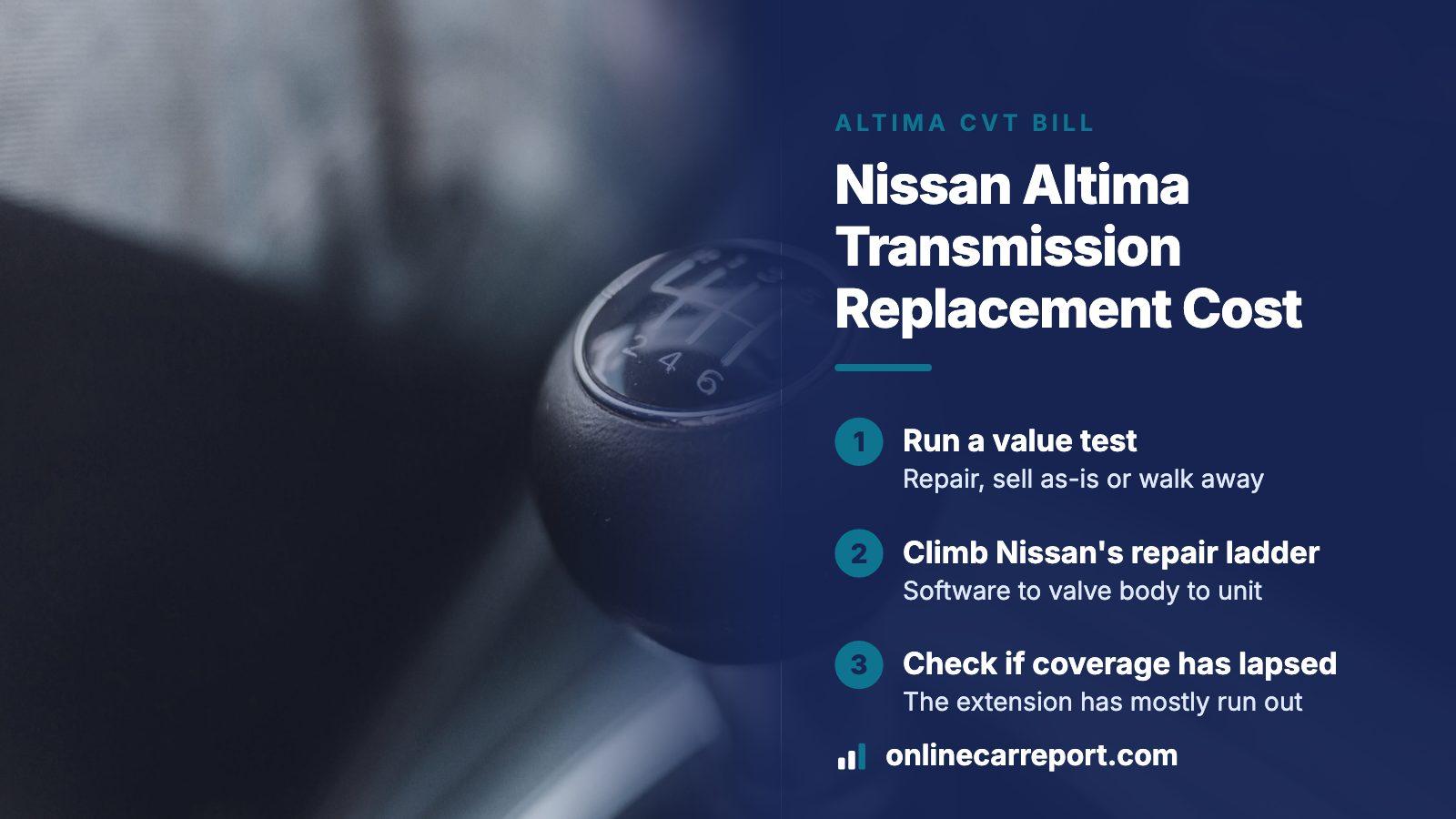
THE SHORT ANSWER
For a 2013 model KBB lists $4,298 up to $6,376, and for 2017 or 2018 cars $4,435 up to $6,417. One remanufactured unit, parts only, is listed at $5,449. Nissan's bulletins often prescribe a valve body or software rather than a whole CVT. Get the diagnosis in writing and weigh the total against the car's value.
- KBB range, 2013
- $4,298 to $6,376 (ZIP 47807)
- KBB range, 2017 and 2018
- $4,435 to $6,417
- Remanufactured CVT, 2014 to 2018 2.5L
- $5,449 before labor
- Coverage extension
- 84 months or 84,000 miles, 2013 to 2018
The bill, as published by the people who price repairs
We sell vehicle history reports, not repairs, so every figure here belongs to whoever printed it. Kelley Blue Book posts a fair range per model year and ZIP code. Its 2013 page, priced for Terre Haute, Indiana, shows the low end at $4,298. The 2017 and 2018 pages, priced for Nevada and California, both show $4,435 at the bottom. Parts make up the larger share of that, with labor a smaller slice of the total.
| Source | What it covers | Figure |
|---|---|---|
| KBB, 2013 Altima | Parts and labor | $4,298 to $6,376 |
| KBB, 2017 and 2018 Altima | Parts and labor | $4,435 to $6,417 |
| Powertrain Products, 2014 to 2018 2.5L | Remanufactured CVT, shipped uninstalled | $5,449, plus a $1,000 core charge if the old unit is not returned |
| Powertrain Products, 2013 2.5L or 2015 to 2018 3.5L | Remanufactured CVT | $4,549 |
KBB paints its numbers in after the page loads, so we took them from the text search engines index. Treat them as a guide, then ask for a written quote.
Repair, sell as-is or walk away: a value test
Three numbers settle it. First, what the Altima would sell for with a working transmission. Second, what it fetches as-is with a failed one. Third, the repair bill. Repair is the smart move only if the gap between the first two numbers is wider than the third.
A VIN-based market value is the place to start for the first figure, because trim, mileage and condition all feed it. On an older, high-mileage car, a four-thousand-dollar-plus replacement can eat most of the value, and a quote near the top of the range can pass it. A smaller repair, like a valve body, can flip that answer, which is why the diagnosis matters before the arithmetic does.
Nissan's own ladder: software, valve body, sub-assembly, whole unit
Nissan's service bulletins describe a sequence of fixes, with the whole CVT at the bottom. A May 2020 dealer bulletin tells technicians to skip a full replacement when the diagnosis points at software or control valves. A second bulletin, aimed at four-cylinder cars built 2013 to 2017, shows how the tech decides.
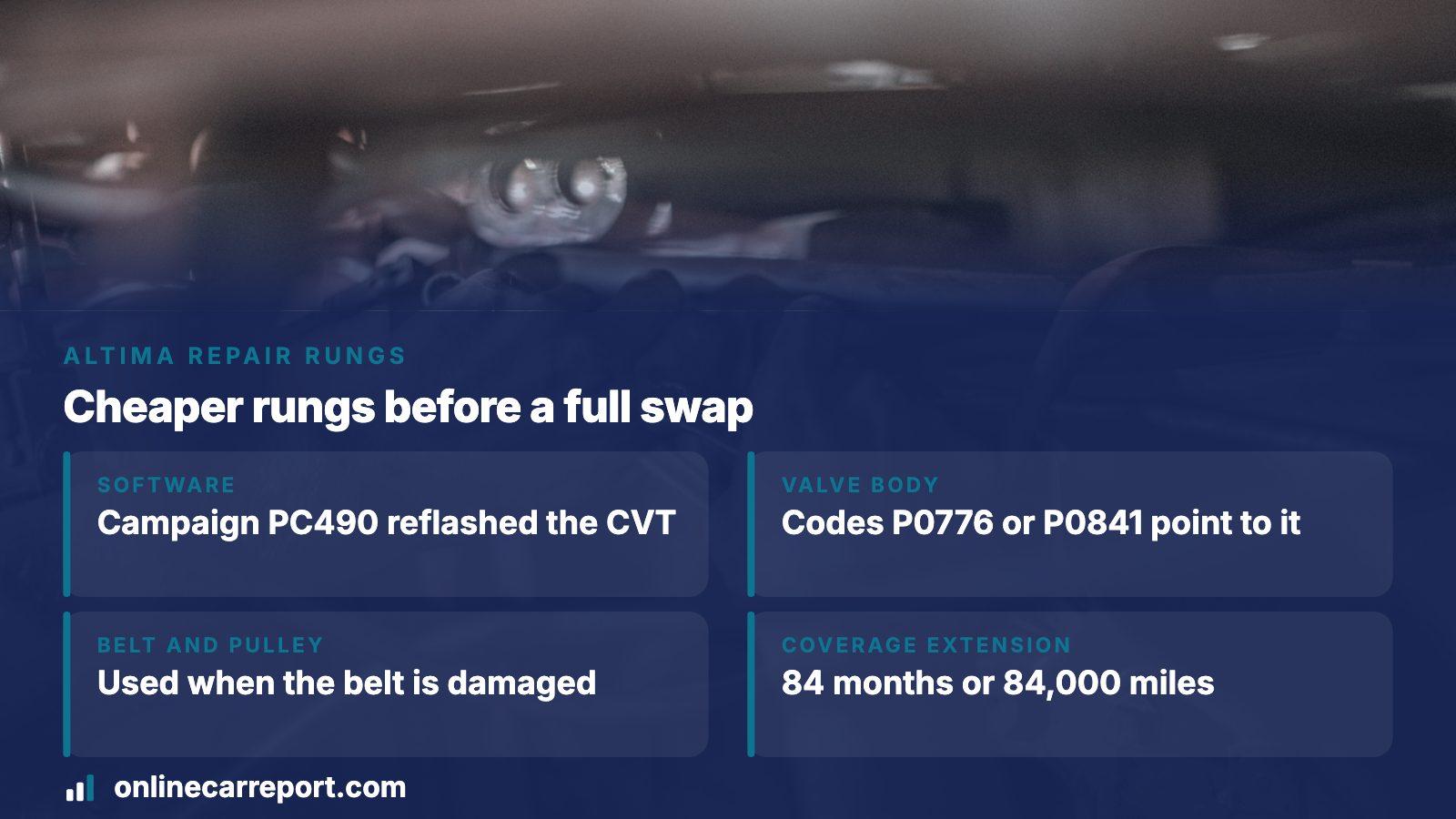
- Software: campaign PC490 reflashed the CVT on 1,184,100 Altimas of the 2013 through 2016 years, aimed at belt slip and code P0776.
- Valve body: with codes P0776 or P0841, the valve body comes off and the belt is inspected. A sound belt means the valve body alone is replaced.
- Belt-and-pulley sub-assembly: used when the belt is damaged, a part weighing about 65 pounds, where a whole unit is nearer 300.
- Complete CVT: for case or internal damage, or when the car is past 84 months or 84,000 miles.
Ask the shop which rung it ruled out, and why.
Nissan's extended coverage has mostly run out by now
Nissan stretched its CVT coverage out to 84 months or 84,000 miles in two rounds: for 2013 to 2016 Altimas from May 11, 2020, and for 2017 and 2018 Altimas from May 23, 2023. The clock starts at the original in-service date. The last 2013 to 2016 car was built in August 2016, so that group crossed 84 months years ago.
Only a 2018 first sold around November 2019 or later, with low miles, could still be inside the window. A few owners opted out of the settlement, and that cancelled the extension on their VIN. A dealer can read that status, and since neither bulletin calls the CVT a safety recall, a recall lookup will not show it.
What owners were quoted after the extension ended
The NHTSA complaint record holds 9,726 reports against the 2008 to 2022 Altima, and 1,655 of them name the power train. Two recent ones show how the bill lands on the people holding the car.
From an NHTSA owner complaint
The owner of a 2015 Altima bought it at about 31,000 miles and put it through highway commuting until 141,000. In January 2025 it would reverse but refuse to move in drive. The dealer quoted $7,776 for a replacement, and Nissan said warranty had applied until the owner missed the limit by about 20,000 miles. No transmission notice ever arrived, the owner says, only mailed recalls for a hood latch and a CVT reprogramming.
From an NHTSA owner complaint
A 2017 Altima owner filed in August 2026 after shuddering and lost acceleration on the highway, with codes P0776 and P0841. At 53,000 miles the dealer recommended a new transmission and Nissan asked nearly $6,200. The alternative was a $3,000 allowance on another car, but $8,700 was still owed on the loan, so about $5,700 would roll into the next one.
Mileage was modest on both, and a quote can still exceed what the car would trade for.
Which unit goes in changes the number
Nissan fits different CVT families to the two engines, so a part listing that only says Altima can be wrong for the car. A 2.5-liter 2013 to 2018 car and a 3.5-liter V6 of the same years take different units, and the V6 unit also appears in the Pathfinder. Confirm the engine from the VIN before anyone orders a part.
Warranty terms differ by seller as much as price does. One remanufacturer lists a short 18-month, 18,000-mile term as standard, while another offers three years and sells longer ones. A salvage-yard unit costs least and carries the most unknowns. Each new unit or valve body also needs its calibration file written to the control module, so look for programming on the estimate.
How the VIN's history moves the value, with or without a new CVT
A replaced transmission rarely stands alone in a car's record. A buyer comparing two Altimas of the same year looks at odometer readings, the use type and number of owners, any damage or auction entries, and open recalls. A clean record with a receipt for the CVT work reads as a car someone looked after. A gap with no paperwork reads as a risk, and buyers discount for it.
Odometer history deserves a second look on a car with a failed transmission. A jump or a rollback can hide a car that was driven far harder than its dash shows.
If you are shopping for an Altima, not repairing one
Among 2016 Altima complaints the power train accounts for 42.5%, while 2013 draws the largest count at 505. Complaints are unverified owner reports, so neither fact condemns a car, but both argue for paperwork.
Start with the VIN's free preview. If the car still seems worth pursuing, the one-time report adds the odometer and damage records, market value and any open recalls to the quote you are weighing. Subtract a realistic transmission bill from the asking price before you counter.
Before you authorize the repair
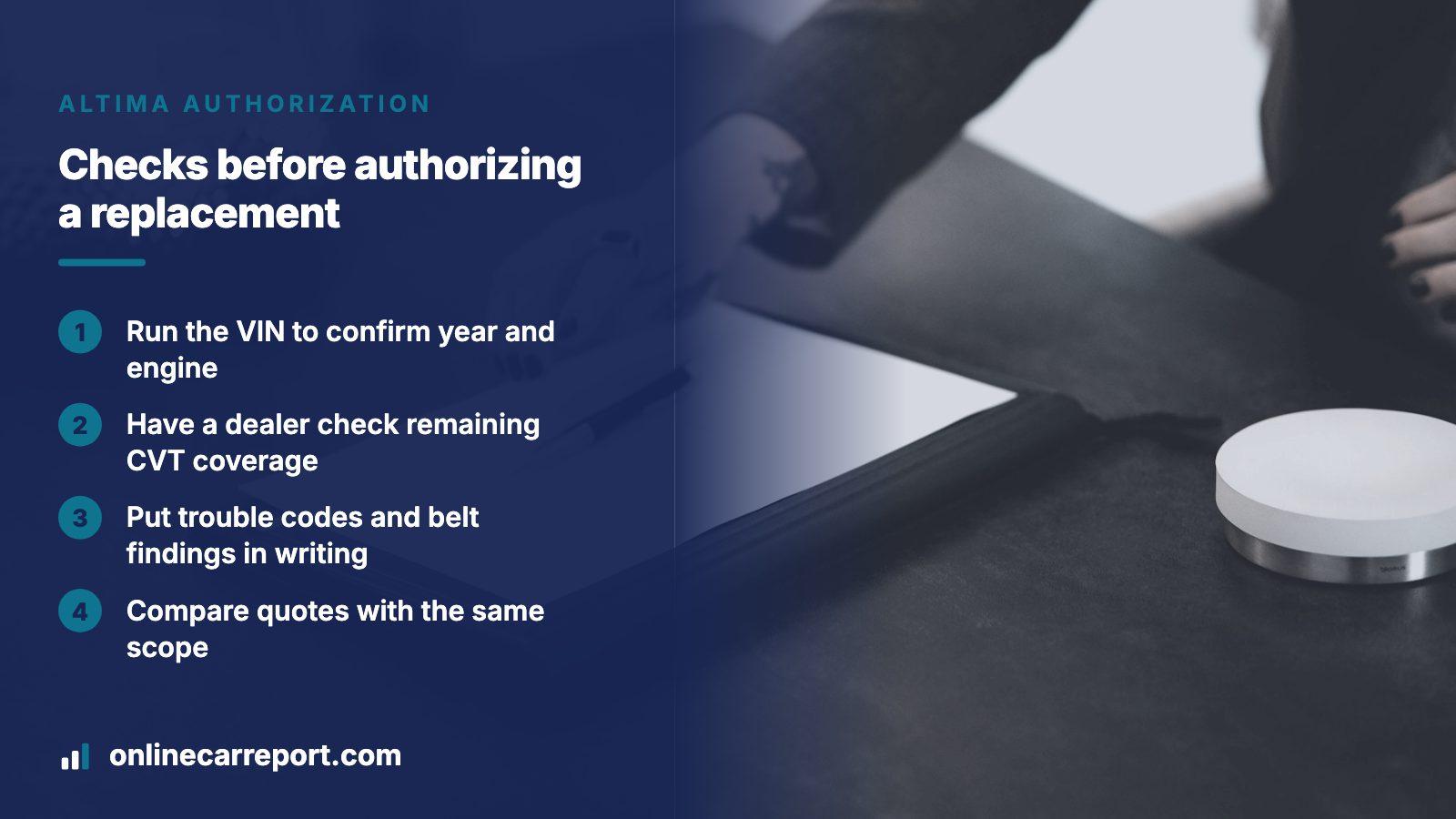
- Run the VIN to confirm year and engine, so the quote names the right CVT.
- Have a Nissan dealer read the VIN for any remaining CVT coverage, the in-service date and an opt-out flag.
- Have the shop put the stored trouble codes and belt findings on paper.
- Compare quotes that list the same scope, including calibration and learning procedures.
- Weigh the total against the car's value, then decide: repair, sell or trade.
Where this information comes from
- NHTSA owner complaint 11661741 — owner experience, paraphrased
- NHTSA owner complaint 11754916 — owner experience, paraphrased
- Nissan bulletin MC-10176204 on NHTSA — the 2013 to 2016 coverage extension and its opt-out flag
- Nissan bulletin MC-10246457 on NHTSA — the 2017 and 2018 coverage extension
- Nissan bulletin NPSB/20-590 on NHTSA — when a complete CVT is and is not recommended
- Nissan bulletin NTB16-110i on NHTSA — valve body versus sub-assembly decision and unit weights
- Kelley Blue Book: 2017 Altima transmission replacement — the fair repair range for parts and labor
Sources and photos: Facts checked against the sources above in November 2026. Photos by Erik Mclean, Annika Wischnewsky and Nina Mercado on Unsplash; diagrams by OnlineCarReport.
Keep reading
- Car value by VIN: what the number tells you and how history moves itLook up what the Altima is worth before you weigh the repair bill.
- Nissan Altima transmission fluid change: cost and what it does to valueThe service side: which fluid the CVT takes and what records do for resale.
- Car trade-in value by VIN number: what a dealer sees and what history changesWhat a dealer may offer if you decide not to fix the car.
- Nissan Sentra transmission replacement cost and what it does to car valueA sister CVT from the same maker, priced the same way.
Frequently asked questions
What does a Nissan Altima transmission replacement cost?
KBB's range starts at $4,298 for a 2013 and $4,435 for 2017 and 2018, and tops out at $6,417, with labor included. A remanufactured 2.5L CVT alone is listed at $5,449. Owners filing with NHTSA mention dealer quotes of $6,200 and $7,776, so ask for an itemized estimate.
Will Nissan pay for a new Altima CVT?
Only inside coverage. The extension runs 84 months or 84,000 miles from the original in-service date, so most eligible cars have aged out. Beyond the limit, Nissan's bulletins tell dealers to look at goodwill guidelines if you ask. That is a request, not a right, so ask a dealer to read the VIN first.
Does every failing Altima CVT need a new transmission?
No. For many coded faults Nissan's bulletins call for a valve body, and software campaign PC490 covered belt slip on 2013 to 2016 cars. A complete unit is the last rung. Ask the shop for the codes and the belt inspection result before accepting a replacement quote.
Is it worth fixing an older Altima's transmission?
Set three figures side by side: the car running, the car dead, and the repair itself. On a high-mileage Altima, a replacement above $4,000 can approach or pass the car's worth. A cheaper valve body repair changes the math, so get the diagnosis before you decide.
Does a replaced transmission show up in a VIN check?
A history report does not list repair work, but it does show odometer readings, use type, damage and auction entries, and market value. Keep the repair invoice yourself, because a buyer will want it. The paper receipt is what turns a replaced CVT into a selling point.
Now check the car itself
The guide explains what to look for. The report shows what this VIN has on record.