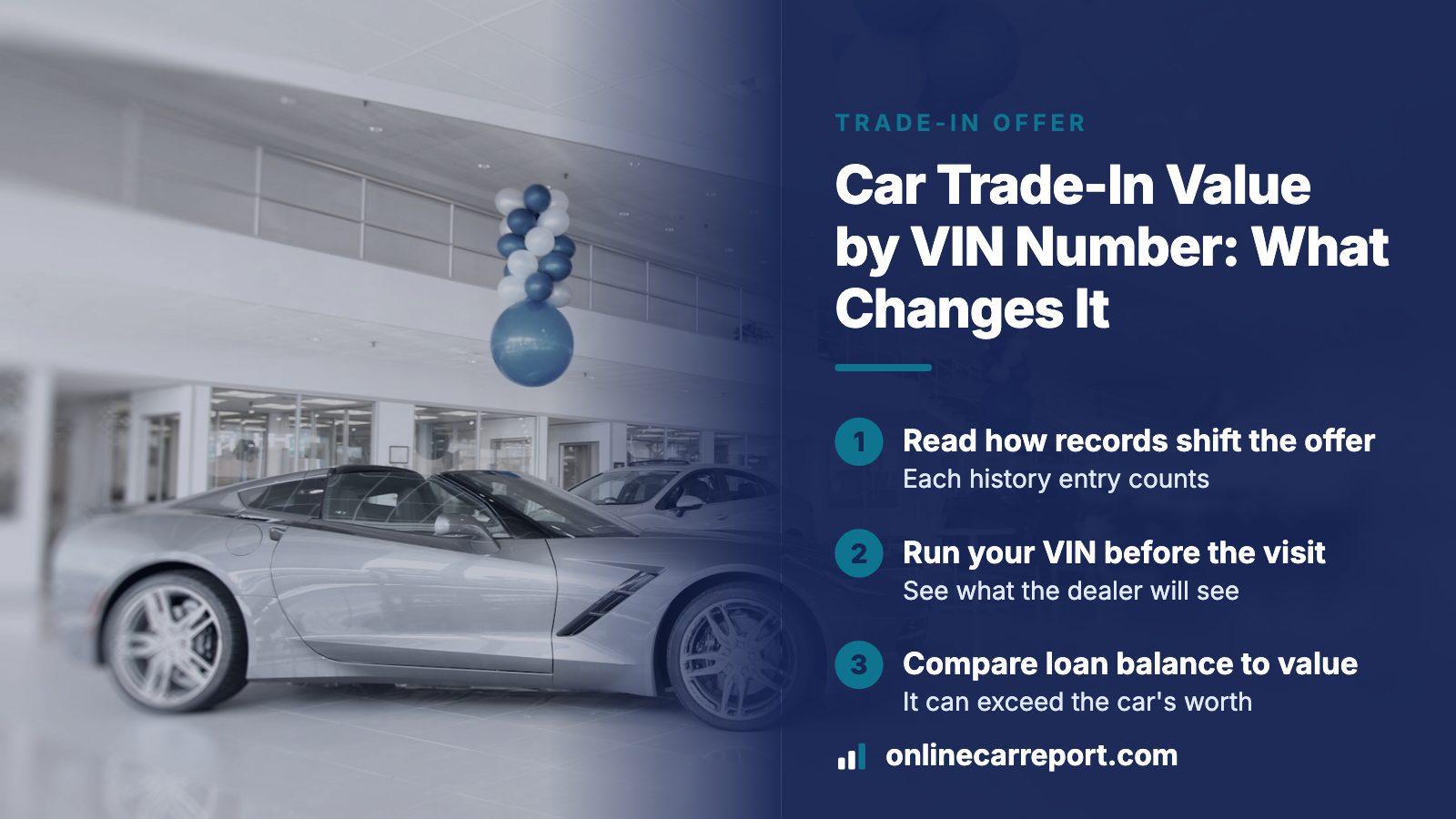
THE SHORT ANSWER
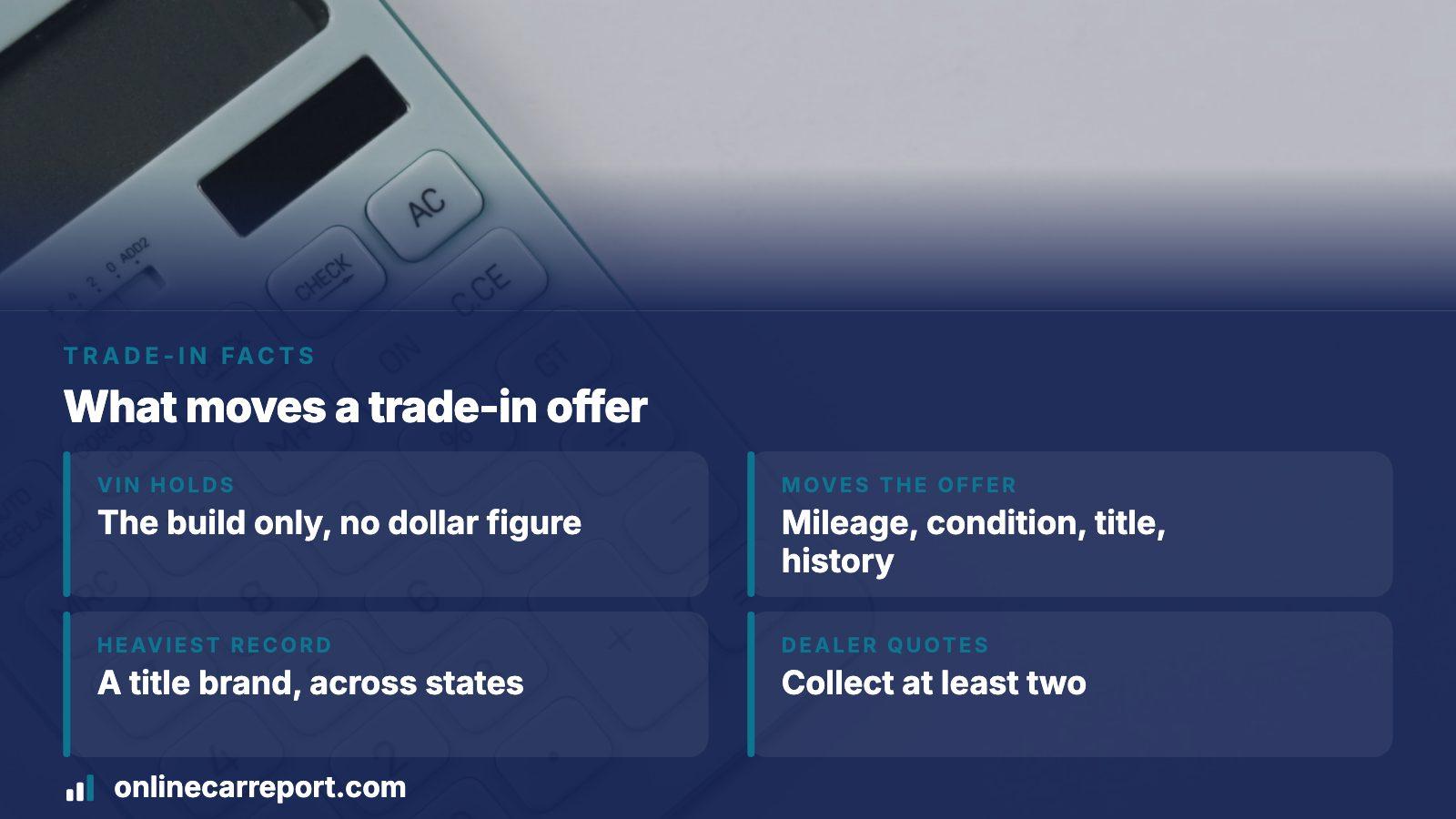
A VIN names the exact car but holds no price, so a trade-in figure by VIN means the build plus mileage, condition and history. Decode the VIN, price the clean version of the car in a valuation book, then mark it down for any title brand, accident or auction record, rental or fleet use, and any loan balance above the car's worth. Treat one dealer quote as a guess and collect at least two.
- What the VIN holds
- The build only, with no dollar figure
- What moves the offer
- Mileage, condition, title and recorded history
- Heaviest record
- A title brand, which follows the car across states
- Preview
- Free; the full report is one payment
What a dealer takes from your VIN
At the appraisal desk the VIN does one job: it settles which car this is. NHTSA's public decoder, vPIC, turns the code into year, make, model, trim and engine for model years 1981 and forward. A sample 2003 Honda Accord VIN we ran through its API returned an EX-V6 coupe built in the United States, and the base price field was empty. That blank is the lesson. The number holds the build, never a dollar figure.
Everything that moves an offer arrives afterward: odometer miles, wear, the title, and what other parties recorded about the car. Knowing those inputs first puts you on equal footing with the appraiser.
How each record in the history shifts an offer
No record comes with a fixed discount. This is how an appraiser tends to read each one.
| Record | What the appraiser reads into it | Likely effect on your offer |
|---|---|---|
| Title brand (salvage, rebuilt, flood, junk) | A permanent label that crosses state lines with the car | Usually the heaviest discount of any entry |
| Accident or damage entry | A repair of unknown quality | Lowers the offer; severity and proof of repair decide how far |
| Salvage or auction sale, with photos | The condition it was in at sale | Photos back up your repair story or undercut it |
| Odometer readings | Whether miles rise in a steady line | A drop or long stall casts doubt on every figure |
| Rental, fleet or taxi use | A harder life than the ad suggests | Pulls the offer under a privately owned twin |
| Lien, impound or theft entry | Another party's claim, or an unresolved past | Delays the deal until the entry is cleared |
Running your VIN before you go in
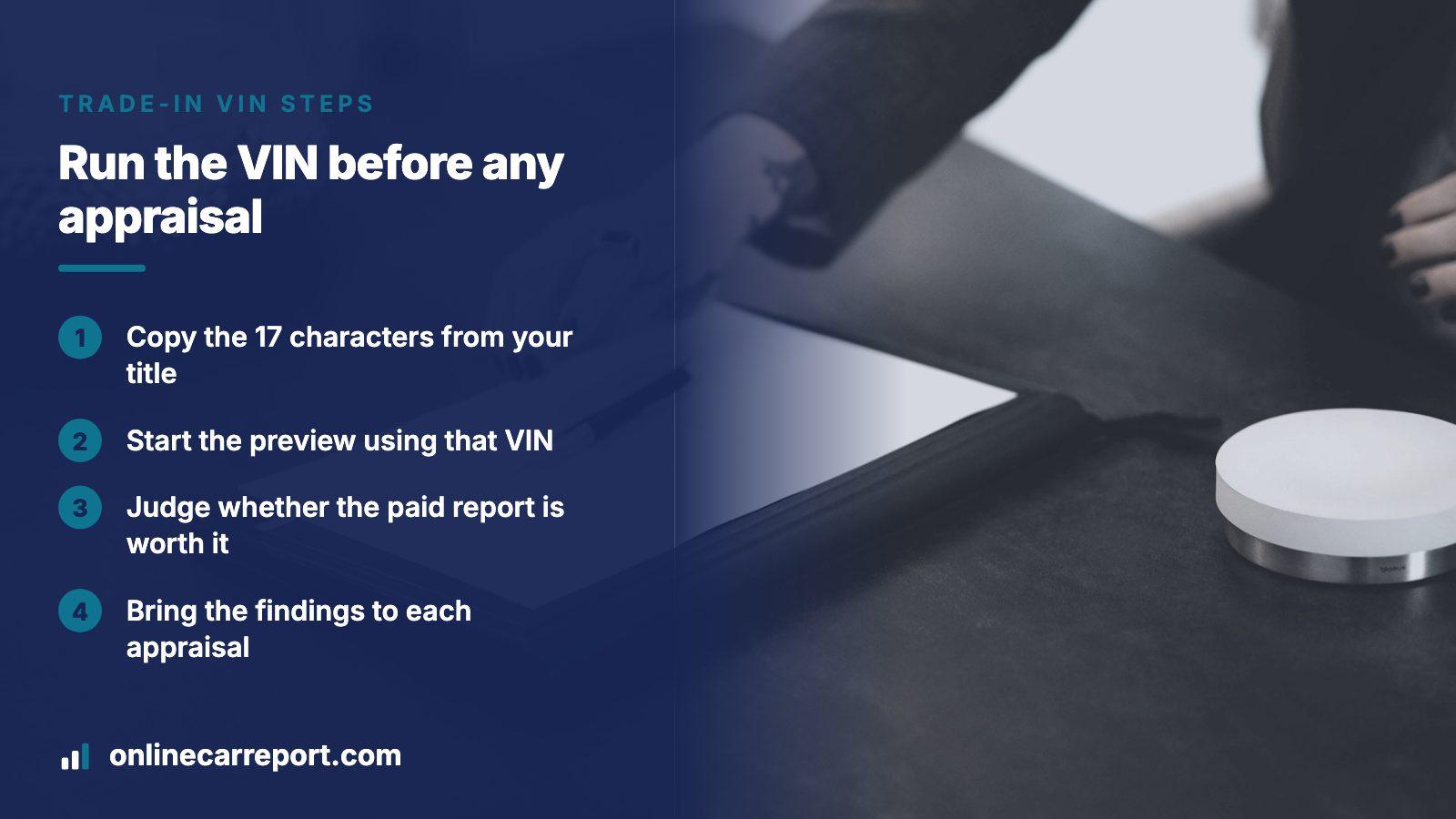
- Copy the 17 characters from your title or registration. The same code appears on a small plate in the dash corner, readable from outside the glass, and on the door-jamb sticker on the driver's side. All three should match.
- Start the free preview at OnlineCarReport using that VIN.
- See what the preview turns up and judge whether the paid report would add to what you already know. Payment is one-off, with no plan to cancel.
- Bring the findings to each appraisal so every dealer prices the same facts.
Reading the results as the seller
Read the title first, then the odometer line, then any damage or auction entry; those three move an offer most. If something surprises you, find the explanation before you walk in and bring repair invoices.
A clean sheet is good news with limits. The Justice Department's title database, NMVTIS, warns that a search can return a false 'no salvage history' when a source has not reported, and that a state may never brand a car a salvage yard handled. Flood labels depend on the state, though the database keeps every brand once reported, so crossing a border does not shed one.
The mileage statement you sign at trade-in
At a transfer of ownership, federal rules have the seller write the odometer reading on the title or its reassignment form, signed and printed by name, along with the date, both parties' details and the car's VIN. The seller attests, to the best of their knowledge, that the reading shows true miles, or states that it does not. A dealer buying for resale cannot accept an incomplete statement, and dealers keep each copy for five years. If you suspect your dash figure is off, say so; the printed warning mentions a fine or prison time for false answers.
Older cars can skip the form
Cars of model year 2010 and earlier are exempt, and newer ones become exempt after 20 years; the regulation's own example says model year 2011 cars reach that point in 2031. On an exempt trade-in, a history report's recorded readings may be one of few outside checks.
When the loan balance exceeds the car's value
A trade-in is clean only when the lender gets paid. Ask the lender for the payoff figure, which can differ from your statement balance. If the payoff is below the trade-in value, the CFPB advises clearing the old loan before taking a new one. If it is above, you have negative equity, and a dealer may offer to carry the shortfall into the new loan, which makes that loan costlier. A 2017 federal figure had close to a third of trade-ins underwater, by an average of $5,195.
The FTC's worked example
Owe $18,000 on a car valued at $15,000 and you are $3,000 short. A dealer who promises to absorb it may fold it into the new financing or subtract it from your down payment, which means interest on the $3,000 too. The FTC says a dealer who claims to settle the old loan while building that balance into the new one is acting illegally. Read the contract's down payment and financed amount against what you were promised.
The history helps here. A lien entry shows the title is not yet clear, and a brand or damage entry warns that the value in your loan math may be too high.
Comparing a trade-in with a private sale
The agreed trade-in amount comes off what you pay for the next car, and it is negotiable. Federal guidance says to price the car in several valuation guides and gather estimates from more than one dealership. It also cautions that pressing for a high trade-in figure may meet a firmer price on the next car, and the reverse. Selling it yourself may beat the car's wholesale value, but a financed car usually means telling the lienholder first.
Tax can tilt the math. Texas, for one, lets a buyer subtract the traded car's value from the price before taxing the remainder, only when the trade is part of the same sale. Money from a private sale does not lower that tax. Other states differ, so ask your own revenue department.
Cost, and a four-step order of work
The preview carries no charge. The paid step is a one-off: pick a single report, or packs sized 3, 5 or 10 when several cars are on your list. No plan bills you again afterward. Today's rates are on the pricing page. The report sets a market value beside the history covered above; treat it as one reference, never as the dealer's offer.
- Run the preview on your VIN and note any brand, damage or odometer surprise.
- Price the clean car in two valuation books, such as Kelley Blue Book and NADA Guides.
- Mark the figure down for what the history shows and for any loan gap.
- Collect at least two dealer quotes and set them against a private-sale estimate.
Where this information comes from
- CFPB: Should I trade in my car if it's not paid off? — Supports the payoff-versus-statement-balance point, the advice on negative equity and the check that the old loan was really closed.
- FTC: Auto trade-ins and negative equity — Source for the worked example and for the point that a promised payoff rolled into the new loan is illegal.
- CFPB and FTC: How to trade in your car (archived blog) — Covers multiple quotes, negotiating the trade-in against the price, the lienholder notice and the 2017 negative equity figures.
- eCFR: 49 CFR Part 580, odometer disclosure requirements — The federal rule on what the seller signs, how long dealers keep it and which older vehicles are exempt.
- NMVTIS: Information for consumers — Explains brands, why a clean search can still be incomplete and how flood labels vary by state.
- NHTSA: vPIC VIN decoder — The federal decoder behind the point that a VIN resolves to build details, not a price.
- Texas Comptroller: Trade-ins, Motor Vehicle Tax Guide — One state's treatment of a trade-in against sales tax, including the same-sale condition.
Sources and photos: Facts checked against the sources above in November 2026. Photos by Richard R, Annika Wischnewsky and Sasun Bughdaryan on Unsplash; diagrams by OnlineCarReport.
Keep reading
- Car value by VIN: what the number tells you and how history moves itThe wider picture of what a VIN can and cannot price, for any kind of sale.
- Kelley Blue Book value by VIN: how the history changes the numberUsing the consumer valuation book with your VIN as one of your two reference figures.
- NADA value by VIN: the lender's book and what history does to itThe dealer and lender reference to put beside it.
- Sample reportSee how the title, damage and odometer entries read before you buy.
Frequently asked questions
Can a VIN lookup tell me exactly what a dealer will pay for my trade-in?
No. A lookup supplies the build and the recorded history, which are inputs. The offer comes from an in-person look at wear, tires, interior and mechanical condition, plus what that dealer wants on its lot. Use the lookup to remove surprises, then let competing quotes settle the number.
Why would two dealers quote different trade-in values for the same VIN?
The VIN fixes the same car in both places, but each dealer judges mileage, wear and resale plans for its own lot, which is why the CFPB suggests gathering several estimates. Ask each dealer what it saw, since the low quote may be pricing a record the other missed.
Does a repaired accident still lower what I get for a trade-in?
It can. The FTC lists accidents and repairs among the things that push a car's value down, and a record on the history means the next buyer will see it too. How far it matters depends on severity, repair quality and whether the title was branded afterward. Keep the repair invoices and photos.
How do I make sure my old loan is really closed after a trade-in?
Ask the old lender which department confirms payoff, then wait about a week after the deal and call to check the balance is zero. If it is not, contact the new lender. The CFPB says that when reasonable efforts fail you can complain to the FTC or the CFPB, or contact your state attorney general.
If my report is clean, will a dealer offer top value?
A clean history removes the discounts a record would cause, but it does not set the price. Mileage, tire and brake wear, paint, interior and mechanical condition still count, and a history report says little about how the car actually runs. A clean report protects you from a markdown for a past event; it promises no high number.
Now check the car itself
The guide explains what to look for. The report shows what this VIN has on record.