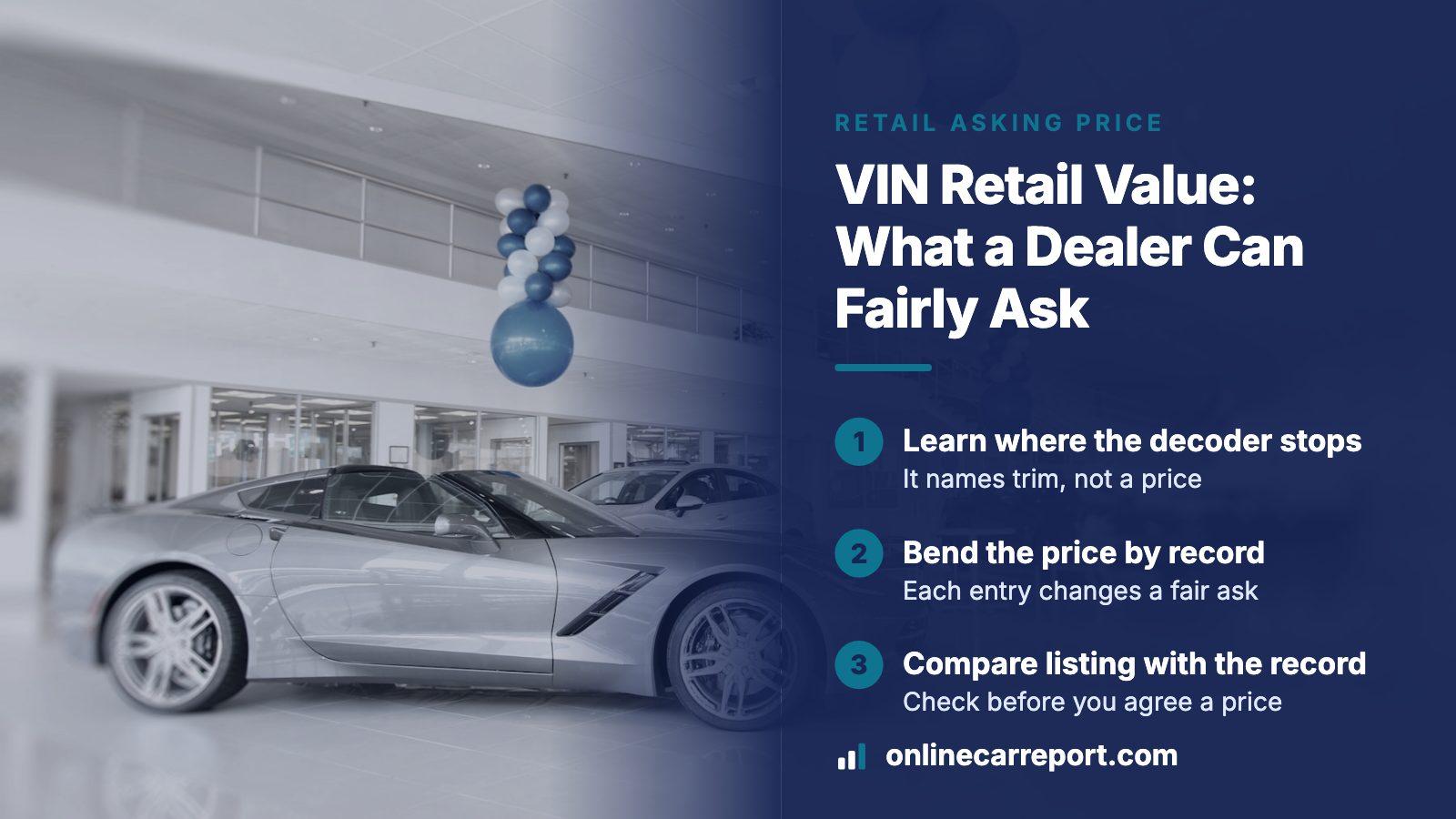
THE SHORT ANSWER
A VIN names the build, not the price. The federal decoder's base price field, when filled, shows what the car cost new with standard equipment only. Retail value today is the clean-car figure for that exact trim and mileage, minus what the history justifies: a title brand, an accident or auction record, an odometer gap or an open lien. Set that number beside the dealer's ask before negotiating.
- What the VIN holds
- The build, with no current price
- Decoder base price
- A new-car figure, blank for some makes
- Heaviest history entry
- A title brand, which stays on the record
- Preview
- Free; the full report is one payment
Retail is a dealer's number, and the VIN cannot supply it
Retail is the figure on the listing: what a dealer asks for a car it has finished preparing. Trade-in and private-sale figures answer different questions, so retail matters when you are judging a dealer's price or setting your own as a seller. The VIN settles which car this is, not what it commands this month.
NHTSA's public decoder shows how little price the code holds. Its base price field means what a new car costs with only standard equipment and no option packages. We ran 19 test VINs for 2015 to 2018 models through it, each built with a valid check digit: 12 returned a base price and 7 returned none. A 2017 Chevrolet Malibu LT returned $25,125, a showroom number that says nothing about what a lot would ask today.
Where the decoder stops: trim and price
Valuation books price by trim, and trim is where a decode gets shaky. The same run gave one clean trim for some cars, a slash-joined list for others and nothing for the rest.
| Test VIN, decoded | Trim field | Base price field |
|---|---|---|
| 2017 Chevrolet Malibu | LT (1LT) | $25,125 |
| 2017 Toyota RAV4 | XLE | $25,500 |
| 2017 Toyota Prius | Five trims listed together | $23,475 |
| 2017 Hyundai Santa Fe | Six trims listed together | Blank |
| 2015 Nissan Altima | Empty | Blank |
So a listing that says Limited or Touring needs confirming against the car; a book figure for the wrong trim spoils every later step.
How each history record bends a fair asking price
No record carries a fixed discount; the table shows which way each one pushes the number.
| Record | What it tells you | Pull on the ask |
|---|---|---|
| Title brand (salvage, flood, junk) | A state labeled the car, and the label stays | Down, often the biggest move |
| Salvage or total-loss record | Written off by an insurer or passed through a salvage yard | Down, sized by the reason |
| Accident or flood entry | Something happened; the record does not grade the repair | Down, less with repair proof |
| Odometer readings | Latest reported miles, to hold against the listing | A gap voids mileage-based figures |
| Lien, impound or theft entry | Another party's claim, or an unresolved past | Holds the deal until cleared |
| Open recall | A recall repair has not yet been done on this VIN | Settle it before signing |
From an NHTSA owner complaint
An owner who paid $13,000 for a 2016 Ford Explorer says the SUV lost control on bumpy roads, got worse within two weeks and spent most of its two months in repair shops. Only at the trade-in stage did a history report show two crashes and a total loss, which the owner says they were never told about. The trade came at a "significant loss".
The order matters: a report run before purchase shows that record before the $13,000 changes hands.
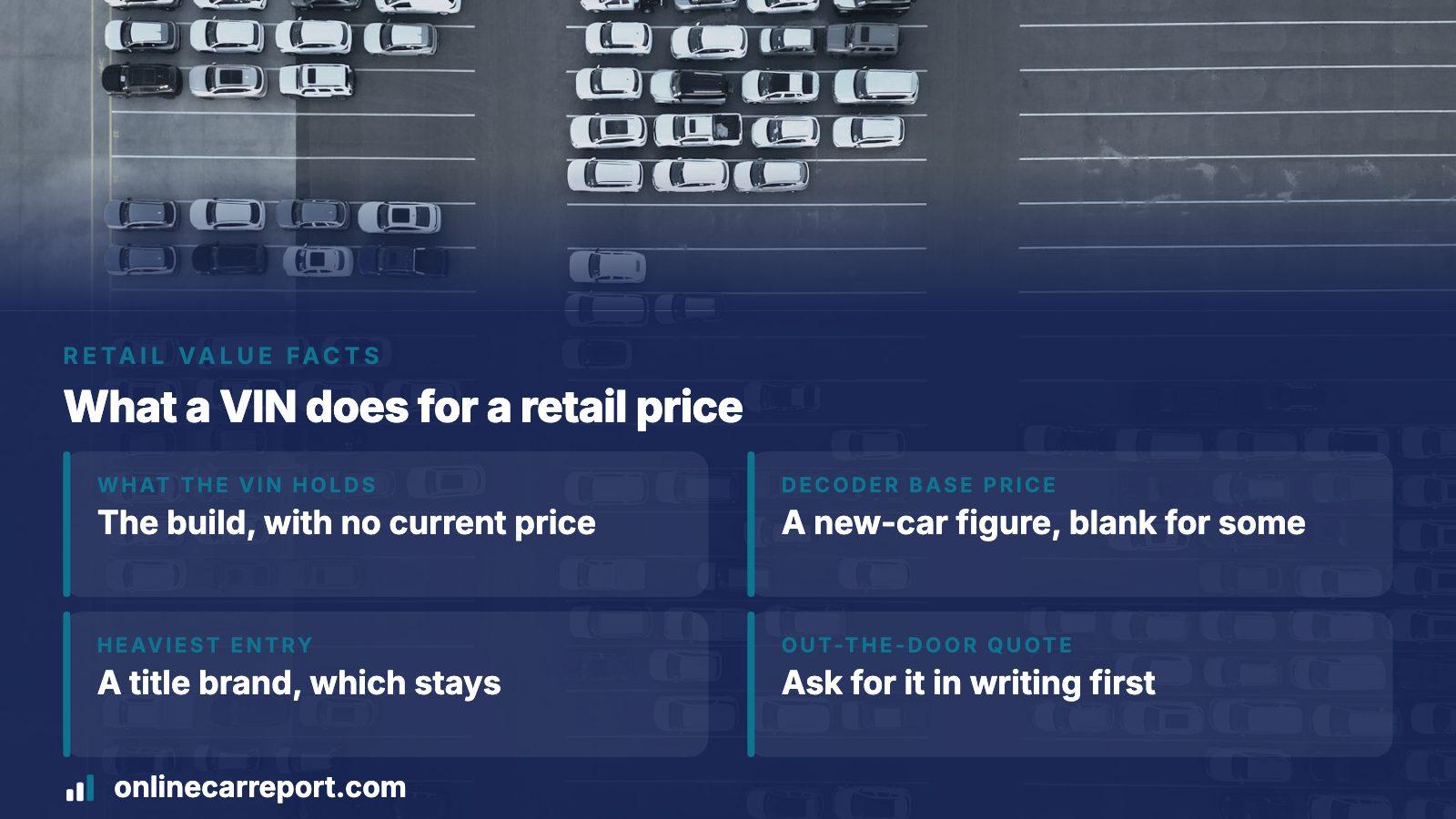
What a clean record does and does not prove
A clean result removes discounts; it does not certify the car. NMVTIS, the Justice Department's title database, covers about 87% of the US vehicle population, and over half of states feed it data. It warns that a search can show no salvage history just because a source never reported. On total loss, it says the label need not mean the car was destroyed, and a stolen car unrecovered after 30 days can carry it permanently, even if it later turns up in good shape.
- Clean title and odometer: a good result, but only for what the source can see.
- Clean history, tired car: the record is silent on brakes, tires and engine, and the FTC says reports typically omit mechanical problems.
- Brand plus repair receipts: a lower ask is fair; ask to see the receipts, not a promise.
The FTC says to hire your own mechanic even when the dealer calls the car certified, and to get the findings in writing with a repair estimate that can support a lower price. A dealer who refuses is a reason to shop elsewhere.
Finding the VIN on the car and running the check
- Read the VIN through the windshield on the driver's side, next to the left pillar. Federal rules make it legible from outside there in daylight, so nothing needs opening. Count 17 characters; I, O and Q are never used.
- Check it against the VIN on the front of the dealer's Buyers Guide. If they differ, the paperwork describes another car.
- Enter it in the free preview at OnlineCarReport, and read title entries first, mileage readings second, damage or auction records third.
- Price the clean car, at its exact trim and mileage, in two valuation books such as Kelley Blue Book and Edmunds. The FTC lists both and endorses neither.
- Subtract for what the record shows and compare the result with the listing.
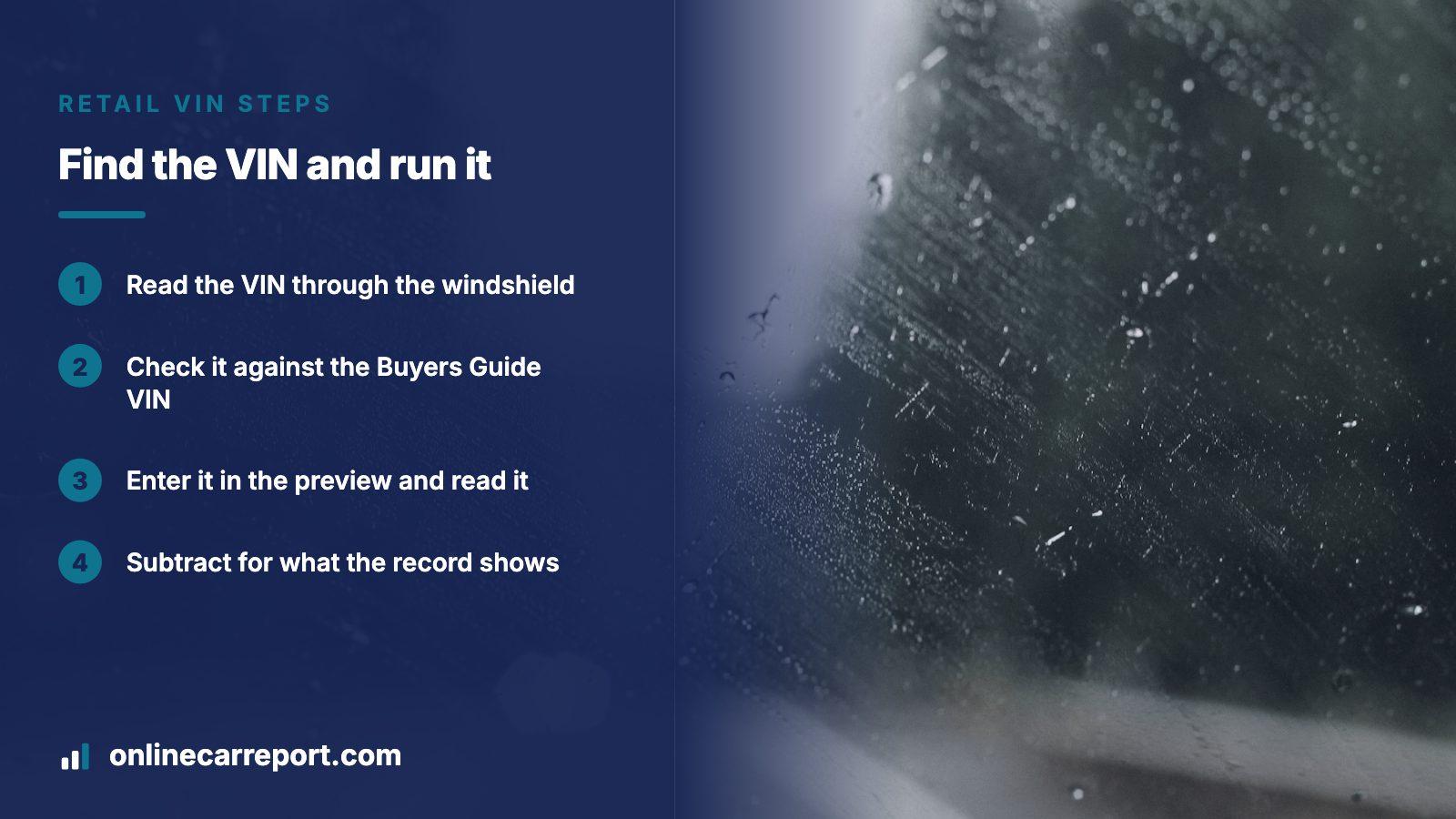
Setting the listing against the record
A retail price is only as good as the numbers under it. Test four: contract mileage against the history's latest reading, the ad's trim against the decode, the title wording against what the salesperson said, and the Buyers Guide box against any spoken promise.
From an NHTSA owner complaint
An owner in New York says a used 2018 Subaru Forester cost about $19,500 with tax and fees, and the contract listed 65,800 miles. The owner says the state's title record and a history report both showed 86,588 miles at the time of sale, and the title was later branded mileage unknown. After repairs, the owner traded the car in for $12,530.24 while still owing $13,705.58, and puts the direct loss at about $9,283.78. These are the owner's claims; the complaint reports no ruling.
Whatever the truth of that dispute, the lesson is mechanical: a mileage gap is a comparison of two numbers, so make it before you sign.
The Buyers Guide, and the price after add-ons
A Buyers Guide has to be posted on each used car a dealer sells, demonstrators and program cars included, and given to the buyer after the sale. It states whether you take the car as is or with dealer coverage. The FTC's advice is blunt: spoken promises are hard to enforce, so have them written on the Guide.
- Request a written out-the-door quote before driving over, so the advertised price, the discounts and the car's presence on the lot are confirmed.
- Ask what each add-on costs and contains. The FTC says gap insurance, VIN etching and rustproofing can run to thousands of dollars, and most can be declined or bought elsewhere.
- Do not count on a return window; federal law requires none, though some states do.
Cost, and the order of work
Running the preview carries no charge. If it earns a closer look, you buy the report once, for one car or for three, five or ten, and nothing renews afterward. Prices are listed on the pricing page. Beside the history, the report carries a market value; weigh it as one more reference next to two valuation books, not as the dealer's number.
Order of work
Run the preview on the VIN. Price the clean car in two books. Subtract for the record. Hold the dealer's out-the-door figure against yours, and where they differ, ask for the reason in writing.
Where this information comes from
- NHTSA: vPIC VIN decoder — The federal decoder behind the base price and trim results, and its definition of base price as a new-car figure.
- eCFR text: 49 CFR 565.13, VIN requirements — Where the VIN must sit inside the car, how it must be readable and which letters it never uses.
- FTC: Buying a used car from a dealer — Source for the Buyers Guide, independent inspections, out-the-door prices, add-ons and the limits of history reports.
- FTC: Used cars — Shows the VIN on the Buyers Guide, lists the value tools it does not endorse and says where to report a dealer.
- NMVTIS: Information for consumers — Coverage figures, permanent brands, false clean results and what a total loss label can mean.
- NHTSA owner complaint 11695152 — owner experience, paraphrased
- NHTSA owner complaint 11556734 — owner experience, paraphrased
Sources and photos: Facts checked against the sources above in November 2026. Photos by Richard R, Cole Keister and Iain on Unsplash; diagrams by OnlineCarReport.
Keep reading
- Car value by VIN: what the number tells you and how history moves itThe wider question of what a VIN can and cannot price, for any kind of sale.
- Car trade-in value by VIN number: what a dealer sees and what history changesThe other side of the counter: what history does to a dealer's offer on your car.
- Diminished value calculatorHow a past accident can lower value even after a good repair.
- Sample reportSee how title, mileage and damage entries read before you buy.
Frequently asked questions
Can I get a retail value from the VIN alone?
The VIN fixes the exact build, which is where a valuation book starts, but retail value also needs mileage, condition and recorded history, none of which sit in the 17 characters. NHTSA's decoder offers a base price, yet it is the price new, and for several makes it is blank.
Why do two valuation books give different retail figures for one VIN?
Expect different numbers from different tools and treat the gap as a range, not a mistake. The FTC lists Edmunds, Kelley Blue Book and NADA Guides as value tools and endorses none. Read two, then adjust for what the history shows.
Does a clean history mean the dealer's price is fair?
No. It means the record gives no reason to discount. Fairness still depends on mileage, wear, trim and local demand, and a clean search can miss events a source never reported. Add an independent inspection and a written out-the-door price.
What if the mileage on the contract differs from the history?
Stop before signing and ask the dealer to explain the gap in writing. A mismatch shakes every mileage-based value. After a purchase, the FTC points to its complaint page, your state's attorney general or a local consumer protection agency.
Should I run the VIN before or after visiting the dealer?
Before, if the dealer will send it; the FTC advises getting answers in writing, and the Buyers Guide shows the VIN on its front. Otherwise read it through the windshield on arrival and run the preview before the test drive.
Now check the car itself
The guide explains what to look for. The report shows what this VIN has on record.