THE SHORT ANSWER
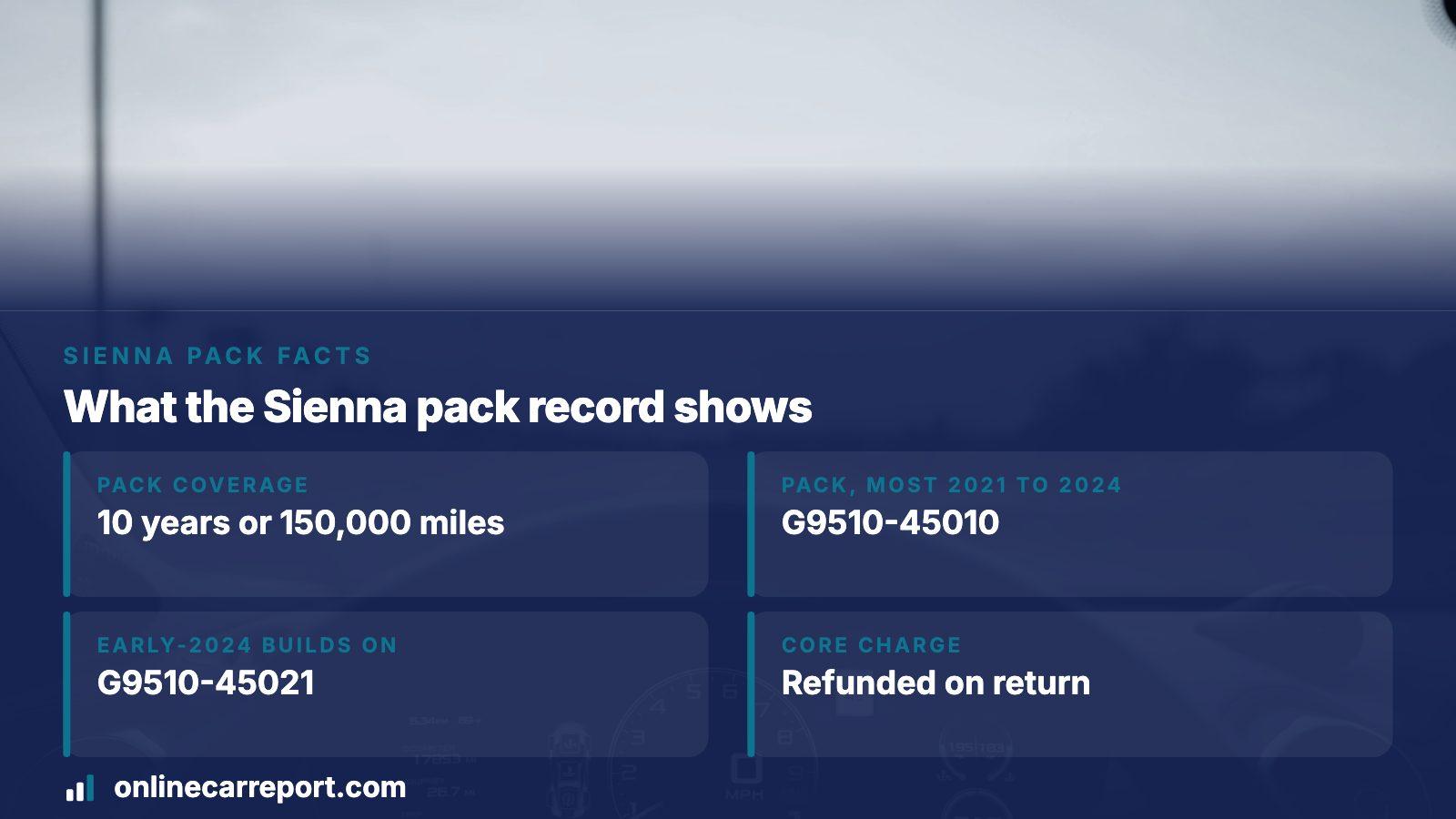
Expect about $4,625.52 on sale for the pack that fits most 2021 to 2024 Siennas, and $10,418.67 MSRP for the part used on early-2024 builds and later, with labor extra. Each pack has a refundable $1,350 core. No rebuilt pack turned up. Toyota covers the pack for a decade or 150,000 miles, so mainly high-mileage vans pay. Check the odometer record and title before pricing any pack.
- Pack for most 2021 to 2024 vans
- G9510-45010, $4,625.52 sale
- Pack for early-2024 builds and later
- G9510-45021, $10,418.67 MSRP
- Core charge
- $1,350, refunded on return
- Pack coverage
- 10 years or 150,000 miles
What the Sienna pack was listed at in October 2026
Each figure came from a parts listing, not a Toyota quote, and sellers change listings overnight. Use the numbers to open a conversation with a dealer parts counter.
| Toyota part | Fits | Listed price | Core charge |
|---|---|---|---|
| G9510-45010 | Most 2021 to 2024 vans, built until about February 2024 | $4,625.52 sale | $1,350 |
| G9510-45021 | Vans built from early 2024 | $10,418.67 MSRP | $1,350 |
| Rebuilt or aftermarket | Nothing from an established seller | None to quote | Not applicable |
The core comes back when the old pack is returned. Labor is the missing line: no flat-rate hours for the pack itself turned up, so get an installed figure in writing.
Two pack part numbers, and the factory month picks one
A 2024 Sienna can take either pack, depending on the month it came off the line, and the newer pack's list price is more than twice the older pack's sale price. A tailgate badge says nothing about that. The full VIN, read by a dealer parts clerk, does.
A decoded VIN gives the model year, drivetrain and plant a parts clerk will ask for, and it catches a seller who quotes the cheaper pack for a van that needs the dearer one. Launch reviews describe a nickel-metal hydride pack beneath the front seats and a hybrid system rated at 245 horsepower. Whether the chemistry changed with the 2024 part number is unconfirmed, so do not assume it swaps with a Highlander or RAV4 pack.
The odometer decides who pays for the pack
Toyota covers the Sienna Hybrid pack for 10 years or 150,000 miles, measured from the day the van was first put in service. Vans began reaching owners in late 2020, so no 2026 Sienna has run out of years. Mileage is the only thing that can end the coverage early.
| Situation | Who pays for a failed pack |
|---|---|
| Under 150,000 miles, in-service date known | Toyota, via its dealers |
| Mileage beyond that limit | The owner pays the listed prices |
| Damage from flooding, fire or a crash | The owner or an insurer, since damage is not a defect claim |
So the bill falls on hard-used vans: ride-hail and shuttle work, mobility conversions, family vans that never sat still. A reading that is high, or wrong for the van's age, marks the car this price list was written for.
Setting the pack price against what the van is worth
A used van's market value comes from year, trim, mileage and condition, and an untested battery pulls on that number quietly. A careful buyer who knows a dealer pack could cost thousands will discount for the risk.
- Low mileage with a documented in-service date: the pack adds little discount, because Toyota still stands behind it.
- Mileage past 150,000 and no record of a pack replacement: expect buyers to price in a dealer pack.
- Odometer readings that step backward between records: treat every mileage-based promise as unreliable.
- A title brand or auction history on top of a battery question: two discounts stack on one van.
Start from the market value for the exact trim, then let the history place this Sienna above that figure or below it.
Where the title record changes the battery picture
Program 22TE09 pays for corroded connectors where the underfloor high-voltage wiring meets the rear motor cable, on 2021 to 2024 Sienna Hybrids, a fault that can leave a van unable to start. Toyota's dealer letter marks the program closed to salvage-title vehicles and leaves out damage from abuse, accidents, theft and vandalism.
A branded title therefore costs the owner a free repair that a clean-title twin still gets. Toyota's listed repair times run from 3.3 to 13.6 hours, a hint of the out-of-pocket cost. The Sienna is also missing from campaign LSC 25TD01, which stretches the program to 10 years with unlimited miles on other models.
Read the title before the quote
A salvage brand, a flood record or an auction listing with photos changes what a pack repair is worth to you and what manufacturer help you can count on. Read those records first.
Van will not start, pack is fine: what else it can be
An owner whose Sienna will not go into ready mode usually blames the pack. Toyota's paperwork points at cheaper parts first.
- A corroded floor harness connector, covered by program 22TE09. AM radio static or a no-start are the symptoms Toyota names.
- A drained 12-volt battery. Bulletin T-SB-0016-21 says a 2021 control unit can fail to sleep after a tow, a jump-start or a new battery. The original cause of the drain needs repair before the software update.
- Hybrid warnings in freezing weather with codes P1C8449 and P300449, which Toyota fixes by replacing the relay assembly, a 1.4-hour job.
Get the trouble codes read out and named before a pack goes on any work order.
A used buyer, a snowy January and a van that would not restart
From an NHTSA owner complaint
The buyer of a used 2023 Sienna wrote in January 2025 that the van would not restart after a stop, even after several jump-starts and more than 45 minutes of driving. Having read about a similar 2022 problem, the owner switched off the rear hatch kick sensor. The van then started again, and still did two days later. The owner blames a dirty sensor in Midwest slush.
Take from this that a van which keeps dying has been misread as a battery or pack failure before. Ask a seller what was replaced, and why, rather than accepting that a new part fixed it.
The hybrid-only complaint owners file is about brakes
Of the hybrid-specific gripes in owner complaints, brakes beat the pack. Bulletin T-SB-0047-24 describes drivers of 2021 to 2024 vans feeling the switch from regenerative to hydraulic braking on downhills or in turns. Toyota's remedy is a software reflash of the brake actuator control module, 0.8 hour of labor, covered by Toyota's 36-month, 36,000-mile basic coverage.
From an NHTSA owner complaint
A 2023 Sienna owner reported in May 2025 that the van lunged forward when the brake was pressed. In November 2024 that happened on a slow hill and the van tapped the car ahead, which needed a new skid plate. The owner says insurance doubled. By April 2025 the van was shaking and revving, and the dealer kept it and would not release it.
An accident entry, a rate change and a van held at a dealer all shape a sale. Ask for repair orders that mention brake software.
A short list before buying a used Sienna Hybrid
- Get the in-service date and the odometer history. Together they show how much pack coverage is left.
- Run the VIN for title brands, damage, salvage or auction records and open recalls. The preview costs nothing, then one payment buys the report.
- Ask a Toyota dealer whether program 22TE09 applies to that VIN and whether the harness was already replaced.
- Ask whether a 2021 to 2024 van got the brake software update described in T-SB-0047-24.
- Have hybrid codes read, and pay a shop with Toyota hybrid diagnostic tools to inspect the pack.
A history report does not test battery health. It shows whether the records support the seller's story.

Where this information comes from
- Toyota Customer Support Program 22TE09 (hosted by NHTSA) — Sienna Hybrid coverage, salvage-title exclusion, repair times and the missing 25TD01 campaign
- Toyota T-SB-0047-24 (hosted by NHTSA) — brake transition feel and the reprogramming fix
- Toyota T-SB-0016-21 (hosted by NHTSA) — 12-volt drain triggers on the 2021 Sienna Hybrid
- Toyota T-SB-0085-23 (hosted by NHTSA) — freezing-weather hybrid warning fixed with a relay assembly
- Clean Fleet Report: 2021 Sienna Hybrid road test — the 10 year or 150,000 mile hybrid battery warranty line
- NHTSA owner complaint 11639214 — owner experience, paraphrased
- NHTSA owner complaint 11660961 — owner experience, paraphrased
Sources and photos: Facts checked against the sources above in November 2026. Photos by Erik Andersson, Carrie Allen www.carrieallen.com and Dennis Eusebio on Unsplash; diagrams by OnlineCarReport.
Keep reading
- Toyota Highlander Hybrid battery replacement cost and what it does to valueSame floor harness program, with the extension the Sienna is still waiting for.
- Toyota RAV4 Hybrid battery replacement cost, and how it moves the car's valueAnother Toyota where the pack part depends on the VIN.
- Car value by VIN: what the number tells you and how history moves itSee how mileage and history move the price of the van itself.
- Diminished value calculatorEstimate what a damage record takes off a van's value.
Frequently asked questions
What does a Sienna Hybrid battery cost from Toyota?
In October 2026 listings, G9510-45010 (most 2021 to 2024 vans) was $4,625.52 on sale, and G9510-45021 (builds from early 2024) carried a $10,418.67 MSRP. A $1,350 core charge on each is refunded on return. Labor is separate, and no aftermarket pack turned up.
Does Toyota still cover the Sienna Hybrid pack?
Almost certainly, on age. Toyota allows 10 years or up to 150,000 miles from when the van first entered service, and the oldest ones were running by late 2020. Only mileage can end it early, so ask the seller for the in-service date and compare it with the odometer history.
Does a salvage title affect Sienna Hybrid repairs?
It can. Toyota's floor harness program 22TE09 is marked as not available to salvage-title vehicles, and its coverage excludes accident damage. A brand also lowers resale value on its own, so a van with a brand and a battery question deserves a lower offer.
Can a bad 12-volt battery act like a failed hybrid battery?
Yes. Toyota describes 2021 Sienna Hybrids whose 12-volt battery drains because a control unit does not sleep after a jump-start or battery change, plus a 2022 liftgate sensor drain in cold weather. A no-start does not prove the pack failed.
Does a VIN report show the Sienna's battery health?
No. A history report is about the van's past: brands on the title, damage entries, mileage readings, auction listings and recalls. It cannot say how the pack performs. For that, rely on service records and a hybrid-capable shop.
Now check the car itself
The guide explains what to look for. The report shows what this VIN has on record.