THE SHORT ANSWER
Plan on $2,949 for an aftermarket 2014 to 2019 pack plus an install the seller puts at $300 to $400, or about $3,932.01 for Toyota's part at a parts-site discount. On 2020 and newer cars Toyota's pack term is a decade or 150,000 miles, whichever ends first; older cars got eight years or 100,000 miles. Brake and inverter faults often mimic a dead pack, so read the codes first.
- Aftermarket pack, 2014 to 2019
- $2,949, install extra
- Toyota pack list price
- $5,002.79 on 2011 and later parts pages
- Pack coverage, 2020 and newer
- a decade, 150,000 miles
- Early inverter recall
- 13V396, free repair, 2006 to 2010
What the packs are listed for
Every figure below belongs to the seller named beside it, and sellers change listings without notice. The prices were read on October 25, 2026, and none of them includes the shop's labor.
| Seller and fit | Listed price |
|---|---|
| Best Hybrid Batteries, 2006 to 2007 | $2,549 |
| Best Hybrid Batteries, 2008 to 2010 | $2,649 |
| Best Hybrid Batteries, 2011 to 2013 | $2,849 |
| Best Hybrid Batteries, 2014 to 2019 | $2,949, with a 3-year warranty |
| Toyota part G9510-48090, 2020 | $5,002.79 list, $3,932.01 at ToyotaPartsDeal |
The same aftermarket seller says a scheduled install typically costs $300 to $400 on top. One Toyota dealer listing for a 2011 to 2013 pack also carries a $1,350 core charge, a deposit you get back when the old pack is returned. We found no verified aftermarket price for the 2020 redesign and no installed dealer total.
Why two quotes for the same car can sit a thousand dollars apart
Toyota's list price has stayed at $5,002.79 across several part numbers, while the aftermarket asks more for each newer generation. On a 2014 to 2019 car the working comparison is $2,949 aftermarket against roughly $3,932.01 for the factory part once a parts site discounts it. That is a gap of about a thousand dollars, narrower than the rule of thumb that a dealer charges double.
Ask each shop three things in writing: the pack's chemistry and part number, the length of its warranty, and the labor line. A cheap pack with a short warranty is a different purchase from a factory part with Toyota's backing, and the quote should say which one you are getting.
Whether the bill is yours at all
Toyota lengthened its hybrid pack coverage with the 2020 model year, which happens to match the Highlander's redesign. Where a car sits on that line decides who pays.
| Model years | Pack coverage |
|---|---|
| 2006 to 2018 | Eight years, 100,000 miles; most have passed the age limit |
| 2019 | Eight years, 100,000 miles; may still run if the car entered service late |
| 2020 and newer | Ten years, 150,000 miles |
Counting begins the day the first owner took delivery, not at the model year, so ask a dealer to look up that delivery date. Some states that follow California's rules can add a longer term, which is worth confirming for a car registered there.
Warnings that look like a dead pack and are not
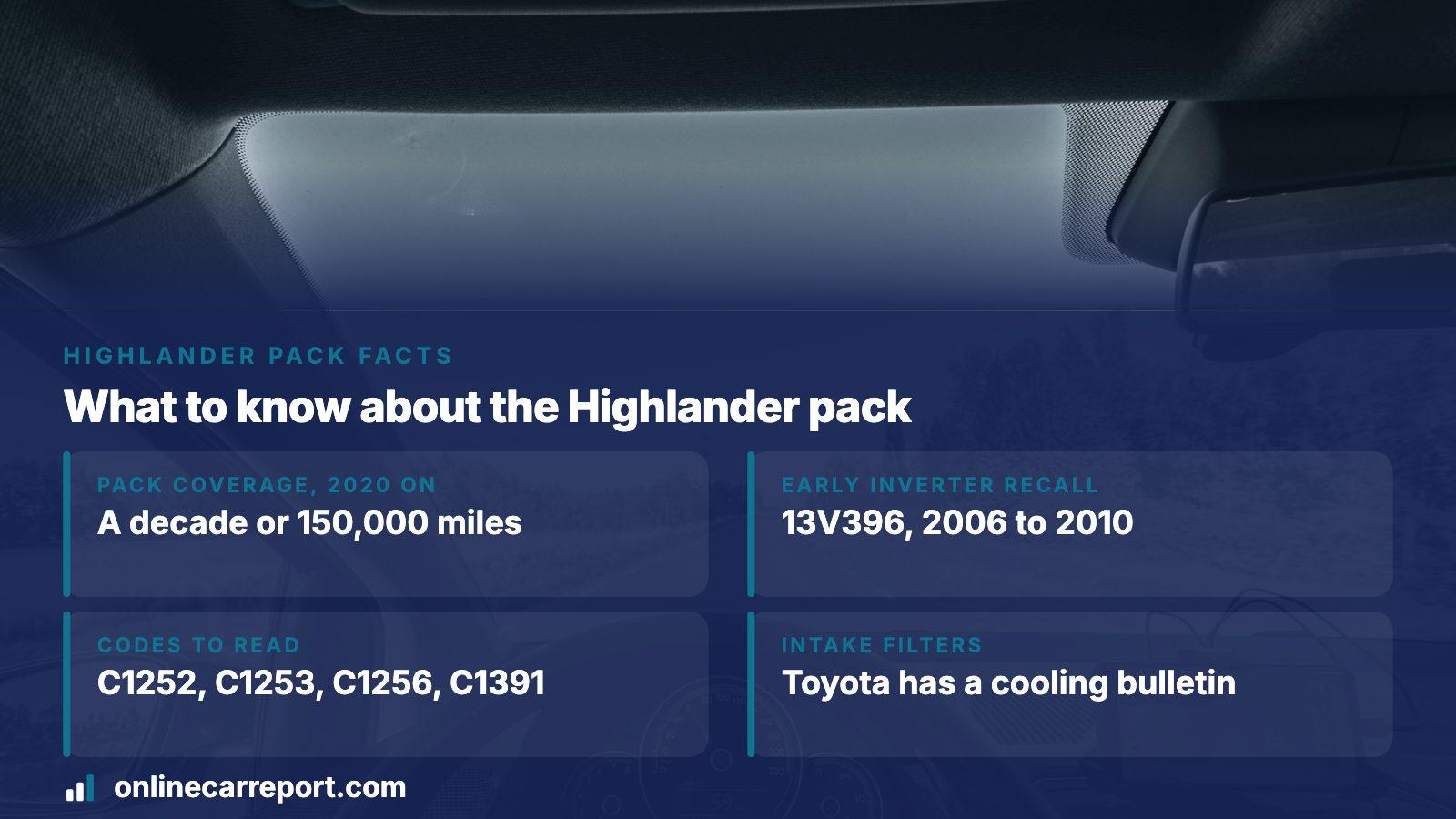
Two hybrid-only parts on this SUV throw lights that read like a failed pack. The first is the inverter power module on 2006 to 2010 cars, covered by recall 13V396, which the dealer fixes without charge, since recall work never expires with age or mileage. The second is the brake actuator and booster pump. Toyota's ZKC program paid for it on certain 2008 to 2010 cars, and program 24TE01 did so for certain 2014 to 2016 cars, tied to codes C1252, C1253, C1256 and C1391.
From an NHTSA owner complaint
Owners of a 2008 Highlander Hybrid wrote that after a toll booth the SUV shuddered and slowed while merging, and the steering turned heavy. The dash showed "check hybrid system" with brake and stability warnings, and the car had to be towed. The dealer said an inverter part needed replacing, and the owners noted Toyota's earlier trouble with it on 2006 and 2007 cars.
Takeaway: warnings across hybrid, brake and stability together are a reason to have codes read before anyone sells you a pack. Those programs have largely expired, which makes the brake unit a second possible bill on an older car.
When the pack is ruined by something outside it
A pack bill is not always a wear story. The compartment sits under the rear seat area, and water or other damage that reaches it can end a pack early. That matters to value because the cause decides whether the repair is a one-time cost or a sign of a car with a rougher past.
From an NHTSA owner complaint
An owner of a 2008 Highlander Hybrid reported that the engine stalled at about 40 mph and warning lights flashed. After a tow, the dealer found water in the hybrid battery compartment and said the compartment needed replacing. The complaint puts the mileage near 120,000 and says the SUV was not repaired.
Takeaway: on an older Highlander Hybrid, ask why a pack was replaced, not only whether it was. A flood, a collision or a long-running leak is exactly the kind of event that shows up in title brands, damage records and auction photos.
What a pack bill does to the car's value
Price a worn pack as a deduction from the car's market value, not as a reason to walk away. If the pack is original and the car is outside coverage, take the aftermarket figure for its generation, add the install, and set aside room for a brake unit repair if it is a 2008 to 2010 or 2014 to 2016 build. A seller who already replaced the pack should hand over the invoice, since a pack with a warranty behind it is worth more than a mystery one.
History moves the number further than the pack does. A clean title, a steady mileage trail and no unfixed recalls back up a full market value. A salvage or flood brand, a mileage gap or an unrepaired recall can take off far more than a battery costs, and no battery quote reflects any of that.
What the VIN record settles before you negotiate
The VIN fixes the model year and drivetrain, which choose the part, and it opens the history that sets the price. For a Highlander Hybrid, the history report can turn up a branded title, crash and damage entries, the mileage trail, salvage auction photos, unfixed recalls and a market value. It cannot test the pack, so add a hands-on check from a technician with a scan tool that reads hybrid pack data.
Entering the VIN brings up a preview at no cost. Reading the rest means paying once, with nothing billed afterward; our pricing page lists what that costs.
A short list for the test drive and the quote
- Run the VIN to confirm year, drivetrain and open recalls, including 13V396 on the early cars.
- Ask for the delivery date and any invoice for a pack swap.
- Get the trouble codes read; C1252, C1253, C1256 or C1391 means the brake unit, not the pack.
- Look at the pack's intake filters; Toyota's cooling bulletin asks for a look every 5,000 miles on 2014 to 2019 cars.
- Load-test the small 12-volt battery too, because a tired one can stop the hybrid system from powering up.
After that, take the likely repair cost off the report's market value and build your offer on the result.

Where this information comes from
- NHTSA owner complaint 10925200 — owner experience, paraphrased
- NHTSA owner complaint 10525250 — owner experience, paraphrased
- NHTSA recalls API: 2008 Highlander Hybrid — Returns recall 13V396, the inverter power module campaign; none of the recalls replaces the pack.
- Toyota program ZKC bulletin, hosted by NHTSA — Brake actuator and booster pump coverage on certain 2008 to 2010 cars.
- Toyota program 24TE01, hosted by NHTSA — Brake booster and pump coverage on certain 2014 to 2016 cars, with the qualifying codes.
- Best Hybrid Batteries: Highlander 2014 to 2019 pack — Source of the aftermarket price, warranty and install estimate.
- ToyotaPartsDeal: 2020 Highlander hybrid battery — Source of Toyota's list price and the discounted parts-site price.
Sources and photos: Facts checked against the sources above in November 2026. Photos by Sasun Bughdaryan, Scott Graham and Sander Jeurissen on Unsplash; diagrams by OnlineCarReport.
Keep reading
- Toyota RAV4 Hybrid battery replacement cost, and how it moves the car's valueA smaller Toyota hybrid with its own pack prices and coverage terms.
- Toyota Camry Hybrid battery replacement cost, and what it does to the car's valueThe same warranty change explained for the Camry.
- Car value by VIN: what the number tells you and how history moves itHow a VIN sets the starting value before a repair bill comes off it.
- Car trade-in value by VIN number: what a dealer sees and what history changesWhat a dealer may offer, and how history pulls that number down.
Frequently asked questions
How much does a Highlander Hybrid battery cost?
Best Hybrid Batteries lists packs from $2,549 to $2,949 depending on the years, with installation extra. Toyota's own part carries a $5,002.79 list price and sells for about $3,932.01 at a discounted parts site. Those are sellers' figures read in late October 2026, so get a written quote that includes labor.
Is the Highlander Hybrid battery under warranty?
For a 2020 or newer car, Toyota's pack term is a decade or 150,000 miles, counted from the day the first owner took delivery. Earlier cars were limited to eight years or 100,000 miles, and age has ended that for most of them. Have a dealer confirm that delivery date before assuming either way.
My Highlander Hybrid shows hybrid and brake warnings. Is the pack dead?
Not necessarily. On 2006 to 2010 cars an inverter recall can cause a shutdown, and certain 2008 to 2010 and 2014 to 2016 cars had brake actuator programs. Have the codes read first, because C1252, C1253, C1256 and C1391 point at the brakes rather than the traction pack.
Is the Highlander Hybrid pack lithium instead of nickel-metal hydride?
In the generations we could document, no. The original 2006 car carried a 288-volt NiMH pack, and the 2014 to 2019 replacement is also sold as NiMH. Each span takes a different part, so match the number to your own VIN before you order.
Will a new battery raise what my Highlander is worth?
A fresh pack with an invoice and a warranty helps a buyer feel safe, but it rarely adds its full cost to the price. Title brands, odometer gaps and open recalls usually move the value more. Run the VIN to see the recorded history before deciding what to ask.
Now check the car itself
The guide explains what to look for. The report shows what this VIN has on record.