
THE SHORT ANSWER
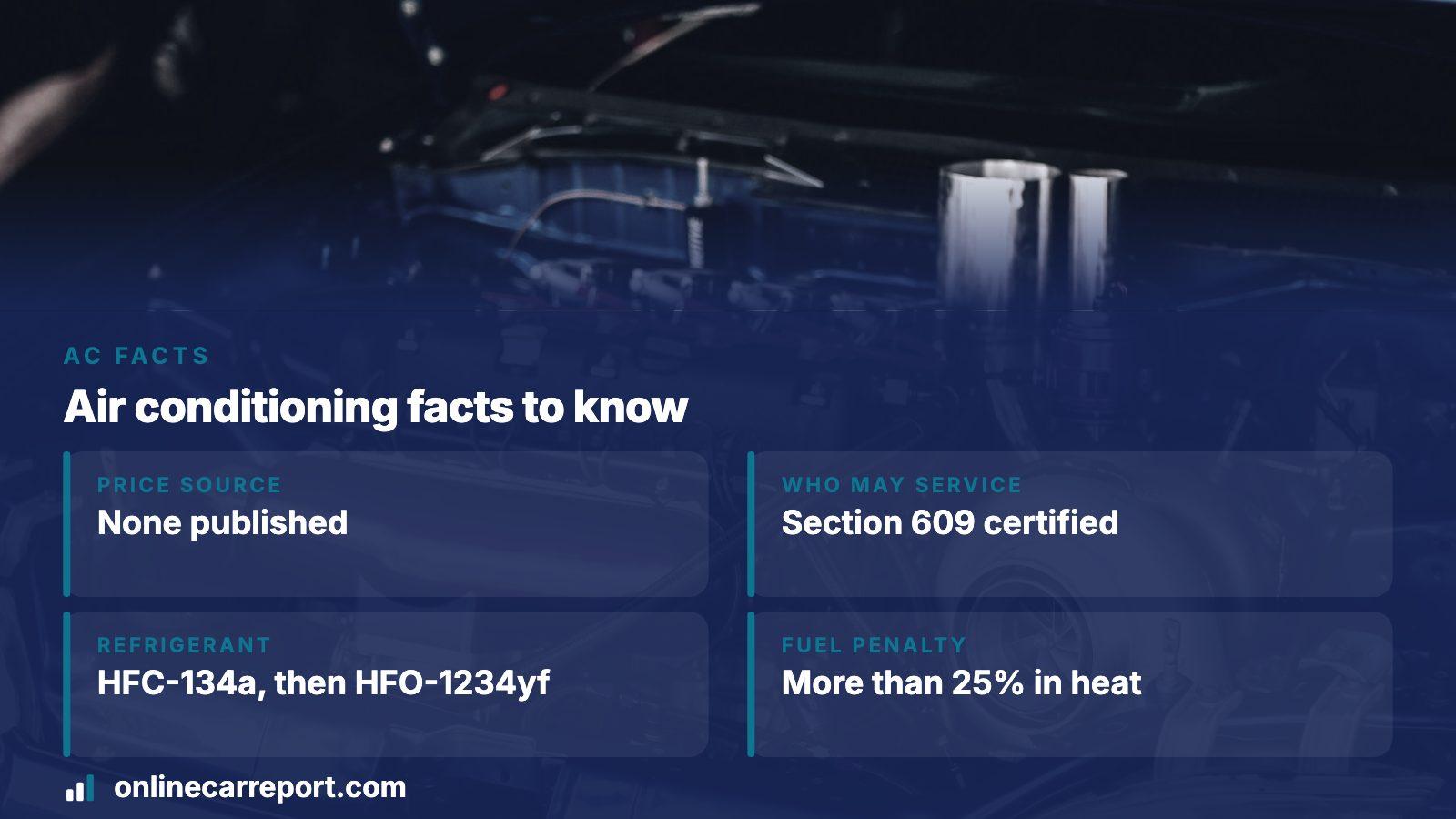
A recharge price could not be confirmed from an official source, so ask each shop for a written quote. The bill is built from labor by a certified technician, the refrigerant your car uses, and a leak check. Cooling that fades again after a recharge points to a leak, and the leak repair, not the refrigerant, is where costs climb.
- Price from an official source
- None published; get written quotes
- Who may service for pay
- Technicians certified under Clean Air Act section 609
- Refrigerant split
- HFC-134a from 1994; HFO-1234yf began arriving in 2012
- Fuel penalty of running AC
- More than 25% in very hot, short-trip driving
Why one recharge price cannot be quoted
Federal agencies regulate how air conditioners are serviced but do not track what shops charge, and the carmakers opened for this page publish no recharge price either. Estimate sites give wide ranges that disagree with each other, so none is printed here.
Three things move the number from one car to the next: the refrigerant the system holds, whether a leak has to be found first, and the shop's hourly rate. A written quote that separates those lines lets you compare two shops fairly, which a single lump sum never does.
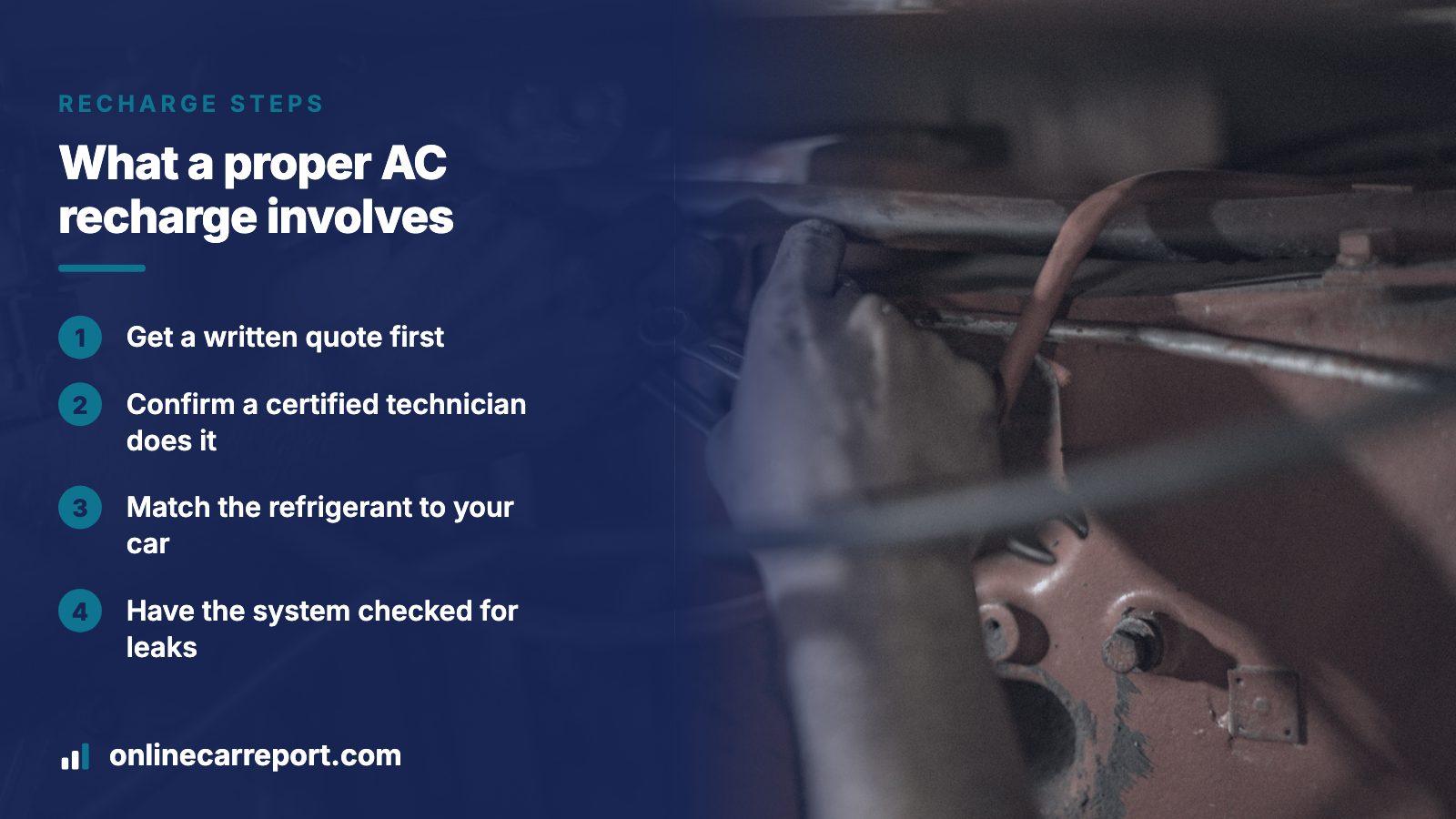
What a legitimate recharge actually involves
Under EPA rules, a shop that works on a car's air conditioning for payment of any kind needs a technician certified under section 609 of the Clean Air Act, and that person must use approved recovery equipment. Old refrigerant comes out into the machine first. It must be cleaned, by recycling or reclaiming, before any of it goes back in, even if it returns to the same car.
- Recovery of whatever refrigerant remains in the system
- A check for leaks, since the gas does not get used up
- New or cleaned refrigerant measured in by weight
- Oil and, on some jobs, dye for tracing a slow leak
Venting the gas to the air is prohibited under section 608, so a shop cannot simply let it escape and refill the system. That is why the labor line is rarely tiny, and why a quote that skips recovery deserves a question.
Your car's refrigerant sets the price floor
Cars built after 1994 generally use HFC-134a. EPA says that by the 1995 model year every new car sold here with air conditioning used it, and that automakers began shifting light-duty vehicles to HFO-1234yf in 2012. Newer cars may carry the second type, and the two are not interchangeable.
| Refrigerant | Where it shows up | Detail that matters to a buyer |
|---|---|---|
| CFC-12 | Cars built before the switch to HFC-134a | Ozone-depleting; small cans may be sold only to certified technicians |
| HFC-134a | Most cars from 1995 onward | Existing cars may keep being serviced with it |
| HFO-1234yf | Newer light-duty models from 2012 on | Uses its own service fittings and can threads |
Each approved refrigerant has its own unique fittings, so a technician cannot adapt one hose to another system. Look under the hood for the label, or ask the shop to name the refrigerant before agreeing to a price.
The store can, and the leak it cannot fix
A car's AC is a sealed loop. When cooling weakens, refrigerant has escaped somewhere: a hose, a seal, the condenser at the front of the car, the compressor, or the evaporator buried behind the dash. Adding gas treats the symptom, and the cooling usually fades again.
Be careful with imported cans
EPA has warned about a product sold online in small cans as "F-12" that was a blend containing ozone-depleting chemicals. Importing or selling it is illegal. Use only refrigerant that matches your car's label.
Hydrocarbon blends are also listed as unacceptable for car air conditioners, and using one is illegal. Cheap online cans of unknown content are a poor trade when a certified technician has to recover the contents later.
When the recharge does not hold
Owner complaints filed with NHTSA show how a top-up can be the first stop on a longer bill. Two recent-model cases make the pattern clear.
From an NHTSA owner complaint
A 2013 Altima owner who had bought the car from a used-car retailer about four months earlier said the air blew hot almost from the first drive, including through a two-hour traffic jam. A salesperson suggested a recharge and the owner had it done, yet "the problem still persists." The owner had heard that a compressor replacement is costly and rarely covered.
The lesson for a shopper is that a recharge is a test, not a cure. If a seller says the AC only needed gas, ask for the invoice and how long it has held.
From an NHTSA owner complaint
Another owner, of a 2014 Grand Cherokee, filed that the AC quit at about 45,000 miles. The dealer found the evaporator behind the dashboard leaking refrigerant, and because of the labor to reach it the repair was quoted at $1,680. The maker declined to pay since the car was past its warranty.
Why a weak AC matters beyond comfort
FuelEconomy.gov, run for the Department of Energy and EPA, names air conditioning as the main reason mileage drops in hot weather. Its own figure is a loss above 25% for a gasoline car in extreme heat, worst when the trips are short. Hybrids and electric vehicles can lose more in percentage terms.
A system running low on gas works harder for less cooling, and a failing compressor adds its own load. Drivers also tend to compensate with open windows, which adds drag at highway speed. The site's advice is to use the AC at highway speeds, air the cabin out first and park in the shade.
How an AC problem figures into a used car's value
OnlineCarReport looks at value through a car's recorded history, and a dead AC is a negotiating point, not a line item on any record. Buyers price it as the likely repair plus doubt about what else was ignored. A compressor or evaporator job costs far more than a top-up, and a seller who has not diagnosed the leak leaves that risk with you.
| Seller claim | Possible reality | Proof to request |
|---|---|---|
| Just needs a recharge | A leak that nobody has located | A leak test result in writing |
| Recharged last month | Cooling may already be fading | The invoice with date and mileage |
| Compressor was replaced | A real repair, or a part swapped on a worn system | Itemized receipt and warranty terms |
Service receipts are the best evidence of how a car was treated, and a car with none is harder to price. Pair them with what the VIN shows about title status, damage entries and odometer readings, since front-end collision damage is one way condensers and lines get hurt.
Run the VIN before you pay for AC work on a car you are buying
If the car is still the seller's, the cheapest move is to learn its record before you spend on it. The preview of a car's record is free to run. Going further means a one-time purchase, no recurring plan, and the current rates sit on the pricing page. The report shows title brands, accident and damage entries, odometer readings and auction history, which together frame what a repair is worth to this particular car.
- Get the VIN from the dashboard plate or the door jamb sticker and run the preview.
- Compare the odometer history with the mileage on the dash.
- Look for accident or salvage entries that might explain damaged AC parts.
- Price the repair from written quotes and subtract it from the car's value.
Where this information comes from
- EPA: Regulatory requirements for MVAC system servicing — Source for the certification, recovery equipment, venting ban and imported-can warning.
- EPA: Acceptable refrigerants and their impacts — Source for the refrigerant timeline and the ban on unacceptable flammable blends.
- EPA: Unique fittings and label colors — Explains why each refrigerant has its own fittings and why adapters are not allowed.
- FuelEconomy.gov: Fuel economy in hot weather — Source for the fuel penalty from running air conditioning.
- NHTSA owner complaint 11014879 — owner experience, paraphrased
- NHTSA owner complaint 10992683 — owner experience, paraphrased
Sources and photos: Facts checked against the sources above in November 2026. Photos by Dennis Eusebio, Nina Mercado and Willian Cittadin on Unsplash; diagrams by OnlineCarReport.
Keep reading
- Coolant flush cost: what a fair quote lists and how it affects resale valueAnother cooling-system service whose price depends on what the shop finds.
- CV axle replacement cost: what shops quote and what the VIN addsA different repair quote that is easier to judge once the car's record is known.
- Used car with no service history: what it does to the price and what to checkWhat to do when no receipts exist to show how the AC was treated.
- Car value by VIN: what the number tells you and how history moves itHow the VIN gives the starting value before repair costs come off.
Frequently asked questions
How much does a car AC recharge cost?
No official source publishes a recharge price, so none is printed here. Ask two or three shops for a written quote that separates labor, refrigerant and any leak test. The refrigerant type, your car's model year and the shop's rate all change the total, and a quote with no recovery step is a warning sign.
Can I recharge my car's AC myself?
Federal rules require certification only when you service air conditioning for payment, so owners can buy small cans. The risk is the leak: the system is sealed, so cooling that fades again means refrigerant is escaping. Cans must also match your car's refrigerant, and each type has its own fitting.
Why does my AC stop cooling after a recharge?
A sealed system should not lose gas, so a recharge that fades usually means a leak at a hose, seal, condenser, compressor or evaporator. The Jeep owner's complaint above shows the evaporator case, where dash labor drove the bill. Ask for a leak test before paying for refrigerant again.
Is it illegal to release car AC refrigerant?
Yes. Section 608 of the Clean Air Act bans intentionally venting refrigerant while maintaining, servicing or disposing of car air conditioning, with carbon dioxide as the one listed exception. A shop must recover the old gas with certified equipment before it opens the system.
Does a weak AC lower what a used car is worth?
Buyers usually knock off the likely repair plus a margin for the unknown, and a compressor or evaporator job costs more than a top-up. A seller who can show a leak test and invoice has a stronger case, and the title and odometer record frames the rest of the price.
Now check the car itself
The guide explains what to look for. The report shows what this VIN has on record.