
THE SHORT ANSWER
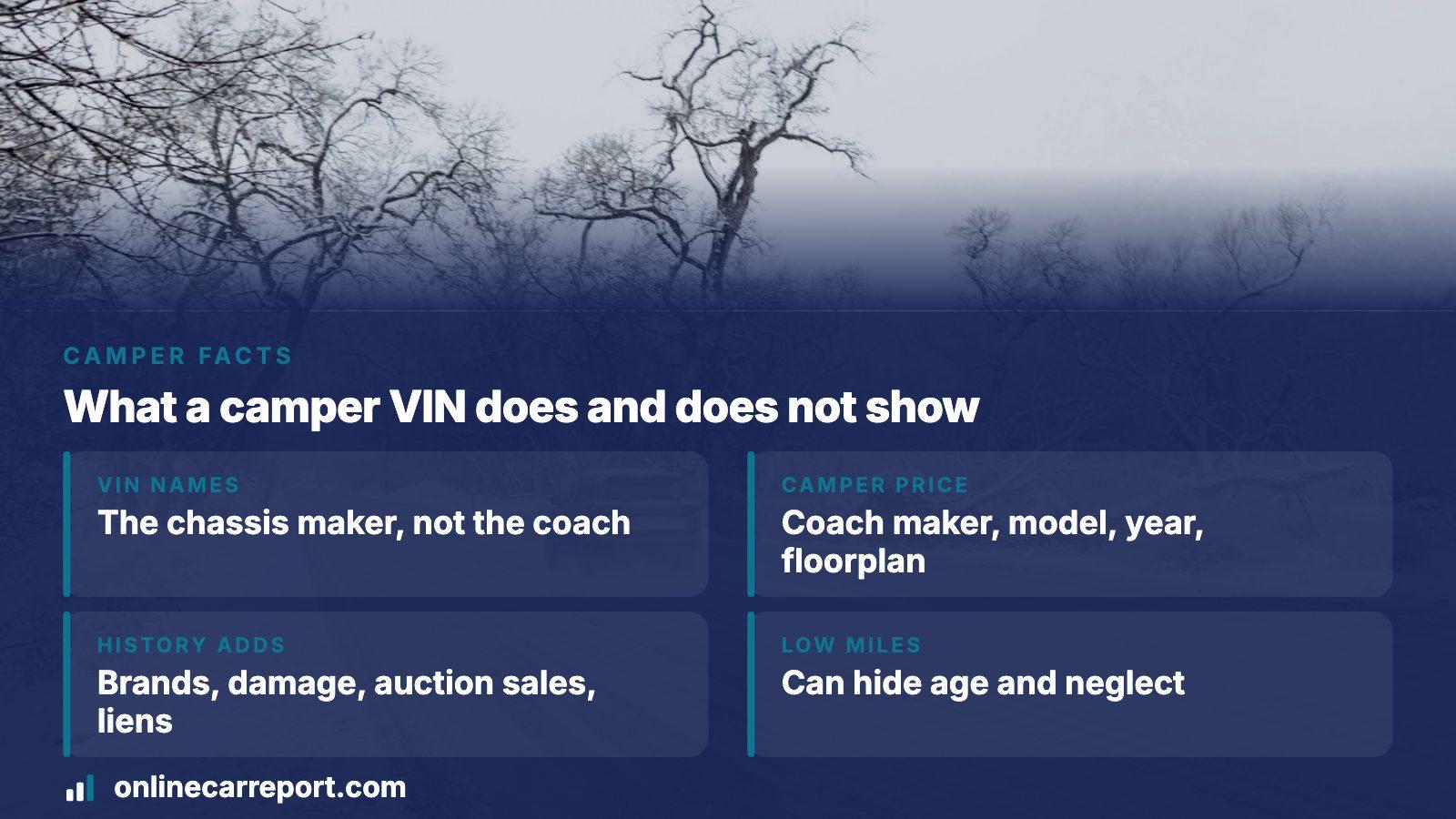
A VIN cannot give you a camper's price. On a motorhome it identifies the chassis, so you learn the engine, weight rating and chassis year, not the coach brand, model or floorplan that valuation guides look up. Read those from the coach maker's label, price from guides and completed sales, then use the VIN for what it reaches: title brands, damage, auction photos, odometer readings, liens and open recalls.
- What the VIN names
- The chassis maker, not the coach brand
- What prices the camper
- Coach maker, model, year and floorplan
- What history adds
- Brands, damage, auction sales, liens
- Preview
- Free; the full report is one payment
A motorhome VIN names the truck, not the coach
Most motorhomes are built in two stages. A truck maker builds a rolling chassis and stamps it with the VIN. A coach maker then builds the living space on top and sells the result under its own name. Federal rules give each stage its own label: the chassis builder states its name, build month and year, weight ratings and VIN, and the final-stage builder adds a certification label of its own.
So a decode of the chassis VIN describes the truck half, and the price lives in the other half. A towable has no separate chassis builder: the maker of the living space welds up the frame as well and assigns the number, so the number and the unit match up. Even then, guides look a unit up by brand, model, year and floorplan, never by the number.
What actually sets a camper's price
Guides index campers on a handful of facts that sit outside the VIN.
| Factor | Why it moves the price | Where to find it |
|---|---|---|
| Coach maker and model line | Sets the brand tier and the pool of comparable units | The coach maker's own label |
| Coach model year | Can run a year past the chassis, which is finished first | Coach label, set against the chassis decode |
| Floorplan | Bunks open the family market; a rear lounge suits couples | Floorplan code on the coach label |
| Overall length | Many campgrounds and parks cap length, so a long unit fits fewer sites | Spec sheet or a tape measure |
| Equipment | Generator, solar and battery capacity or leveling jacks change where the unit can go | A slow walk-through |
| Condition | Roof, seals and appliances outweigh any published figure | A hands-on inspection |
Cosmetic upgrades barely register. Slide-outs add room but also add mechanisms that can fail, so buyers weigh them both ways.
The part a VIN can reach: history that moves the price
A guide's figure describes a typical unit with a clean record. The VIN is the key to the record, and the record is where that figure gets marked down.
- A salvage, rebuilt or flood brand on the title stays with the camper for good, and some lenders and insurers will not take such a unit at all.
- Damage and accident entries, especially auction photos of a roof, slide or corner that a tidy walk-through hides.
- Odometer readings logged at earlier sales and inspections, to test the figure on the dash.
- An open lien, which means a lender may still hold a claim when you pay the seller.
- Open recalls on the chassis, which still need a repair appointment.
- Theft or impound entries, which raise questions about who held the unit and when.
None of this replaces a guide. It sets how far below the guide's figure your offer should sit. Treat any market value a VIN report prints for a motorhome as a chassis-side reference at most, never as the price of the coach.
Low miles can hide age and neglect
On a car, few miles usually means a better car. On a camper it often means the unit sat, and sitting is when seals dry out, roofs let water in and appliances seize. A low reading can cover years of that.
From an NHTSA owner complaint
A motorhome bought as new, built on a 2018 Ford F53 chassis, suffered a front tire blowout with fewer than 4,000 miles on the coach, and the owner filed a complaint. The tire carried a 2005 date code, which the owner calls 15 years old. The owner suspected an undisclosed event during delivery, and says the dealer and the coach maker each pointed at the chassis maker. The coach maker later agreed to repay the tire.
Mileage and age are separate facts. Read the build month on the labels, check the date codes on the tires, and read the damage and auction entries before you accept an as-new story.
Two builders, two sets of weights
Two builders means two sets of ratings, and a buyer can end up between them. The chassis decode gives a gross weight rating, while the coach maker publishes its own weight and capacity figures. When the two do not square, each company may point at the other.
From an NHTSA owner complaint
A 2021 motorhome on a 2020 Ford F53 chassis is the subject of this one. The owner reported that the weight published for the coach was 19,208, yet a scale reading of the empty coach came back at 21,080. Noises and poor handling in turns began at about 2,200 miles. The chassis maker said the coach was overweight, the coach maker said its figure was right and nothing had failed, and the dealer was "unable to perform the needed repair."
Before you buy, set the chassis weight rating beside the capacity on the coach label, then weigh the unit loaded as you would travel. Little capacity left for people and gear makes a weaker buy, whatever the floorplan.
Running the check on a camper, step by step
- Read the chassis VIN where the truck maker placed it, then compare it with the title or registration. All 17 characters should agree.
- Photograph the coach maker's label, which sits apart from the chassis plate, often in a cabinet, a storage bay or near the entry door. Note the model, floorplan code and coach year.
- Enter the VIN for the preview, which costs nothing, and see whether title, damage or auction entries exist.
- If entries appear and the camper is still on your list, buy the full report and read each one against the seller's story.
- Price the coach on its own: guides and completed sales for the same maker, model and floorplan, then subtract for what the record shows.

Reading the result: what to mark down, and what is normal
| On the record | What to do with it |
|---|---|
| Salvage, rebuilt or flood brand | Treat it as permanent; expect a deep cut and fewer lenders and insurers |
| Auction photos of roof, slide or corner damage | Pay an inspector to open that area before you discuss price |
| Odometer reading lower than an earlier entry | Stop; the dash figure is a claim, not a record |
| Lien still listed | Get a written payoff and a clear title before any money moves |
| Open chassis recall | Agree who arranges the repair before handover |
| Chassis a year older than the coach | Usually normal, since a chassis can be finished the following year |
Even a spotless record cuts risk without erasing it: roof leaks, seal failures and appliance wear leave no entry anywhere.
What the report costs, and your next moves
Running a VIN through the preview carries no charge. The report itself is bought once, in a quantity of one, 3, 5 or 10; no plan renews. The pricing page lists rates. On a camper it covers the history half and leaves coach pricing to you.
Then work in order. Price the coach from a guide that covers recreational vehicles, such as the service J.D. Power now runs under the old NADA name, and from completed sales of the same maker, model and floorplan. Subtract for the record, inspect the roof, seals and appliances, and read the FTC's used-car advice if a dealer is selling. Go carefully on a loan near the full price, because campers lose value faster than cars early on.
Where this information comes from
- NHTSA: vPIC VIN decoder — The federal decoder that returns the chassis maker, engine and weight class for a motorhome VIN.
- NHTSA: Recalls lookup — Where open safety campaigns on the chassis can be checked by VIN.
- eCFR: Labels for vehicles built in two or more stages — Federal text on the separate chassis and final-stage labels, with names, dates and weight ratings.
- FTC: Buying a used car from a dealer — Federal consumer guidance that applies when a dealer sells the camper.
- NHTSA owner complaint 11193368 — owner experience, paraphrased
- NHTSA owner complaint 11470720 — owner experience, paraphrased
Sources and photos: Facts checked against the sources above in November 2026. Photos by Alexander Lunyov, Justin Cron and Zoshua Colah on Unsplash; diagrams by OnlineCarReport.
Keep reading
- NADA value by VIN: the lender's book and what history does to itThe valuation book that also covers recreational vehicles, read against a VIN.
- Car value by VIN: what the number tells you and how history moves itWhere mileage does most of the pricing, and how history adjusts a car's figure.
- Sample reportSee how title, damage and odometer entries are laid out before you pay.
- Motorcycle value by VIN: how a bike's history moves what it is worthAnother vehicle type with its own pricing rules, read from the VIN.
Frequently asked questions
Can a VIN tell me what a camper is worth?
Not directly. On a motorhome the number identifies the truck underneath, so a lookup describes the chassis. Guides price a camper by coach maker, model, year and floorplan. Take those from the maker's own label and use the VIN for the build and the history.
How much does a title brand cut a camper's price?
No fixed percentage applies, and anyone quoting one is guessing. The cut depends on the brand, the damage behind it and the quality of the repair. A brand never wears off and shrinks the pool of lenders, insurers and buyers, so expect a heavy cut.
Do travel trailers and fifth wheels have a VIN?
Yes, a 17-character number assigned by the trailer builder. With no second manufacturer involved, the number points at the whole unit. Valuation still keys on brand, model, year and floorplan, so the number mainly opens the record.
Does low mileage make a motorhome worth more?
Less than on a car. A motorhome with very few miles has often been standing, and standing is where roofs, seals and appliances decay. Condition decides more than the odometer, so an inspection beats a reading.
Which valuation guide covers campers?
The service J.D. Power runs under the former NADA name covers recreational vehicles along with cars and trucks, so lenders and insurers often lean on it. Consumer coverage is thinner, so completed sales of the same maker, model and floorplan make useful evidence.
Now check the car itself
The guide explains what to look for. The report shows what this VIN has on record.