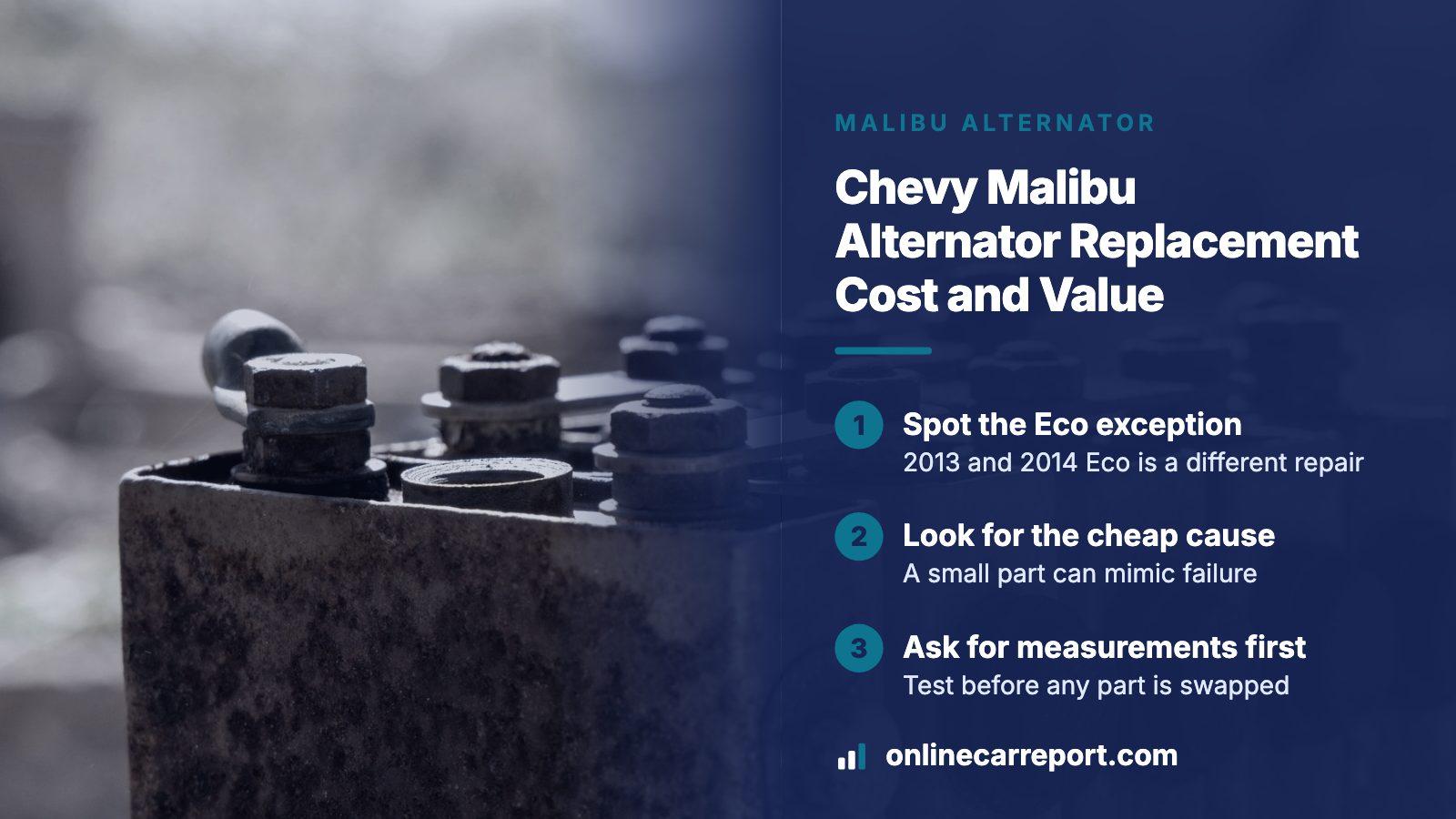
THE SHORT ANSWER
Budget around RepairPal's published $573 to $823, then adjust for your engine and local labor rates. A 2013 or 2014 Eco charges through a belt-driven motor generator, so have the shop confirm it works on eAssist cars before it quotes. NHTSA recall data shows no campaign for the alternator, so the first question for any shop is what it tested before ordering the part.
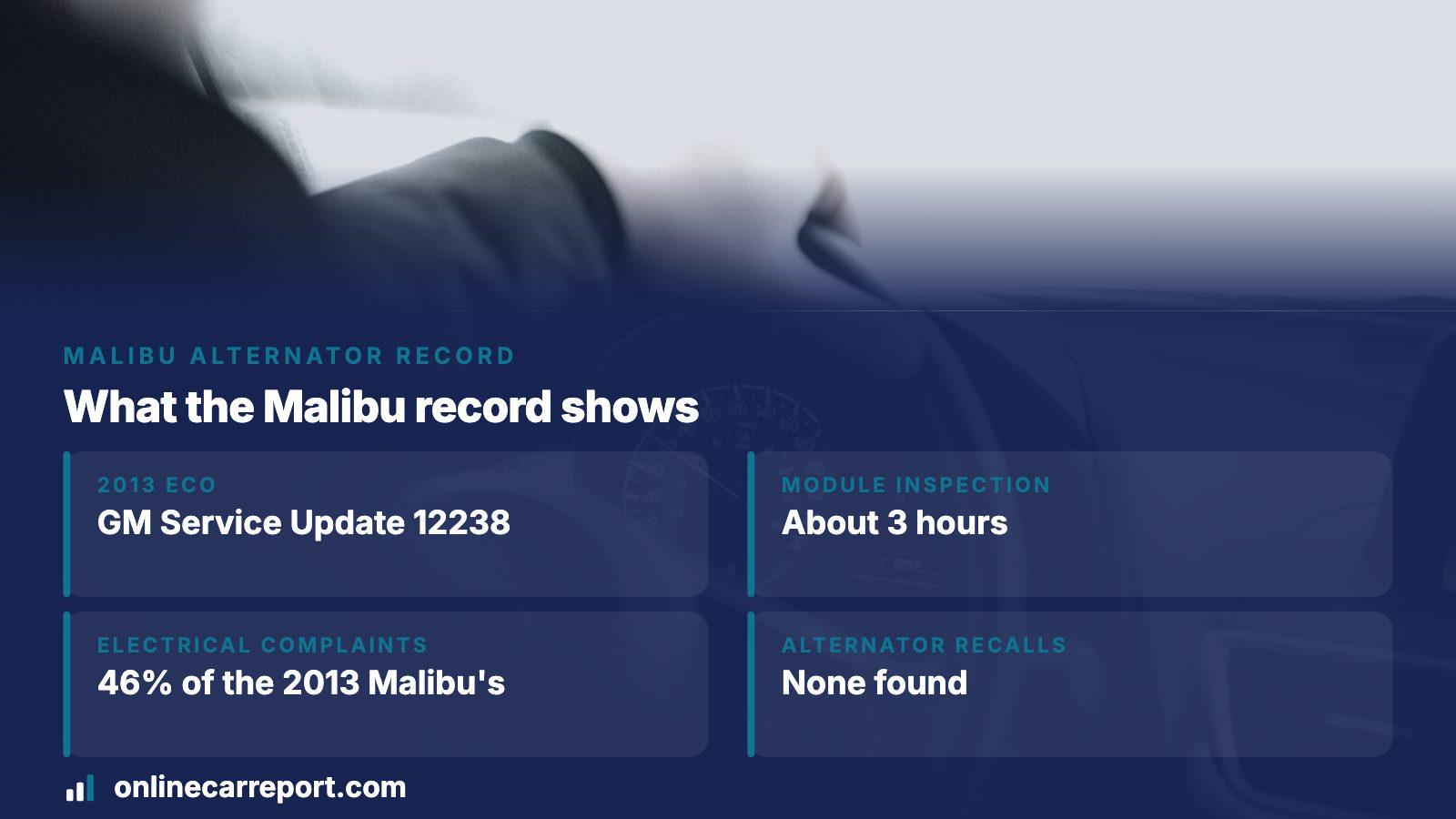
- RepairPal range, 2020 and 2023 Malibu
- $573 to $823
- 2013 Eco, GM Service Update 12238
- Module inspection took about 3 hours
- 2013 Malibu complaints touching electrical
- 46%, against 22% to 32% in other years
- Recalls naming the alternator
- None found
What the published Malibu alternator range covers
RepairPal's 2020 and 2023 Malibu pages carry the same alternator range. The site does not open for automated readers, so the figure comes from page text in search listings from late October 2026, with no parts-and-labor split visible. Taxes and fees are not in the figure, and neither is any adjustment for where you live.
OnlineCarReport deals in VIN history and value, not repair work, so any dollar figure here belongs to someone else. Test a quote you already hold against that range. Engine, shop type and ZIP code move the number, and a second fault behind the first can cost more than one clean swap.
Why a 2013 or 2014 Eco is a different repair
GM sold the Eco with eAssist. EPA's fuel-economy listings treat the 2013 car as its own model, the Malibu eAssist, with a 2.4-liter four-cylinder. Where other Malibus carry an alternator, GM's bulletins point to a belt-driven motor generator, a generator control module and a dedicated battery module.
GM issued two service updates in October 2012 that cover the 2013 Eco. Update 12238 told dealers to inspect the control module on lot cars, since a failing one drains the battery and can end in a stall or no-start. GM expected about 3% to need a new one, and the update lapsed October 31, 2013. Update 12239 covers a drive belt that can separate and light the red BATTERY warning.
From an NHTSA owner complaint
The owner of a 2013 Malibu Eco filed in February 2024 after the car stalled at a stop light with heavy steering and a charging-system message. It was towed home, not to a dealer, and the owner made the repair personally, reporting that both the alternator and the starter had failed at roughly 174,000 miles.
The takeaway: a charging message on an Eco points at a system with several parts, so confirm the model from the VIN and ask whether the shop works on eAssist before it names a price.
A $25.00 part behind a dead alternator
From an NHTSA owner complaint
A 2011 Malibu owner wrote in July 2016 that the battery light came on, the dealer called the alternator bad and fitted a new one, and two weeks later every dash light lit and power steering vanished mid-drive. After a tow, the dealer found a burnt fusible link at the alternator, which had killed the first unit. The owner puts that part at $25.00.
The takeaway: when an alternator dies, ask what killed it and have the answer written on the invoice. Replace only the part and the cause may take the new one down too.
Two alternators and two batteries, still no fix
From an NHTSA owner complaint
A 2016 Malibu owner reported in July 2021 a charging-system message and a battery that kept draining. Two batteries and two alternators had gone in, and the owner says at least $2,000 went into trying to fix it. The car once stopped on a busy interstate while the owner was working, and the owner waited there for a tow truck.
The takeaway: the published range prices one clean job. Repeat visits for the same warning cost more, and a later buyer who spots them on receipts will price the doubt.
What to ask a shop to measure first
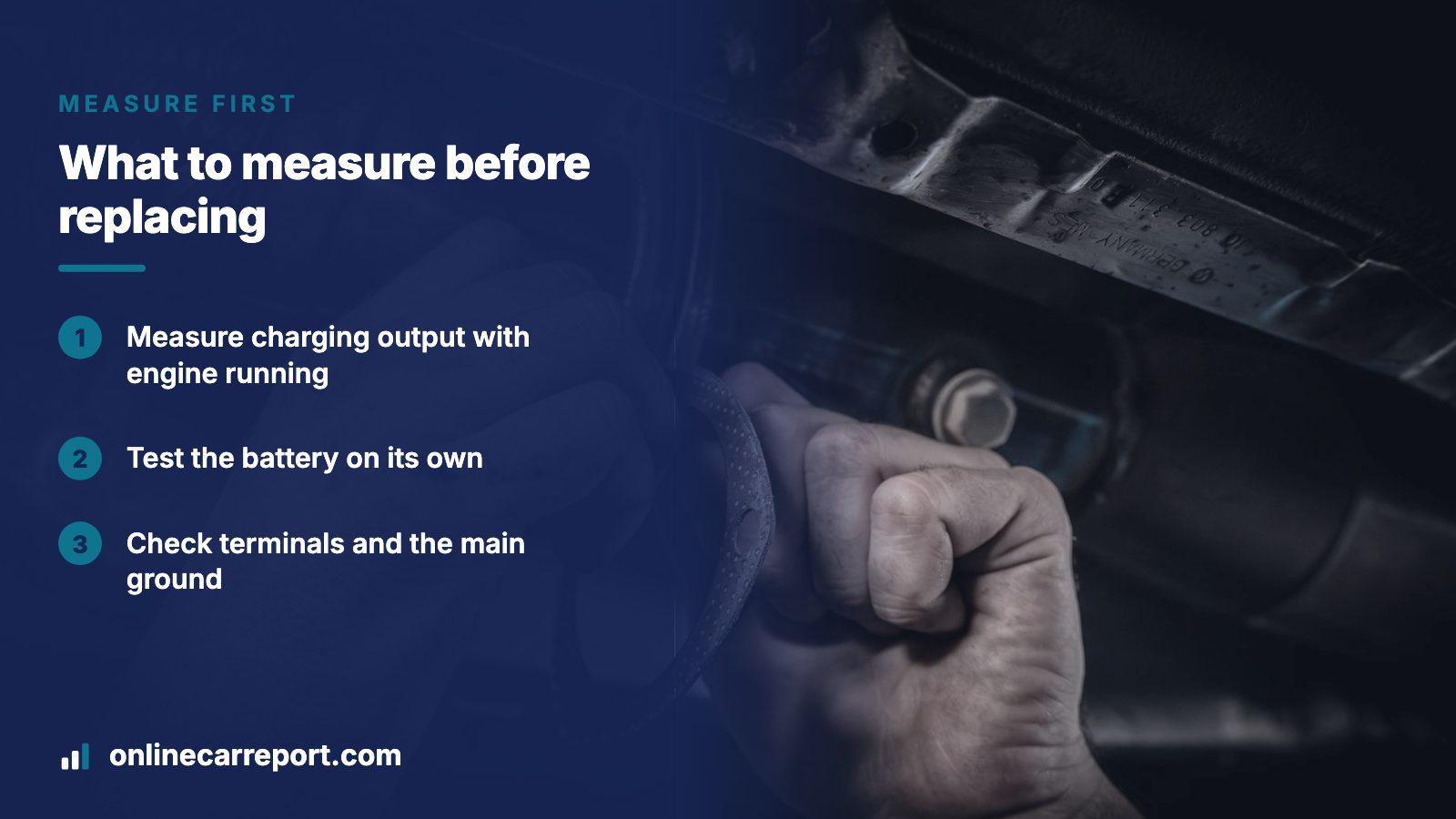
Ask for the readings in writing.
- Output of the charging system with the engine running and the electrical loads on.
- A battery test done on its own, so a worn battery does not get blamed on the alternator.
- A check of terminal condition, the main ground connection and the fuse box under the hood.
- On a 2013 or 2014 Eco, the specific part that failed: motor generator, control module, belt or battery module.
- On a Malibu from 2016 to 2018 that keeps killing batteries, whether Shift to Park shows at shutdown.
A shop that recommends the part with no readings attached deserves a second opinion.
Where the Malibu record points, year by year
The likely cause of a dead battery shifts with the generation.
| Model years | What the record shows | What to ask |
|---|---|---|
| 2008 to 2012 | Many electrical complaints, but recalls 14V153000 (power steering) and 14V252000 (body control module connection) explain more than charging does | Whether the fault was traced before parts were bought |
| 2013 | 425 electrical complaints in NHTSA's file, 46% of the year's 924, and 56 narratives that mention an alternator or generator | Is it an Eco, and which part failed |
| 2014 and 2015 | Bulletin PIC6017A: an intermittent Service Charging System message with code P0621 on 2.5-liter cars with stop/start | For the bulletin's test steps first |
| 2016 to 2018 | Shift to Park at shutdown, tied by bulletin 18-NA-297 to the shifter's park switch | About the shifter before the alternator |
In the other years through 2020, the electrical share runs from 22% to 32%, and none passes 12 alternator or generator mentions.
How a swap reads when the car is sold
A VIN-based value starts from year, trim, mileage and the local market. History then adjusts it, and a title brand, accident or damage entries, auction records and odometer readings usually move the figure more than one repair does. A fresh alternator helps only when the paperwork explains it.
| What the buyer finds | How it tends to play in price talk |
|---|---|
| New alternator, no receipt | The buyer asks why it was replaced and assumes the cause is still open |
| Receipt with a test result and the root cause | The fault looks closed, so there is less to deduct |
| Two alternators and two batteries on file | Reads as an unsolved fault, and the doubt gets priced |
| Open recall on the VIN | A dealer repair the buyer will want done first |
That is how a careful buyer reasons, not a measured discount. A VIN history holds no shop invoices, so read it beside the receipts, since each covers what the other lacks.
Recalls and bulletins: who pays for the repair
NHTSA's recall data lists 10 campaigns for the 2013 Malibu and 9 for the 2016. None of them mentions an alternator, generator or battery, and the same query across 2008 through 2022 found no charging-part campaign. GM's service updates guide dealers but are not recalls, so no owner can insist on a no-cost repair under one.
A neighboring GM program, number 15611, applied to some 2016 Malibus carrying the 2.5-liter engine whose fuse-block bracket was the wrong part, a flaw that could short the generator bus bar. It ended September 30, 2017. Open recalls still matter at sale time, since dealers fix them at no charge.
Before you buy a Malibu that just had an alternator
Ask the seller for the invoice and for what was tested first, then run the VIN. OnlineCarReport begins with a free preview, then charges once for the full report, with packs on the pricing page. It gathers title brands, accident and damage entries with auction photos, odometer readings, open recalls and market value.
The factory specs list the engine and trim, and in 2013 and 2014 a 2.4-liter engine points toward eAssist. A report cannot stand in for a charging test, so the repair questions stay with the seller and the shop.
Where this information comes from
- GM Service Update 12238 (NHTSA copy) — The 2013 Eco generator control module inspection, the share of cars needing a new module and the expiry date.
- GM Service Update 12239 (NHTSA copy) — The eAssist drive belt that can separate, the red BATTERY light and the warranty-length coverage.
- NHTSA: 2013 Chevrolet Malibu recalls and complaints — Where the recall counts and the complaint file for the 2013 car can be read.
- RepairPal: 2020 Chevrolet Malibu repair costs — The alternator range quoted above, as search listings showed it in October 2026.
- NHTSA owner complaint 10885379 — owner experience, paraphrased
- NHTSA owner complaint 11424510 — owner experience, paraphrased
- NHTSA owner complaint 11571980 — owner experience, paraphrased
Sources and photos: Facts checked against the sources above in November 2026. Photos by Stephen Mabbs, Martin Fennema and Miles Loewen on Unsplash; diagrams by OnlineCarReport.
Keep reading
- Chevy Malibu timing chain replacement cost and its effect on valueThe Malibu's other big repair bill, priced the same way.
- Nissan Altima alternator replacement cost, and what the repair does to its valueA midsize rival's alternator question, answered from a different electrical record.
- Car value by VIN: what the number tells you and how history moves itHow a VIN sets a starting value before repair bills are subtracted.
- Used car with no service history: what it does to the price and what to checkWhat to do when the seller has no receipts for an alternator or anything else.
Frequently asked questions
What should a Malibu alternator job cost?
RepairPal's range is $573 to $823 for 2020 and 2023 Malibus, before taxes and without a ZIP code adjustment. No parts-and-labor split was visible, so ask each shop to itemize both. An Eco or a repeat fault pushes the total higher.
Does a 2013 Malibu Eco even have an alternator?
Not a conventional one. GM's bulletins for the 2013 and 2014 Eco describe a belt-driven motor generator working with a control module and its own battery module. A shop that prices a plain alternator for one is quoting from the wrong parts list.
Has Chevrolet recalled the Malibu for alternator trouble?
No. NHTSA lists 10 campaigns for the 2013 Malibu and 9 for the 2016, and none names the alternator or charging parts. GM did issue service updates for the 2013 Eco's control module and belt, but those guide dealers. A VIN recall check still catches any other open campaign.
My Malibu says Service Battery Charging System. Is the alternator bad?
Not necessarily. The message means the car detected a charging fault, and the alternator is only one possible source. On 2014 and 2015 cars equipped with stop/start and the 2.5-liter engine, bulletin PIC6017A describes it appearing now and then with code P0621, and GM's advice is to run normal diagnostics first.
Does a new alternator raise a used Malibu's value?
Mostly it removes a worry rather than adding value. Buyers expect charging to work, so price follows the larger record: title brand, accident and damage entries, odometer readings and open recalls. Keep the invoice showing the test result, the date and the mileage.
Now check the car itself
The guide explains what to look for. The report shows what this VIN has on record.