THE SHORT ANSWER
RepairPal's national estimate puts the job at $694 to $893, with labor between $101 and $148 and parts between $594 and $745, before tax and with no local adjustment. The part you choose moves the total more than the shop does. Test the charging system and the battery before approving anything, because owners report replaced alternators that did not cure the fault. A dated invoice helps resale; repeat repairs raise questions.
- RepairPal estimate, whole job
- $694 to $893
- Labor and parts
- $101 to $148 and $594 to $745
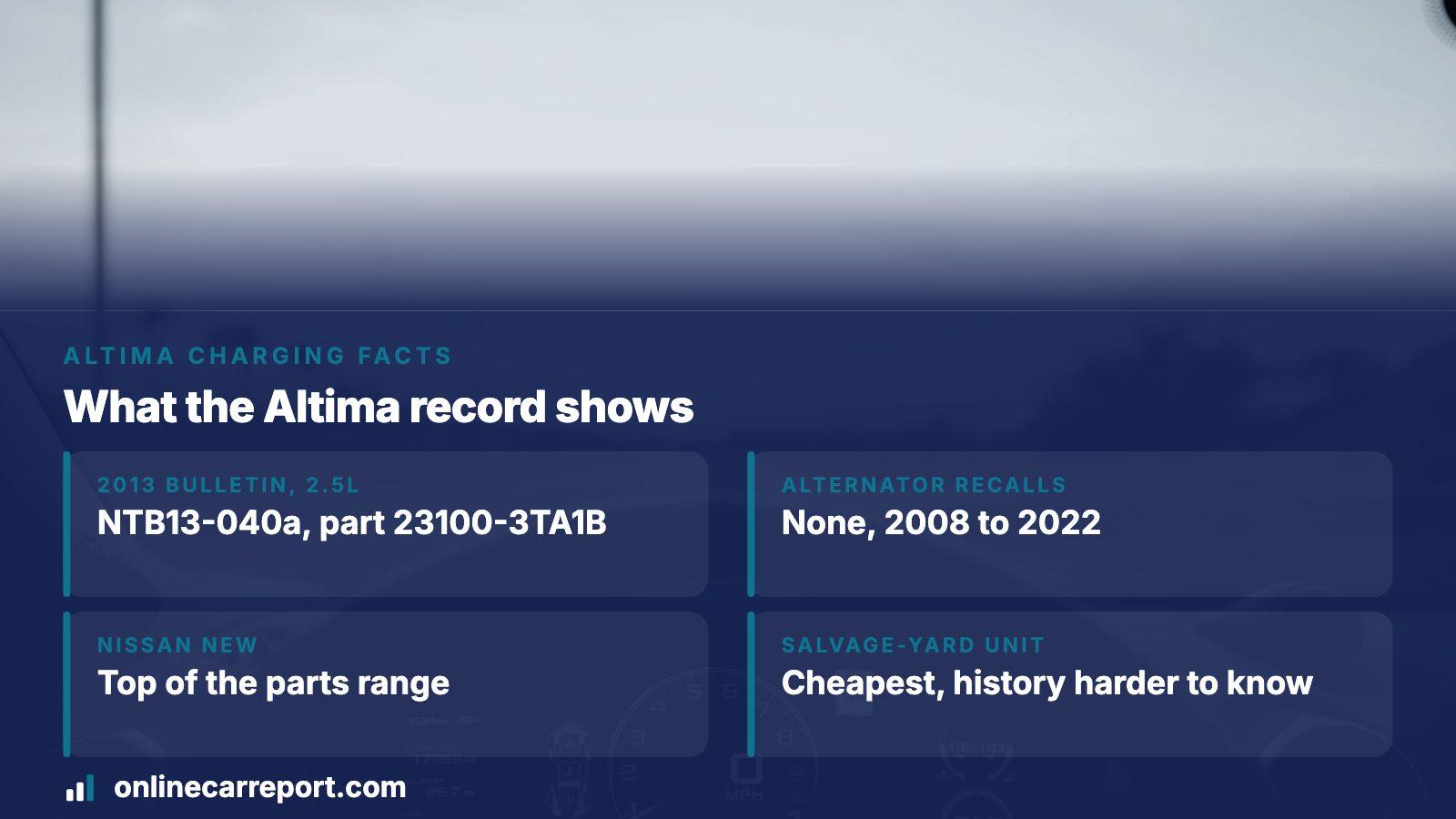
- 2013 bulletin, 2.5L cars
- NTB13-040a, part 23100-3TA1B
- Recalls naming the alternator
- None, model years 2008 to 2022
What the published range covers
RepairPal prices a full Altima alternator job at $694 to $893. It dates the figures September 3, 2026, calls them a national estimate, and leaves out tax and your location. The site refuses automated requests, so we took the numbers from its page text as search listings display it; check the live page before you budget.
| Line item | RepairPal range |
|---|---|
| Labor | $101 to $148 |
| Parts | $594 to $745 |
| Whole job | $694 to $893 |
Parts are the bulk of the total, so which alternator you accept matters more than which garage you pick. Treat the range as a ruler for judging a quote, not a price list: your engine, ZIP code and the shop's hourly rate all shift the real figure.
New, rebuilt or used, and why the VIN matters at the parts counter
- Nissan new: the top of the parts range, and what a dealer offers first.
- Remanufactured: rebuilt, often with a core charge that is credited when you return your old unit.
- Used, from a salvage yard: the lowest price, and a history you cannot inspect.
Whichever you choose, hand over the full VIN, not only the model year. Nissan's 2013 bulletin calls for one specific alternator on four-cylinder cars produced before mid-April 2013, and it applies by VIN range and engine, so the model name alone cannot tell a dealer whether it fits.
When the alternator gets blamed for something else
We read NHTSA's owner complaints for all 2008 to 2022 Altimas on November 5, 2026: 9,694 filings. Only 45 use the word alternator, and 15 of those also mention the transmission or the CVT. In several narratives the alternator is the first suspect and the real fault turns up elsewhere.
From an NHTSA owner complaint
The owner of a 2015 Altima reported engine and battery warning lights and a shudder at 25 to 35 mph in October 2023. An independent mechanic said the alternator needed replacing; the car was repaired, but the fault came back. A dealer then diagnosed a transmission that needed replacing, said no warranty applied, and the car was left unrepaired at about 94,000 miles.
What to take from it: a fault that returns after a new alternator calls for a second diagnosis before the next part is bought.
A 2013 bulletin: the alternator groan that sounds like the CVT
Nissan's bulletin NTB13-040a, dated July 5, 2013, applies to 2013 Altima sedans with the four-cylinder QR25DE engine, with cutoffs of April 19 and April 22, 2013 for its two VIN ranges. The complaint is a groan or rattle from the right-front strut tower area, heard at 20 to 40 mph, or when the engine turns 1,400 to 1,500 rpm. Nissan warns it can be mistaken for a CVT or heat shield problem, and the fix is alternator 23100-3TA1B.
A bulletin is repair guidance for dealers, not a recall, and its closing note warns readers not to assume the condition fits their car.
From an NHTSA owner complaint
The owner of a 2013 Altima with the 2.5-liter engine described a vibration at 1,500 to 2,000 rpm that began around 3,600 miles on a new car. In January 2014 the dealer replaced the alternator, then two days later the belt and tensioner, and neither changed the vibration. A vibration is not the groan Nissan describes, so this does not show the bulletin applied.
What to take from it: ask which test pointed at the alternator, since a swap can be reasonable and still miss.
Recall, bulletin or neither: who pays
We queried NHTSA's recall data for Altima model years 2008 to 2022 and got 36 distinct campaigns, none naming the alternator or the charging system. With no recall, the alternator is your expense unless a warranty or service contract covers it.
One older campaign can pass for an alternator problem. Nissan's PC516 replaced the steering column lock on 2009 and 2010 Altimas, a part that could stop the engine starting. Covered repairs needed a work order opened by May 28, 2020; after that, owners paid unless a service contract applied. On one of those cars that refuses to start despite a healthy battery, ask about the lock before the alternator.
What an alternator repair does to the car's value
In a VIN-based valuation the alternator is a small line. Year, trim, mileage and local demand set the starting figure, and the history then adjusts it. Title brands, accident and damage entries, auction records and odometer readings tend to move the number further than one repair does. An unrepaired alternator is a deduction priced from the range above; a dated invoice shrinks it.
| What the buyer sees | How the price talk tends to go |
|---|---|
| Alternator failed, no invoice yet | Buyer subtracts a repair and may add a margin for doubt |
| Invoice with date and mileage | The cause is documented, so there is less to discount |
| Several alternator invoices in a short span | Raises the question of whether the real fault was ever found |
| Alternator replaced, brand or damage entry on the VIN | The history, not the repair, sets the price |
A VIN history holds no shop invoices, so it cannot confirm the swap. It covers what receipts leave out: the title brand, accident and damage entries, photos from salvage auctions, odometer readings, any open recalls and a market value for comparing with the asking price.
Buying an Altima that already has a charging fault
From an NHTSA owner complaint
A buyer of a 2008 Altima from a used-car lot in New Jersey wrote in March 2021 that warning lights came on as they drove away. They were traced to the alternator and several oxygen sensors. A garage inspection the next day also called for work on the rear control arm, the shocks and the brakes with their rotors. The lot cited a 90-day warranty; the warranty company found no such contract on file, and the lot had not followed up on the remaining repairs.
What to take from it: get the inspection and the warranty paperwork before you pay, not after. Run a VIN preview first so the history is known when you negotiate, then deduct the alternator and anything else the inspection finds. OnlineCarReport opens with a no-cost preview; the full report is bought once, never billed monthly, with packs on the pricing page.
Before you approve the invoice
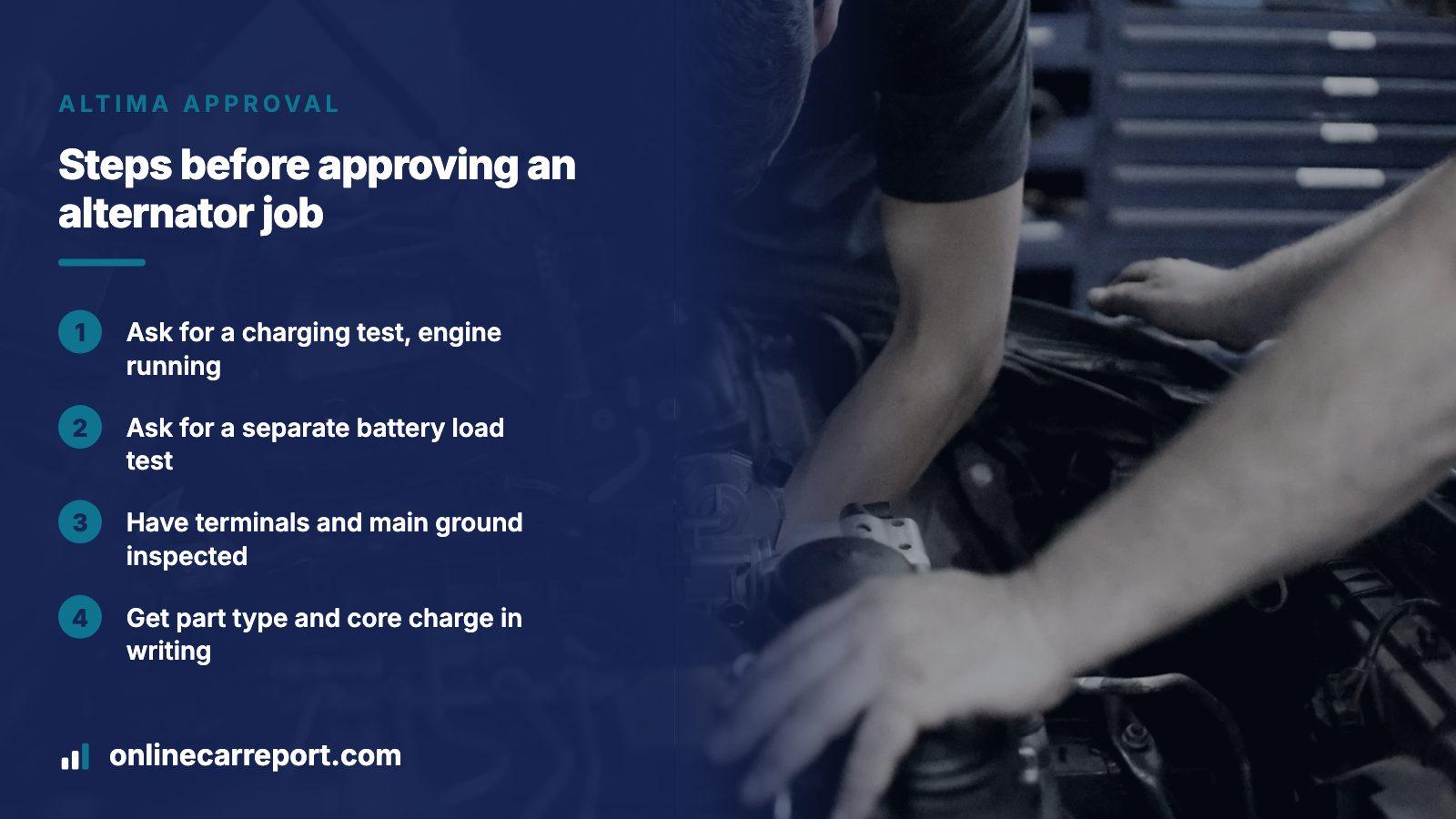
- Ask for a charging test with the engine running and the reading written on the work order.
- Ask for a separate battery load test, so a weak battery is not mistaken for a failed alternator.
- Have the terminals and main ground inspected before any part is ordered.
- Ask about the belt and tensioner. The belt spins the alternator, and a worn one can bring you back.
- Get the part type (new, rebuilt or used), the core charge and the warranty on part and labor in writing, in months and miles.
- On an early 2013 four-cylinder with a low-speed groan, ask whether the dealer looked at NTB13-040a before the transmission takes the blame.
- Keep the final invoice, with date and odometer reading, for the next buyer.
Where this information comes from
- Nissan bulletin NTB13-040a (NHTSA copy) — Applied cars, the groan symptom, the CVT misdiagnosis warning and the replacement part number.
- Nissan campaign PC516 expiration notice (NHTSA copy) — The steering column lock fault on 2009 and 2010 Altimas and the last covered repair date.
- NHTSA: recalls by vehicle and VIN — The recall lookup behind the finding that no Altima campaign names the alternator.
- RepairPal: Altima alternator replacement estimate — The $694 to $893 range and its labor and parts split, taken from search-listing text because the site blocks automated reads.
- NHTSA owner complaint 11550671 — owner experience, paraphrased
- NHTSA owner complaint 10559715 — owner experience, paraphrased
- NHTSA owner complaint 11404707 — owner experience, paraphrased
Sources and photos: Facts checked against the sources above in November 2026. Photos by Stephen Mabbs, Mustafa Sheikhmouss and Dennis Eusebio on Unsplash; diagrams by OnlineCarReport.
Keep reading
- Nissan Altima transmission replacement cost against what the car is worthThe bigger Altima bill, and the one a blamed alternator sometimes turns out to be.
- Used car with no service history: what it does to the price and what to checkWhat to do when the seller has no invoice to show for the alternator.
- Car value by VIN: what the number tells you and how history moves itHow a VIN gives the car a starting value before repair bills come off it.
- Toyota Camry alternator replacement cost and what it does to valueThe same repair on the Altima's most common cross-shop rival.
Frequently asked questions
How much does an alternator replacement cost on a Nissan Altima?
RepairPal's national estimate is $694 to $893: $101 to $148 for labor and $594 to $745 for parts, dated September 3, 2026 and excluding tax. The part is most of the total, so new versus rebuilt versus used changes the bill more than the shop does.
Is there a recall on the Altima alternator?
Not in NHTSA's data. Altima model years 2008 to 2022 return 36 distinct campaigns, and none names the alternator or the charging system. Nissan's 2013 bulletin NTB13-040a is dealer guidance for certain early-build 2.5-liter cars, and a bulletin is not a recall, so ask a dealer about your VIN's coverage.
How can I tell a bad alternator from a bad battery on an Altima?
Both leave you with a dead car in the morning. Have the alternator's output measured with the engine running, and have the battery load-tested on its own. Owners in NHTSA's file describe swapping parts and keeping the fault, so get written results before paying for a second part.
Can a failing alternator feel like a transmission problem?
On some 2013 four-cylinder cars Nissan says so: its bulletin warns that an alternator groan can be mistaken for a CVT or heat shield fault. Several NHTSA complaints show the reverse too: an alternator replaced before the transmission proved to be the real problem.
Does a new alternator raise what my Altima is worth?
It mostly cancels a deduction instead of adding value, since buyers assume charging works. The wider record sets the price: title brand, accident and damage entries, odometer readings and open recalls. A dated invoice helps; several in a short span invite questions. Keep your own, because a VIN history cannot show shop receipts.
Now check the car itself
The guide explains what to look for. The report shows what this VIN has on record.