THE SHORT ANSWER
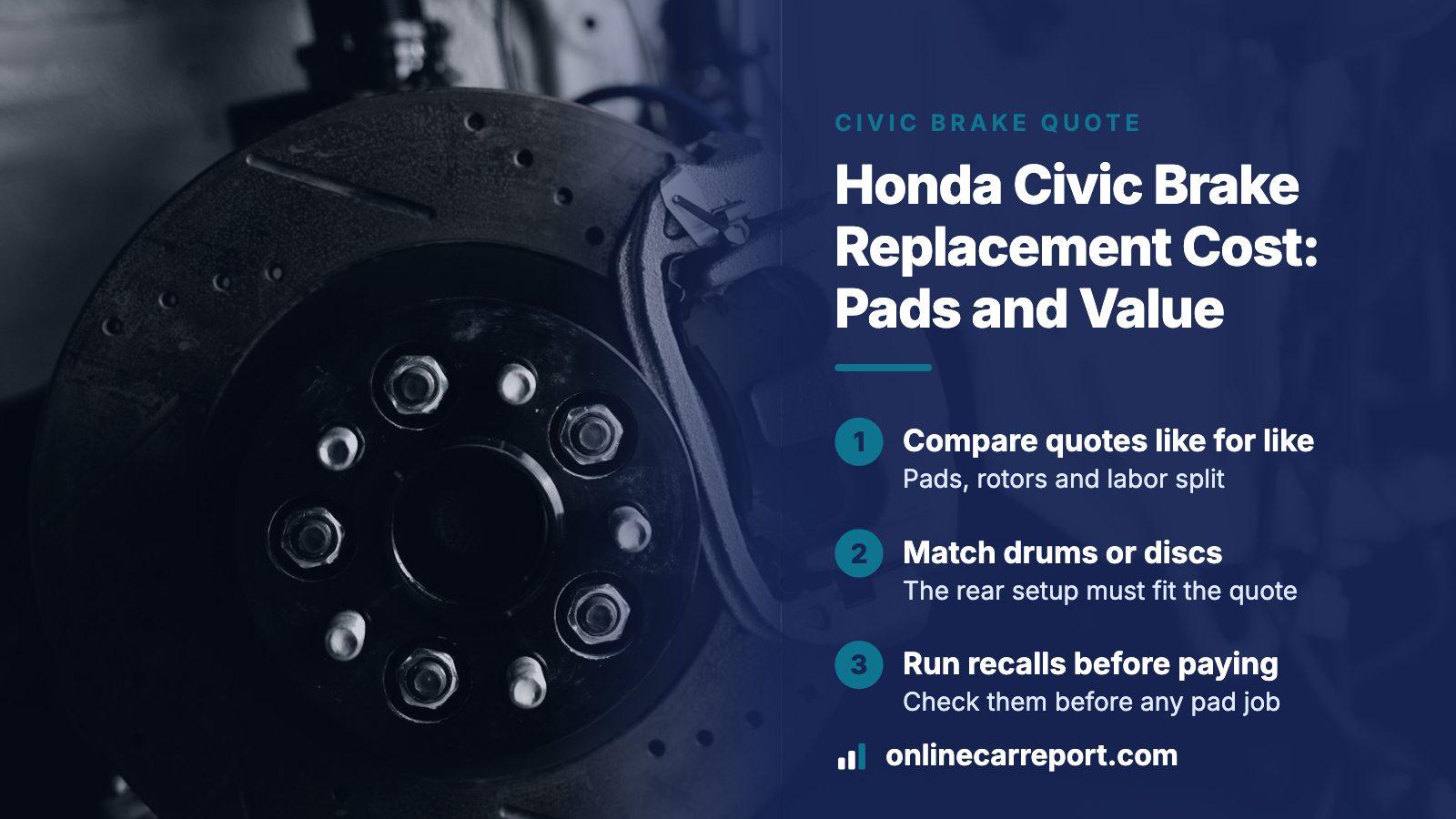
Budget about $271 to $328 for Civic brake pads on one axle, per one estimate site, with tax and rotors extra. Rear drums, a 2016-or-newer electric parking brake and an open recall can each change the price. Before paying, run the VIN for recalls, ask which axle the quote covers, and keep the invoice for the next buyer.
- Pad estimate
- $271 to $328 per axle, before tax
- Rear shoe estimate
- $304 to $391 on drum-brake Civics
- Brake recalls, 2008 to 2022
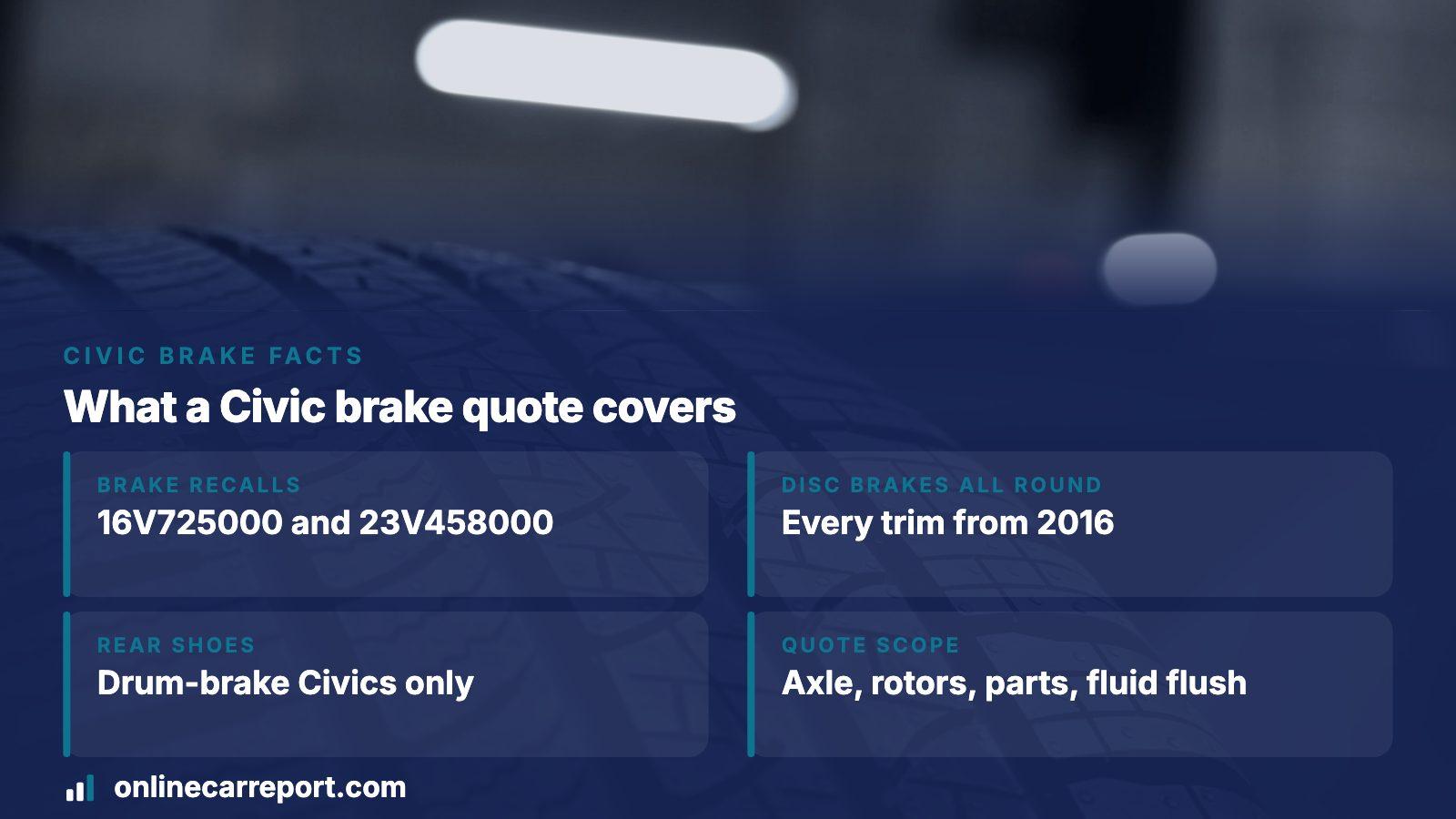
- 16V725000 and 23V458000
- Disc brakes all round
- Every trim from the 2016 model year
What one estimate site charges, and what it leaves out
RepairPal's Civic pages split the work into labor and parts. Both ranges exclude tax, fees and your local rates, and they come from search listings seen in October 2026, because the site blocks direct requests. A newer car can price differently: its 2023 Civic pad estimate is $191 to $242.
| Job | Total | Labor | Parts |
|---|---|---|---|
| Brake pads | $271 to $328 | $122 to $179 | about $149 |
| Rear brake shoes | $304 to $391 | $187 to $275 | about $117 |
Rotors, calipers and a fluid flush sit outside both figures. Read the table as an average from one source, not a price for your car.
Why a shop quote can look twice as high
Kelley Blue Book sets Civic brake prices by ZIP code and model year, yet each figure is for one axle only. A quote near double the number you saw online is often charging for front and back. Have the shop list the wheels it is working on before you compare it with anything.
- Which axle or axles the price covers
- Whether the back takes pads or shoes on your trim and year
- Rotors replaced or resurfaced, with measured thickness
- Original Honda parts or aftermarket ones, and the guarantee on each
- Whether a fluid flush is in the total
Drums or discs at the back: the part your quote must match
Every Civic in this range has disc brakes up front. The back is where the job changes. Honda's specification sheets list drums on cheaper trims of the 2008, 2012 and 2014 cars, with discs reserved for the higher grades. From the 2016 model year, Honda says all trims get four-wheel discs.
| Model year and trim | Rear brakes |
|---|---|
| 2008 DX and LX sedan | Drums |
| 2008 Si, plus the EX trims | Rear discs |
| 2012 and 2014 base trims | Drums; the EX and EX-L get discs |
| 2016 and later, all trims | Discs, with an electric parking brake |
For years and trims not listed, look through the rear wheel: a caliper clamped over a flat rotor means discs, a closed drum means drums. A rear-pad quote on a car with drums prices a part it does not have.
Rear pads on newer Civics need a scan tool
On these cars each rear caliper has its own motor to move the piston, so the system must be retracted electronically before the caliper comes off. Blue Print, a Honda-fit pad supplier, warned in 2025 that skipping its maintenance-mode procedure can over-extend the piston and set actuator fault codes. When you book, ask what tool the shop uses.
From an NHTSA owner complaint
A 2016 Civic EX-T owner told NHTSA in May 2021 that after the brakes and rotors were replaced, the brake system light stayed on, with electric parking brake and brake hold alerts. The parking brake still set and released, and the car stopped fine, but the alerts never cleared and the hold button seemed dead.
The point for a buyer: dash warnings that follow a brake job are worth testing before you hand over money.
Check recalls before you pay for pads
Two brake recalls fall inside the 2008 to 2022 model years. Recall 16V725000 reached roughly 350,000 coupes and sedans from 2016: switch the ignition off and set the electric parking brake right away, and it might not apply. Recall 23V458000 covers some 2020 and 2021 Civics whose brake booster fastener may have been assembled wrongly, which can let the master cylinder separate. Both fixes are free at a Honda dealer.
Honda Service Bulletin 17-007 adds a software reflash for 2016 and 2017 coupes and sedans showing an electric parking brake message, booked at 0.4 hour. Its warranty time has run out on cars this old, so ask a dealer whether the update was done before any part is replaced.
The 2009 to 2011 cars and pads that vanish early
Owners of these years filed many complaints about pads and rotors wearing out far sooner than expected. It ended in a class settlement rather than a recall, and its claim window closed years ago. A current owner or buyer should watch for one pattern: the outer pad worn down with the inner one on that wheel looking fresh, which points at a sticking caliper, not just old pads.
From an NHTSA owner complaint
A 2010 Civic owner wrote in March 2014 that the car was back for brakes after six months, with over $1,800 already spent on pads, rotors and calipers. Brakes were still wearing out in under 10K miles, and the owner suspected the design or materials.
If a used Civic of this age has fresh pads, ask what was done about the cause.
How a brake job moves a used Civic's value
Fresh pads erase a deduction, since the next owner would otherwise pay for them. They seldom raise the price. Buyers weigh the car's past: a title brand, damage entries, odometer readings and auction listings with photos each move value further than one brake bill.
A VIN history will not show a shop's parts invoice, so ask the seller for paperwork with part, date and mileage. It does show the record that invoice sits inside. OnlineCarReport matches a VIN's history to its market value; the preview costs nothing, and a full report is a single payment, with options on the pricing page.
Five steps before approving the work or buying the car
- Check the VIN for open recalls before any brake spending.
- Get the quote split by axle, with pad thickness measured at each wheel.
- Confirm what is at the back: drums or discs, and parking brake type.
- On a 2016 or newer car, test the parking brake and brake hold after the job.
- Keep the invoice, with date and odometer reading, for resale.
Buying one? Turn the list into questions for the seller. Worn pads are a small bargaining point; a flashing brake light is a bigger one.
Where this information comes from
- RepairPal: Honda Civic brake pad replacement estimate — The pad and shoe ranges, read from search listings in October 2026.
- NHTSA recalls API: 2016 Honda Civic — Recall 16V725000 and the electric parking brake software update.
- NHTSA recalls API: 2021 Honda Civic — Recall 23V458000 and the brake booster fastener.
- Honda Service Bulletin 17-007 (NHTSA copy) — The parking brake message, its code and the 0.4-hour reflash.
- NHTSA owner complaint 11416205 — owner experience, paraphrased
- NHTSA owner complaint 10574336 — owner experience, paraphrased
Sources and photos: Facts checked against the sources above in November 2026. Photos by Erik Mclean, Annika Wischnewsky and Pablo Alvarez on Unsplash; diagrams by OnlineCarReport.
Keep reading
- Car value by VIN: what the number tells you and how history moves itWhere a Civic's starting value comes from, before any repair is subtracted.
- Toyota Corolla brake replacement cost, and how brake history shapes the car's valueThe same brake question for the Civic's closest rival.
- Honda Civic alternator replacement cost and how history shifts the car's valueAnother warning-light repair that is easy to misdiagnose on a Civic.
- Used car with no service history: what it does to the price and what to checkWhat to do when a seller has no invoices for brake work.
Frequently asked questions
What does a Honda Civic brake pad job cost?
One estimate site lists $271 to $328 for pads, split between about $149 in parts plus labor, before tax. Rotors, calipers and fluid cost extra. A Kelley Blue Book figure covers a single axle, so a quote for both ends will run higher.
Do Honda Civics have drum brakes in back?
Some do. Honda's sheets list rear drums on base trims of the 2008, 2012 and 2014 cars, with discs on the EX and EX-L. From the 2016 model year every trim has rear discs. For other years, look through the rear wheel or ask a dealer to match the VIN.
Has Honda recalled Civic brakes?
Two, across 2008 to 2022. Recall 16V725000 pushed a parking brake software update to roughly 350,000 coupes and sedans from 2016. Recall 23V458000 covers some 2020 and 2021 cars with a booster fastener issue. Both repairs are free at a dealer, so check the VIN first.
Will new brakes raise my Civic's resale value?
Mostly they cancel a deduction instead of adding value. An invoice showing date and mileage lets a buyer trust the work. The price still tracks the wider record: title brand, damage entries, odometer readings and open recalls.
Does a VIN history show if the brakes were replaced?
No. Shops and owners keep repair invoices. A VIN history covers title brands, damage, odometer readings, auction records and open recalls. For the brake work itself, ask the seller for paperwork showing the part, the date and the mileage.
Now check the car itself
The guide explains what to look for. The report shows what this VIN has on record.