
THE SHORT ANSWER
Published estimates for a Civic transmission fluid change start around $91 on an older car and reach $244 on a 2016 or newer one, with a general figure of $187 to $215. The fluid depends on the gearbox: CVT cars need Honda's CVT fluid, manual cars need gear oil. Honda does not set one mileage; the dash Maintenance Minder decides when the service is due.
- Estimate range
- $91 to $244 by model year (RepairPal)
- Fluid split
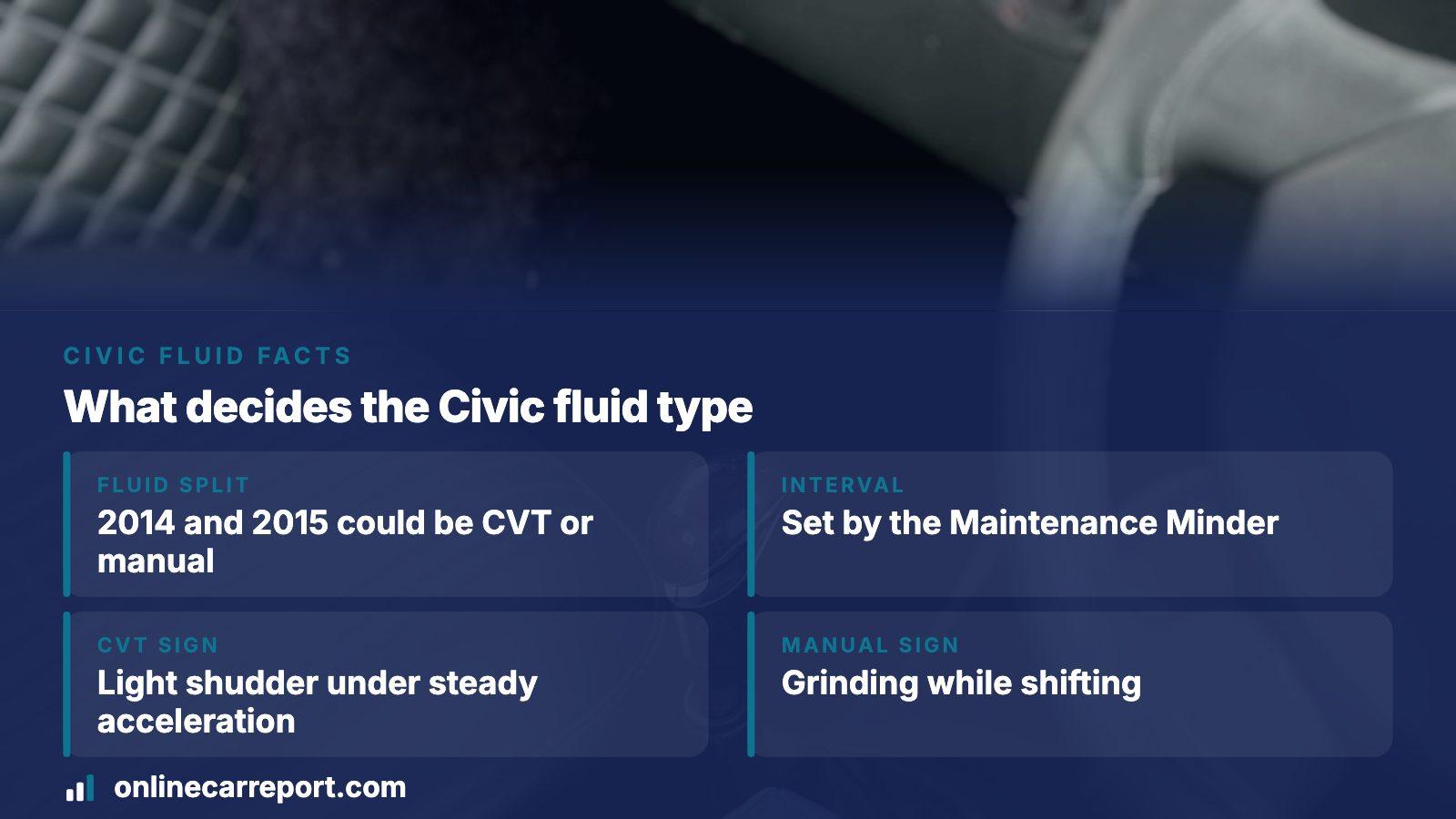
- 2014 and 2015 Civics could be CVT or manual
- Interval
- Set by the Maintenance Minder, not a fixed mileage
What the published estimates say
RepairPal gives a general range of $187 to $215 for this job on a Civic, but its per-year figures are more useful because they spread so far. A 2007 comes in at $91 to $114, a 2010 at $148 to $170, a 2014 at $149 to $178, and a 2016 or newer car at $215 to $244. YourMechanic lists its own Civic service from $160.
| Model year | Estimate |
|---|---|
| 2016 or newer | $215 to $244 |
| 2014 | $149 to $178 |
| 2010 | $148 to $170 |
| 2007 | $91 to $114 |
These are third-party numbers, not quotes from us. We sell vehicle history reports, not repairs, so use the table only to judge whether an invoice looks sensible.
Two gearboxes, two fluids, one model year
For 2014, Honda replaced the sedan and coupe's 5-speed automatic with an all-new CVT. A manual stayed on offer for the LX and EX trims. That means a 2014 or 2015 Civic can hold either gearbox, and a shop pricing from the badge alone may quote the wrong job.
A CVT uses Honda's own CVT fluid, formulated for its belt and pulley system. A manual box takes gear oil. They are not interchangeable, and the quantities differ too, so ask the shop which transmission it believes it is servicing.
When the service is actually due
Honda does not print a single mileage for every Civic. Cars built since 2008 carry the Maintenance Minder, which watches how the car is driven and flashes a letter code, A or B, with numbered items beside it. The fluid change shows up as one of the numbered items, and only when the car's own algorithm decides it is time.
That is why two Civics can reach the service at 30,000 and 45,000 miles. A seller who says the fluid is fine at some round number may not be wrong, but the dash code is the better evidence than any chart.
What owners tell NHTSA about old fluid
Federal complaints are unverified, and they say nothing about how often a problem happens. They do show how owners describe it. In the record we reviewed, POWER TRAIN names 363 of 7,501 complaints on 2008 to 2022 Civics (4.8%), yet 278 of those 363 (76.6%) sit in just 2014 and 2015.
The year 2014 has 99 power train complaints out of 295, and 2015 has 179 out of 390 (45.9%). Two filings show why fluid history matters to a buyer.
From an NHTSA owner complaint
The owner of a 2014 Civic wrote that the transmission grabbed and released when coasting at city speeds, and that the fluid was already "burnt with only 19k since last change". The owner worried it would lock up. Takeaway: a recent fluid change on paper does not prove a healthy CVT, so ask for the invoice and drive the car.
From an NHTSA owner complaint
A 2015 Civic owner reported the CVT slipping at 128,000 miles, with the car unable to pass 20 mph on a busy road. The fluid was black and burnt when inspected, and the owner saw no earlier sign of trouble. Takeaway: dark fluid and a high odometer reading belong in the same conversation when you price the car.
Signs the fluid question is already urgent
- A light shudder under gentle, steady acceleration on a CVT car
- A slow, hesitant launch from a standstill with either gearbox
- The Maintenance Minder showing the transmission sub-item
- Grinding while shifting a stick-shift Civic, a separate complaint from CVT judder
Do the cheap steps first: confirm the transmission, have the fluid level and condition checked on that unit, and look up open recalls before anyone prices more than routine service.
Recall, bulletin or maintenance: who pays
| Type | What it covers |
|---|---|
| NHTSA recall | A safety defect, fixed free at a dealer |
| Service bulletin | Repair instructions for dealers, with no promise of a free fix |
| Dealer says normal | No repair offered |
| Fluid service | Routine maintenance, paid by the owner |
The record shows 2 recall campaigns for 2014 and 1 for 2015, no more than other Civic years. Research for this page found no Civic bulletin naming CVT judder. Check the car's VIN on NHTSA's recall lookup rather than relying on a forum thread.
What fluid service does to a Civic's value
A documented fluid service helps a used Civic's price, but it sits below the facts that move value the most: title brand, accident and damage entries, and auction history. A tidy invoice cannot offset a salvage brand, and a missing invoice costs far less than a rebuilt title.
Odometer readings matter here too. Mileage tells you whether the Minder's sub-item should have appeared already, and a reading that drops between records makes any service claim hard to trust. A VIN report lays those entries side by side, plus open recalls, so you can see what a seller leaves out. Start with the free preview; the report itself is paid once, and the pricing page lists the options.
Five steps before you approve the work
- Confirm the transmission type from the VIN, not the badge.
- Read the Maintenance Minder code instead of a generic mileage.
- For a 2014 or 2015 CVT, find out if any shudder was investigated.
- Look up open recalls on the VIN before you pay.
- Ask for a quote broken out into fluid brand, amount and labor.
If you are buying rather than servicing, pull the history first, then use the service record and test drive to negotiate.

Where this information comes from
- RepairPal: Honda Civic transmission fluid change — The per-year estimate range quoted above.
- Honda: 2014 Civic model-year announcement — The switch from the 5-speed automatic to a CVT, with a manual kept on LX and EX.
- NHTSA: Civic complaints and recalls — Where the power train complaint counts come from.
- NHTSA: recall lookup by VIN — The official check for open campaigns on one car.
- NHTSA owner complaint 11625798 — owner experience, paraphrased
- NHTSA owner complaint 11594694 — owner experience, paraphrased
Sources and photos: Facts checked against the sources above in November 2026. Photos by Mustafa Sheikhmouss, Masjid MABA and Thakur Jaideep Singh on Unsplash; diagrams by OnlineCarReport.
Keep reading
- Car value by VIN: what the number tells you and how history moves itHow a Civic's history sets its value before any repair bill.
- Honda Civic brake replacement cost and what a brake job does to resaleAnother routine Civic bill that buyers ask about.
- Honda Civic alternator replacement cost and how history shifts the car's valueA second Civic repair cost to weigh when pricing a used car.
- Honda Accord transmission fluid change cost, and what it does to valueThe same fluid question on the Civic's bigger sibling.
Frequently asked questions
What should a Civic fluid service run?
RepairPal quotes $187 to $215 overall and $91 to $244 once you split by year. YourMechanic begins at $160. Gearbox type, labor rates and the fluid all shift the total, so get the bill itemized.
Does a Honda Civic have a CVT?
Since the 2014 model year, most sedans and coupes do. Honda kept a manual on LX and EX trims, so a 2014 or 2015 car may have either. A VIN decode tells you which, which matters because the fluids differ.
How often should I change Civic transmission fluid?
Honda's Maintenance Minder decides. It tracks how the car is driven and shows the transmission item only when due. A fixed mileage from a website is a guess, and it differs between a CVT and a manual.
Which Civic years draw the most power train complaints?
Model years 2014 and 2015. Together they hold 278 of the 363 drivetrain complaints in the record we reviewed, or 76.6%. These are owner reports, not a measured failure rate.
Can a VIN report show if the transmission was serviced?
Not directly. It shows title brands, accident entries, odometer readings and open recalls, which help you judge a seller's story. Ask for service invoices separately, and read them against the mileage history.
Now check the car itself
The guide explains what to look for. The report shows what this VIN has on record.