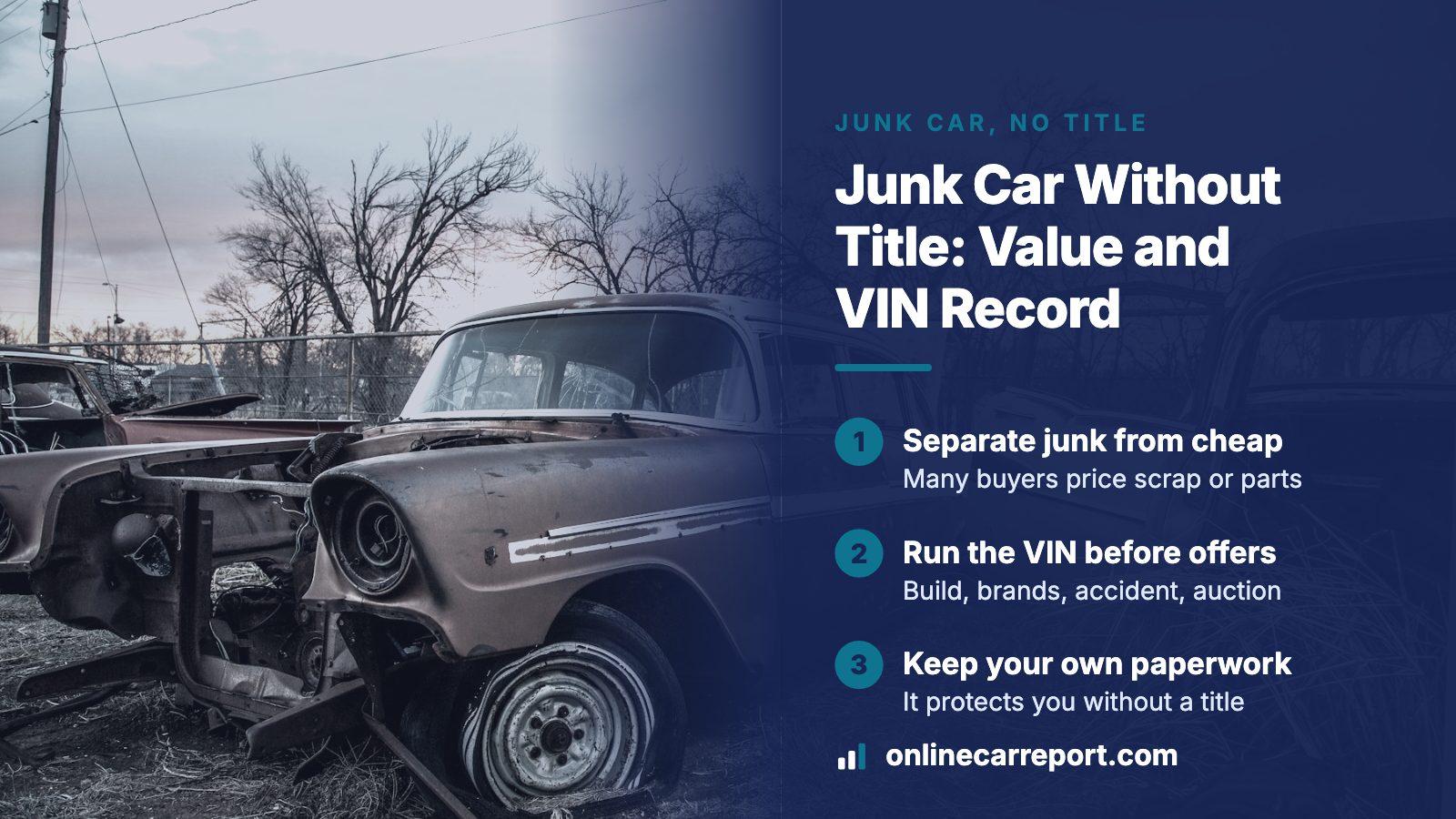
THE SHORT ANSWER
You can often sell a junk car without a title, because many buyers take it as scrap or parts and accept a bill of sale plus ID, depending on your state. Expect a lower quote than a car with clean paperwork, since the buyer carries the risk. Before you agree, read the VIN record to see whether the car is really junk, then file your state's notice of sale so the car stops being yours on paper.
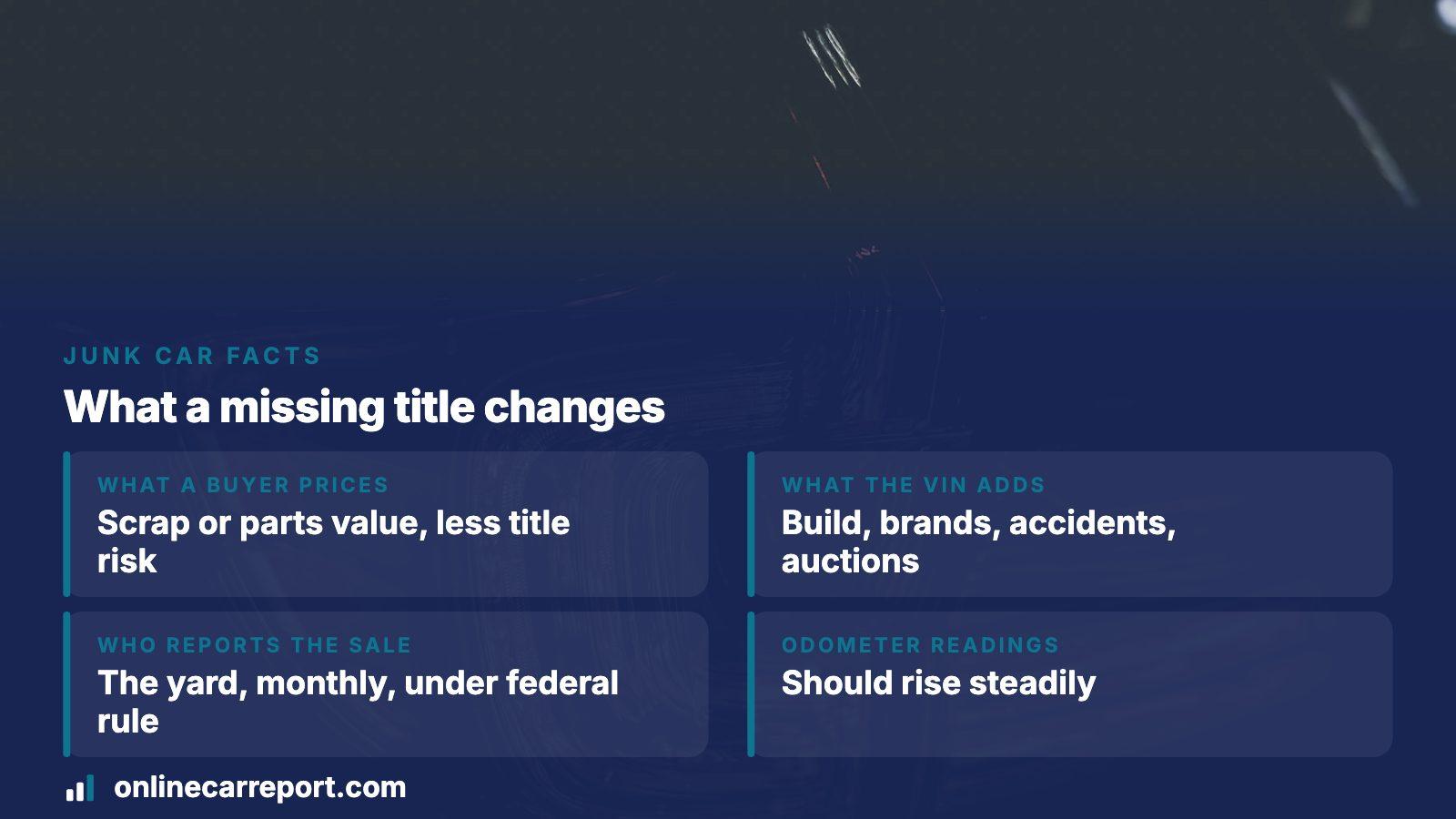
- What a buyer prices
- Scrap or parts value, minus the risk of a missing title
- What the VIN adds
- Build, brands, accident and auction entries, market value
- Who reports the sale
- The yard, monthly, under a federal rule, with your name on it
- Preview
- Free; the full report is one payment
What a missing title does to the price
A title is the state's proof of who owns the car. Without it, a buyer is taking your word, and anyone who takes your word wants to be paid for the chance of being wrong. In practice that shows up as a lower quote, a request for extra identification, or a flat refusal at the yards that only deal in titled vehicles.
Rules on what a buyer may accept differ by state, so ask the buyer what they need and then check it against your motor vehicle agency's own page. A friendly voice on the phone is not the law. Either way, the quote prices metal and parts, not a car someone could drive away.
Is it really a junk car, or just a cheap one
Under the federal wording, junk means two things at once: the car is unfit for public roads, and nothing about it sells except parts or scrap. If either half fails, the label fails. A rough sedan that still starts and moves is a used car with problems, however ugly, and should be priced like one.
Salvage is another class: damage so heavy that repairs plus the wreck's leftover worth would beat what the car fetched before the damage. An insurer's total-loss ruling counts. A car with that history will likely go to a yard or salvage auction, priced on its condition more than its paperwork.
| Your car | How it is likely classed | Where its value comes from |
|---|---|---|
| Runs and drives, needs work | A used car, not junk | Private sale or trade-in, priced as a running car |
| Wrecked, insurer declared it a total loss | Salvage | Salvage auction or yard, priced on damage and parts |
| Cannot run, nothing worth selling but parts and metal | Junk | Scrap weight and parts a yard can pull |
What the VIN tells you before you take an offer
The seventeen characters give a buyer the car's exact build, and a yard uses that to decide which parts are worth pulling. They also open a record you can read yourself. Run the VIN first and you learn whether the car carries a title brand, whether it went through an auction, and what the recorded damage looked like.
- A salvage or auction entry with photos shows the condition the car was in when it last changed hands.
- Accident and damage entries tell you whether the story you are about to tell a buyer matches the record.
- Odometer readings should rise steadily; a drop or a long stall is a warning.
- An open recall is worth knowing about on a car with years of life in it, since a free fix could change a scrap decision.
- A market value entry gives you a figure for the car as a running vehicle, which is the number a scrap quote should be compared against.
Compare two numbers, not one
Set the scrap quote beside the market value for the car in running condition. If the gap is small, scrapping is a fair deal. If the gap is large, the car may be worth more repaired or sold to a private buyer.
What the yard files after it takes the car
Federal title-information rules make junk and salvage yards send a monthly list of the cars they took in. Each line holds the yard's details, the VIN, the arrival date, who supplied the car, and what became of it, including any export.
That duty attaches to the yard taking the car, not to a title changing hands, so a missing certificate does not make the sale invisible. Your name goes into a national record beside the VIN. A buyer later anywhere in the country can see that the car went to a yard.
Who is exempt
Yards that take in under five wrecked, scrapped or insurer-written-off cars over a year are excused from reporting. A buyer with a trailer and cash may sit below that line, and then no federal entry exists for your car. That helps nobody but the buyer.
Why the shell may not stay dead
Junk does not always mean crushed. A yard may sell a car whole, strip it, or rebuild it, and the federal definition of a junk yard names all of those uses. The report form even asks whether the car was crushed or sold on.
That matters to you because a car with a readable VIN can return to the road years later. If it comes back with a new title and its past erased in the buyer's mind, the record that shows it passed through a yard is the thing that protects an honest seller. When you can, ask the buyer whether the yard reports its intake.
Paperwork that protects you when there is no title
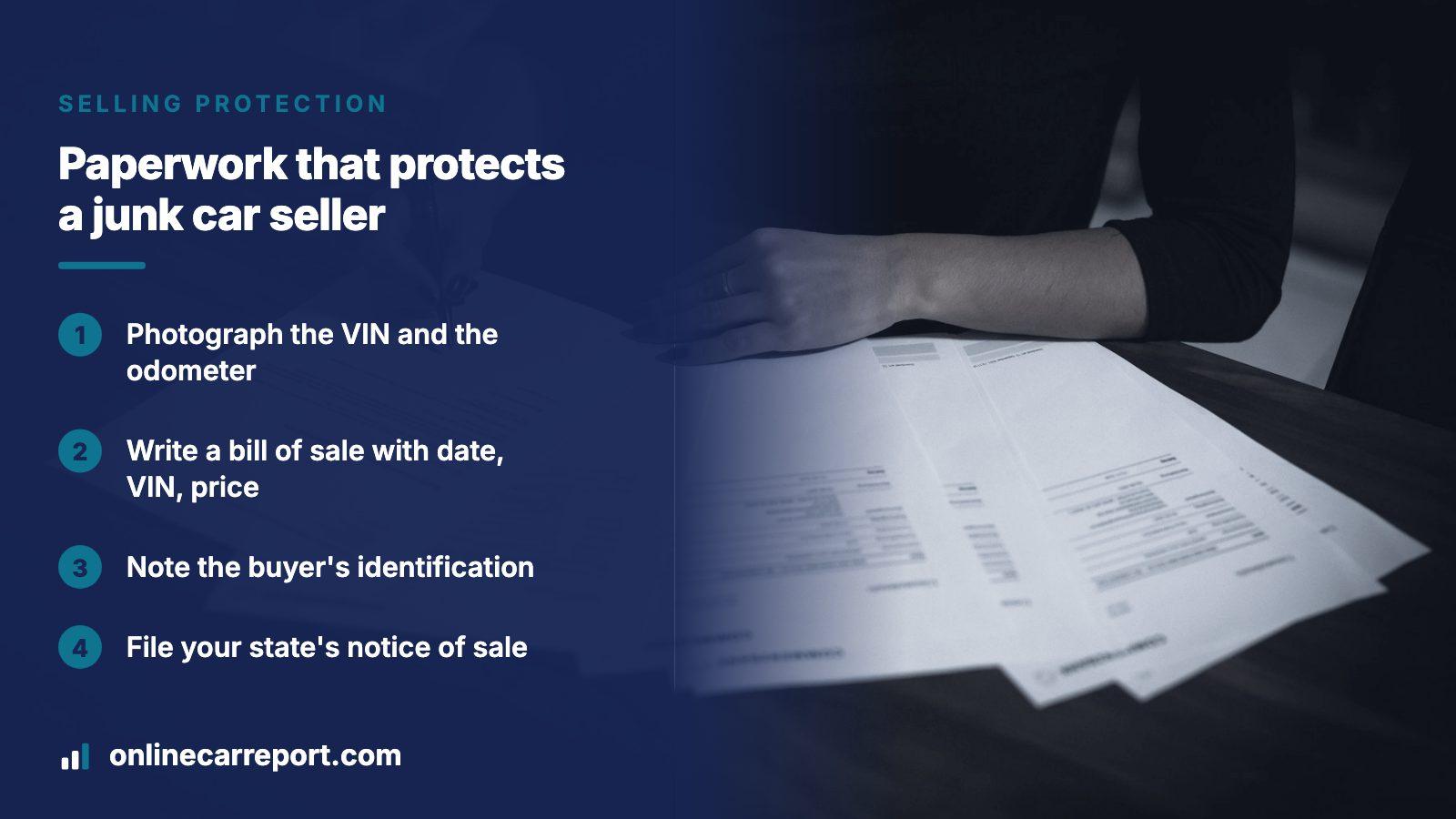
The title is gone, but your own file does not have to be empty. A bill of sale is the main thing you will hold, so make it specific. Do these steps on the day the car leaves.
- Photograph the VIN where it is stamped on the car and the odometer reading, with the car still in your driveway.
- Write a bill of sale giving the date, the VIN, the price and the buyer's name and business, and have the buyer sign it.
- Ask for the buyer's identification and note how they intend to move the car.
- File your state's notice of sale or release of liability right away, since that filing, not the yard's report, ends your responsibility.
- Keep every document until the state confirms the car is out of your name.
If the title is only lost and the car is yours, ask your motor vehicle agency about a duplicate before you sell. It can lift the offer and settle the question.
When the car is not yours on paper
Some readers never moved a title after buying, or inherited a car with no paperwork. Selling then is harder than a lost-title sale, because the state may not see you as the owner at all.
A VIN record helps here too. It can show a lien, an impound entry or a theft record, and any of them can stall a sale. Clear those with the state or the lender before a yard takes the car, because the yard may find the same entry and leave you with a car that cannot move.
Running the check and its cost
Enter the VIN at OnlineCarReport and the free preview shows what the record holds before you spend anything. For the whole history with the market value alongside, the full report is one payment, not a subscription. See the pricing page for amounts.
Use it before you accept a scrap quote, to learn whether the car is junk or just cheap. For a free federal check, NHTSA's open-recall lookup needs only the VIN.
Where this information comes from
- eCFR 28 CFR 25.56: junk yard and salvage yard responsibilities — Supports the monthly inventory, the fields it holds, and the exemption for small handlers.
- eCFR 28 CFR 25.52: definitions — Supports the junk, salvage and total-loss definitions and what a junk yard does.
- Vehicle History: NMVTIS approved providers — Justice Department page on providers that sell the record these inventories feed.
- NHTSA: recalls lookup — Free open-recall check by VIN.
Sources and photos: Facts checked against the sources above in November 2026. Photos by Leo_Visions, Dimitri Karastelev and A n v e s h on Unsplash; diagrams by OnlineCarReport.
Keep reading
- Car value by VIN: what the number tells you and how history moves itHow a VIN and its history combine into a value, for cars that are not junk.
- Car trade-in value by VIN number: what a dealer sees and what history changesThe better route when the car still runs and a dealer might take it.
- Private party car value by VIN: what a fair price is when history is on the tableWhat to expect when you sell a running car yourself instead of scrapping it.
- Diminished value calculatorUseful when damage, not age, is what pulled the car's worth down.
Frequently asked questions
Is selling a scrapped car with no title allowed?
Often yes, since many yards accept a bill of sale and identification in its place, but the rules depend on your state and on the buyer. Expect a lower quote, and some yards will refuse. Ask your motor vehicle agency what a buyer may accept, and file a notice of sale afterward.
Will the scrap yard report my car if I have no title?
Yes, in most cases. The federal duty belongs to the yard that takes the car, not to the title, so the VIN, the date and your name as the supplier go into a monthly report. The exception is a handler dealing with under five such cars in a year, who does not have to report.
Does the VIN change what a junk car is worth?
It can. The VIN identifies the build, which tells a yard what parts are worth pulling, and it opens the history that shows brands, auction sales and damage. A car with a record of a total loss is priced as salvage, while one with a clean record may be worth more than scrap if it can still be repaired.
Is a car that does not run always junk?
No. Under the federal wording the car must be unfit for public roads and also be worth nothing beyond parts or scrap. A car that does not run today but has real resale value fails the second test and should be priced on its condition, not by the pound.
What if I lost the title and want to avoid the discount?
Ask your state's motor vehicle agency about a duplicate before you sell. A replacement document often costs little compared with the cut a buyer takes for the risk, though the fee and the wait differ by state, so check the current terms with your agency.
Now check the car itself
The guide explains what to look for. The report shows what this VIN has on record.