
THE SHORT ANSWER
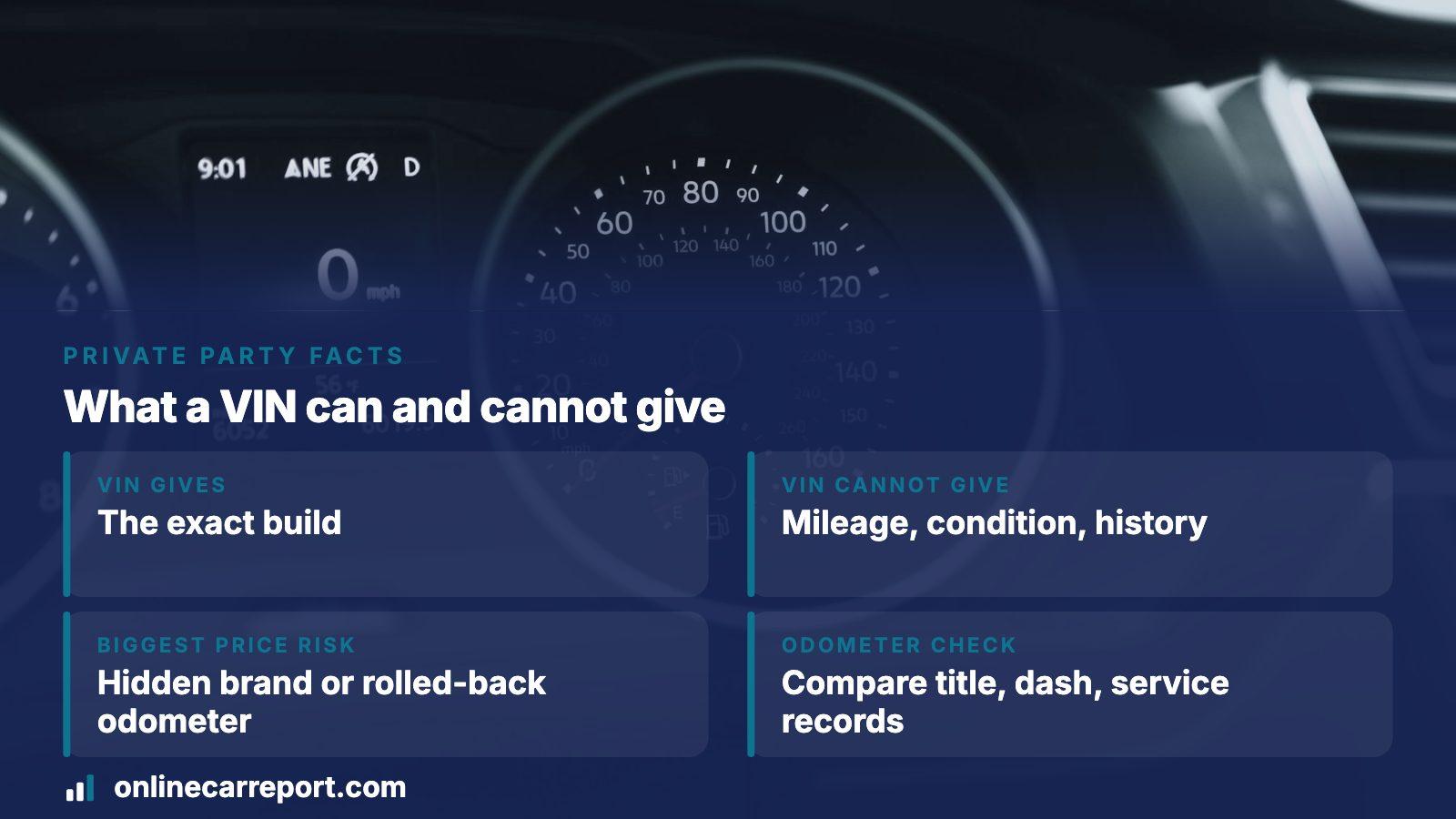
The VIN identifies the exact year, trim and engine, which is the starting point for a private party value. It does not hold mileage, condition or history. Run the VIN through a valuation tool for the private party figure, then adjust it for what the records show: a salvage or flood brand, an odometer that disagrees with the dash, or a past auction sale. A clean-title figure applied to a branded car overstates what it is worth.
- What the VIN gives
- The exact build, so you price the right car
- What it cannot give
- Mileage, condition and recorded history
- Biggest price risk
- A hidden salvage brand or a rolled-back odometer
- Preview
- Free; the full report is one payment
What a private party value actually measures
Valuation guides split one car into several numbers depending on how it changes hands. Kelley Blue Book, for instance, describes its private party figure as a fair price for selling to an individual, and keeps a separate trade-in range for what a dealer might pay this week. The private number is normally the higher of the two, because there is no dealer margin to cover.
It is still an estimate of a typical car. Kelley describes the inputs as completed sales plus auction prices, tuned for season and region, with a weekly refresh. Your car is not typical once its own history is added, and that is where this page spends its time.
What the VIN does and does not settle
Entering the full VIN is better than picking a model from a dropdown, since it locks the trim and engine. Sister trims wearing one nameplate can sell for noticeably different money, and the VIN settles which of them is in your driveway.
| Input | Source | Effect on the private party price |
|---|---|---|
| Year, trim, engine | The VIN | Puts the car in the right band to begin with |
| Mileage | The dash, checked against records | Usually the largest adjustment on an ordinary used car |
| Condition | Your own honest grading | Tires, paint, interior and mechanical state all count |
| Title status | Title and state records | A brand can override every other input |
| Location | The local market | Demand for trucks, AWD and convertibles shifts by region |
Why a title brand breaks the private party number
Published private party values assume an ordinary, clean-title example. A salvage, rebuilt or flood brand is a different product, and buyers, lenders and insurers treat it that way. If a seller quotes the book figure for a car whose title says otherwise, the seller is charging you for a past the car never had.
The federal NMVTIS database is built to catch this. Its consumer reports show brand history such as junk, salvage and flood, plus insurer total-loss decisions and transfers to salvage yards. Treat those entries as price events, not footnotes.
The mileage you type in has to be true
Every private party value leans on mileage, and a seller can alter the one number you cannot see inside the car. By NHTSA's estimate, false readings accompany more than 450,000 vehicle sales every year, and tampering with a digital display leaves less to see than a mechanical one.
From an NHTSA owner complaint
One Accord owner (model year 2013) wrote to NHTSA about a private sale listed at 120,000 miles. A Carfax lookup later showed 209,000. The owner filed it as odometer fraud. Read it as a reminder that the price you agree on is only as good as the mileage behind it, so check the readings before you hand over money.
- Hold the figure on the title up against the dash.
- Look for service stickers and maintenance records that show earlier readings.
- Judge tire, pedal and seat wear against the claimed miles.
- Order a history report by VIN if the seller has none.
When the ad says clean title and the record disagrees
Private listings rarely come with paperwork beyond the title, and an ad is only a claim. The check costs far less than discovering the problem after payment.
From an NHTSA owner complaint
A 2012 Civic owner told NHTSA about a purchase arranged through a marketplace app, from an individual. The listing claimed a spotless title and 112,000 miles. Afterward the owner learned the car was salvage and had roughly 180,000 miles or more. A seller's word and a listing photo cannot replace a record, and the gap here would have changed any sensible offer.
How to run the check before you agree on a price
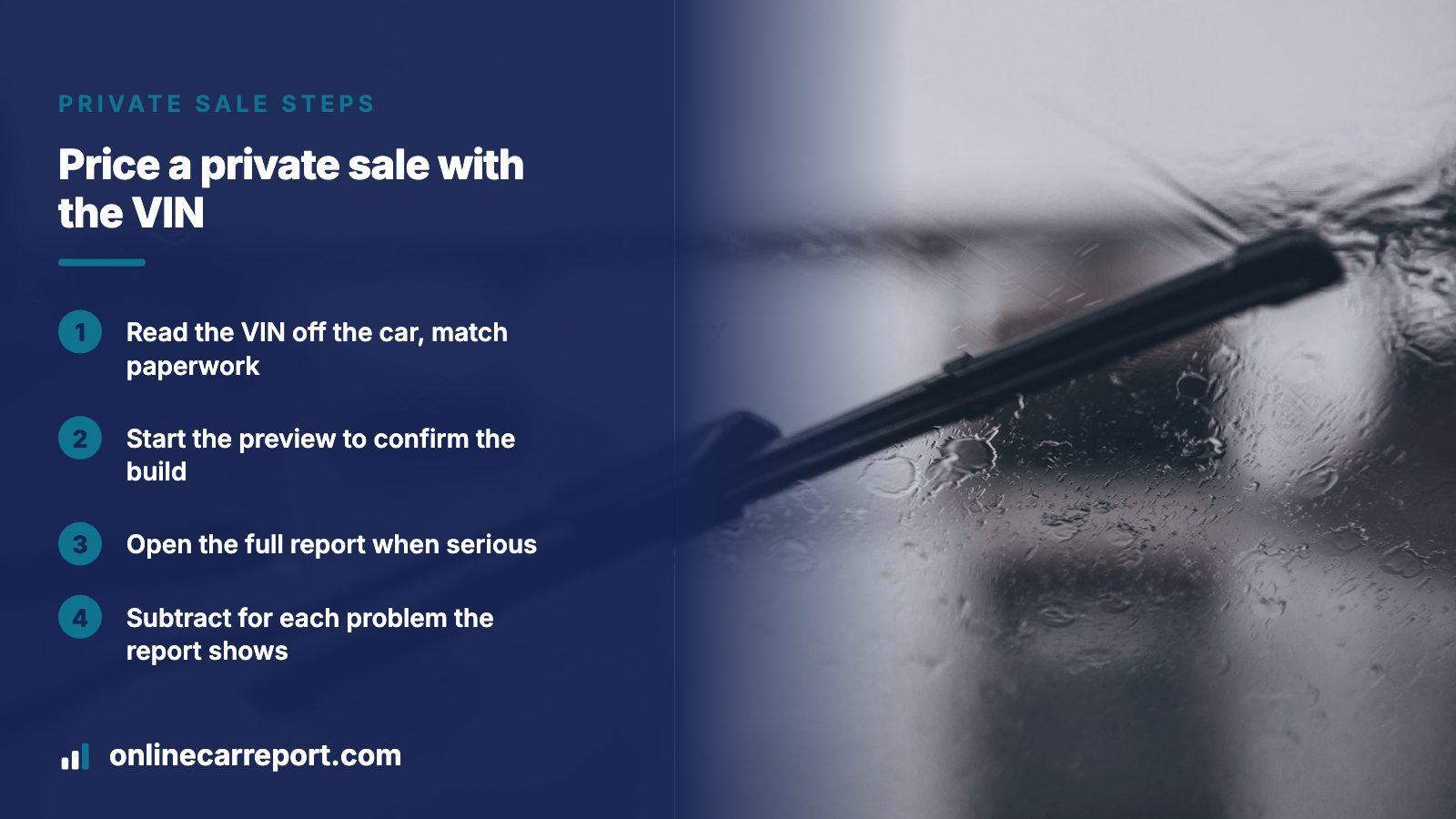
- Read the VIN off the car, then confirm it agrees with the number on the title.
- Start the free preview on OnlineCarReport to confirm the build.
- Open the full report when you are serious: expect brand entries, damage, odometer readings, and photos from any salvage or auction sale.
- Set the private party value, then subtract for each problem the records confirm.
- Offer on the adjusted number and keep the report in the file.
A report reads data, so it will not see a worn transmission. Pair it with an inspection by a mechanic who works for you, and ask for the findings in writing so any repair estimate can support your offer.
What a clean result still leaves open
No database sees everything. By NMVTIS's own account, roughly 87 percent of vehicles appear in it and only a bit over half the states contribute, which means a clean search is not proof. State brand rules differ, and not every detail in a state title file reaches the national system.
One quirk worth knowing: a car stolen and gone for 30 days may be coded a total loss by its insurer, even when it later turns up undamaged. Read the detail behind each entry before reaching a conclusion, and when the car matters, request the state title record as well.
Cost, and your next move
You pay nothing for the preview. The full report follows as a single purchase for each VIN, with no recurring charge, and every option is laid out on the pricing page. Comparing several cars? Packs of reports are offered on that same page.
Run it before you negotiate, not after. A price built on confirmed records is easy to defend to the seller, and if the history is worse than the ad, you have the evidence to walk away.
Where this information comes from
- Kelley Blue Book: What's my car worth — how private party and trade-in values differ and how they are built
- NHTSA: Odometer fraud — scale of false readings and buyer checks
- NMVTIS: For consumers (DOJ) — what the federal title database holds and where it falls short
- FTC: Buying a used car from a dealer — history reports versus a mechanic's inspection
- NHTSA owner complaint 11771405 — owner experience, paraphrased
- NHTSA owner complaint 11726572 — owner experience, paraphrased
Sources and photos: Facts checked against the sources above in November 2026. Photos by Karwin Luo, Thibault Valjevac and Nathan Dumlao on Unsplash; diagrams by OnlineCarReport.
Keep reading
- Car value by VIN: what the number tells you and how history moves itHow a VIN becomes a value and where history moves it.
- Kelley Blue Book value by VIN: how the history changes the numberWhat the blue book figure leaves out.
- Car trade-in value by VIN number: what a dealer sees and what history changesThe lower number a dealer sees when you hand the car over.
- Retail value by VIN: what a dealer can fairly ask and what history takes offWhat a dealer can fairly ask on the lot.
Frequently asked questions
Can I get a private party value from a VIN alone?
Not completely. The VIN fixes the year, trim and engine, which is the right starting point. The tool still needs mileage and condition, and none of those live in the VIN. Records then show whether a brand or auction sale should pull the figure below the book.
Is private party value higher than trade-in value?
Usually yes, because a private sale skips the dealer's resale costs and margin. The trade-off is that you handle the ad, the buyers and the paperwork yourself. Compare both figures before choosing, and weigh the effort against the difference.
Does a salvage title change the private party value?
Yes, a lot. Book figures assume a clean title, so a salvage or rebuilt brand needs a separate, lower price, and some buyers and lenders will not touch it. Quoting the clean figure for a branded car is the most common pricing mistake.
How do I know the mileage is real?
Compare the title, the dash and any service records, then check readings recorded over time in a history report. A reading that drops, or one far above the dash, is the warning. Tire and pedal wear that do not fit the miles are another clue.
Do I pay for the report?
Only the preview costs nothing, and it confirms the build for your VIN. The report is a single purchase for that VIN. Nothing renews, and the pricing page shows the choices, packs included.
Now check the car itself
The guide explains what to look for. The report shows what this VIN has on record.