THE SHORT ANSWER
YourMechanic averages $238 for the job, while KBB shows $448 to $526 at a dealer and $457 to $537 at an independent shop. Parts are a minor piece. Most of the spread comes from labor on a flat engine and from quotes that bundle a full 60,000-mile service. Plugs are due at 60,000 miles, so a used Outback past that mark should come with a dated record.
- Lowest estimate
- $238 average (YourMechanic)
- Highest estimate
- $537 at an independent shop (KBB)
- Service interval
- 60,000 miles
- Engine share of complaints
- about 7% of 7,698 NHTSA reports
Three published estimates, side by side
Nobody publishes one number for this job, so it helps to see the sources next to each other. YourMechanic, a mobile repair marketplace, gives an average of $238. Kelley Blue Book gives separate ranges for a dealer and for an independent shop. These are their figures, quoted as they appeared in September 2026, and they will move.
| Source | Low end | High end |
|---|---|---|
| YourMechanic average | $238 | $238 |
| KBB at a dealer | $448 | $526 |
| KBB at an independent shop | $457 | $537 |
YourMechanic splits its average into $70 of parts and $168 of labor. KBB puts dealer parts between $179 and $211, and dealer labor between $269 and $315. The top figure is a little more than twice the bottom one. A repair that routine should not vary that much, which points to what sits inside each quote rather than to the plugs themselves.
Why the labor line is the one that moves
Every Outback uses a horizontally opposed engine, with its pistons working sideways from both flanks of the block. The plugs thread in from the side and face the frame rails, so a technician works through a narrow gap instead of dropping a socket straight down from the top of an upright engine.
That layout is what the labor figures in the table are paying for. Some shops pull the airbox or the battery to get room, and the rear pair takes patience. Each shop sets its own book time for that work, which is why two competent shops can differ by a hundred dollars on labor while the parts line barely changes.
When the quote is really a service package
Owners often remember a large invoice as the price of spark plugs when the work order covered much more. At the 60,000-mile visit, the plugs ride along with oil-change style extras and a walk-around check, and the advisor reads out a single total.
Ask for the breakdown
Before comparing two quotes, ask each shop to separate plug labor, the plugs themselves, and every other item. A package price and a plugs-only price are different products, and a shop that itemizes without fuss is easier to trust.
Waiting too long on the plug schedule
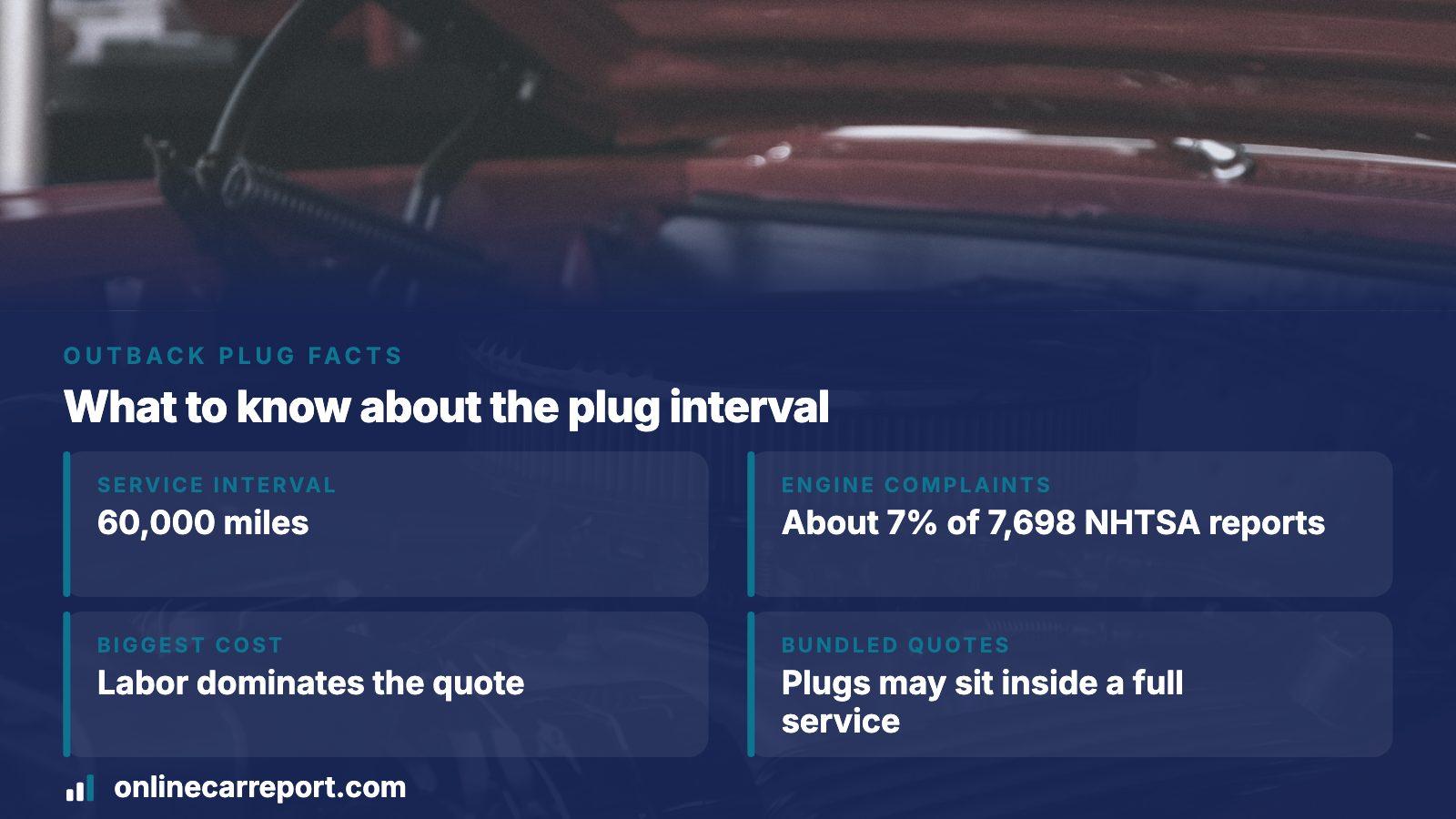
For newer Outbacks without a turbo, Subaru's printed maintenance plan puts fresh plugs at 60,000 miles, a figure dealer service pages echo. Long-life iridium electrodes make the interval possible. They also mean there is little reason to replace plugs years ahead of schedule on an engine that runs well.
Stretching far past the interval has its own price. Worn plugs make the ignition coils work harder, and coils cost more than plugs. A misfire that starts as a plug job can turn into a larger bill, so the schedule is worth following in both directions.
What Outback owners tell NHTSA about plugs and stalling
Across 7,698 federal complaints on the 2008 to 2022 Outback, about 7% name the engine. The busiest year, 2019, drew 1,032 reports and only 4% of them concern the engine. Complaints are unverified owner statements, not failure rates, but they show a plug quote is not a sign of a fragile motor.
From an NHTSA owner complaint
The owner of a 2012 Outback described stalling at stops and on freeway entry, with warning lights on. At about 112,000 miles the dealer replaced two plugs and cleared the lights. By 117,000 the car stalled again, and the next-day diagnosis pointed at the torque converter instead.
The lesson is to treat plug replacement as maintenance, not a cure for every stumble. A code scan before authorizing parts can save a repeat visit. A second complaint, from a 2010 owner whose car stalled when braking, also ended with new plugs at 68,000 miles, so the pattern is one to watch rather than assume.
How plug history changes what a used Outback is worth
A value estimate starts from year, trim and mileage, then moves with condition and history. A car that has skipped a due plug service has a bill waiting for the next owner, and a careful buyer subtracts it. A car with dated invoices for the work sells with less haggling.
Maintenance receipts and a VIN report answer different questions. The receipts show whether the service happened. The report shows what happened to the car itself: damage, title brands and mileage readings that a seller's story might leave out. Both sit in the file behind any fair price.
Questions to ask when you are buying, not servicing
The interval turns the odometer into a checklist. Past 60,000 miles, ask when the plugs were changed and expect a line on an invoice. Past twice that distance, there should have been a second visit.
- Ask for the date, mileage and shop for each plug service.
- Ask whether the invoice listed plugs alone or a full service package.
- Look for stalling, rough idle or a stored misfire code in the seller's own account.
- Compare the odometer on the paperwork with the readings in the vehicle's history.
- Confirm any open recalls before you agree on a price.
A seller with no answer is not necessarily hiding something serious, since this is a routine job. But each missing interval is a real cost to take off the offer.

Doing it in the driveway
Owners do this job at home, and parts alone cost well under a hundred dollars. Clearance is the hurdle, not difficulty. Expect swivel extensions, a removed airbox, and time with the rear plugs. Aluminum heads punish over-tightening, so follow the torque spec and the plug maker's guidance on anti-seize.
If a free afternoon is not realistic, the labor on a quote buys real hours of awkward access. Read the totals in the table with that in mind.
Where a VIN check fits before you pay
Run the VIN on any Outback you are considering before talking service costs. Start with the free preview. If you go on, you pay once for that report, not monthly, and the pricing page lists the options. Inside are brand flags on the title, crash and damage entries, mileage readings, unresolved recalls and a market value.
It does not list shop invoices, so keep asking the seller for plug receipts. What it does give you is a trustworthy baseline for the car, so a plug quote is judged against a known history rather than a hopeful one.
Where this information comes from
- NHTSA owner complaint 11434205 — owner experience, paraphrased
- NHTSA owner complaint 10950187 — owner experience, paraphrased
- NHTSA: Subaru Outback complaints — federal complaint record behind the engine-share figures
- KBB: Outback spark plug replacement — dealer and independent ranges with parts and labor split
- YourMechanic: Outback spark plug estimate — average price with its parts and labor split
- Subaru of Dayton: plug interval — dealer page repeating the 60,000-mile schedule
Sources and photos: Facts checked against the sources above in November 2026. Photos by Erik Mclean, Carrie Allen www.carrieallen.com and Victor Hughes on Unsplash; diagrams by OnlineCarReport.
Keep reading
- Subaru Outback head gasket replacement cost, and what it does to the car's valueThe larger Outback engine repair, and how it prices into a used car.
- Subaru Forester head gasket replacement cost, and what the job does to the car's valueThe same flat-engine repair on the Forester, for comparison.
- Used car with no service history: what it does to the price and what to checkWhat to do when a seller has no records for the maintenance you just read about.
- Car value by VIN: what the number tells you and how history moves itHow a VIN sets the value that maintenance costs are weighed against.
Frequently asked questions
What should I expect to pay to replace Outback plugs?
Published estimates differ. YourMechanic averages $238, with $70 in parts and $168 in labor. KBB shows $448 to $526 at a dealer and $457 to $537 at an independent shop. Labor assumptions and whether the quote bundles other service explain most of the gap. Ask any shop for an itemized price.
How often should Outback spark plugs be replaced?
The maker's plan for newer naturally aspirated Outbacks says 60,000 miles, and dealer service pages echo it. Iridium plugs last long enough that early replacement rarely helps. Waiting far past the mark strains the ignition coils, which cost more to replace than the plugs.
Why is spark plug replacement more expensive on a Subaru?
The engine lays its cylinders flat, so plugs face sideways toward the frame rails with limited room. Technicians may remove the airbox or battery to reach them, and book time is longer than on an upright engine. The plugs themselves are ordinary parts.
What are signs the plugs on an Outback need replacing?
Common signs are a rough idle, hesitation when accelerating, harder cold starts, lower mileage per tank, and in the end a stored misfire code that lights the dash. Coils and fuel delivery cause similar symptoms, so scan for codes before buying parts.
Does missing plug service lower a used Outback's value?
It can, because a due service is a bill the next owner pays and buyers price it in. Dated invoices help a seller. A VIN report adds the car's damage, title and odometer history, which matters more to the price than any single maintenance item.
Now check the car itself
The guide explains what to look for. The report shows what this VIN has on record.