THE SHORT ANSWER
Expect about $233 to $277 on RepairPal's general page, with a 2019 to 2021 model as low as $101 to $136. A 4Runner built before the 2010 redesign uses Toyota Type T-IV in a transmission you can check with a dipstick. From 2010 the unit is sealed, has no dipstick and calls for Toyota Genuine ATF WS. Past roughly 60,000 miles with no record of a change, treat the service as money the next owner will spend.
- General estimate
- $233 to $277 (RepairPal)
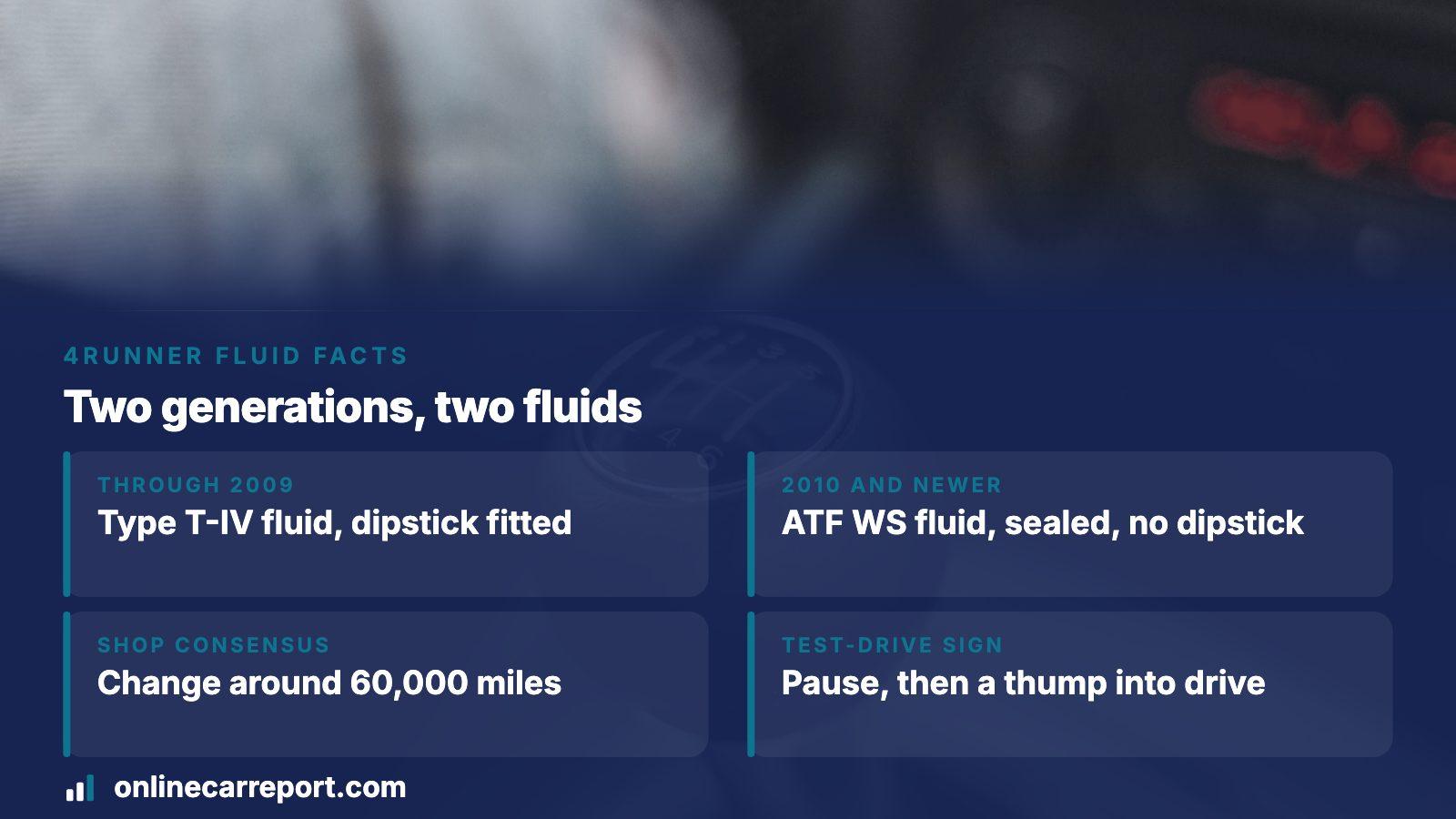
- Through 2009
- Type T-IV fluid, dipstick fitted
- 2010 and newer
- ATF WS fluid, sealed, no dipstick
- Shop consensus
- Change around 60,000 miles
What the service costs, and who published each number
One estimator supplies every price on this page, and it gives three different answers for the same job (retrieved September 2026). None of it is an OnlineCarReport quote, since the site sells vehicle history reports, not repairs.
| Where RepairPal lists it | Published range |
|---|---|
| All years, general page | $233 to $277 |
| The 2008 page | $130 to $164 |
| The 2019 to 2021 pages | $101 to $136 |
The spread follows fluid type, fluid quantity and the shop's labor rate far more than any defect in the truck, and the older and newer trucks do not even share a fluid. Use these ranges to test a quote, not predict one.
Where a fluid service sits in a 4Runner's resale value
A buyer prices a used 4Runner from mileage and condition, then subtracts the work to come. A documented transmission service subtracts nothing. An overdue one subtracts roughly what a shop would charge. The worst case is the seller who cannot say whether the fluid was ever changed, since a careful buyer then wonders what else was skipped.
From an NHTSA owner complaint
The owner of a late-2007 4Runner told NHTSA the transmission and oil pan system were replaced at 63,000 miles. Toyota pointed to aftermarket parts; the owner answered that service records showed the maintenance had been done. Toyota supplied the transmission but billed labor, because the truck had left warranty.
Whatever the cause, that owner's argument rested on records. A seller with dated invoices has an answer; one without has a story. A report's market value cannot see that paperwork, but its odometer readings, damage entries, title brands and use type show whether the truck belongs above or below the figure. A salvage history moves price far more than a fluid service.
Two generations, two fluids: confirm yours first
Toyota rebuilt the 4Runner for the 2010 model year, and its press materials say the V8 option disappeared in that redesign. The 2.7-liter four-cylinder was paired with a 4-speed automatic, and the 4.0-liter V6 got a 5-speed unit. The fluid specification changed with the platform, according to parts-fitment listings and owner forums.
| Generation | Model years | Fluid | Dipstick |
|---|---|---|---|
| 4th | 2003 to 2009 | Toyota Type T-IV | Yes, non-sealed |
| 5th | 2010 to 2024 | Toyota Genuine ATF WS | No, sealed |
A quote that says only 'transmission fluid' has not told you which job is being priced. Ask for the product by name and confirm it with the owner's manual or a Toyota dealer.
No dipstick, and why 'inspect' does not mean 'never'
On a 2009 or older 4Runner, a dipstick lets you judge level and condition in the driveway. On a 2010 or newer truck the transmission is sealed, so a shop has to open the fill plug. A forum thread that assumes a dipstick describes the older truck.
For the sealed transmission, the owner's manual asks for an inspection and names no change mileage. Some dealers take that to mean a lifetime fill. Independent shops and owner forums say about 60,000 miles, sooner for towing or trails, which Toyota counts as severe service. That is opinion, not a Toyota schedule.
From an NHTSA owner complaint
A 2008 4Runner owner wrote to NHTSA seeking reimbursement for a transmission repair. The invoice, as quoted in the record, said a thrust bearing behind the front planetary gear failed and damaged it. Metal debris contaminated the unit, so the torque converter and electronics were replaced too.
The record does not say what service the truck had, and a fluid change might not have saved it. It does show how far a repair like that outruns a routine service, so an undocumented gap belongs in the price talk.
What a VIN report tells you before you price the service
A history report will not say whether the fluid was changed. It records the facts that decide how much that question matters on a given truck.
- Factory specs, to confirm the generation, engine and transmission
- Odometer readings, to see how far past 60,000 miles the truck is and whether they climb believably
- Ownership and use type, a hint at how hard the truck worked
- Accident and damage records, title brands, and salvage or auction history with photos
- Open recalls, so you never pay for work Toyota already covers
The preview is free. The full report is one purchase, and the pricing page has the details for a single report or a pack.
History entries that outweigh a fluid service
| Entry in the history | What it suggests | In the price talk |
|---|---|---|
| Odometer readings that stall or step backward | The mileage may not be real, so the interval cannot be judged | Treat the service as overdue and ask for dated invoices |
| Salvage or rebuilt title brand | The truck was once written off | Usually outweighs any maintenance item in value |
| Accident or damage record | A repair of unknown quality, possibly near the drivetrain | Ask what was fixed and by whom, then test drive with care |
| Auction record with photos | A snapshot of condition at the sale | Compare the photos with the seller's story |
None of these says anything about the transmission itself. They show how much faith to put in the seller's account, which is what a fluid invoice is meant to support.
What a tired transmission does on a test drive
From an NHTSA owner complaint
One owner bought a 2008 4Runner new in November 2008. By spring, the automatic sometimes hung for 5 to 8 seconds after a shift from reverse to drive. The truck went back to the dealer under warranty several times, but the service department said it could not act unless the fault repeated. Nothing was repaired.
A fault that comes and goes may not appear on a short drive, so shift between reverse and drive several times with the engine warm. Watch for these on either generation:
- A pause, then a thump, when you shift between reverse and drive
- A clunk, hesitation or engine flare under acceleration
- Fluid that looks dark or smells burnt, where a dipstick lets you see it
- Any transmission warning light, which matters most on a sealed unit you cannot inspect by eye
If any of these appear, a fluid change is the wrong price anchor. Get a diagnosis first, then negotiate from the real repair figure.
Before you authorize the service or sign the deal
- Read the generation from the VIN and match the fluid: T-IV and a dipstick on older trucks, ATF WS and a sealed case on newer ones.
- Run the VIN through NHTSA's recall page. It costs nothing and shows whether Toyota already owes the truck a fix.
- Have the shop write the fluid brand, the amount and the labor as three separate lines.
- Ask the seller for dated invoices and compare the odometer against 60,000 miles.
- Read the history for brands, damage and odometer trouble before you trust the paperwork.
Run the preview first, since it costs nothing, and pay for the full report once a truck survives your shortlist. One truck, one payment, and the report's value figure gives your offer a starting number.
Where this information comes from
- NHTSA: recalls by VIN — The official lookup that shows whether a specific 4Runner has an open safety recall.
- NHTSA owner complaint 10332536 — owner experience, paraphrased
- NHTSA owner complaint 10514215 — owner experience, paraphrased
- NHTSA owner complaint 10409755 — owner experience, paraphrased
- RepairPal: 4Runner transmission fluid change estimate — Source of the general and per-year price ranges, retrieved in September 2026.
- Toyota Newsroom: 4Runner generations — Toyota's own account of the 2010 redesign, including the dropped V8 and the new engine and transmission pairings.
Sources and photos: Facts checked against the sources above in November 2026. Photos by Sean Foster, Scott Graham and Erik Mclean on Unsplash; diagrams by OnlineCarReport.
Keep reading
- Car value by VIN: what the number tells you and how history moves itHow a VIN report turns mileage, damage and title history into a value you can negotiate from.
- Kelley Blue Book value by VIN: how the history changes the numberA look at book value by VIN when you are checking a seller's asking price.
- Jeep Wrangler transmission fluid change: cost, fluid and used valueAnother off-road favorite where severe-service use changes the fluid interval.
- Sample reportSee which records a report returns before you decide to buy one.
Frequently asked questions
What should a 4Runner transmission fluid service cost at a shop?
RepairPal lists $233 to $277 on its general page, $130 to $164 for a 2008 and $101 to $136 for 2019 to 2021. A real quote depends on fluid type, quantity and local labor, so ask for those three items on separate lines.
Does a Toyota 4Runner have a transmission dipstick?
Through 2009, yes, and that transmission is non-sealed. From 2010 it is sealed with no dipstick, so a shop has to open the fill plug to check the fluid. A guide that mentions a dipstick on a newer truck is describing the older generation.
How often should the 4Runner's transmission fluid be changed?
For the sealed transmission, Toyota's manuals say to inspect the fluid and name no fixed interval. Independent specialists and owner forums suggest about 60,000 miles in normal use, and sooner with regular off-road driving or towing. Dipstick trucks follow their own inspection routine.
Does a missed fluid service lower a used 4Runner's value?
It lowers what a careful buyer will pay by about the cost of the service, and by more when the seller cannot say what was done. A damage record or rebuilt title usually matters far more. The service itself has to be proven with invoices.
Can a VIN report show whether the transmission fluid was changed?
No. A report is built from title, damage, mileage and sale records, not shop invoices, so a fluid service never appears in it. You can read the odometer trail, which shows whether the truck has passed 60,000 miles, plus any brands or damage that change how much the service matters.
Now check the car itself
The guide explains what to look for. The report shows what this VIN has on record.