THE SHORT ANSWER
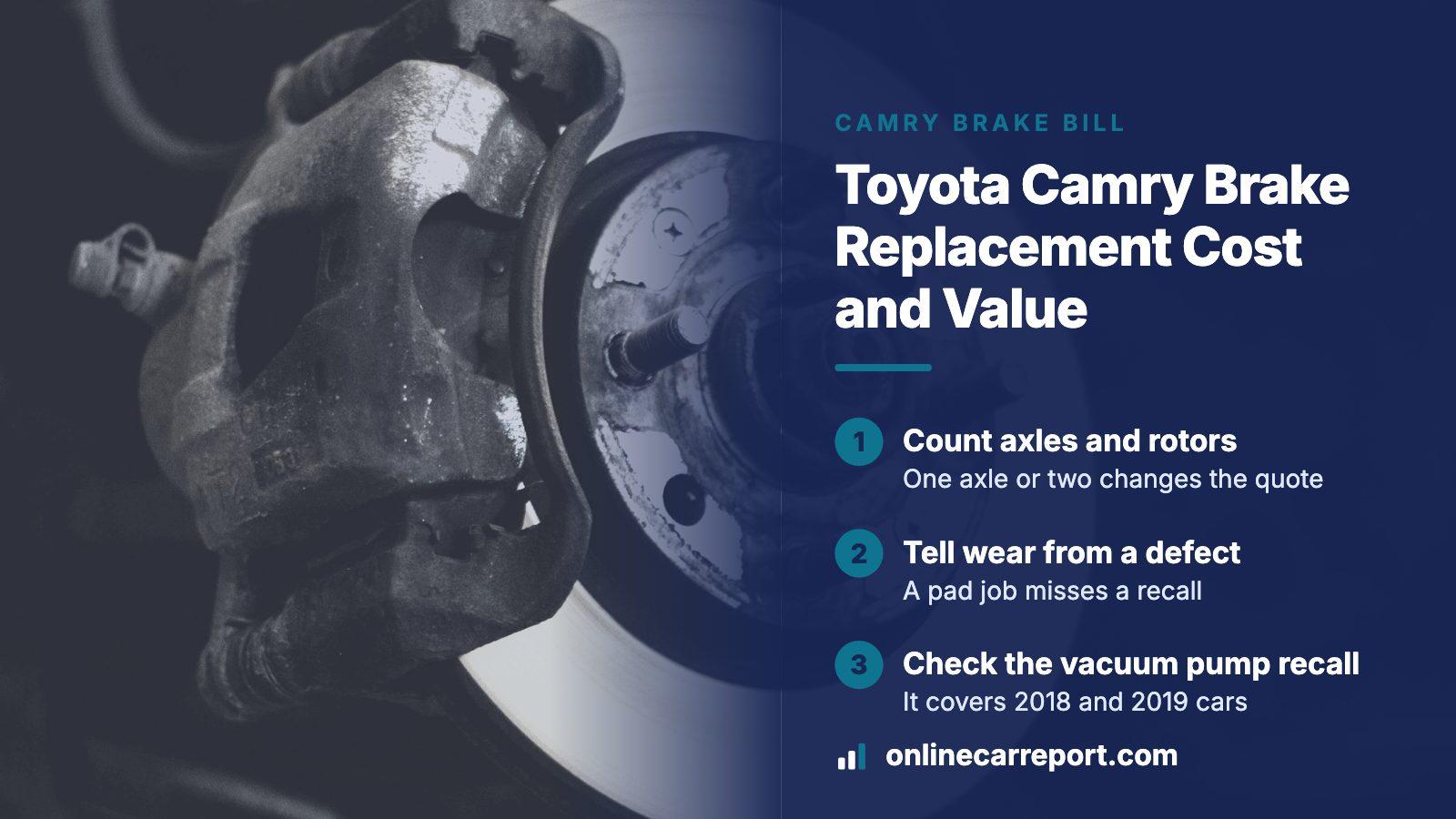
Plan on roughly $304 to $368 for Camry brake pads at RepairPal, or $276 to $346 on Kelley Blue Book's 2022 page, per axle and before rotors. A warning light or a hard pedal changes the job from wear to diagnosis. On 2018 and 2019 cars, check the VIN for open recall 21V-890 before paying anyone for brake work.
- RepairPal pad average
- $304 to $368, before tax
- Kelley Blue Book, 2022 Camry
- $276 to $346 for one axle
- Vacuum pump recall
- 21V-890, 2018 and 2019 Camry
- Rotor average at YourMechanic
- about $377
What the published Camry pad prices say
RepairPal's Camry estimator, dated September 3, 2026, averages $304 to $368 for pads, taxes and fees excluded and no adjustment for your area. Kelley Blue Book prices a 2022 Camry for one northern Virginia ZIP at $276 to $346. OnlineCarReport sells vehicle history reports, not brake jobs, so each figure below belongs to the site that published it.
| Source | What it quotes | Amount |
|---|---|---|
| RepairPal, Camry average | Whole pad job | $304 to $368 |
| RepairPal, same page | Labor, then parts | $122 to $179, then $182 to $189 |
| Kelley Blue Book, a 2022 car | Parts, then labor | $96 to $113, then $179 to $210 |
| YourMechanic, one 2016 example | Front pads, shop or dealer price | $360.00 to $483.54 |
One axle, two axles, and the rotor question
Both big estimators price a single axle, so a Camry that needs front and rear pads costs about double what the headline suggests. Rotors sit on top of that. YourMechanic puts a Camry rotor job at about $377, with about $209 of it parts, and its mechanic-network quote for those 2016 front pads was $316.12.
A rotor that still measures above the minimum thickness stamped on it can take fresh pads. Ask to see the reading. If the quote swaps rotors, the shop should be able to say why in numbers rather than in adjectives.
Pad wear is one thing, a brake defect is another
Drivers burn through pads at very different rates, and nobody files a federal complaint because friction material ran thin. NHTSA's brake complaints describe other trouble: lights that stay on, a pedal that sinks or turns stiff, long stopping distances. Those reports point to a few Camry model years, and a pad quote written for such a car may be fixing the wrong thing.
That matters to a buyer because the problem travels with the VIN. A recall completed at the dealer is a clean mark. A defect left alone is a cost the next owner inherits, and a sensible offer accounts for it.
2018 and 2019: the vacuum pump recall
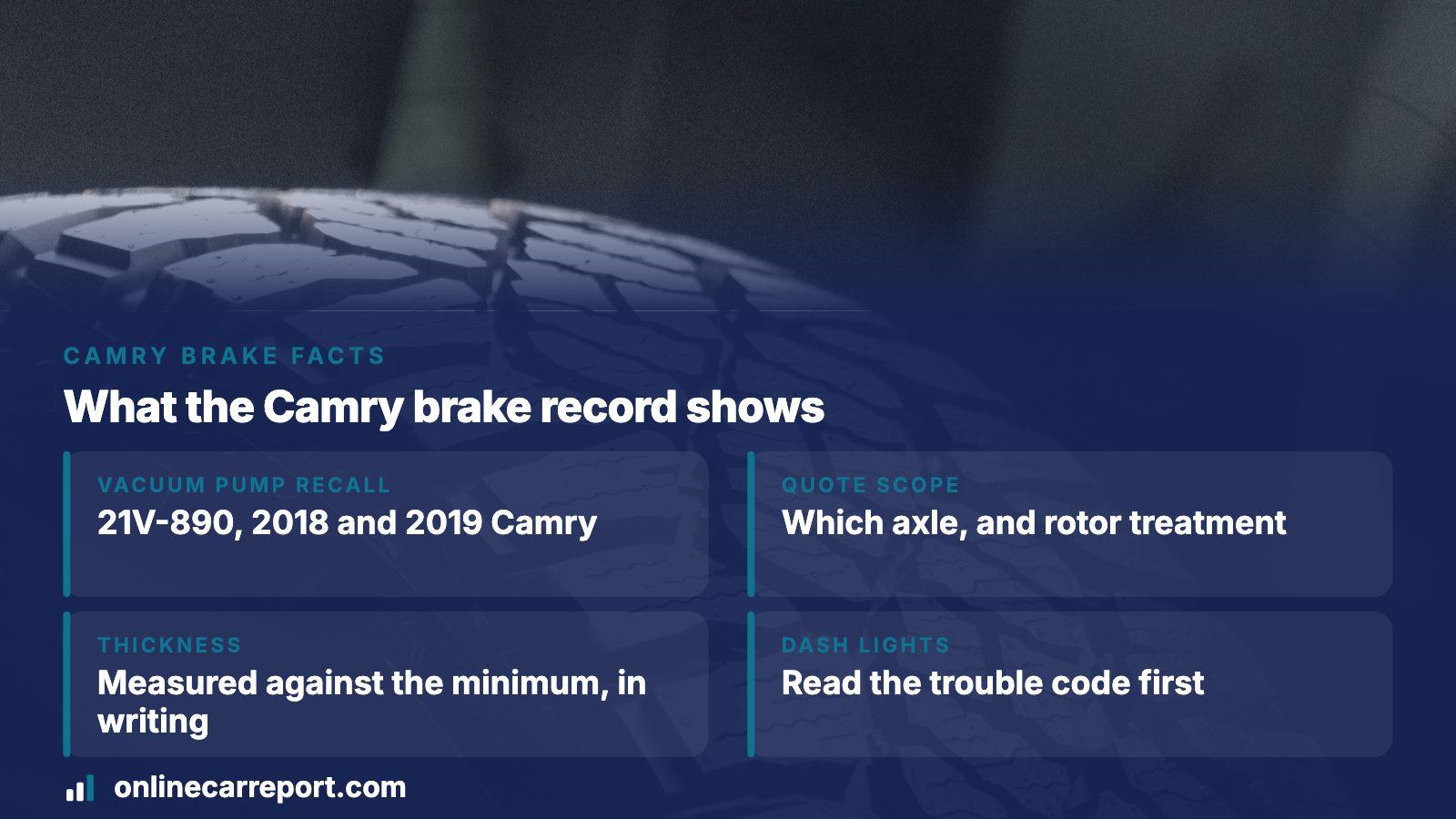
Recall 21V-890, filed by Toyota, reaches roughly 227,490 Camrys built for model years 2018 and 2019. A vane cap in the brake vacuum pump can wear early, break, and stop the pump from helping the booster, so the pedal gets heavy. Toyota's report warns that braking performance could drop suddenly before any warning shows. The dealer checks the pump and fixes or swaps it without billing the owner. U.S. Toyota hybrids carry no such pump, so the recall is a gas-car matter.
From an NHTSA owner complaint
A 2019 Camry owner reported a low-brake-power alert and trouble stopping. Its dealer blamed the brake booster. The owner added that a similar recall existed but left this car out. Another 2019 owner, at 46,000 miles, described a car that would not start, with a brake system warning and a mushy pedal. That owner also said the VIN was outside the recall.
Take from this that a recall number settles less than it seems to. Check the VIN, and if it comes back clear while the symptoms match, expect a paid repair and price it into any deal.
2007 to 2011: the hybrid brake actuator
NHTSA opened an evaluation of the first Camry Hybrid's brake actuator in January 2014. In its closing summary the agency noted repair costs above $3,000 in some owner complaints. Toyota's answer, a warranty enhancement program covering about 177,500 hybrids, lasted a decade from first use, or 150,000 miles if that came sooner, so it is over on every car. An actuator failure on one of these today is the owner's bill.
From an NHTSA owner complaint
A 2009 Camry owner wrote that the ABS light came on, the actuator pump made loud noises and the brakes sometimes locked up, off and on for a few years. The owner said Toyota had issued a service announcement but no recall. The complaint does not state a repair cost.
If a car from these years shows a brake or ABS light, treat the actuator as a possible price drop of its own and ask for the repair history before agreeing on a number.
2015: a booster bulletin and no recall
The 2015 Camry shows a quieter pattern. Toyota's bulletin T-SB-0010-15 covers 2.5-liter cars that set trouble code C1441 with a flickering brake warning light, and the repair is a newer-design booster, with 2.5 hours of labor on the bulletin. It sat under the basic 36-month or 36,000-mile warranty, and no recall exists, so the work is now paid for by the owner.
From an NHTSA owner complaint
A 2015 Camry owner described a pedal that dropped to the floor after an odd sound, with no warning light. The dealer thought the master cylinder and the pump could both need replacing. The owner did not go ahead because of the cost, at about 82,600 miles.
A car like that is a project for the next buyer, which is exactly why its price should reflect it.
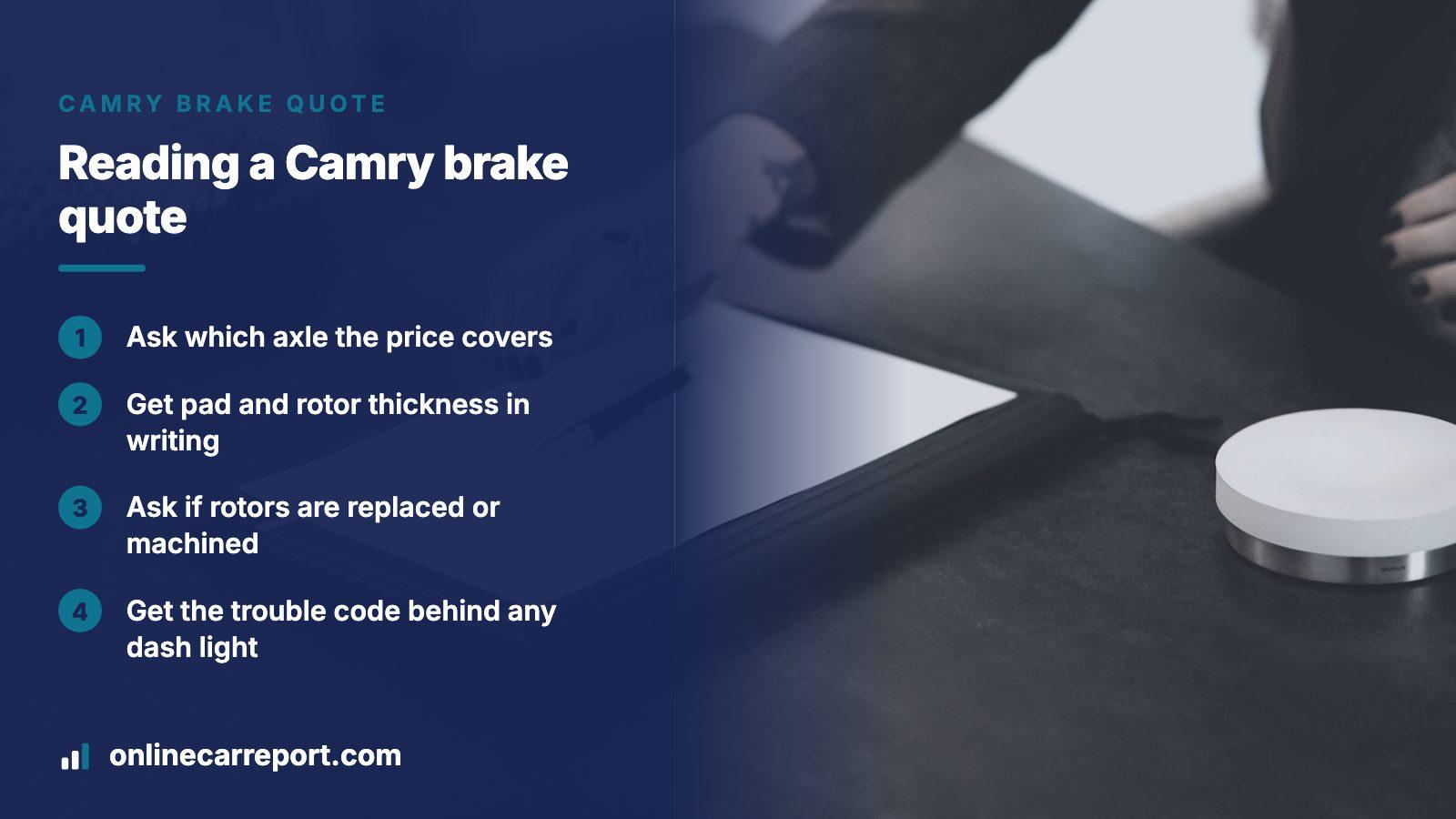
Going through an estimate item by item
- Which axle the price covers, and whether the other one was measured
- Pad and rotor thickness against the minimum, in writing
- Whether rotors are being replaced or machined, and the reason given
- On 2018 to 2022 cars that squeal, Toyota's updated front fitting kit, part 04947-06130
- On a car with a console parking-brake switch, how the rear calipers get retracted
- The trouble code behind any dash light, before any part is ordered
The last item is the one to insist on. A shop that quotes pads for a car showing a brake warning has skipped the diagnosis, and the bill tends to grow once it catches up.
How brake history shows up in a Camry's value
Fresh pads add almost nothing to what a Camry is worth, since buyers expect them. What moves value is the pattern around them: an open recall, an actuator or booster repair that was skipped, a warning light a seller cleared before the test drive. The same model year can price very differently depending on that record.
Run the VIN's preview before you negotiate. The full report brings open recalls together with odometer readings, accident and damage records and market value, so a brake concern can be weighed against the car's other history. The preview costs nothing, and the full report is one payment.
Where this information comes from
- RepairPal: Toyota Camry brake pad replacement cost — the $304 to $368 average and its labor and parts split
- Kelley Blue Book: 2022 Toyota Camry brake repair prices — per-axle range for one ZIP code
- NHTSA: Toyota Part 573 recall report 21V-890 — population, pump defect and the hybrid exclusion
- NHTSA: Preliminary Evaluation PE14001 — the hybrid actuator investigation and its repair-cost remark
- NHTSA owner complaint 11613878 — owner experience, paraphrased
- NHTSA owner complaint 11455295 — owner experience, paraphrased
- NHTSA owner complaint 11686874 — owner experience, paraphrased
Sources and photos: Facts checked against the sources above in November 2026. Photos by Benjamin Brunner, Annika Wischnewsky and Rob Wingate on Unsplash; diagrams by OnlineCarReport.
Keep reading
- Car value by VIN: what the number tells you and how history moves itSee how a VIN's history feeds into what the car is worth.
- Toyota Camry alternator replacement cost and what it does to valueAnother Camry repair that can look like something else.
- Toyota Camry water pump replacement cost and what it means for valueThe cooling-side repair that shows up on older Camrys.
- Toyota Camry Hybrid battery replacement cost, and what it does to the car's valueThe hybrid-only cost to weigh next to brake faults.
Frequently asked questions
What do Camry pads cost to replace?
RepairPal averages $304 to $368 before tax, with labor near $122 to $179 and parts near $182 to $189. Kelley Blue Book's 2022 page shows $276 to $346 for one axle. Rotors, calipers and a second axle add to the total, so get the quote itemized.
Should I replace the rotors with the pads?
Only when they measure below spec or show damage. A rotor above the minimum thickness stamped on it can take new pads. YourMechanic lists about $377 for a Camry rotor job, so ask for the thickness reading before agreeing to the extra work.
Which Camry years have real brake problems?
Owner complaints cluster in 2008 to 2010, mostly around the hybrid brake actuator, and in 2018 to 2019, the vacuum pump years. The 2015 car has a booster bulletin. These are defect reports, separate from ordinary pad wear.
Does the Camry have a brake recall?
Yes, for some cars. Recall 21V-890 covers 2018 and 2019 Camrys with a vacuum pump that can fail, and dealers repair it without charge. Whether yours is open depends on the VIN, and some owners report symptoms on cars outside the recall.
Does a brake repair lower a Camry's resale value?
A routine pad job does not. A repeated fault, a skipped recall or a warning light the seller ignored can. Buyers compare the repair story against the VIN record, so keep invoices and check that open recalls were completed before you list the car.
Now check the car itself
The guide explains what to look for. The report shows what this VIN has on record.