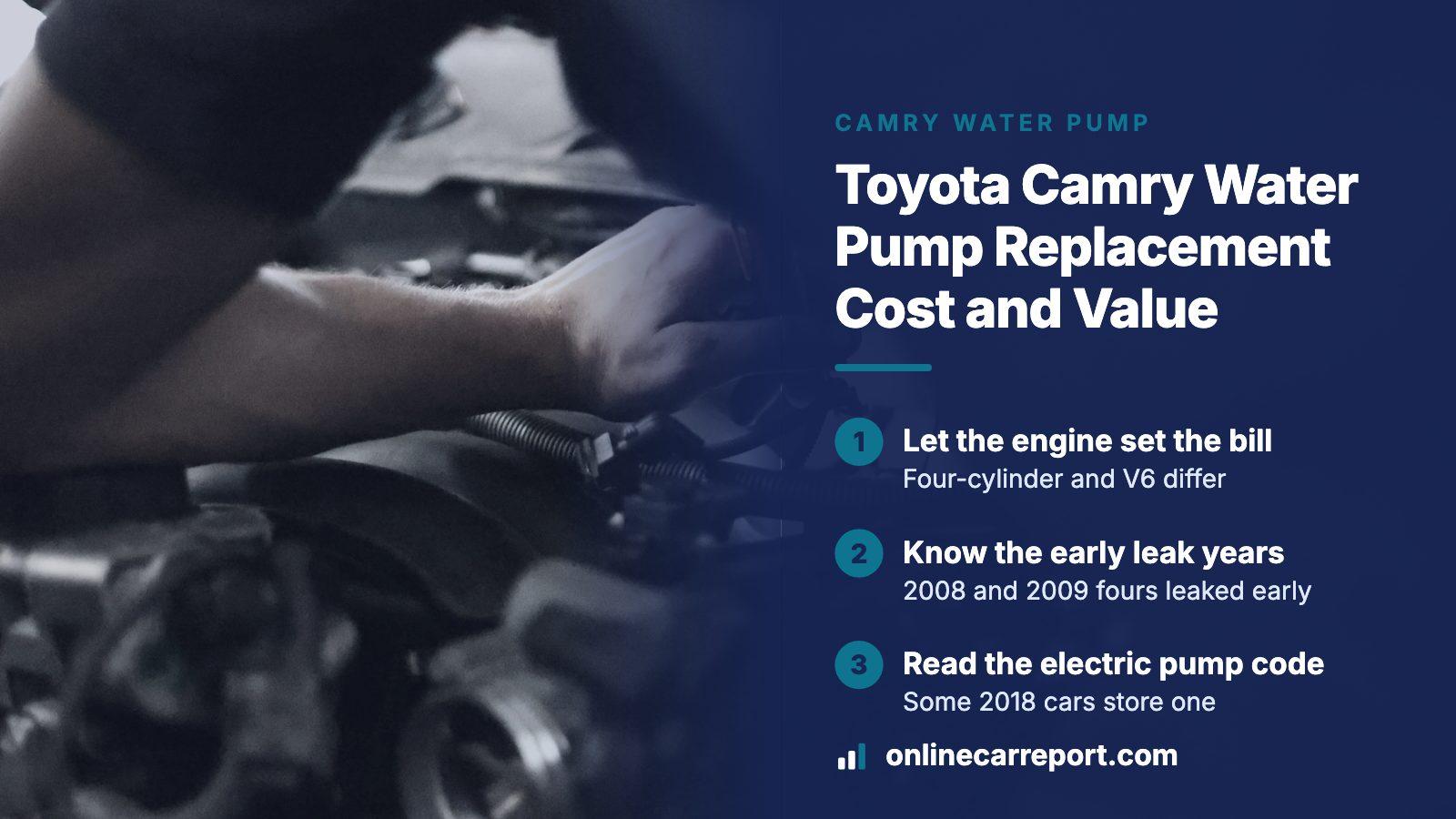
THE SHORT ANSWER
RepairPal averages $625 to $807 for a Camry water pump, split roughly between $313 to $460 of labor and $311 to $347 of parts. The 3.5-liter V6 sits at the top because the pump is buried, and 2018 and newer four-cylinders carry an electric pump with its own failure code. No recall replaces a Camry pump. Ask for the receipt on any car you are pricing, because a recent pump is worth something and a missing one is a bill waiting.
- RepairPal average
- $625 to $807, labor $313 to $460
- 2025 and 2026 cars
- $836 to $1,052 as listed
- Electric pump code
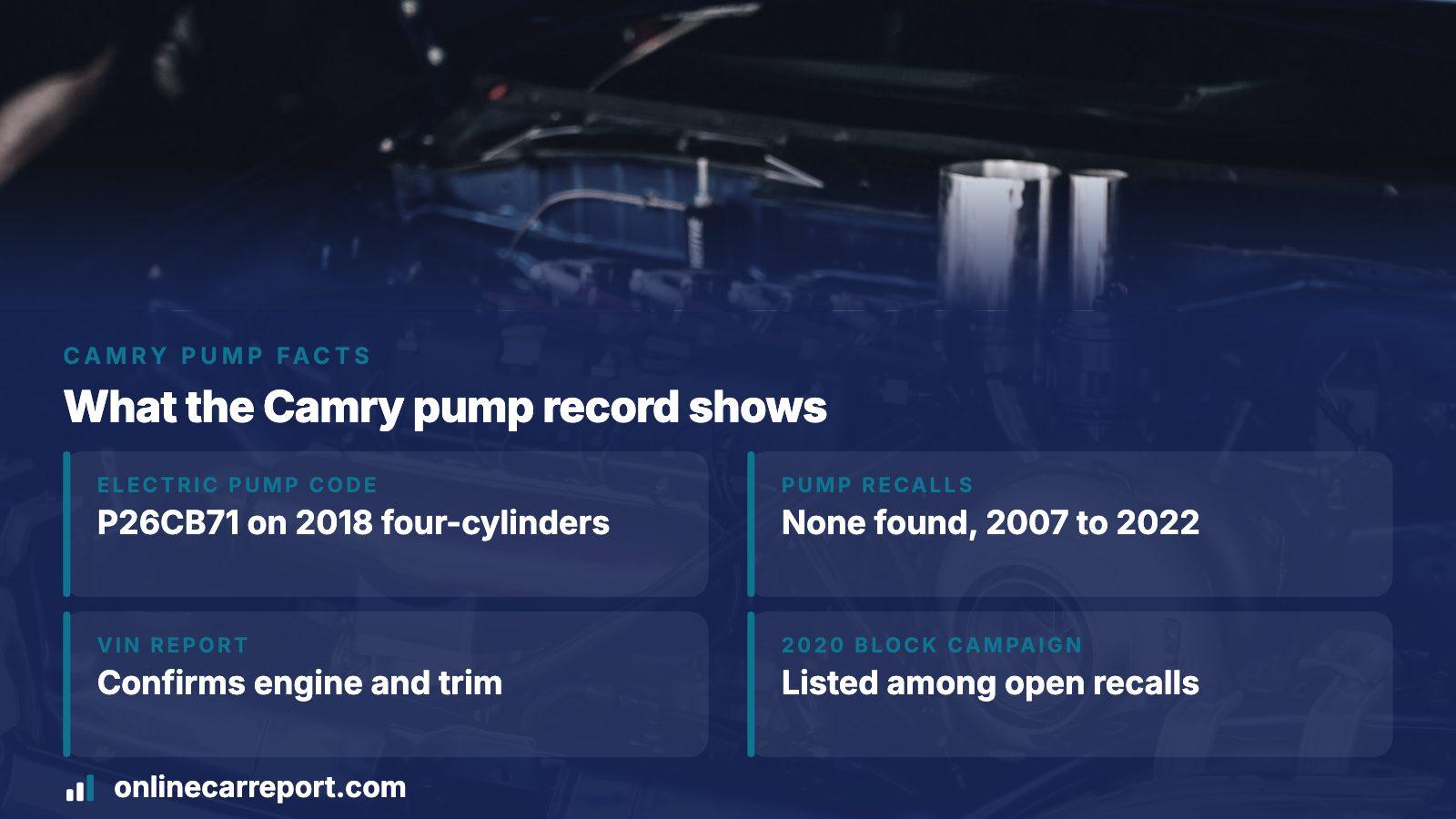
- P26CB71 on 2018 four-cylinders
- Pump recalls
- None found for 2007 to 2022
What the estimators list for a Camry pump
OnlineCarReport sells vehicle history, not repairs, so every dollar figure below belongs to the company named beside it. RepairPal's Camry estimator is the most specific, and it was read in late October 2026.
| Source | What it shows |
|---|---|
| RepairPal, all years | $625 to $807 on average |
| RepairPal, labor line | $313 to $460 |
| RepairPal, parts line | $311 to $347 |
| RepairPal, 2022 and 2023 | $781 to $981 |
| RepairPal, 2025 and 2026 | $836 to $1,052 |
Parts are close to labor here, which is unusual for a repair that can swing so far. The spread comes from how many hours the shop needs to reach the pump, so the first thing to settle with any quote is which engine your car has.
The engine decides the bill
Across the 2008 to 2022 model years, the gas Camry came with three engine families, and the pump differs on each. The model year narrows it down, and the VIN confirms it.
| Engine and years | Where the pump is |
|---|---|
| 2.4-liter or 2.5-liter four, 2008 to 2017 | Bolted on the front, spun by the serpentine belt |
| 3.5-liter V6, 2008 to 2017 | Belt driven but buried behind a bracket, idlers and the tensioner |
| 2.5-liter four, 2018 to 2022 | Electric pump run by the engine computer |
| 3.5-liter V6, 2018 to 2022 | Not confirmed from a Toyota document |
Toyota's 2008 manual for the V6 begins its pump procedure by taking out the engine and transaxle. Owners describe shorter routes, but the depth of the job explains why a V6 quote can run well past the four-cylinder average. Every one of these engines uses a timing chain, so a quote that adds a timing belt kit to a 2008 or newer Camry is pricing the wrong car.
Early leaks on 2008 and 2009 fours
NHTSA's complaint file for the 2008 and 2009 Camry carries dozens of entries naming the pump, many at modest mileage. The agency has no separate water pump category, so these sit under the engine heading, and they are an owner's account rather than a count of failures.
From an NHTSA owner complaint
A 2009 Camry owner in Georgia went in for an oil change at just over 50,000 miles, mostly highway driving, and was told the pump leaked and needed replacing. The dealer quoted about $530. The owner never saw a drip at home, left the old part behind, and wrote that they could not tell whether the charge was fair.
The lesson is practical. A leak can be real and still invisible at home, so ask to see the weeping pump or the crusted coolant, and keep the old part and the invoice. That paperwork is also what makes the repair count when you sell.
The 2018 electric pump and its warning code
The 2018 redesign brought a 2.5-liter four with an electric pump. Bulletin T-SB-0323-17 from Toyota addresses certain 2018 four-cylinders that set code P26CB71, named Electric Water Pump Speed Stuck. Its fix is an engine computer reflash taking 0.4 hours, and the bulletin ties it to the federal emission warranty of 96 months or 80,000 miles.
From an NHTSA owner complaint
A 2018 Camry owner reported the check-engine lamp, stored code P26CB71 and a dealer quote of $1,257.81 for a stuck pump actuator. The owner cited the bulletin and said the dealer would not honor the emission coverage. How it ended is not in the record, and the bulletin applies only to cars built before a production change.
From an NHTSA owner complaint
Another 2018 owner, with 32,465 miles, said the car stopped on a six-lane road with no earlier warning. The pump, thermostat and gaskets were replaced for $1700, and Toyota offered nothing after a call and a letter.
Two reports are not a pattern, but they show what to ask. Before paying for a 2018 pump, have the code read and compared with the bulletin, and ask the dealer in writing whether the car qualifies.
No recall for the pump, but two nearby ones
NHTSA's recall data for the Camry and Camry Hybrid from 2007 through 2022 returned nothing that mentions a water pump. It did return two cooling-adjacent campaigns. Campaign 20V064000 covers some 2020 Camrys fitted with the 2.5-liter engine, where porous block castings can leak coolant, and 18V200000 covers certain 2018 cars with oversized pistons.
A coolant puddle under a 2020 car may be the recalled block, and that repair is free. The 2008 and 2009 owners above were also not covered by any pump recall, only by whatever warranty was left. Running the VIN through NHTSA's lookup takes a minute and should come before any pump purchase.
How a pump repair moves a Camry's value
A water pump is a wear item, so a car past 100,000 miles with a receipt for one has shed a known risk. That is worth more on a V6, where the next job costs the most, than on a four. A dealer invoice naming the engine and date reads better than a verbal promise.
The opposite case matters just as much. A 2008 or 2009 car with high mileage and no record of a pump or coolant service should be priced with a repair in mind, using the estimator ranges above. Overheating history is the real worry, since a pump that failed under load can leave the engine damaged in ways a simple swap does not fix.
Repairs do not move value alone. Accident records, a title brand, odometer rollbacks and open recalls all weigh on the same asking price, which is why our value-by-VIN pages treat the pump as one line among several.
What a VIN report adds, and what it does not
Start with the no-charge OnlineCarReport preview, which shows what the VIN decodes to. The full report is a single payment with no subscription, priced on the pricing page. For a Camry buyer it does three useful things around a pump question.
- It confirms the engine and trim, so you know which row of the table above applies.
- It lists open recalls, including the 2020 block campaign.
- It shows odometer readings, accident and damage records and any title brand, which tell you whether an overheating story could be hiding behind a clean-looking engine.
It cannot tell you that a pump was replaced, because a repair shop's invoice is not a title or crash record. For that, ask the seller for receipts and book a pre-purchase inspection.
Reading a Camry pump quote
Two quotes for the same car usually differ by one or two lines. Ask each shop the same list:
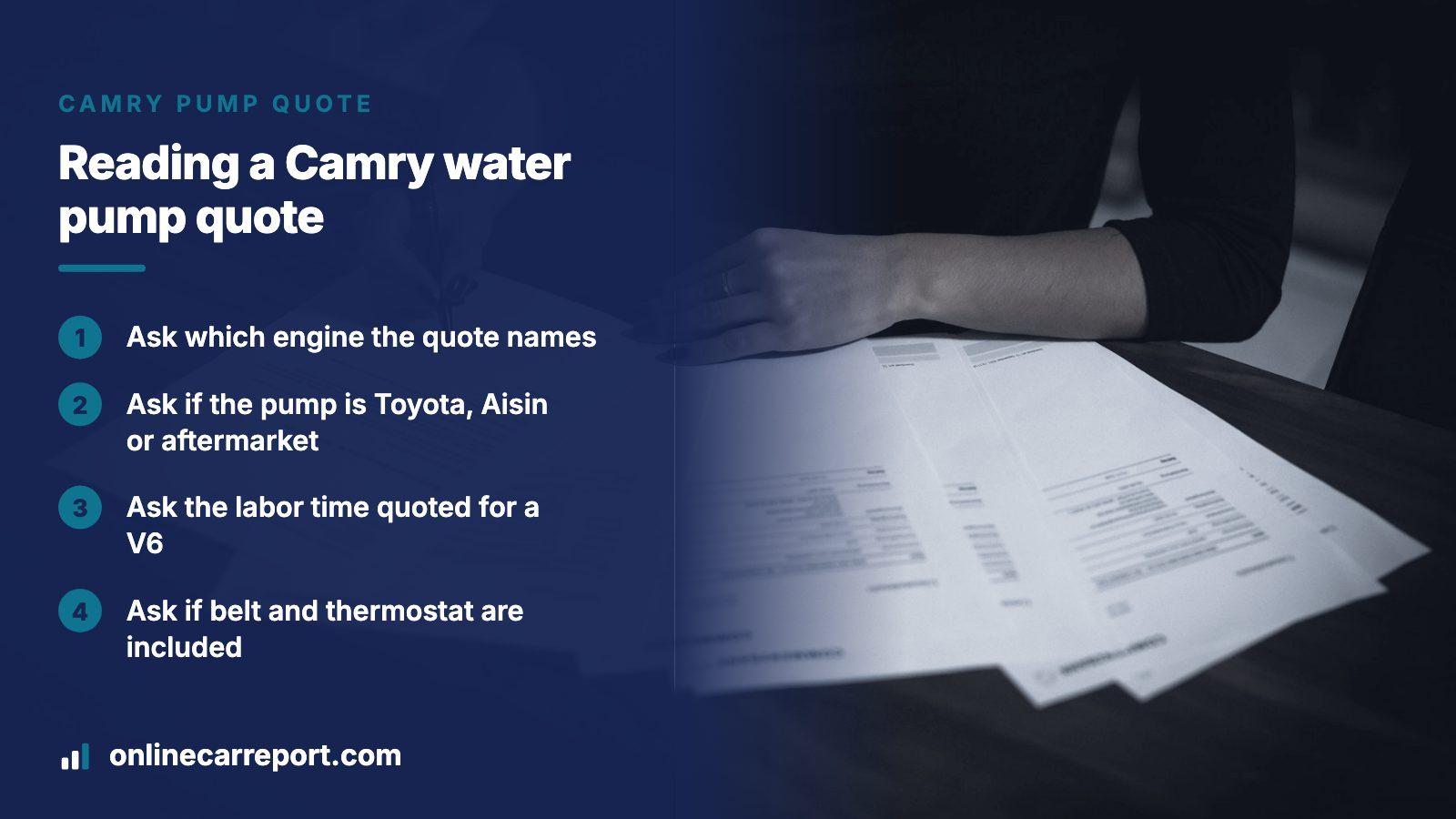
- Which engine does the quote name, and does the part number fit it?
- Is the pump original Toyota or Aisin equipment, or aftermarket, and what is the warranty?
- For a V6, what labor time is quoted, and is the engine staying put?
- Are the belt, idlers and thermostat included while the front of the engine is open?
- On a 2018 four-cylinder, was the stored code read before a part was ordered?
Where this information comes from
- Toyota T-SB-0323-17 (NHTSA-hosted) — the electric pump code, the reflash and the 96-month or 80,000-mile coverage
- NHTSA recalls API: 2020 Camry — campaign 20V064000 and the absence of any pump recall
- NHTSA owner complaint 10897269 — owner experience, paraphrased
- NHTSA owner complaint 11703097 — owner experience, paraphrased
- NHTSA owner complaint 11766991 — owner experience, paraphrased
- RepairPal: Camry water pump estimate — the average and the labor and parts split
Sources and photos: Facts checked against the sources above in November 2026. Photos by Mustafa Sheikhmouss, Dimitri Karastelev and Willian Cittadin on Unsplash; diagrams by OnlineCarReport.
Keep reading
- Toyota Camry alternator replacement cost and what it does to valueanother front-of-engine Camry job where the V6 costs more
- Toyota Camry Hybrid battery replacement cost, and what it does to the car's valuethe larger repair bill on a hybrid Camry
- Toyota Camry brake replacement cost, and what brake history does to valuea routine Camry cost to weigh against the pump
- Car value by VIN: what the number tells you and how history moves ithow history records change what a car is worth
Frequently asked questions
How much does a Toyota Camry water pump replacement cost?
RepairPal lists $625 to $807 on average, with $313 to $460 of that as labor and $311 to $347 as parts. Its listing for 2025 and 2026 cars is $836 to $1,052. A V6 usually costs more because the pump is harder to reach, so get a written quote that names your engine.
Why is the V6 pump job more expensive?
Access. On the 3.5-liter engine the pump hides behind an engine bracket, two idlers and the tensioner, and Toyota's 2008 manual starts the job by removing the engine and transaxle. The part itself costs about the same as on a four-cylinder, but the hours do not.
Is the Camry water pump electric?
Yes on the 2018 and newer 2.5-liter four. Bulletin T-SB-0323-17 deals with certain 2018 cars that set code P26CB71, and the fix is a computer update. Earlier Camrys use a belt-driven pump, and the pump type on the newer V6 is not confirmed here.
Is there a recall on Camry water pumps?
None that we found. NHTSA's recall data for the Camry and Camry Hybrid from 2007 through 2022 has no campaign naming the pump, though it does list a 2020 engine block recall for coolant leaks. Check your own VIN with NHTSA before paying for a repair.
Does a new water pump raise a Camry's value?
It removes a known cost, and a dated receipt helps a seller, especially on a high-mileage V6. It does not offset accident damage, a title brand or an odometer problem, which move the price more. A VIN report shows those records, though not the repair itself.
Now check the car itself
The guide explains what to look for. The report shows what this VIN has on record.