THE SHORT ANSWER
A VIN cannot price a trailer by itself. A decode can give the builder, what kind of trailer it is, its body type, length and axle arrangement, as the maker filed them, which is enough to compare like with like. The price comes from similar trailers for sale or sold. The history then sets your discount: a branded title, damage in auction photos, a lien, a theft entry or an open recall each justify paying less.
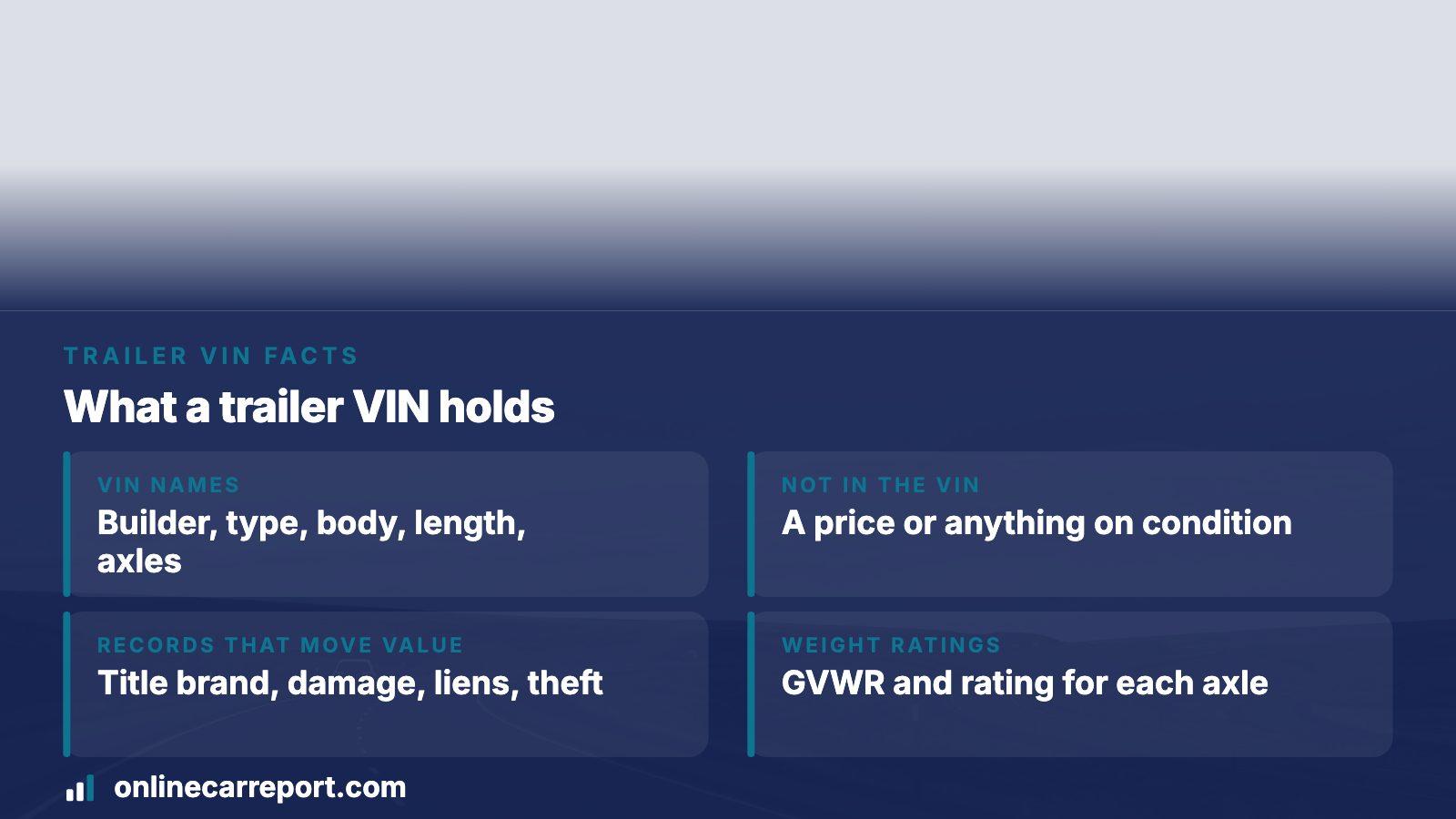
- What the VIN names
- Builder, trailer type, body, length, axle layout
- What it does not hold
- A price, or anything about condition
- Records that move value
- Title brand, damage, liens, theft, recalls
- Preview
- Free; the full report is one payment
What a trailer's 17 characters actually hold
Federal rules give trailers their own VIN recipe. The first three characters point to the builder, and a small shop making fewer than 1,000 of a type a year borrows characters twelve to fourteen to finish its identifier. The builder chooses the code for the middle block but must give NHTSA the key, so a decode is only as good as what that builder filed.
| Characters | What they carry | Why a buyer cares |
|---|---|---|
| 1 to 3 | Builder and vehicle type | Shows who made it, and who answers a recall question |
| 4 to 8 | Trailer type, body, length, axle arrangement | Places the unit among comparable trailers |
| 9 | Check digit | A mismatch means a typo or a non-standard number |
| 10 | Model-year code | Lets you test the seller's year against the label |
| 11 to 17 | Plant and serial number | Digits at the end; nothing here prices or grades the trailer |
Where the price comes from, since the VIN holds none
The number sorts a trailer into a group, and price gets set inside that group. Compare units that match on type, length, axle count and age, then adjust for the shape yours is in. The certification label holds the inputs for that search.
- Build month and year, which can sit a calendar year away from the model-year code.
- Gross vehicle weight rating, the most the builder allows for trailer plus load.
- Gross axle weight rating for each axle, the most each one is rated to carry.
- The builder's name, or a dealer-builder's name marked as the responsible maker.
Paint and accessories rarely move an offer. Tires, brakes, lights, gate hardware and frame condition do, because each costs real money to fix.
How recorded history takes money off the comparable price
A comparable listing assumes an ordinary past. The record shows whether this trailer had one.
- A salvage, rebuilt or flood brand on the title, which stays on the record and shrinks the pool of buyers.
- Damage and auction entries with photos, which can show a bent frame or crushed corner that fresh paint covers.
- A lien, meaning a lender may still hold a claim after you pay the seller.
- A theft or impound entry, which should pause everything until the seller accounts for it.
- An open recall, which is a repair to schedule before you tow the trailer.
Coverage needs a warning. A trailer can have a thin record, and an empty result then means nothing is on file, not that the trailer is clean. The federal title-record system builds its reports on five indicators and says private providers add items it lacks, such as repair and recall information.
Recalls: the record every trailer buyer can look up
NHTSA's recall data includes trailers, and the entries read like car recalls with different parts: gate latches, spare tire mounts, tire sidewalls, couplers, axle brackets. One Haulmark campaign covered 2,227 car haulers whose axle-bracket welds could crack.
From an NHTSA owner complaint
The owner of a 2013 Big Tex utility trailer reported that both rear gate locks sheared off at 65 miles per hour on a New Jersey highway. The gate swung open and the furniture he was hauling spilled into the road. The dealer he bought it from told him afterward that this was a known recall issue, and he says nobody mentioned it at the sale and no letter ever reached him.
NHTSA's record holds a Big Tex campaign on that kind of part, 13V508000: ramp gate latches on utility trailers built from March through September 30 of 2013. Dealers fit a supplemental latch free of charge. Whether a campaign applies depends on the build, so look up the VIN before paying and agree who books any repair.
What a clean record still cannot show
Welds, axles and tires wear out where no database can see. A trailer with no brand, no auction photos and no recall can still be a pile of tired metal.
From an NHTSA owner complaint
The owner of a 2021 Aluma trailer brought it in to have one broken fender weld redone. That afternoon the dealer phoned to say 20 points on the trailer had broken and that it was unsafe to use. The owner says he had told the maker and sent photos.
Treat that as two separate jobs. The VIN check covers what got recorded. A hands-on look, ideally by a trailer shop, covers what never did: welds at the tongue and axle brackets, tire sidewalls and date codes, brakes and lights with a tow vehicle hooked up, and any gate hardware.
Running the check on a trailer, step by step
- Walk to the left side of the trailer, toward the hitch end, and find the certification label. Builders have to attach it so that removing it destroys it, so a missing or painted-over label is a question for the seller.
- Photograph the label and copy the VIN. Count 17 characters. Federal VINs skip the letters I, O and Q, so anything shaped like one is a misread. Compare the result with the title or registration.
- Note the build month and year, the weight rating and the axle ratings. Those are your matching figures.
- Enter the VIN for the preview, which counts the title and auction records and open recalls on file and costs nothing.
- If entries show up and the trailer is still on your list, buy the full report and read each entry against the seller's story.
- Price the trailer from similar units, subtract for the record, and inspect before any money moves.

Reading the result: red flags and ordinary quirks
| What you see | What it usually means |
|---|---|
| Model-year code a year off the label's build date | Ordinary. Model year is the maker's label, and the label shows when work finished |
| A dealer-builder's name marked as responsible maker | Allowed for trailers; ask who handles any recall |
| I, O or Q in the VIN, or too few characters | A misread or a non-standard number; recheck first |
| Branded title entry | Price it as a damaged unit and expect a smaller pool of buyers |
| Lien still listed | Get a payoff letter and a release in writing before money moves |
| Open recall | Ask who books the repair; in the NHTSA entries read here, the fix was free of charge |
| No records at all | Nothing on file, which proves nothing; lean harder on the inspection |
No single line decides it. Add the entries up against the comparable price, and walk away if the seller cannot account for a theft, impound or lien entry.
Cost, and the order to work in afterward
The preview carries no charge and shows what is on file before you commit. After that the report is paid for once, either one report or three, five or ten at a time, and no subscription follows. The pricing page lists rates.
Where the report prints a market figure for a trailer, use it as a reference point and test it against live listings, never as the price. Then match units, deduct for the record, and put your own eyes on the frame, axles and tires. Ask the seller in writing what comes with the trailer, and collect any lien release before paying.
Where this information comes from
- eCFR 49 CFR 565.15: VIN content requirements — The federal table of what a trailer VIN must describe, from builder to model-year code.
- eCFR 49 CFR 565.13: VIN general requirements — Seventeen characters, the check digit in position nine and the letters a VIN may not use.
- eCFR 49 CFR 567.4: Certification label — What a trailer's label must show and where on the trailer it goes.
- NMVTIS: Understanding a vehicle history report — The five indicators a federal title-record report rests on, and what private providers add.
- NHTSA recall data: Big Tex ramp gate latch campaign — Where the 2013 campaign, its build window and the free latch fix are on record.
- NHTSA owner complaint 10703889 — owner experience, paraphrased
- NHTSA owner complaint 11461356 — owner experience, paraphrased
Sources and photos: Facts checked against the sources above in November 2026. Photos by Zoshua Colah, Owen Michael Grech and John Kakuk on Unsplash; diagrams by OnlineCarReport.
Keep reading
- Camper value by VIN: what it can price and how history moves itTravel trailers and motorhomes follow their own pricing rules, and the VIN reaches only part of them.
- VIN truck value: what the VIN prices and what a truck's history takes offIf the trailer comes with a tow truck, here is how that truck gets priced from its VIN.
- Car value by VIN: what the number tells you and how history moves itThe baseline guide to how a vehicle's recorded history moves its value.
- Sample reportSee how title, damage and auction entries are laid out before you pay.
Frequently asked questions
Can I find a trailer's value from the VIN alone?
Not a dependable one. The VIN says what the trailer is and links to its record, while value comes from matching units and condition. Treat any single number as a starting point to test against live listings.
Do utility trailers have a VIN?
A trailer built by a maker carries a 17-character VIN that the maker assigned, with a label showing it. A kit trailer counts too, and the kit fabricator may be named as the manufacturer. For one built from scratch, ask your state's motor vehicle agency what number it issues.
Is the model year the year the trailer was built?
Not always. The model-year code is the maker's label for the model, and a production run can stretch across more than one calendar year. The certification label gives the month and year the work finished, so compare both before accepting the seller's year.
Can I check a trailer for open recalls?
Yes. NHTSA's recall data includes trailers, and the federal buying tips send shoppers to NHTSA's website and hotline for recalls. Campaigns are tied to a build window, so go by the VIN, not the make alone. The OnlineCarReport preview also counts open recalls before you pay.
What should I do if a trailer's VIN plate is missing?
Sort it out before paying. Federal rules require a manufactured trailer to carry a maker-assigned VIN and a permanent label, so a missing one suggests a lost, removed or homemade unit. Ask your state agency what titling needs, and price that work in.
Now check the car itself
The guide explains what to look for. The report shows what this VIN has on record.