THE SHORT ANSWER
RepairPal's range for this repair is $2,743 to $3,761, mostly shop time. Taxes and fees come on top. Many owners are quoted a replacement engine instead, which is a different bill. The risk sits with the 2010 to 2015 cars, and no recall names the gasket.
- RepairPal estimate
- $2,743 to $3,761
- Labor share
- $2,080 to $3,051
- Years most affected
- 2010 to 2015
- Recall naming the gasket
- None found
What the published estimate says
RepairPal's Prius estimator gives a head gasket replacement a range of $2,743 to $3,761. Shop time accounts for $2,080 to $3,051 of it, and components for $664 to $709. Taxes and fees are excluded, nothing is adjusted for your location, and the listing was refreshed in September 2026. It is a single published source, so hold it up against a quote rather than treating it as one.
| Cost line | RepairPal range |
|---|---|
| Labor | $2,080 to $3,051 |
| Parts | $664 to $709 |
| Total | $2,743 to $3,761 |
Components are the small number here. Getting at the cylinder head on a hybrid engine wedged under the cowl takes long hours, and those hours drive the bill. A different job also gets confused with this one: a hybrid battery replacement is separate work on a separate system.
A repair bill sits on top of the car's starting value
A gasket bill only makes sense next to what the car is worth. An older third-generation Prius with high miles and a rough record may be worth little more than the repair, while a cared-for one with paperwork may justify it. The starting number depends on trim, odometer reading and what the history shows, which is why value is worth pulling before the shop visit.
Fixing the gasket does not erase the history around it. A buyer who sees an engine swap or a large engine invoice will ask when it happened and why. Keep the diagnosis, the invoice and the test results together, because a documented repair reads as maintenance and an undocumented one reads as a risk. Odometer entries and any accident or title brands on the VIN record help you price the car honestly either way.
Price the car before the repair
Our car value by VIN page shows how mileage, condition and record move a Prius's price. Subtract the quote from that figure to see whether fixing, selling as-is or trading it in comes out ahead.
Which Priuses carry the risk
Trouble concentrates in the third generation, built 2010 through 2015 around the 1.8-liter 2ZR-FXE engine, and the Prius V and plug-in share that engine. In a tally of federal complaint data covering 2008 to 2022, 275 engine complaints could be counted by year, and 232 of them, about 84 percent, fall in those six model years. The 2016 to 2022 cars account for 43.
Read those counts as a minimum. Engine reports only appear in the tally for a year when the engine is among that year's top five components, and the 2010 car drew so many brake complaints that its engine count is unknown. A VIN decode confirms the generation and engine, which tells you whether any of this applies to your car.
Why one failure produces two very different quotes
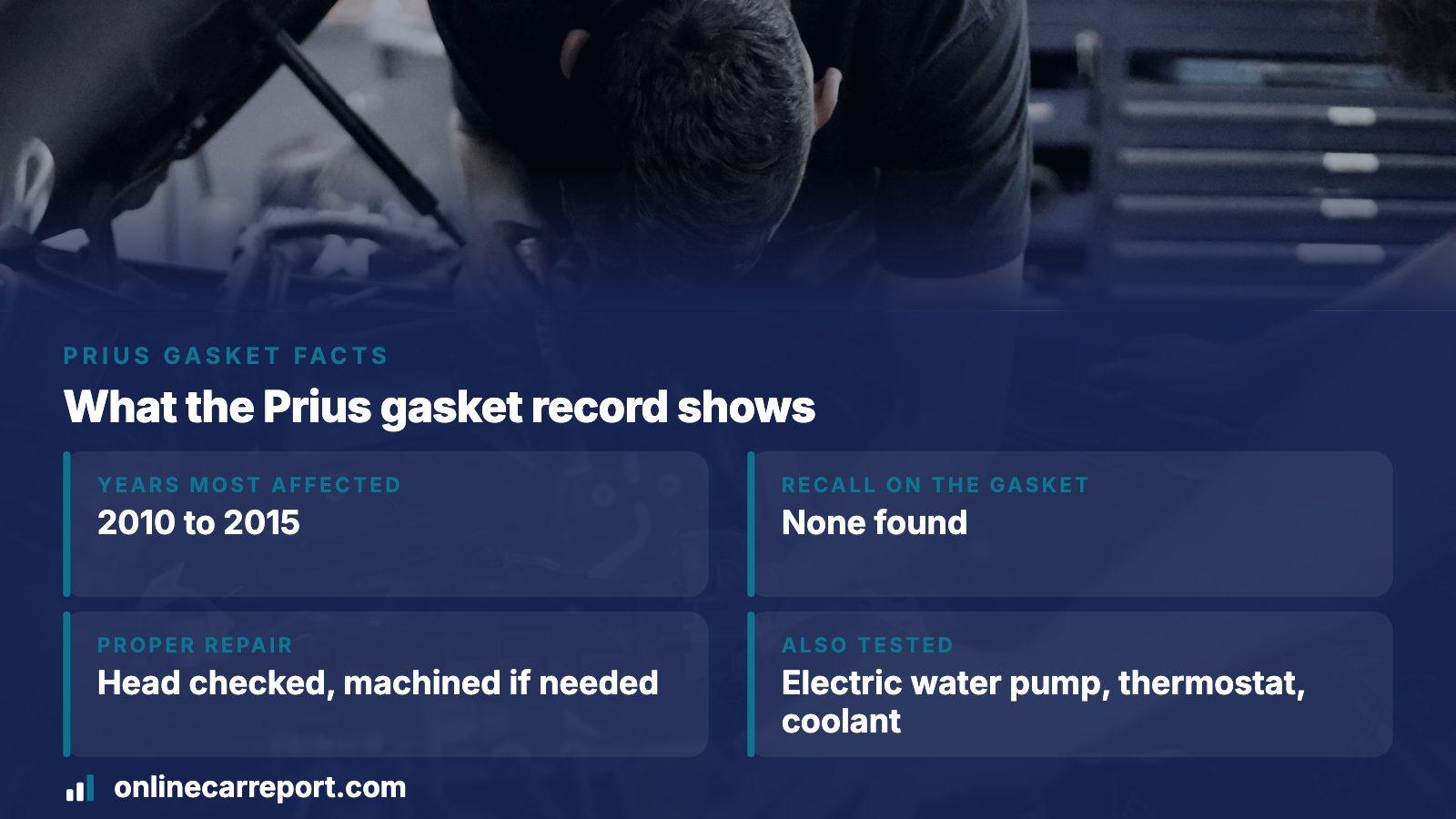
The choice between a new gasket and a new engine usually depends on what else was hurt. Coolant entering a cylinder can wash oil off the bore, and a car run hot may end up with a warped head. If both pass inspection, a gasket job is fair. If not, the gasket price no longer matters.
Toyota's bulletin T-SB-0169-16 shows how deep the work goes. For oil consumption on 2010 to 2014 Prius models, it books 16.6 hours to replace pistons and rings with the head removed. A gasket-only job stops short of that, but much of the teardown overlaps.
- Head checked for flatness and machined if needed
- Cooler, pipe and intake manifold cleared of carbon, not just the valve
- Named cylinders that misfired, with a compression or leak-down result
- Coolant, thermostat and the electric water pump tested
What owners told NHTSA
Complaints filed with NHTSA are first-hand records, and the ones naming a head gasket bunch up in 2010 to 2014 Priuses. Three show how differently it can end.
From an NHTSA owner complaint
One 2011 Prius owner said pulling away felt like driving over rumble strips. The cause was a misfire, which the dealer blamed on a leaking head gasket common to high-mileage third-generation cars. The bill, by the owner's account, was $4,000, and the owner called it a design fault.
From an NHTSA owner complaint
Another owner, with a 2012 Prius II serviced at the dealer, saw the check engine light come on at 151,000 miles. Two cylinders were misfiring and coolant had reached two more, so a new engine was advised. Toyota's customer service said the fault was not theirs.
From an NHTSA owner complaint
A third filing, on a 2014 model, mentions no warning light, only heavy knocking and misfires on two cylinders. A chemical test found combustion gases in the coolant, which settled the diagnosis. The writer had kept up maintenance and later learned the fault is widespread.
The lesson for a seller or buyer is that the failure can arrive without warning and that confirmed test results, not a hunch, separate a gasket from an engine replacement.
Recalls, bulletins and what Toyota covered
We found no recall naming the Prius head gasket. Toyota did write about the EGR system on this engine: bulletin T-SB-0116-15 covers 2010 to 2015 cars that run rough or set misfire codes with EGR active, and its repair is a new intake manifold and EGR pipe gasket. It does not say misfires cause gasket failure.
Toyota's June 2016 program ZF3 reached about 517,900 vehicles with a sticking EGR valve. Once the primary period ended, coverage continued until a decade from first use or 150,000 miles, whichever came first, and paid for the valve alone, not engine damage. Every named car is past that decade now, so a seller's claim of coverage deserves a question.
If you are shopping for a third-generation Prius
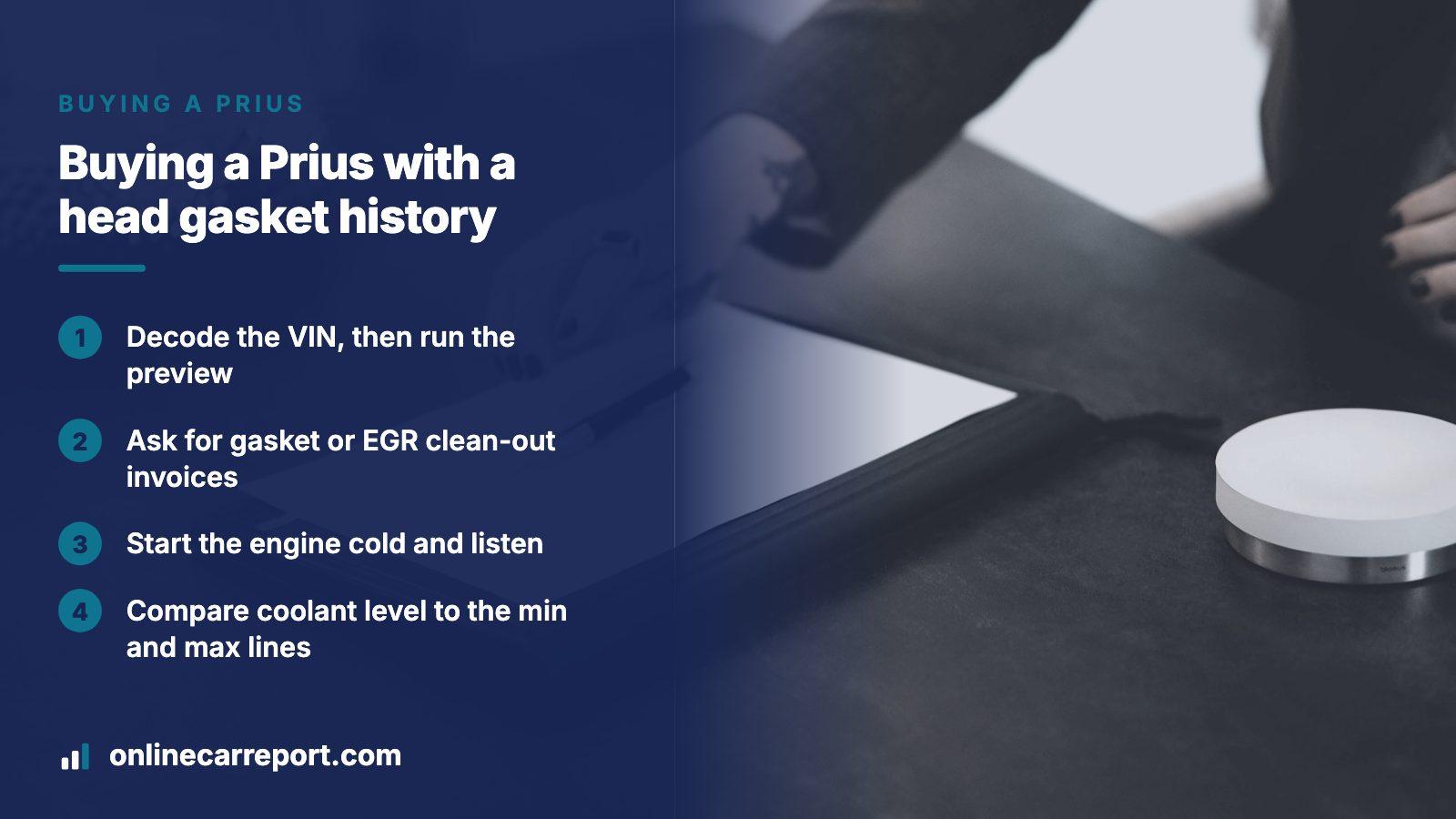
- Decode the VIN for the year and engine, then run the preview of a vehicle history report, which costs nothing.
- Ask for invoices showing a head gasket job or EGR clean-out, and price the car as if neither happened when there is no paperwork.
- Start the engine cold yourself and listen for shaking or rattling in the first seconds.
- Compare the coolant level to the reservoir's min and max lines and look for a dried residue ring higher up the tank.
- If the car passes, buy the full report for odometer readings, accident and title records before you pay.
You pay once for the report, and only the preview costs nothing. It cannot tell you the condition of the engine, but it can show a title brand or an odometer rollback that changes what the car should cost, which no shop test will reveal.
Where this information comes from
- RepairPal: Prius head gasket replacement estimate — The cost range and its labor and parts split.
- Toyota T-SB-0116-15 (NHTSA copy) — Misfire with EGR active on 2010 to 2015 Prius, and the intake manifold fix.
- Toyota T-SB-0169-16 (NHTSA copy) — The oil consumption repair and its labor time.
- Toyota Warranty Enhancement ZF3 (NHTSA copy) — Vehicle count and coverage terms for the sticking EGR valve.
- NHTSA owner complaint 11204529 — owner experience, paraphrased
- NHTSA owner complaint 11319578 — owner experience, paraphrased
- NHTSA owner complaint 11721338 — owner experience, paraphrased
Sources and photos: Facts checked against the sources above in November 2026. Photos by Johnathan Kaufman, Annika Wischnewsky and Mustafa Sheikhmouss on Unsplash; diagrams by OnlineCarReport.
Keep reading
- Car value by VIN: what the number tells you and how history moves itHow a VIN sets the starting value a repair bill gets subtracted from.
- Car trade-in value by VIN number: what a dealer sees and what history changesWhat a dealer may offer when an engine fault is on the table.
- Subaru Forester head gasket replacement cost, and what the job does to the car's valueThe same repair on a boxer engine, priced against its own record.
- Toyota Camry Hybrid battery replacement cost, and what it does to the car's valueThe other costly Toyota hybrid repair, kept separate from the engine.
Frequently asked questions
How much does a Toyota Prius head gasket replacement cost?
RepairPal's estimator shows $2,743 to $3,761 in total. Roughly $2,080 to $3,051 of that pays for labor, and the remaining $664 to $709 buys parts. Tax and shop fees are not counted, and your area and shop will move it. A thorough job that also cleans the EGR passages may cost more, so get the quote in writing.
Which Prius years have head gasket problems?
Mainly the third generation, 2010 to 2015, with the 2ZR-FXE engine. Complaints naming a head gasket bunch up in the 2010 to 2014 cars. The 2016 and later cars show a much quieter record, though a VIN decode is the way to confirm the engine in a specific car.
Is there a recall on Prius head gaskets?
We found none naming the head gasket. Toyota issued bulletins about EGR faults and a warranty program for sticking EGR valves on certain 2010 to 2012 cars, but that program covered the valve only, and every car it named has aged out of that window.
Is it worth repairing a Prius with a blown head gasket?
It depends on the car's value and whether the head and cylinders survived. Compare the quote to what the car sells for running, ask why a shop suggests an engine instead, and keep the invoice, since buyers will ask about major engine work.
Will a VIN report show a bad head gasket?
No. A VIN report shows records such as odometer readings, accident and title history and market value, not engine condition. It helps you check the car's past and the seller's claims, while a shop test checks the gasket itself.
Now check the car itself
The guide explains what to look for. The report shows what this VIN has on record.